




Abstract
Eastern equine encephalitis virus (EEEV) is a highly pathogenic arbovirus that infects humans, horses, and other animals. There has been a significant increase in EEEV activity in southeastern Canada since 2008. Few data are available regarding nonlethal EEEV infections in mammals, and consequently the distribution and pathogenicity spectrum of EEEV infections in these hosts is poorly understood. This cross-sectional study focuses on the evaluation of viral activity in southern Quebec's horses by seroprevalence estimation. A total of 196 horses, 18 months and older, which had never been vaccinated against EEEV and have never traveled outside Canada, were sampled from 92 barns distributed throughout three administrative regions of southern Quebec. Blood samples were taken from each horse and titrated for EEEV antibodies by plaque reduction neutralization test (PRNT). Equine population vaccination coverage was estimated by surveying horse owners and equine practitioners. PRNT results revealed an EEEV seroprevalence up to 8.7%, with 95% confidence limits ranging from 4.4% to 13.0%. Vaccination coverage was estimated to be at least 79%. Our study reveals for the first time in Canada a measure of EEEV seroprevalence in horses. High seroprevalence in unvaccinated animals challenges the perception that EEEV is a highly lethal pathogen in horses. Monitoring high-risk vector-borne infections such as EEEV in animal populations can be an important element of a public health surveillance strategy, population risk assessment and early detection of epidemics.
Introduction
EEEV is maintained in an enzootic cycle by ornithophilic arthropod vectors. Culiseta melanura is recognized to be the main enzootic vector of EEEV in North America (Morris 1988). In 2009, mosquitoes were sampled in southern Launaudière, near Lanoraie-Lavaltrie. Cs. melanura represented 51% of trapped mosquitoes, with 6% of Cs. melanura pools being positive for EEEV (Vincent et al. 2011). More than 10 potential EEEV bridge vectors have been identified in Quebec, including Culex pipiens, Aedes vexans, Coquillettidia perturbans, Ochlerotatus Canadensis, and Anopheles punctipennis (Maire et al. 1980, Howard et al. 1988, Nasci et al. 1993, Calisher 1994, Knudsen 1995, Moncayo et al. 2000, Cupp et al. 2003, Hachiya et al. 2007, Armstrong et al. 2010, Hongoh et al. 2012).
Many efforts have been made in recent decades to estimate viral activity in wild birds and mosquitoes and to define virus ecology (Emord et al. 1984, McLean et al. 1985, Howard et al. 1988, Howard et al. 1996, Unnasch et al. 2006, Hachiya et al. 2007). Studies reported seroprevalence in wild birds from northeastern United States endemic regions, with results ranging from about 1% during low viral activity periods to 35% in epidemic years (Emord et al. 1984, Crans et al. 1994). Antibodies against EEEV were often observed in the following captured wild bird species: Wood Thrush (Hylocichla mustelina), Gray Catbird (Dumetella carolinensis), Song Sparrow (Melospiza melodia), Veery (Hylocichla fuscescens), and American Robin (Turdus migratorius) (Emord et al. 1984, Crans et al. 1994, Howard et al. 1996). High antibody prevalence in these species likely reflects the preference of Cs. melanura to feed upon these animals (Molaei et al. 2006), and, as a result, it is likely that these wild bird species are particularly important in the epizootiology of EEEV.
Published seroprevalence data in mammals are sparse: Mutebi et al. reported a seroprevalence of 7.1% in 226 white-tailed deer (Odocoileus virginianus) in Maine, 2009 (Mutebi et al. 2011). In 2011, 7 of 121 white tail deer of southern Quebec were positive on plaque reduction neutralization test (PRNT) (N. Côté, Quebec Ministry of Agriculture, Fisheries and food–Ministère de l'agriculture, des pêcheries et de l'alimentation du Québec [MAPAQ], personal communication). In humans, only about 4–5% of EEEV infections would result in clinical encephalitis (Steele et al. 2010, Centers for Disease Control and Prevention 2012). To our knowledge, until now, no published data are available in North America concerning the seroprevalence of EEEV antibodies in unvaccinated horses. Vaccination coverage of horse populations is also unknown for most regions of North America. Therefore, it is difficult to assess whether equine clinical cases reflect the level of viral activity in a given region.
Estimating the prevalence of nonlethal infections is one of the first steps in understanding virus spillover to mammals, including humans. This information is essential to better understand the epidemiology of this infection and contributes to the monitoring of virus activity for public health surveillance in high-risk communities. The goal of our study was to estimate EEEV seroprevalence in unvaccinated horses in three selected regions in Quebec and to estimate vaccination coverage of the horse population to assess the feasibility and modality of an animal-based surveillance component for public health.
Materials and Methods
We used a cross-sectional study design with the individual horse as the unit of analysis. Study protocol was approved by the Committee for ethical animal use of the Université de Montréal.
Population
The source population was defined as follows: Horses that had never been vaccinated against EEEV, currently living within the boundaries of the study area, that have never traveled outside Canada, and were 18 months or older. The 18-months age cutoff for eligibility was chosen to avoid any possible false positives related to maternal antibodies and to include study subjects with at least one complete exposure season to mosquitoes. Any horse having received any injection of an unknown substance in the last 6 years was excluded from the study. This 6-year cutoff was chosen because EEEV vaccination was rarely done in Quebec before the outbreak of 2008.
Study area
Three adjacent administrative regions in southern Quebec were selected based on eastern equine encephalitis (EEE) clinical cases reported to the MAPAQ since 2008: Lanaudière, Montérégie, and Laurentides. A theoretical northern limit was set for the regions of Lanaudière and Laurentides. This limit follows the natural cleavage line between the lowlands of the St. Lawrence River valley and highlands of the Lower Laurentians and corresponds to the 200 meters above sea level elevation curve (Fig. 1). This boundary was based on the assumption that Cs. melanura is mainly distributed in lowlands (Morris et al. 1994); however, it is understood that EEEV activity may expand further north.
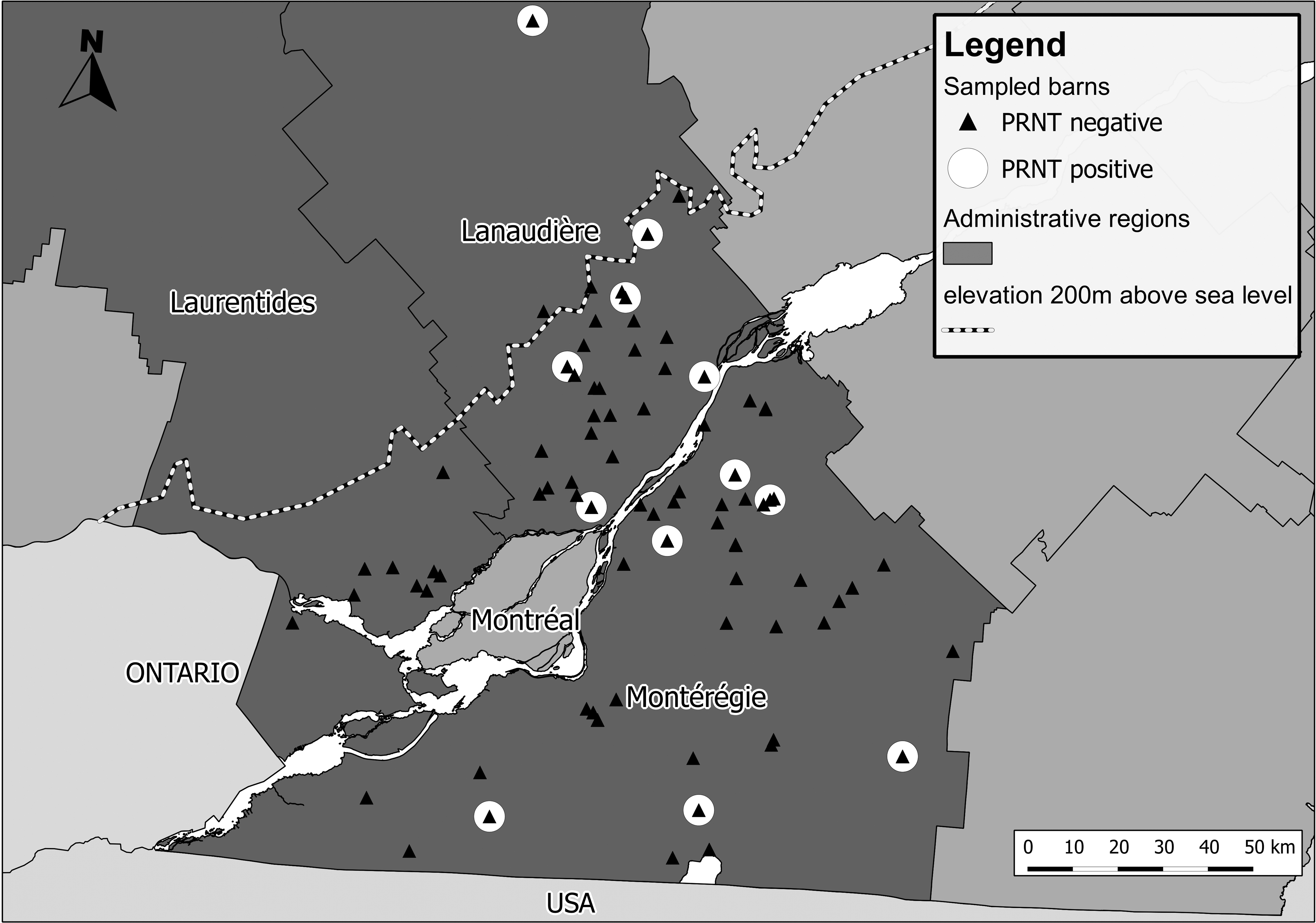
Geographical distribution of sampled barns in three selected administrative regions : Lanaudière, Laurentides, and Montérégie, Quebec, Canada, 2012. A plaque reduction neutralization test (PRNT)-positive barn has one or more PRNT-positive horses.
Sampling
Horses were recruited by convenience either from patients of participating equine practitioners or by the lead author after direct contact with horse owners in the field. All equine practitioners treating horses in the selected area (as determined by a provincial registry) were contacted by phone and asked to participate in the study. The lead author proceeded to sample in areas where few practitioners were involved. Every barn visible from the road was identified, the street address was recorded, the number of horses in the barn was counted or estimated based on the barn size, and a direct contact was attempted with the owner. Every contacted owner was questioned about the vaccination status of their horses.
Blood samples were collected by jugular venipuncture on horses that met inclusion criteria described above. The length of stay in the barn where sampling was performed was recorded for each sampled horse.
Laboratory analyses
Each sample was screened for antibodies to EEEV by a PRNT at the National Microbiology Laboratory (NML) of the Public Health Agency of Canada in Winnipeg, followed by titration of positive or borderline samples. The PRNT was performed by mixing a known amount of virus (e.g., 100 plaque forming units [pfu]) with two-fold serial dilutions of test sera and incubating for 90 min at 37°C. Following this adsorption, 100 μL of the virus–serum mixture was then added to a fully confluent Vero cell monolayer (in six-well tissue culture plates) and incubated for 1 h at 37°C with gentle rocking every 15 min. After the infection, 3 mL of an agar overlay was applied to each well and the plates were incubated at 37°C, 5% CO2 for 72 h. A second agar overlay containing the vital dye Neutral Red was added and the presence/absence of plaques noted after an additional 18 h incubation. If virus-specific neutralizing antibodies were present in a serum specimen, plaque formation was inhibited. By determining the final dilution of serum that led to a 90% reduction in plaque formation, an end-point titer for neutralization activity was calculated. Although the sensitivity/specificity of the EEEV PRNT on equine sera has not been established by the NML, the PRNT is considered the gold standard for the detection of viral antibodies across species, and this test would be considered very specific for EEEV antibody detection (World Organisation for Animal Health 2009).
Confirmation of vaccination status
The vaccination status of all positive horses was double-checked after obtaining PRNT results. Owners and equine practitioners were called back to assess if any injection could have been given to the horse by any veterinarian in the past 6 years and medical records were checked for vaccination history.
Mapping of sampled horses
Each sampled barn was mapped to evaluate sampling distribution (Fig. 1). Longitude and latitude coordinates of the barns were obtained using Google Maps® according to the address of the barn and then confirmed or corrected using Google Street View®.
Estimation of the proportion of vaccinated horses in the study area
Vaccination coverage was estimated from data collected by the lead author and from a web-based survey administered to equine practitioners who collected samples. Practitioners were asked to estimate the total number of horses in their medical practice and the proportion of these horses that had been vaccinated at least once against EEEV. An overall proportion, weighted for clientele sizes, was calculated according to these data.
Statistical analyses
Descriptive statistics were used to present data. All 95% confidence intervals (CI) were calculated with adjusted standard errors for clustered sampling using the surveyfreq procedure in SAS 9.3. For the seroprevalence and the vaccination coverage estimated by the lead author, each barn was considered as one cluster. For the vaccination coverage estimated from the practitioners' survey, the clientele of each practitioner was considered as one cluster.
Results
Fifty-four veterinarians were invited to participate in sampling. Twenty-one (39%) agreed to participate. Only nine of these succeeded in finding horses that met the inclusion criteria of the study. Most of the practitioners who refused to participate in the study mentioned having a completely vaccinated clientele.
Sampling was conducted between March 7th and July 4th, 2012. A total of 196 horses from 92 barns were sampled. A total of 121 horses were sampled by equine practitioners during regular veterinary consultations and 75 horses were sampled by the lead author. Overall, 177 barns were identified by the lead author for a total of approximately 1161 horses. Owners were successfully contacted from 126 barns. The number of refusals, exclusions and inclusions among these 126 barns are presented in Table 1.
Barns where all owners refused to participate
Excluded barns—all horses vaccinated
Barns where at least one horse was not vaccinated
Vaccination coverage estimated by exclusions/(total minus refusal)
Sampled horses ranged in age from 1.4 to 30 years old (median=9, interquartile range [IQR]=6). They had been housed at the barn where sampling was performed for 0–28 years (median=3, IQR=7); 50% of sampled horses were mares, 41% were geldings, and 9% were stallions.
Eighteen samples were positive on PRNT test, with titers ranging from 20 to 320 (Table 2). Vaccination status validation revealed that two PRNT-positive horses had been vaccinated once in 2009 (Table 2). On the basis of a study suggesting that postvaccination PRNT titers in horses generally fade below 1:10 at 220 days after EEEV vaccination (Holmes et al. 2006), one horse with a titer of 20 was a posteriori excluded from study data, resulting in n=195; the other titer (i.e., 80–160) was considered as possibly being the result of natural exposure to the virus and was kept in the database. We could not get reliable information regarding vaccination history before 2009 for three horses because they changed ownership in that period of time and no data were available from their previous owners. Given this uncertainty, we reported our results based on two scenarios, one (more conservative) including only confirmed positives from known natural exposure (scenario 1, n=191), the other including all remaining positive horses, regardless of possible, but often improbable, vaccine exposure (scenario 2, n=195).
Scenario 1 and scenario 2 gave an overall seroprevalence of 6.8% and 8.7% with 95% CI ranging from 2.7 to 10.9% and 4.4 to 13.0%, respectively. Seroprevalences for each region are given in Table 3.
Includes only seropositive horses from natural exposure (scenario 1, n=191).
Includes 4 horses from Montérégie with possible vaccine exposure (scenario 2, n=195).
Confidence intervals (α=0.05).
Clinical cases reported to Quebec Ministry of Agriculture, Fisheries and Food, 2008–2012.
Among horses identified by the lead author, 89.7% were vaccinated (95% CI 84.4–94.9%) (Table 1). The overall clientele of the seven equine practitioners who answered the vaccination survey represented 4400 horses; 3514 (79.9%, 95% CI 58.0–100%) of these were vaccinated.
Discussion
For the first time in Canada, we estimated the prevalence of nonlethal EEEV infections in horses. These results may lead veterinarians to adopt a different approach to EEE diagnosis in North America. EEE is actually perceived as a generally highly pathogenic and fatal disease in horses. Increased awareness of the wide clinical spectrum of the disease may bring practitioners to be more attentive of mild EEEV infections and to further include EEE as a differential diagnosis of febrile or mild neurologic diseases. More frequent detection of EEEV infections in horses is important from a public health perspective by providing early warning of virus activity in a given region. According to a study conducted in Maine in 2009, 90% of human clinical encephalitis cases of undetermined aetiology were never tested for EEEV (Gibney et al. 2011). EEE may therefore be under diagnosed both in humans and horses.
Although we should not extrapolate our findings to human health, the similarity between the clinical and pathological presentation of human and equine EEE (Keane et al. 1987, United States Department of Agriculture 2004, Steele et al. 2010, Centers for Disease Control and Prevention 2012) suggests that increased vigilance of human exposure to the virus in Canada is warranted, even if equine clinical cases have decreased over the last 2 years. This apparent reduction of occurrence of cases may be due to widespread vaccination and thus we cannot rely on equine clinical cases to assess risk of human exposure to EEEV.
The geographical distribution of our seropositive horses follows approximately the distribution of the clinical cases declared to the MAPAQ from 2008 to 2011 and seems to gravitate around large wooded swamps. More advanced spatial analyses are needed to assess this potentially important ecological relationship suggested by many authors (Howard et al. 1988, Morris et al. 1994, Ross et al. 1996).
Our study suggests that horses could be used to some extent to monitor EEEV activity. Use of animal sentinels can be of particular relevance for human surveillance and is supported here by the fact that no human EEE cases have been reported up to now in Canada, despite known viral activity in other species. We must recognize the difficulty in obtaining precise EEE vaccination history when considering the use of sentinel horses. This, in addition to the inability of current serological techniques to discriminate between natural infection and vaccination, may complicate the interpretation of some laboratory results.
The development of a commercially available diagnostic method able to discriminate between natural and vaccine-derived antibodies could allow the implementation of an efficient surveillance system based on blood samples collected for other diagnostic purposes. As an example, more than 35,000 equine blood samples are collected yearly in eastern Canada for the screening of equine infectious anemia (Canadian Food Inspection Agency 2011). Testing samples from 18- to 24-month-old horses may allow for a timely estimation of possible viral spillover in a given region and enable further focused epidemiological assessments both in human and animal populations to confirm the risk.
We must finally recognize the high acceptance of owners to participate in our study despite the invasive nature of the blood test and the time required for the appointments; this may reflect the willingness of animal owners to contribute to animal and public health.
Study limits
Given the cross-sectional nature of the study design, we had no precise indication of the moment when virus exposure occurred in seropositive animals. Furthermore, the precise duration of immunity conferred from natural exposure to the virus is not known. Given these limitations, results from this study should not be interpreted as reflecting the actual level of viral activity, but as an overall snapshot of virus circulation that occurred at some time in the past.
Despite all of our efforts to seek and validate vaccination history on the sampled horses, there is still some degree of uncertainty that remains about vaccination status due to recall bias and incomplete data as a result of change of ownership; undeclared vaccination may result in positive PRNT tests that do not reflect natural exposure to EEEV. However, the very low postvaccination titers observed in the study from Holmes (2006) were taken into account in the interpretation of our results.
The vaccination coverage estimated from the equine practitioners survey should be seen as minimum vaccination coverage because most of the practitioners who refused to participate in our study declared having a completely vaccinated clientele. However, the 90% vaccination coverage estimated from data collected by the lead author could be biased upward: Data were gathered from owners who accepted to give information about vaccination status of their horses. Owners of unvaccinated horses may have been reluctant to be involved in the study.
Caution should be given when attempting to compare the regions under study because these three selected regions are seemingly different, considering their respective landscape and land uses, and are believed to represent different ecosystems. Because EEEV activity and geographic distribution are highly dependent on these ecosystems, particularly in term of habitat for vectors, one cannot extrapolate these results to other geographical regions.
Conclusion
Despite on-going recent EEEV activity in Quebec, Canada, the epidemiology of this potentially fatal disease interfacing human, animal, and ecological health is, however, still poorly understood. The relatively high level of virus circulation in horses in our study seems to indicate a possible significant risk of exposure to humans and suggests that an increased attention for this mosquito-borne disease should be given by animal and public health officials in their planning for prevention and control activities in eastern Canada.
Footnotes
Acknowledgments
We thank all veterinary practitioners who participated in data collection, with special thanks to Dr. Julie Collins for initiating contact with the Association of equine practitioners of Quebec. We thank Michael Drebot at the National Microbiology Laboratory for team coordination of PRNT testing. Funding was provided by the Public Health Agency of Canada.
Author Disclosure Statement
No competing financial interest exists.