




Abstract
In Brandenburg, northeastern Germany, an outbreak of zoonotic Dirofilaria repens in a sledge dog kennel was detected in January, 2012. Using the modified Knott test, 8 out of 28 adult dogs were microfilaria positive. A D. repens–specific PCR based on the internal transcribed spacer 2 region detected filarial DNA in 11 of these dogs. Northeastern Germany is currently considered to be free of Dirofilaria. The 39% prevalence within the kennel and the fact that the dogs transiently stayed in endemic areas only during the winter suggest that autochthonous infections occurred. Analysis of weather data shows that extrinsic development of Dirofilaria was continuously possible in the summers of 1994–2012, thus allowing active transmission within the area.
Introduction
I
Humans are accidental hosts of Dirofilaria spp., but incidences and prevalence are apparently increasing (Pampiglione and Rivasi 2000, Pampiglione et al. 2001, Szenasi et al. 2008, Lee et al. 2010). Absence of circulating microfilariae and unavailability of reliable serological tests often lead to false-negative diagnosis in humans. Dirofilaria in lungs, testicles, central nervous system (CNS), or subcutis are frequently misdiagnosed (Poppert et al. 2009, Lee et al. 2010) as cancer, tuberculosis, or rheumatism (Pampiglione and Rivasi 2000) with serious consequences. Ocular manifestations are easier to diagnose and are frequently reported. Although D. immitis is of importance for human health, especially in the United States, human dirofilariosis in Europe is apparently exclusively attributable to D. repens, although both pathogens are prevalent in European dogs (Pampiglione et al. 2009).
Duration of larval development of Dirofilaria in the mosquito vectors depends on the mean ambient temperature and cannot proceed when temperatures are below 14°C (Genchi et al. 2009). Development from microfilaria to infective third-stage larvae (iL3) takes 29 days at 18°C, 10–14 days at 26°C, or 8–9 days at 30°C (Fortin and Slocombe 1981, Genchi et al. 2009). To describe the temperature-dependent extrinsic development of Dirofilaria, heartworm development units (HDU; also named growing degree days) (Genchi et al. 2009) have been defined, as the sum of °C above 14°C over a 30-day time window corresponding to the maximal mosquito life span (Fortin and Slocombe 1981). Extrinsic development is considered to be possible if 130 HDU/30 days are exceeded, while the prepatency of Dirofilaria is at least 25–34 weeks.
In the autumn of 2007, five dogs in a kennel of 28 sledge dogs (Siberian Husky) were microfilaria-positive using the modified Knott test (Sassnau et al. 2009). The kennel is located in the periphery of a small village in the Havelland district in Brandenburg, Germany, 52°35′N and 12°37′E, 29 meters above sea level) near Berlin. The definite diagnosis of D. repens was achieved by PCR. Infected dogs were treated with ivermectin/doxycycline (McCall 2005), and those five dogs remained microfilaria-negative in follow-up examinations and again appeared negative in this study. In contrast, other dogs in the same kennel were diagnosed positive for Dirofilaria. This study investigated the combined analyses of dogs and the weather data from this area to provide evidence that autochthonous transmission is possible.
Materials and Methods
In January, 2012, all 30 Siberian Huskies (9 male, 21 female) in the kennel were again investigated for the presence of microfilariae. The dogs were never in a known Dirofilaria endemic area during transmission season but only between November and February in snow-rich areas for sledge dog races. Two of the dogs were 9 months old; the other dogs were between 3 and 11 years.
Samples taken in the early afternoon were analyzed for microfilariae using the modified Knott test. DNA extracted from EDTA-blood was analyzed with an internal transcribed spacer 2 (ITS-2), filaria-specific PCR modified from Rishniw et al. (2006). Reactions (25 μL) contained 150–600 ng of DNA, 0.3 μM of each primer, 0.2 mM deoxyribonucleotide triphosphates (dNTPs), 0.25 U/μL Maxima Hot Start Polymerase (Fermentas), 2.5 mM MgCl2, and 1× Q-Solution (Qiagen). After denaturation at 95°C for 4 min, 40 cycles 95°C for 15 s, 58°C for 30 s, 72°C for 30 s, and a final extension at 72°C for 10 min were performed. Species were differentiated according to amplicon size and DNA sequence.
Samples were further analyzed by a D. immitis circulating antigen enzyme-linked immunosorbent assay (ELISA; MegaCor Diagnostic GmbH, Austria).
Results
In January, 2012, eight dogs (seven negative in 2007, one born in 2008 thus not tested) tested positive for microfilaremia using the Knott test. PCR revealed an infection with D. repens in these eight dogs and three additional dogs (one negative in 2007, the other two born in 2008), whereas the D. immitis antigen ELISA remained negative (for all dogs in the kennel). Because two D. repens–negative juvenile dogs had no chance to acquire a patent D. repens infection, they were excluded from the statistics, and the prevalence in the kennel was calculated to be 39% (11/28).
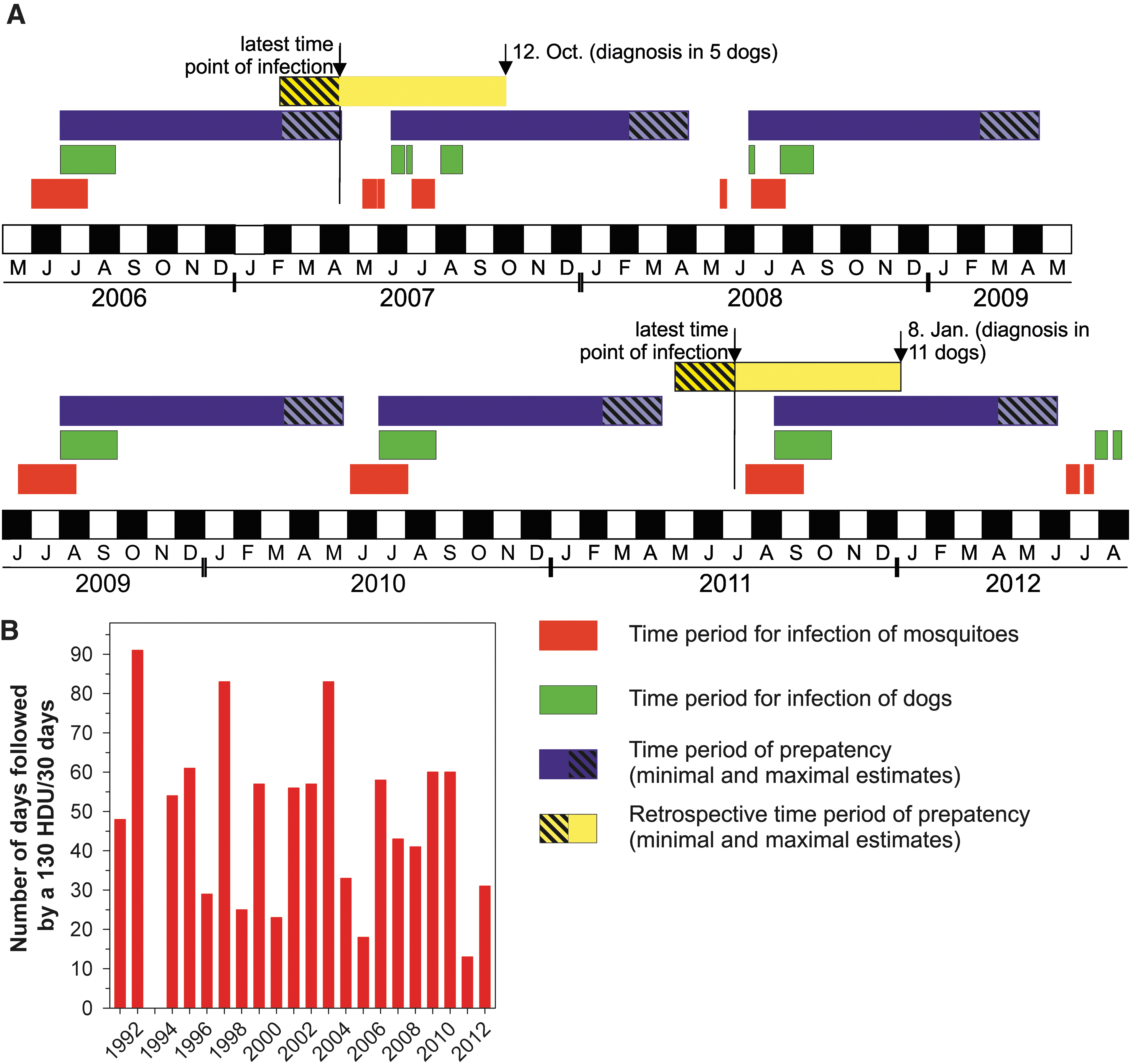
To analyze the development potential of Dirofilaria in the Havelland, the mean average daily temperature was obtained from the German Weather Service (DWD) for the weather station Berge, located at 52°62′N and 12°79′E, 40 meters above sea level. According to the HDU analysis obtained from the weather data and a prepatency period of 25–34 weeks, infections of hosts must have been acquired before 2011 and could not have occurred in September/October, 2011 (Fig. 1A). On the basis of the date of the first diagnosis of microfilariae in 2007, the first infection with D. repens of the dogs must have occurred in the summer of 2006 at the latest because it was too cold to allow development of Dirofilaria in mosquitoes during the spring of 2007 (Fig. 1A). In the Havelland, the time period allowing complete extrinsic development from L1 to iL3 in 2006 included 58 days (Fig. 1B).
(
Discussion
D. repens is endemic in eastern and southern Europe. It has been found in canine and human samples in Italy, France, Slovakia, Poland, the Czech Republic, and Austria (Genchi et al. 2011). More recently, first cases of autochthonous D. repens were described in The Netherlands (Overgaauw and van Dijk 2009) and southwestern Germany (Hermosilla et al. 2006, Pantchev et al. 2009). The data obtained during the present study confirm the only earlier report from northeastern Germany from the same kennel (Sassnau et al. 2009). The sledge dogs of the examined kennel regularly participated in competitions in endemic areas, namely Austria, Spain, Poland, and the Czech Republic, but exclusively during the winter. Therefore, the possibility that the high prevalence of D. repens in the kennel is a consequence of exclusively imported infections is extremely low.
Because weather data showed that larval development to iL3 was possible in the Havelland in the summers of 1994–2012 (Fig. 1B), the infections described here are presumably autochthonous. The continuous favorable weather conditions for development of Dirofilaria in mosquitoes are in agreement with the results of Genchi et al. (2009), who identified many weather stations in central and northern Europe where Dirofilaria development was possible at least once in 15 years. Unfortunately, these authors did not provide any information regarding the number of years in which development was possible. Analysis of the mean temperature over 15 years for calculation of HDU predicted no potential development in northern Europe, and Genchi et al. (2009) concluded that development was probably not possible every year. In contrast, our data of the weather data from Berge show that development of Dirofilaria was possible in nearly every summer during the last 20 years. This different outcome is probably due to the fact that warm weather periods occurred at different time periods of the year (between May and September) resulting in lower mean temperature values.
Conclusions
Obviously canine cutaneous filariosis can be transmitted in northeastern Germany and is thus not necessarily only a potential problem in traveling or imported dogs. Further investigations regarding the prevalence and seasonal pattern of transmission of D. repens in the Berlin/Brandenburg area are necessary to allow rational prevention of spreading. This should also include population genetic molecular markers to identify the origin of the Brandenburg population, i.e., spread from northern France/southwestern Germany, spread from Poland, or infection of a few dogs in an endemic country followed by autochtonous spread within the kennel. Although D. repens is of low pathogenicity for dogs, its zoonotic potential is very high and might severely affect public health after endemization.
Footnotes
Acknowledgments
Many thanks to the Muscher Torsten Pelz and Sabine Pelz, owner of the sled dog kennel. Without their profound engagement and the helping hand of my qualified veterinary nurse Cand. med. vet. Rona Müller (FU-Berlin) this study would not have been impossible.
Author Disclosure Statement
No competing financial interests exist.