




Abstract
Seroprevalence rates for immunoglobulin G (IgG) antibodies to Tahyna virus (TAHV) and Inkoo virus (INKV) were determined in sera of 1630 blood donors from North, East, and South Tyrol by immunofluorescence assays (IFAs) and confirmatory serum neutralization tests (SNTs). Ten sera (0.6%) reacted positive by TAHV IFA, five of which (0.3%) were confirmed by SNT. Eleven sera (0.7%) reacted positive in the INKV IFA; only one thereof (0.06%) was verified by subsequent SNT. To identify the source of infections, mosquitoes were trapped at 18 sampling sites in the study area, resulting in the collection of 2571 adult mosquitoes: 1254 individuals of the genus Aedes (48.8% of total) including A. albopictus, 640 Culex (24.9%), 303 Coquillettidia (11.8%), 252 Ochlerotatus (9.8%), 49 Anopheles (1.9%), and 73 mosquitoes of the genus Culiseta (2.8%). The mosquitoes were pooled according to species, trapping site, and time, and were tested by RT-PCR for the presence of California serogroup orthobunyavirus nucleic acids. PCR amplification products were obtained in five of 195 pools (2.6%), and all were identified as TAHVs by subsequent sequencing. This represents the first evidence of TAHV circulation and human exposure in the Tyrols and in the alpine region in general. Interestingly, all TAHV sequences were identified in Culex pipiens/torrentium mosquitoes. Whether other California serogroup orthobunyaviruses such as INKV are also circulating in this area is subject of further investigations on larger numbers of mosquitoes.
Introduction
T
The European hare (Lepus europaeus) is considered a major reservoir host for TAHV (Simkova 1963, Aspöck and Kunz 1971); however, high seroprevalence rates of anti-TAHV immunoglobulin G (IgG) antibodies were also identified in small mammals and insectivores (Málková et al. 1969, Le Lay-Rogues et al. 1984, Mitchell et al. 1993) as well as in medium-sized and large mammals (Hubálek et al. 1993, Madić et al. 1993) and birds (Juricová et al. 1993, Juricová et al. 1998), suggesting a wide range of vertebrate reservoir species.
INKV is widespread in Northern Europe and has been isolated from Aedes communis in Sweden (Francy et al. 1989), from A. hexodontus and A. punctor in Russia (Mitchell et al. 1993) and it is also quite common in Finland (Brummer-Korvenkontio and Saikku 1975).
The aim of this study was to assess the occurrence of California group bunyaviruses in the Tyrols. Therefore, we screened Tyrolean blood donors for the presence of IgG antibodies to TAHV and INKV, respectively, by immunofluorescence assays (IFAs) and serum neutralization tests (SNTs), and investigated indigenous mosquitoes for the presence of orthobunyaviral RNA by RT-PCR.
Material and Methods
The area of investigation comprised the transnational Alpine Central European region of the Tyrol (North and East Tyrol, both parts of Austria, and South Tyrol, northern Italy).
In all, 1630 healthy blood donors between 18 and 72 years of age, representing the total population of the study area regarding gender, profession, and altitude of residency, gave informed consent, answered a questionnaire, and donated 2 mL of blood for study purposes at the Central Institute for Blood Transfusion and Immunology in Innsbruck and Bozen. A detailed description of the donor collective is given in Table 1. All 1630 sera were tested for IgG antibodies to TAHV (strain S10 V1) and INKV, respectively, by in-house IFAs.
Immunofluorescence assay
For the production of the IFAs, 25-cm2 flasks with monolayers of Vero B4-cells (no. ACC-33, DSMZ) were infected with 1 mL of TAHV and INKV, respectively, and incubated at 36°C by gently shaking the flasks every 10 min. After 1 h, Medium 199 (Invitrogen GmbH, Darmstadt, Germany), supplemented with 5% of inactivated fetal calf serum (FCS; Invitrogen GmbH, Darmstadt, Germany) was added to the cultures. When the first cytopathic effects (CPEs) were detected 3–4 days postinfection, the infected cultures were trypsinized and the cells were fixed with ice-cold 1:1 acetone–methanol mixture on IFA slides.
The IFA cutoff titers were established by analyzing a well-characterized low-risk collective, consisting of a cohort of 145 blood donors out of a total of 1630. Inclusion criteria were: (1) Residence higher than 1400 meters above sea level; (2) place of employment higher than 1400 meters altitude; (3) no travel history; and (4) low mosquito exposure. Among this low-risk collective of 145 blood donors, 6.2% were positive for IgG antibodies to TAHV at a titer of 1:32 and 1.4% were positive at 1:64. Among the same collective, 4.1% were positive for IgG antibodies to INKV at a titer of 1:32 and 1.4% were positive at 1:64. Thus, according to the criteria of the World Health Organization (WHO), the cutoff titer was set at 1:64 for both viruses. Sera were assessed positive if the fluorescence signal was strong at a dilution of 1:64 or above and negative if the signal was weak or negative at a dilution of 1:64. The IgM cutoff value was determined in the same way; it was set at a titer of 1:128 for both viruses. All IFA-positive sera were subjected to the “gold standard” verification/falsification by SNT.
Serum neutralization test
For the SNT, cell culture supernatants of TAHV and INKV, respectively, were used, and infectivity titrations of these suspensions were carried out by plaque assays using Vero B4 cells (no. ACC-33, DSMZ). The final virus concentrations were adjusted to 1000 plaque forming units (pfu). The tests were performed in 96-well flat-bottomed microtiter plates. Serum samples were titrated in duplicate in two-fold dilution steps (50 μL per well), starting at a dilution of 1:8 in Medium199 (Gibco, USA) containing 3% FCS. Equal volumes of virus and serum dilutions in Medium 199 were mixed and subsequently incubated for 1 h at 36°C. Thereafter, a Vero B4 cell suspension was added to each well and the cells were incubated at 36°C for 5 days.
The SNT titers were expressed as the reciprocal of the highest serum dilution that was able to inhibit the CPE. The test was repeated and the results were averaged. In each test, titrations of virus controls in the absence of antibodies and one positive and one negative reference serum were included.
Sampling of mosquitoes, RT-PCR, and phylogenetic analysis
Sampling of mosquitoes and RNA extraction was performed as described elsewhere (Sonnleitner et al. 2013), followed by RT-PCR for the detection of orthobunyaviral RNA targeting a nonstructural open reading frame within the S RNA segment (Lambert and Lanciotti, 2009; forward and reverse primers "Cal/Bwa group"). The mosquito trapping sites are indicated in Figure 1. For RT-PCR, a commercial kit was used (IScript™ One-step RT-PCR kit with SYBR(R) Green, BioRad Laboratories, Hercules, CA), containing reverse transcriptase and a two-fold reaction buffer with 0.4 mM of each deoxyribonucleotide triphosphate (dNTP), magnesium ions, Taq DNA polymerase, 20 nM fluorescein, and SYBR Green I dye. Briefly, 12.5 μL of the two-fold reaction buffer was mixed with each 0.25 μL of reverse transcriptase and primers (100 pmol/ μL), 1.8 μL of water, and 10 μL of the particular template. PCR was performed according to the following protocol: 50°C for 10 min and 95°C for 5 min, followed by 25 cycles of 95°C for 10 s and 59°C for 30 s in a real-time thermocycler (Biorad CFX 96). To increase sensitivity and yield of the PCR, nested primers were designed using Mega version 5.1 (Tamura et al. 2011). For the second PCR round, the PCR products of the first round were diluted 1:1000 with Aqua Dest and nested PCR was carried out with the primers: Forward, TAHVrb 5′-GTAGAGGCGGTCTTAGCGAC-3′, and, reverse, TAHVrb 5′- CCCTACCACCCACCCATTTAG-3′. The authenticity of the resulting amplicons was verified by nucleotide sequencing done by a commercial provider (MWG Operon Eurofins, Ebersberg, Germany). For phylogenetic analysis, the neighbor-joining method of the Mega program was used on 190-bp-long sequences identified in this study and published reference sequences, respectively.
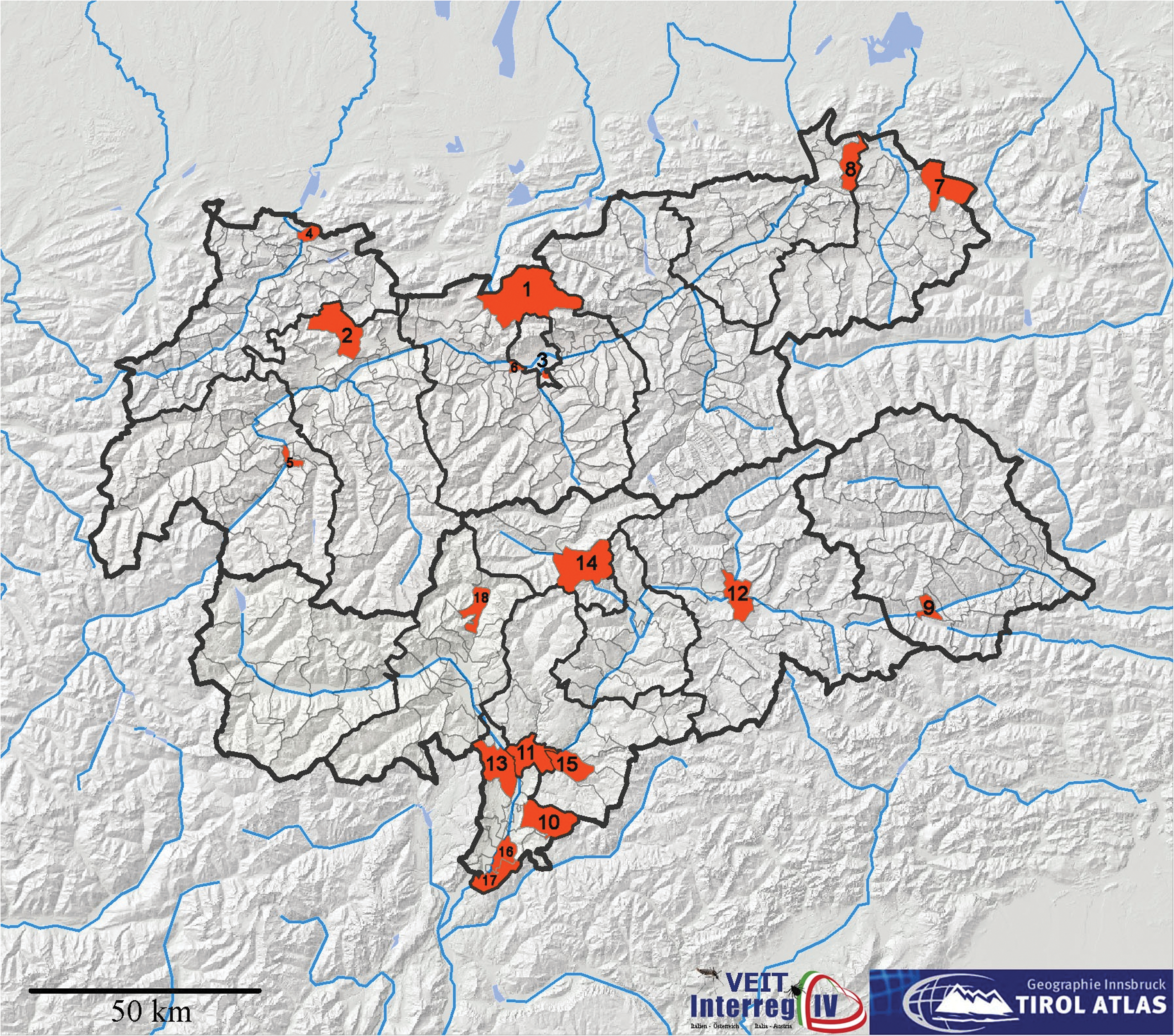
Location of the 18 mosquito trapping areas in North and South Tyrol in the summer months of 2011 (indicated in red); dry ice (CO2)-baited Encephalitis Virus Surveillance (EVS) light traps were used from 5:00 PM to 9:00 AM. Color images available online at
Results
Serology
Of 1630 sera tested, 10 (0.6%) showed clear fluorescence in the TAHV-IFA, and five of them (0.3%) neutralized TAHV in a subsequent SNT with titers between 1:40 and 1:60. Three of the blood donors with neutralizing TAHV antibodies were North Tyroleans, and two were South Tyroleans, resulting in seroprevalence rates of 0.3% in the collective of the northern and 0.4% in the collective of the southern part of the study area, respectively. The exact locations of the TAHV antibody-positive blood donors are given in Figure 2. Four of the five positives were male; the only female positive was identified in North Tyrol. The average age of the positives was 59.7 years in North Tyrol (52–66 years) and 36 years (33–39 years) in South Tyrol. The average altitude of their residency was 497 meters above sea level (335–1221 meters). Only the two South Tyrolean positives reported temporary stays abroad, one mainly in Italy and the other one at various places worldwide. None of the three North Tyrolean positives declared any temporary stays outside of Austria. Two of the five positives indicated symptoms after mosquito bites in terms of visible dermatologic reactions; the seropositive female blood donor reported a "summer flu."
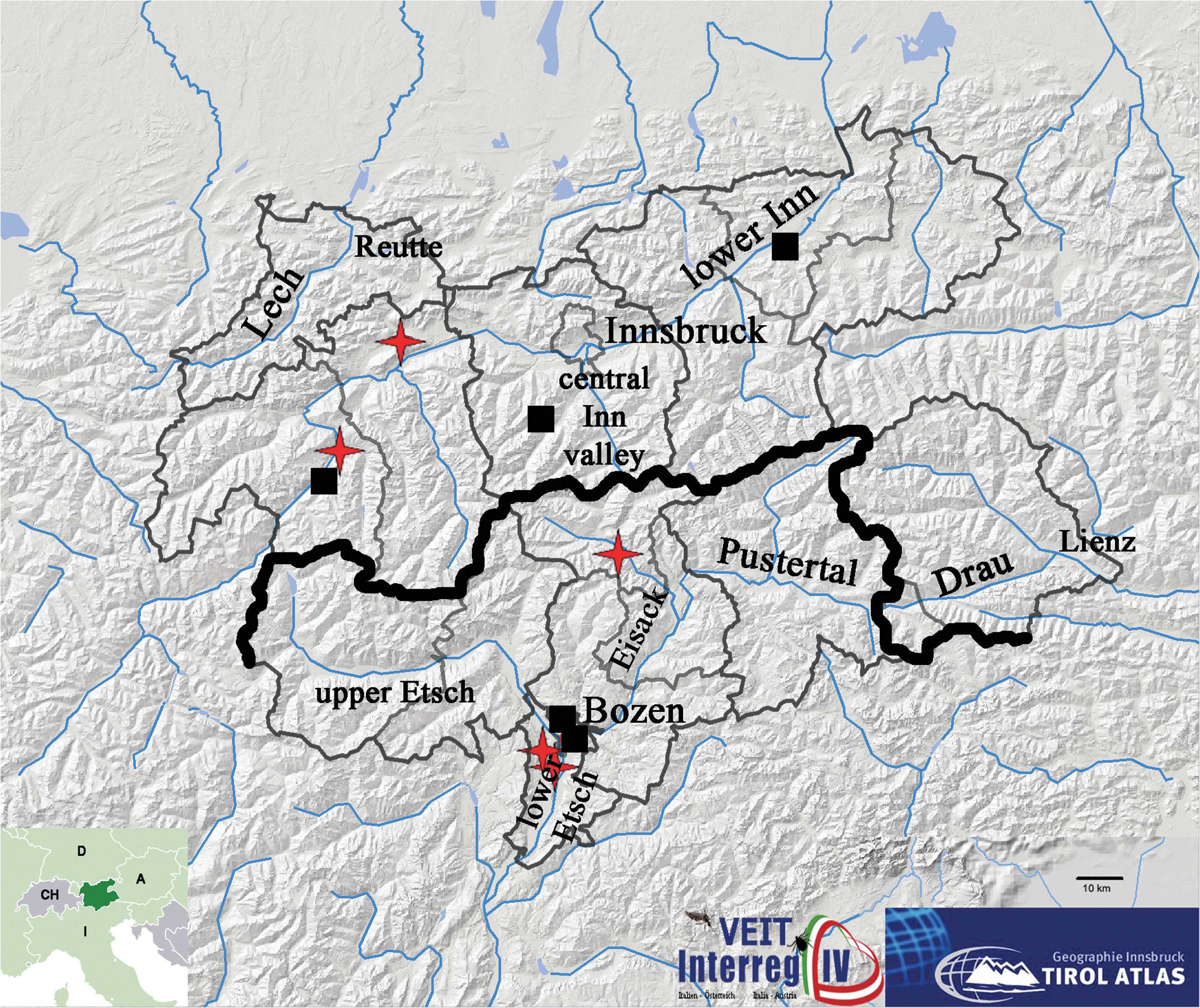
Distribution of the five anti-Tahyna virus (TAHV) antibody-positive blood donors in the study area (black squares) and sites, where TAHV was identified in mosquitoes by RT-PCR and subsequent sequencing (gray stars). Color images available online at
Any kind of recreational activities (hiking, cycling, swimming, collecting mushrooms, hunting, other outdoor activities) investigated by questionnaires failed to appear as a risk factor for contracting TAHV infection in the Tyrols (p>0.05) except for gardening, which was carried out regularly by all five seropositives (100%) but only by 48.2% of the seronegatives.
Of the 1630 sera tested for INKV antibodies, 11 (0.7%) were positive by IFA, but only one (0.06%) could be confirmed by subsequent neutralization assay. The INKV antibody-positive patient is a 57-year-old North Tyrolean, declaring stays abroad in the United States and Egypt. No serologic cross-reactions of any positive human serum were observed between these two viruses at a titer of 1:64.
Sampling of mosquitoes, RT-PCR, and phylogenetic analysis
Trapping of mosquitoes at 18 sampling sites throughout the study area (Fig. 1) resulted in the collection of 2571 adult mosquitoes, with 1254 Aedes (48.8%), amongst others also A. albopictus, 640 Culex (24.9%), 303 Coquillettidia (11.8%), 252 Ochlerotatus (9.8%), 73 Culiseta (2.8%), and 49 Anopheles (1.9%). RT-PCR testing of the 195 mosquito pools resulted in 2.6% positive pools (5 of 195), 7.4% (2 of 27) in the north and 1.8% (3 of 168) in the south. All amplification products originated from pools of Culex pipiens/torrentium mosquitoes, and all of them proved to be TAHV, as shown by sequencing, with 98–100% identities to published TAHV sequences. Figure 3 displays the close genetic relationship of all TAHV strains by phylogenetic analysis.
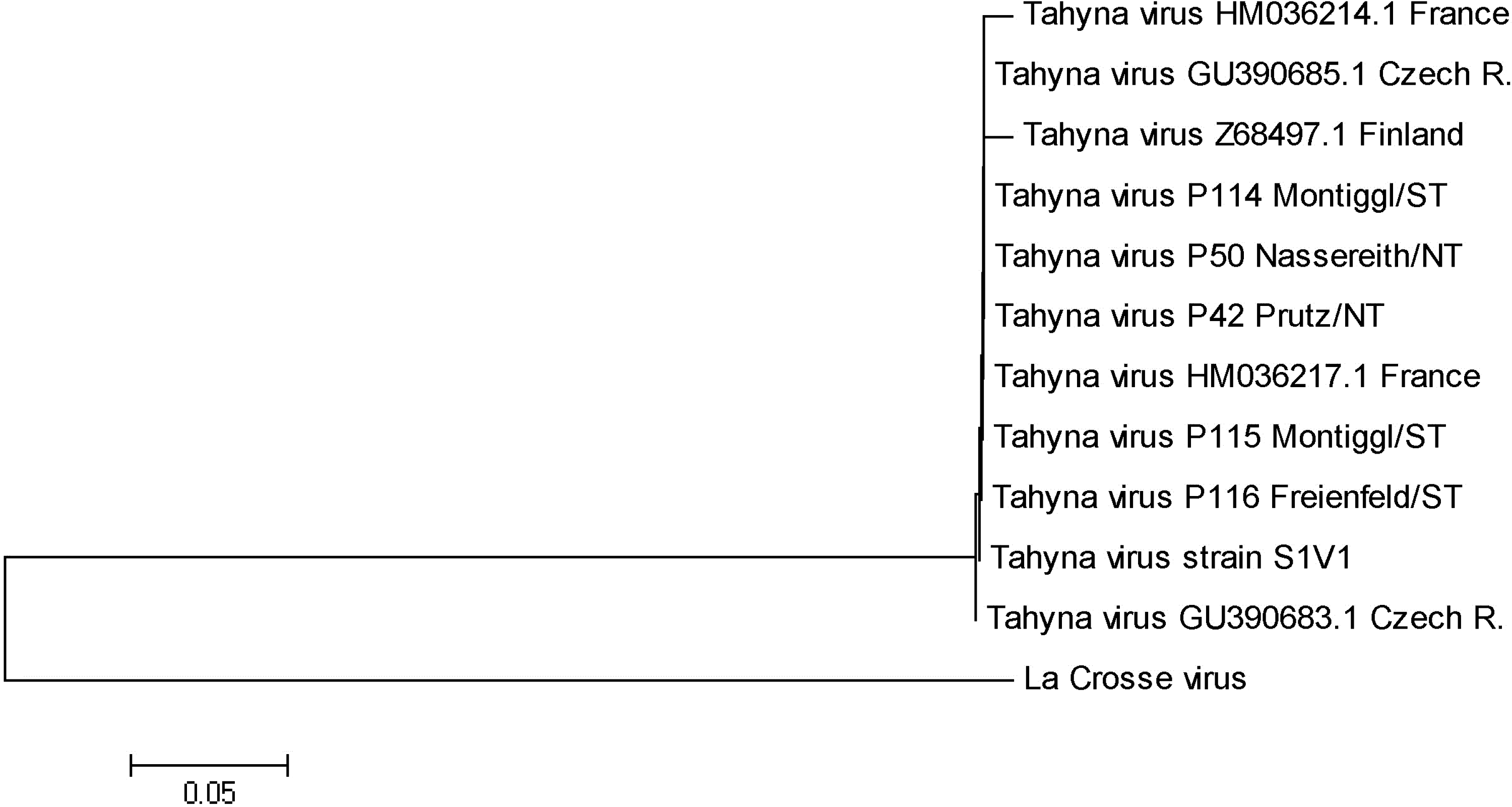
Neighbor-joining phylogenetic tree of 190-bp-long partial sequences within the nonstructural open reading frame of the S RNA segment. NT, North Tyrol; ST, South Tyrol. All Tyrolean Tahyna virus (TAHV) sequences were found in female adults of Culex pipiens complex mosquitoes.
Discussion
This study provides the first evidence of TAHV infections in an Alpine region, i.e., in the Tyrols (Austria/Italy). The detection of TAHV-specific RNA by PCR and subsequent sequencing clearly proves the occurrence of the virus in indigenous mosquitoes, and neutralizing antibodies in blood donors verifies its transmission to humans.
The IFA is a reliable screening method for the detection of antibodies to “neglected” virus infections, for which no commercial tests are available. Although we carefully assessed the cutoff titer by testing a low-risk collective, the IFA results were only used to narrow the number of potentially positive samples. As a confirmatory test, the “gold standard” SNT was employed, and only with a positive SNT result was a sample considered positive. All positive PCR results of the investigated mosquitoes were subjected to sequence analysis, which is a useful tool not only to get insight into the phylogenetic relationship between the detected virus strains, but also to avoid false-positive results due to cross-contamination.
TAHV seems to be widespread in Europe; however, it was never reported from the central parts of the Alpine arc. Data on alpine mosquito fauna is rather scarce, but there are notable differences to lowland areas. Studies on West Nile virus suggest, that alpine environments do not necessarily favor the circulation of mosquito-borne viruses (Gibbs et al. 2006, Roth et al. 2010, Sonnleitner et al. 2012).
Interestingly, all TAHV nucleic acids identified in this study originated from C. pipiens mosquitoes, although different Aedes species have been described of being the main vectors of TAHV (Aspöck 2008). C. pipiens was identified only once as vector for TAHV (Arcan et al. 1974), and in three studies TAHV was found in Culex modestus mosquitoes (Danielová and Holubová 1977, Hubálek et al. 2010, Cao et al. 2011).
Five blood donors showed neutralizing antibodies to TAHV. The likelihood is high that the subjects acquired the infection in the study area, because travel activities could not be identified as a particular risk factor. One of the seropositive donors denied completely that he ever left the study area. Furthermore, seropositivity rates rose with increasing age, which is consistent with an agent leading to lasting immunity. Statistical analysis showed gardening to be a risk factor in the Austrian part of the study area, which seems plausible. However, given the low number of seropositives and considering that gardening is a leisure activity typical for older people in the Tyrols, it cannot be determined whether gardening can be considered an independent risk factor or a factor associated with age. TAHV may have been repressed in the last decades by numerous river regulations in the 1960s and 1970s, but it is still endemic in the Tyrols. Five seropositives out of 1630 blood donors, extrapolated to the population of the Tyrols, suggests that approximately 70 TAHV infections can be expected every year in this region. Although the majority of infections take an asymptomatic course, clinically severe diseases may also occur in the near future and will be subjects of further investigations.
In contrast, INKV is probably not an autochthonous virus in the Alpine environment, and the only seropositive case is most likely travel associated. Notably, no cross-reactions were observed between TAHV and INKV in the IFAs.
Footnotes
Acknowledgments
The authors wish to thank Prof. Zdenek Hubálek for providing anti-TAHV–positive polyclonal mouse serum. The study has been supported by the European Union (Interreg IV), the Austrian Federal State of the Tyrol, and the Autonomous Province of Bozen/South Tyrol (Italy). Mosquitoes were collected by volunteers among hunters, foresters, and members of the Tyrolean Alpine Guards.
Author Disclosure Statement
No competing financial interests exist.