




Abstract
Salmonella enterica is a pathogen with a wide host-range that presents great concern in developed and developing countries. To determine and characterize Salmonella strains found in Chile's waterfowl, we sampled 758 birds along 2000 km of the Chilean coast. In this sample, 46 isolates from 10 serotypes were detected, several with multidrug resistance phenotypes and different combinations of virulence-associated genes (virulotypes). These results suggest that Salmonella infection in waterfowl in Chile could have impacts on public and animal health.
Introduction
T
The objective of our study was to identify S. enterica serotypes infecting waterfowl in Chile and to characterize them through antimicrobial resistance phenotypes and PCR-based virulotyping.
Materials and Methods
From October, 2011, to October, 2012, a sample of 758 birds was collected individually from eight sites and five Chilean Regions (Table 1). This included the following species: Leucophaeus pipixcan (29), Larus dominicanus (676), Leucophaeus modestus (39), and Chloephaga melanoptera (14). Using swabs with Cary–Blair transport medium (COPAN, Murrieta, CA), fresh bird feces were collected from the environment and sent to the Laboratory of Infectious Diseases at the University of Chile in Santiago to be processed. To isolate bacteria, swabs were placed into 5 mL of buffered peptone water (Difco APT broth, Beckton Dicknson, Franklin Lakes, NJ) supplemented with 20 μg/mL novobiocin (Sigma, St. Louis, MO), and incubated for 24 h at 37°C. Then, 100 μL of the suspension were inoculated into modified semisolid Rappaport Vassiliadis basal medium (Oxoid, Sao Paulo, Brazil) supplemented with 20 μg/mL novobiocin and incubated for 24 or 48 h at 41.5°C. Cultures with bacterial growth were plated in Xilose Lysine Deoxicholate agar (Difco XLD broth, Beckton Dicknson, Franklin Lakes, NJ) and incubated for 24 h at 37°C. Suspicious colonies were identified by biochemichal tests and invA gene detection by PCR (Malorny et al. 2003). S. enterica strains were serotyped according to the Kauffman–White scheme (Grimont and Weill 2007). Antimicrobial susceptibility was evaluated by the disk diffusion method following Clinical and Laboratory Standards Institute (CLSI) criteria (CLSI 2010). Antimicrobials tested were (μg/disk) ampicillin (10), amoxicillin–clavulanic acid (20/10), cefotaxime (30), gentamicin (10), trimethoprim–sulfamethoxazol (1.25/23.75), tetracycline (30), cefadroxil (30), (5), cefradine (30), ceftiofur (30), and enrofloxacin (10). Escherichia coli ATCC 25922 was used as a control strain. Virulence-associated genes pefA, spvC, sirA, gipA, SEN1417, trhH, and prot6e, all of which have been variably detected in the S. Enteritidis serotype (Pan et al. 2009, Huehn et al. 2010), were used as target sequences for the PCR-based virulotyping. DNA extraction was performed by the High Pure PCR Template preparation Kit® (Roche, Mannheim, Germany) following the manufacturer's recommendations. The reaction mixture and amplification times were at standard conditions, as previously described (Hughes et al. 2008). After agarose gel electrophoresis, amplified DNA segments were stained with GelRed® (Biotium, Hayward, CA) and detected using an ultraviolet (UV) transilluminator.
There are different sampling sites in regions of Arica and Valparaíso.
Serotyped as Group B (I 4,5,12:b:-).
AMC, amoxicillin–clavulanic acid; AMP, ampicillin; CTX, cefotaxime; CFR, cefadroxil; CE, cefradine; EFT, ceftiofur; ENR, enrofloxacine; CN, gentamicin; STX, trimethoprim–sulfamethoxazol; TE, tetracycline.
Categorical data analyses were made through contingency tables with INFOSTAT (2010v) software.
Results and Discussion
Salmonella strains were detected in 46 samples (6% isolation rate), with Enteritidis as the most frequent serotype (70%, Table 1). S. Dublin, which is considered a cattle-adapted serovar, was also detected and could represent an evidence of interspecies transmission among terrestrial mammals and waterfowl.
In the study, the largest proportion of samples was represented by Kelp gulls (L. dominicanus) (89%), which showed an infection rate of 6.4% and suggests that this species can be a reservoir of Salmonella in aquatic environments along the Chilean coast, in agreement with previous reports from the city of Talcahuano (Lopez-Martin et al. 2011, Rodriguez et al. 2012). Because of nonmigratory habits of Kelp gulls, the potential for periodic dissemination of Salmonella between the Americas is represented by Franklin's gulls (L. pipixcan), which are latitudinal migratory birds that showed infection with a multidrug-resistant S. Enteritidis strain (Table 1).
Almost all isolates found were resistant to at least one antimicrobial, with most of them resistant to tetracycline (74%). This phenotype was found to be serotype associated (p<0.01), although more isolates (other than Enteritidis) are required for its characterization. In addition, resistances to tetracycline and amoxicillin–clavulanic acid had contrasting geographical distributions (p<0.01), because the first was mainly detected in strains from Valparaíso, whereas the latter was not detected there. Notably, 21 strains, most of which belonged to the serotype Enteritidis, had multidrug-resistant phenotypes to a range of two to five antimicrobials (Table 1).
The detection of virulence associated genes identified 12 combinations or virulotypes, with a variable distribution among serotypes (p<0.01) (Fig. 1). Variations in pathogenicity functions and genetic repertoire between serotypes explain the differential clustering of S. Enteritidis and S. Heildelberg strains (Fig. 1). The other serotypes were not clearly discriminated, likely due to both the scarcity of isolates from each one and the S. Enteritidis–based criterion for selection of targeted genes. Within S. Enteritidis, two virulotypes (A and B) represent the majority of strains and show geographical association (p<0.01) to the Valparaíso and Coquimbo Regions, respectively (Fig. 1), suggesting a heterogeneous distribution of S. Enteritidis strains along the Chilean coast.
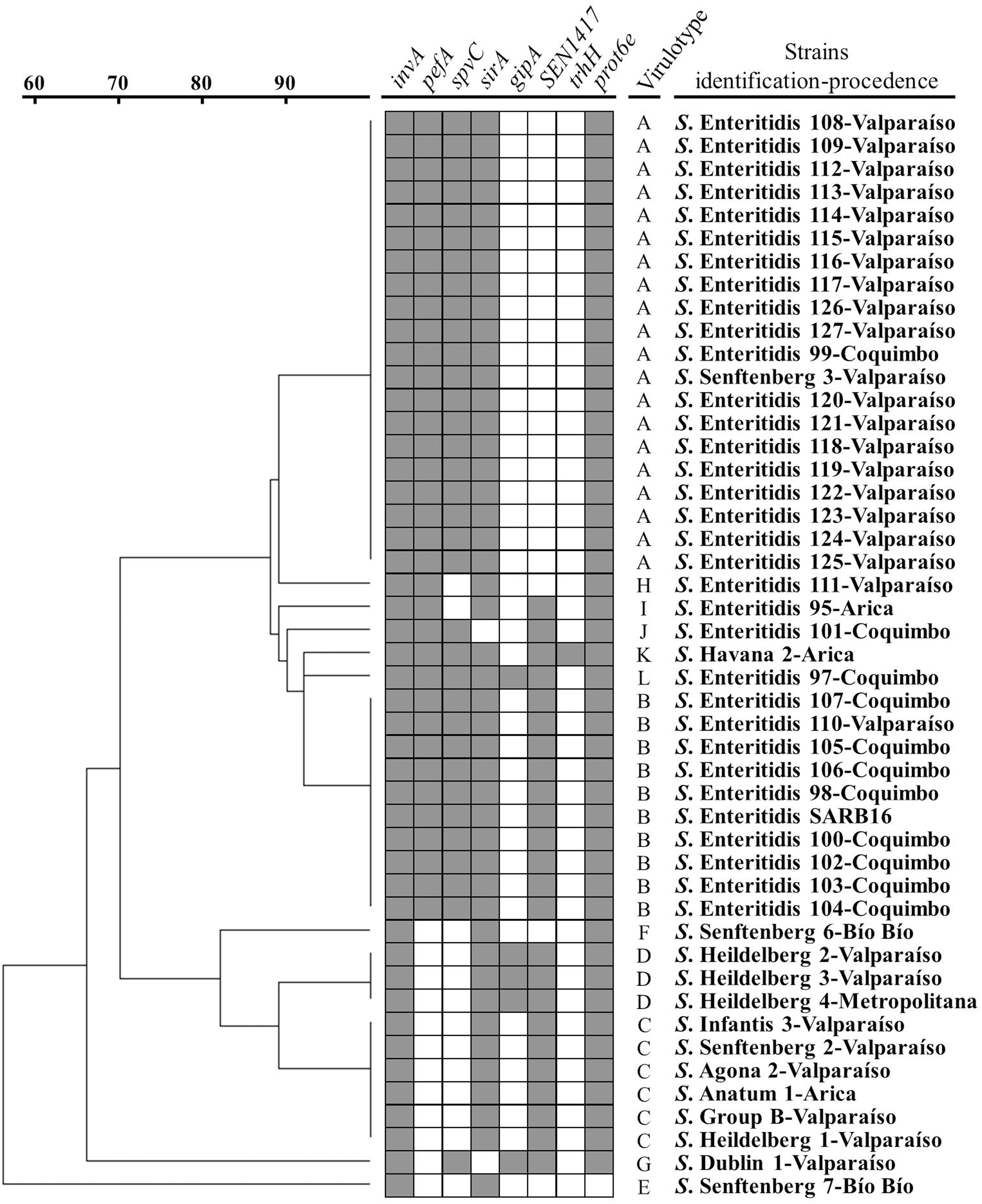
Dendrogram showing genetic similarities (%) between Salmonella enterica strains analyzed using PCR. Detection of virulence-associated genes is depicted as grey squares when present. Virulotypes are indicated by letters according to their frequencies (A:20, B:10, C:6, D:3, E to L:1). The tree was constructed using the unweighted pair group method with arithmetic mean (UPGMA) method with TREECON software (1000 replicates). The Salmonella reference collection B 16 (SARB16) strain was included as a control.
In Chile, S. enterica is an endemic bacterium that produces infections in humans and domestic animals. Among the top 20 most common serotypes isolated from humans in the South American region (Hendriksen et al. 2011), six of them were detected in waterfowl (Enteritidis, Agona, Infantis, Dublin, Anatum, and Heidelberg).
With sampling sites situated along 2000 km of coastline between Arica and Bío Bío, this work constitutes the most extensive survey of Salmonella in South American waterfowl and confirms that antimicrobial resistance phenotypes and virulotypes have spatial variations. Further research and monitoring of Salmonella infection in wild birds is needed to characterize emerging strains, transmission cycles, and temporal–spatial fluctuations due to global changes, with the aim of reducing potential risks in public health, domestic animals, and wildlife.
Footnotes
Acknowledgments
The authors thank Daniel Gonzalez Acuña and Meaghan Lunney for their help in sampling activities. This study was supported by FONDECYT grant 11110398 and predoctoral fellowships from CONICYT.
Author Disclosure Statement
No competing financial interests exist.