




Abstract
To describe the prevalence of Rickettsia in ticks at the Sino-Russian and Sino-Mongolian borders, a total of 292 ticks were collected and tested by conventional PCR assays. The prevalence of Rickettsia was 53.4%, and phylogenetic analysis showed that they belonged to R. raoultii species after alignment for the ompA, ompB, and gltA genes, respectively. Coxiella burnetii DNA was detected for 14%, and no Ehrlichia, Borrelia burgdorferi, and Babesia species were found. Co-infection of two pathogens was 9.9%, and no co-infection with three or more pathogens was found. This study suggested Rickettsia was the most common pathogen in the ticks and co-infection was found. The findings might be helpful to provide advice on the prevention and control of tick-borne disease potential for tourists and residents.
Introduction
R
In the present study, we describe the prevalence of Rickettsia in ticks at the Sino-Russian border and the Sino-Mongolian border in Inner Mongolia, China, as well as co-infection with other DNA pathogens, so as to provide data to prevent and control rickettsial diseases.
Materials and Methods
Study area
The Inner Mongolia Autonomous Region is located in the north of China, bordering Mongolia and Russia. It is the third largest subdivision of the country, spanning about 1,200,000 km2. Ganqimaodu (GQMD) and Heishantou (HST) are the regions of naturalistic importance located at the Sino-Mongolian and Sino-Russian borders, respectively (Fig. 1). These landscapes are characterized by a wide diversity of geology, vegetation, and landscape features, marked by the presence of watercourses and great grasslands, which are dedicated to rearing and grazing of farm animals.
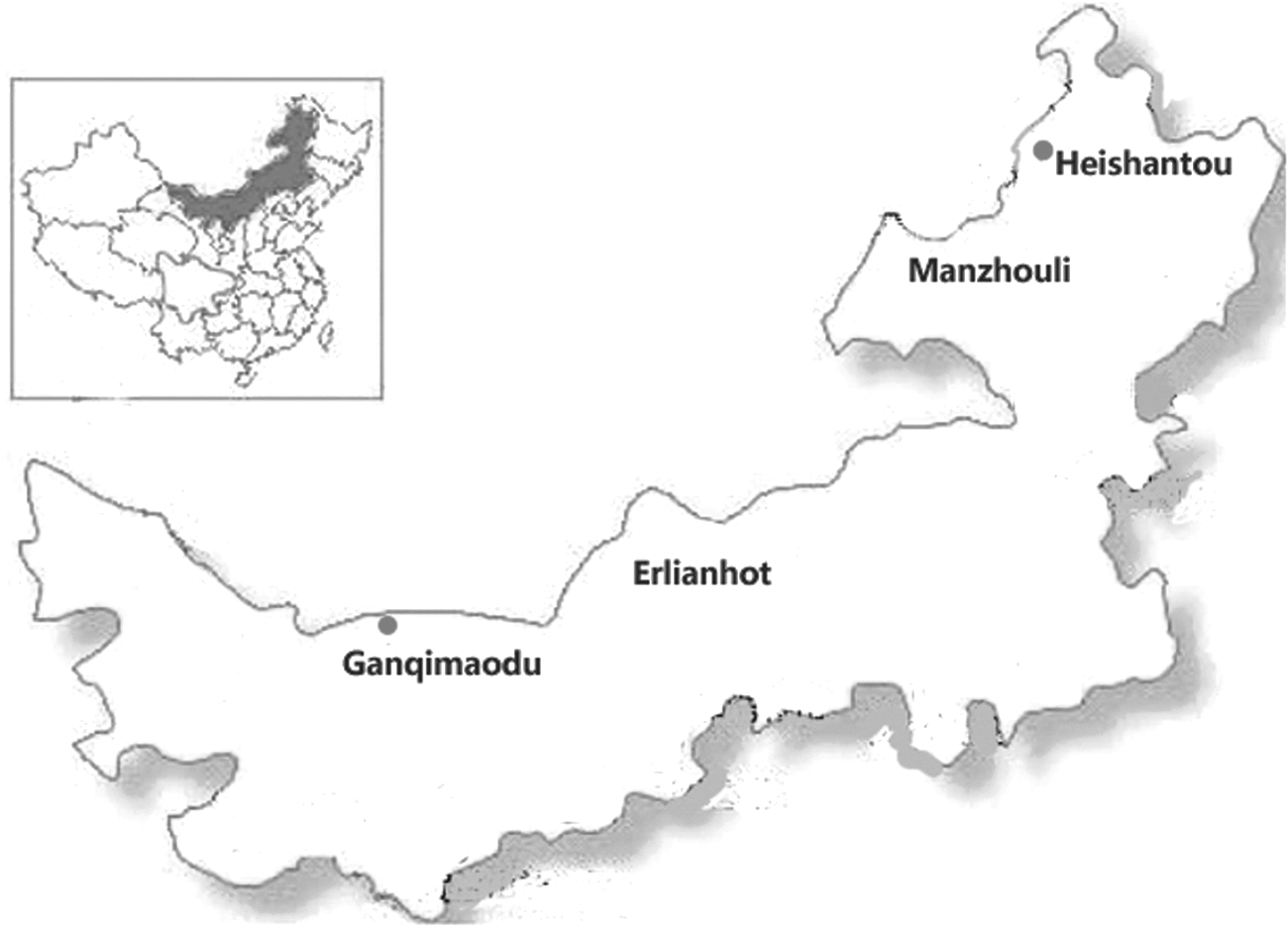
The sites of tick collection at the Sino-Mongolian and Sino-Russian borders.
Tick collection and identification
Adult ticks were collected from vegetation and domestic animals at two sites from May to June of 2013. Verbal authorization for collection of feeding ticks was obtained from animal owners. Collection of questing ticks was performed with cloth-dragging methods; feeding ticks were removed with forceps from cows and sheep. After identification of species by standard morphological characteristics with standard taxonomic keys, ticks were stored in 70% ethanol and sent to the Chinese Academy of Inspection and Quarantine (CAIQ) laboratory until detection.
Detection of Rickettsia and other pathogens
Ticks were homogenized individually with metal beads and resuspended in 225 μL of phosphate-buffered saline (PBS). Total genomic DNA was extracted from 200 μL of the homogenate using a Tiangen DNA extract kit (Tiangen Inc., Beijing, China) following the manufacturer's instructions and was stored at 4°C until use as a template in PCR assays.
PCR was performed to evaluate the presence of Rickettsia spp., Borrelia burgdorferi, Babesia spp., Coxiella burnetii, and Ehrlichia spp. DNA in each pool using the GeneAmp PCR System 9700 (Appied Biosystems). The assay amplifies Rickettsia specifically with a 382-bp part of the gltA gene by primers of GltA.877p and GltA1258n; a 530-bp fragment of the ompA gene by primers of Rr190.70p and Rr196.02n; and a 515-bp fragment of the ompB gene by primers of RrompBf and RrompBr. Other DNA pathogens, including B. burgdorferi, Babesia, C. burnetii, and Ehrlichia, were also detected by PCR assays as previously described. The PCR assays were conducted with field-isolated and tick DNA template as positive and negative controls, whereas dH2O was used as a blank control. PCR products were resolved on a 1–1.5% agarose gel in 1× TAE buffer.
After electrophoresis at 100V for 30 min, gels were stained with Goldview and examined over ultraviolet (UV) light. PCR products were purified and sent for sequencing. The nucleotide sequences obtained were aligned with corresponding sequences retrieved from the GenBank database using MEGA6.0 (
Statistical analysis
SPSS 18.0 software was used with the Fisher exact test or chi-squared test when needed. p values <0.05 are given in the text.
Results
A total of 292 ticks were collected consisting of 72 (25%) from GQMD at the Sino-Mongolian site and 220 (75%) from HST at the Sino-Russian site in Inner Mongolia, China. After tick species identification, Dermacentor nuttalli was the predominant species with 179(61%), the remaining was Ixodes persulcatus. As a result, 156 (53.4%) ticks were demonstrated to contain Rickettsia DNA with primers targeting the ompA, ompB, and gltA genes.
The overall infection rate of Rickettsia at HST was 70%, significantly higher than that of 2.8% in GQMD (χ2 = 98.515, p < 0.001). There was still a significant difference in the infection rate between the tick species (p < 0.001). Additionally, 41 (14%) infected ticks were positive for C. burnetti DNA were detected with PCR assays by primers targeting outer membrane protein; no Ehrlichia, Borrelia burgdorferi, or Babesia species were detected in the ticks.
Co-infection with two pathogens was found in 29 of 292 ticks (9.9%), and no co-infection with three or more pathogens was detected. A significant difference of the two pathogens co-infection rate was found between the two sites and the tick species, respectively (p < 0.001).
The sequence coding a fragment of ompB (HST204 ompB) showed 99% similarity to the Rickettsia raoultii Khabarovsk omp gene (DQ365798) isolated in territories of the Former Soviet Union; the gltA gene (HST204 gltA) exhibited 100% similarity to the R. raoultii strain Khabarovsk gltA gene (DQ365804). Although no Khabarovsk ompA segment was deposited in the GenBank, the nucleotide sequence of PCR products of the ompA gene (HST204 ompA) was identical to the others, for example, the Rickettsia spp. DnS28 ompA gene (AF120018) with 99%. We concluded the homology levels of the ompA, ompB, and gltA genes are within the species thresholds for R. raoultii proposed by Fournier and Raoult (2009). Phylogenetic analysis showed that HST ompA and gltA genes were clustered within an R. raoultii clade as expected; however, the sequence of ompB showed a different clade, which was probably due to the variation of R. raoultii isolated in different areas (Fig. 2A–C).
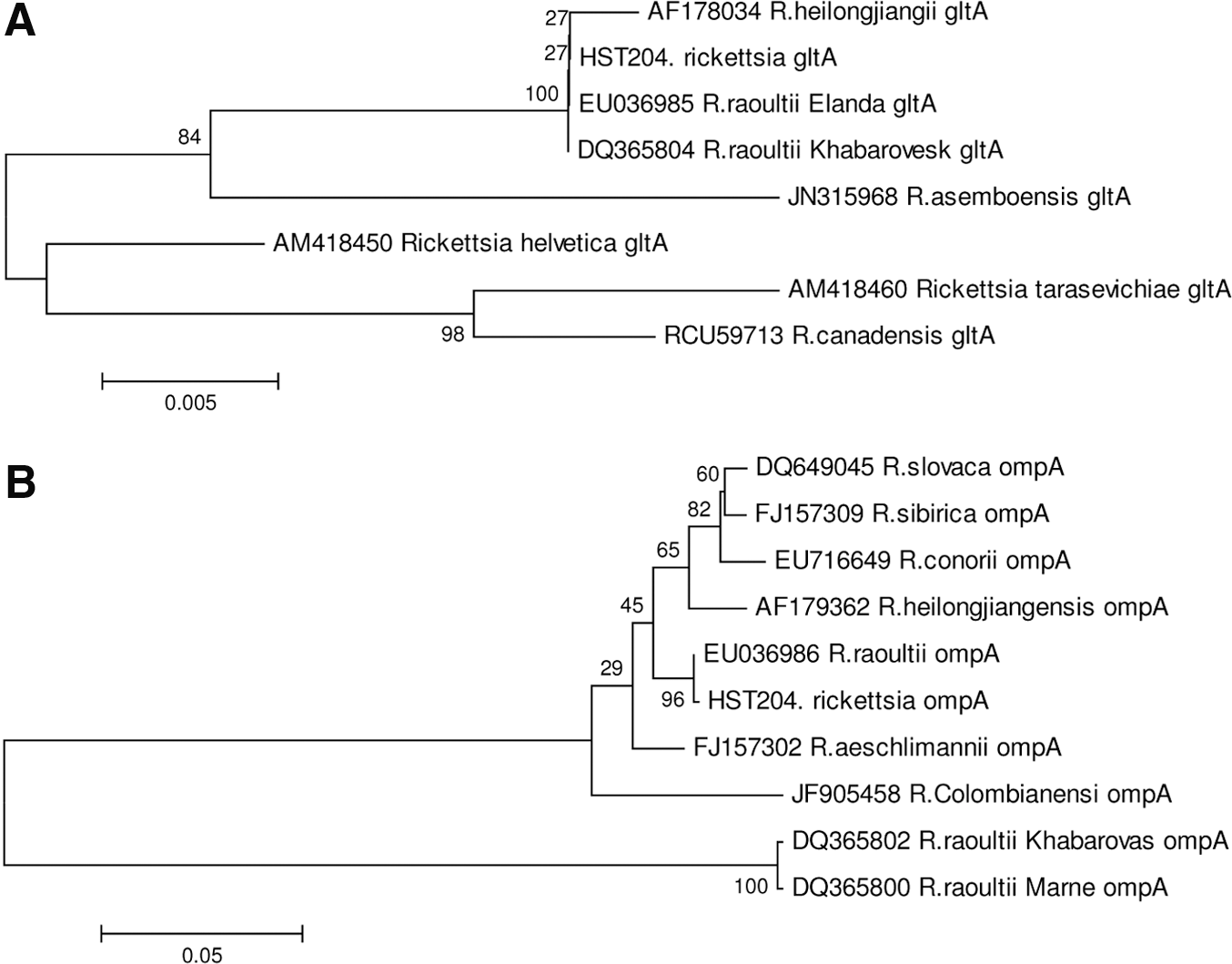
Phylogenetic tree of R. raoultii based on the gltA gene (

Discussion
It was well known that ticks are vectors or reservoirs of bacterial, viral, or protozoal pathogens. Tick-borne rickettsioses play an important role in public health and are of great medical interest in the world. These rickettsioses are one of the most frequently identified etiologies for systemic febrile illness among travelers or dwellers, following malaria (Freedman et al. 2006, Jensenius et al. 2009). Consequently, the first step for risk assessment of tick-borne diseases in a geographical area is the detection of the pathogens in the infected vector in natural surroundings. In the present study, we performed a survey on the prevalence of Rickettsia and other pathogens in ticks to provide health suggestions to tourists or dwellers that are traveling or living at the borders. The results showed that D. nuttalli and I. persulcatus were found in the study sites, and D. nuttalli was the predominant species. The total prevalence of Rickettsia in the study sites was 53.4%, whereas the prevalence in D. nuttalli was 66.5%, significantly higher than 32.7% in I. persulcatus. Although the prevalence of Rickettsia in Inner Mongolia was higher than in Eastern Europe, it was still in accordance with the reported prevalence of R. raoultii natural infection varying from 4% to 97% depending on the species and habit structures (Wen et al. 2014).
Co-infection of Rickettsia with other pathogens, such as Borrelia spp. or Anaplasma spp. is commonly found in ticks and humans (Satta et al. 2011, Socolovschi et al. 2012). In the present study, we detected that Rickettsia co-infected with C. burnetii or Ehrlichia spp. Therefore, we suggest that the potential co-infection of Rickettsia with C. burnetii should be considered for tick-bite patients with fever. Phylogenetic analysis after alignment with the sequences of ompA, ompB, and gltA showed that the genotype of Rickettsia belonged to R. rauoltii.
To date, there have been almost 15 new tick-borne rickettsial species or subspecies reported over the past three decades (Parola et al. 2013). R. raoultii is a member of the Rickettsia species and suspected to cause human tick-borne lymphadenopathy. Consequently, the potential threat of R. raoultii in ticks should be considered in differential diagnosis in spotted fever patients. Previous studies showed R. raoultii species had been isolated in different parts of China, including Jilin, Heilongjiang, Tibet, Xinjiang, and Gansu provinces, as well as the present area of Inner Mongolia. It could be deduced that R. raoultii is of immense clinical relevance for human tick-borne cases, although only a few human cases caused by Rickettsia subspecies have been reported until now (Jia et al. 2013a, b).
These results increase the knowledge of the potential threat of tick-borne rickettsioses to the tourists or dwellers that travel and live at the Sino-Russian and Sino-Mongolian borders, and they provide a useful contribution to understanding their epidemiology of rickettsioses. These findings might also be helpful for evaluation of tourist health problems and for risk prevention.
Footnotes
Acknowledgments
This study was supported by grant no. 201310076 from the Quality Inspection Public Welfare Program of China; National Special Project of International Cooperation in Science and Technology 2012DFA30540; Chinese National Science and Technology Support Project 2013BAD12B03; CAIQ Basic Research Expenditure 2012JK038; and Shan-K201404 by SNCIQ.
Author Disclosure Statement
No competing financial interests exist.
Dr. Xu is an expert of health quarantine of the Institute of Health Quarantine of CAIQ; his primary research interest is the public health in the field of quarantine. Baoliang Xu and Fuxiang Wang are the correspondence writers and responsible for the total design of the study; Qian Chen and Jiancheng Wang performed the lab detection work; xiaomei Cao and Yu Yang identified the tick species; Sheng Zhang, Hong Li, and Yong Hou were responsible for the tick collection; Lijuan Liu wrote the manuscript.