




Abstract
Borrelia miyamotoi, a relapsing fever spirochete, has been found recently in Ixodes ricinus ticks; however, little is known about its spatial distribution and potential local impact on human health. A total of 640 ticks (447 nymphs and 193 adults) collected throughout Portugal were analyzed using two nested PCR protocols, one targeting the flagellin gene and the other the internal transcribed space region between the 5S and the 23S rRNA. As a result, B. miyamotoi was detected, for the first time, in one guesting I. ricinus nymph collected in the Lisboa district. In addition, a prevalence of 11% (71/640) for B. burgdorferi sensu lato was obtained. Even though no human relapsing fever cases due to infection by B. miyamotoi have been reported yet in Portugal, surveillance must be improved to provide better insight into the prevalence and distribution of this spirochete in ticks.
Introduction
I
Other Borrelia spp., such as Borrelia miyamotoi, belonging to the relapsing fever group have recently been detected in I. ricinus ticks. This species was first identified in 1995 by Fukunaga and collaborators in Ixodes persulcatus ticks and in a small mammal (Apodemus argenteus), at Hokkaido, Japan (Fukunaga et al. 1995). Since then, B. miyamotoi has been found in several ticks classified in the Ixodes genus in North America, Europe, and Asia, revealing an extensive geographic distribution (Geller et al. 2012, Cochez et al. 2014, Cosson et al. 2014, Dibernardo et al. 2014, Hansford et al., 2014, Kiewra et al. 2014, Takano et al. 2014).
The aim of the present study was to determine the presence of B. miyamotoi in questing I. ricinus ticks collected throughout Portugal and to evaluate the phylogenetic relatedness of these spirochetes to other species of the relapsing fever group.
Material and Methods
To assess the presence of B. miyamotoi in I. ricinus ticks from Portugal, 12 sites from six districts from the North (Braga and Vila Real), Center (Aveiro, Lisboa and Setúbal) and South (Faro) regions of Portugal were selected (
Ticks' genomic DNA was extracted by adding 500 μL of ammonium hydroxide (NH4OH) to each adult tick, and 100 μL to each immature stage (nymphs). Adult specimens and nymphs were processed individually. The lysates obtained were then stored at −20°C for further use.
Detection of Borrelia DNA was carried out using two different nested PCR protocols. The first protocol targeted the internal transcribed spacer (ITS) region between the 5S and 23S rDNA with the external primers 23SN1 and 23SC1 (amplifying a 320-bp fragment) and inner primers 23SN2 and 5SC (amplifying a 280-bp fragment). The PCR conditions were denaturation at 94.5°C for 1 min, 25 cycles of amplification at 94°C for 30 s, 52°C for 30 s (outer primers) or 55°C for 30 s (inner primers), and 72°C for 1 min, followed by a 5-min extension phase at 72°C.
The second nested PCR targeted the flagellin gene and included a first amplification with the outer primers 132f and 905r (amplifying a 774-bp fragment) and a second amplification using the inner primers 220f and 823r (amplifying a 604-bp fragment). The PCR conditions were denaturation at 94°C for 10 min, 40 cycles of amplification at 94°C for 30 s, 50°C for 45 s (outer primers) or 54°C for 45 s (inner primers), and 72°C for 1 min, followed by a 7-min extension phase at 72°C.
The PCR products were directly sequenced at GATC Biotech AG (Cologne, Germany), and the sequences were compared with those available in the GeneBank/EMBL/DDBJ database using the National Center for Biotechnology Information (NCBI) BLAST program. Additionally, phylogenetic trees were constructed using the neighbor-joining (NJ) clustering algorithm and a matrix of corrected genetic distances or inferred using the maximum likelihood (ML) criterion, starting from a NJ tree, using Mega 5.0 (
Results
A total of 640 I. ricinus ticks were collected and analyzed according to the following distribution by district: Braga, two adults; Vila Real, 16 adults; Aveiro, three adults; Lisboa, 447 nymphs and 118 adults; Setúbal, 19 adults; and Faro, 35 adults (Table 1).
Ticks were collected from several different locations within the six surveyed districts.
Sequencing results from 47% of the positive tick samples.
Analysis of nucleotide sequences of the fla gene amplicons obtained from a nymph collected in the district of Lisboa (Tapada Nacional de Mafra) and deposited in the GenBank/EMBL/DDBJ databases under accession number LC006092 revealed 99% identity with several B. miyamotoi reference sequences (BLASTn). Phylogenetic trees constructed on the basis of the analysis of nucleotide sequence alignments of fla coding sequences (using multiple Borrelia spp. as references) clearly indicate that LC006092 (indicated by the arrow in Fig. 1), clustered with the group of relapsing fever–like Borrelia within the European sequence lineage (supported by bootstrap analysis of the NJ and ML trees). This lineage, found inside the B. miyamotoi monophyletic group, segregates from the Japan/Russia–Asia, and US monophyletic clusters.
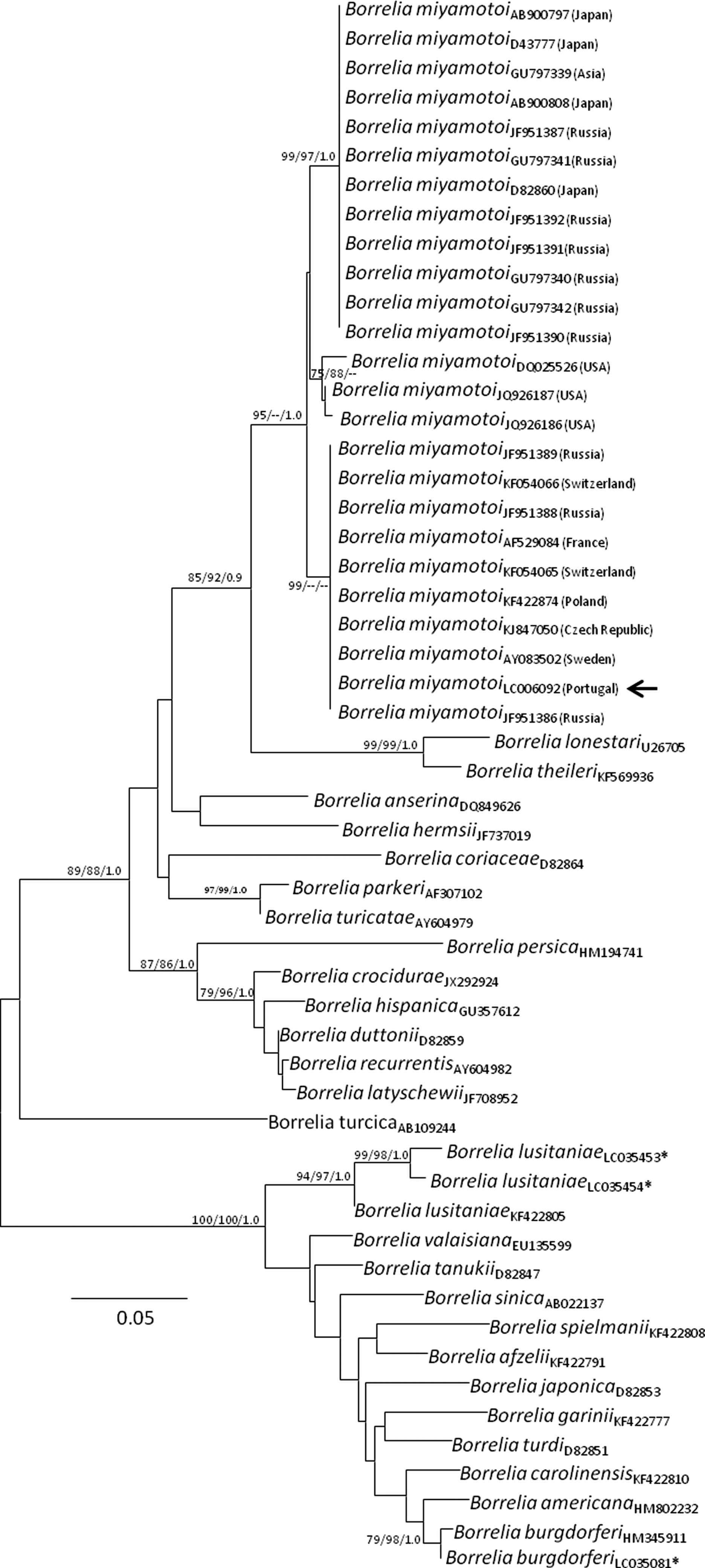
Borrelia phylogenetic analysis of fla nucleotide sequences (372 bp). B. miyamotoi clusters are denoted by species, accession number, and country of origin. At specific branch nodes bootstrap values (b; >75%) or posterior probabilities (pp; >0.90) are indicated (bNJ/bML/ppBayes), “–” indicating either bootstrap values or posterior probabilities below the indicated limits of significance. The arrow indicates the position of the B. miyamotoi, and the asterisks indicate the positions of other B.b.s.l. species, all described in this article. The size bar indicates 5% divergence.
Finally, B. burgdorferi s.l. DNA was also amplified by the two nested PCR protocols, leading to an overall prevalence of 11% (71/640). These positive samples were collected from Vila Real, Lisboa, Setúbal, and Faro districts, and about 50% (33/71) of them were sequenced, B. lusitaniae being the predominant genospecies (18/33).
Discussion
In the current study, B. miyamotoi DNA was detected for the first time in Portugal in a questing nymph collected in Tapada Nacional de Mafra, in the outskirts of Lisboa. However, so far, no evidence has ever been found to indicate that this putative pathogen may be responsible for causing human clinical cases in the country. Nevertheless, studies from Europe have suggested that B. miyamotoi may cause human disease, because B. miyamotoi–specific antibodies and DNA have already been detected in patients presenting symptoms like fever, headache, and muscle aches, typical of tick-borne relapsing fever.
Current studies have shown a crucial role of several vector species in the spread of B. miyamotoi. The typical vectors of tick-borne relapsing fever spirochetes are soft ticks from the genus Ornithodoros, therefore the low prevalence of B. miyamotoi, revealed by this and other studies may indicate a recent emergence and spread of these bacteria in hard ticks. It is important to highlight that ticks could simultaneously transmit B. miyamotoi and Lyme disease spirochetes to humans, supporting the risk of possible co-infections to occur, with potential strong implications for public health. Therefore, further investigations are needed to understand the competence of I. ricinus for B. miyamotoi and predict a possible spread of this group of spirochetes in Portugal. This will, in turn, contribute to the determination of the risk of exposure (for humans) in areas where Ixodes ticks live.
Footnotes
Acknowledgments
We deeply thank Tapada Nacional de Mafra, Herdade da Ribeira Abaixo, and Dunas de São Jacinto for allowing the tick collections.
This study was supported by Ministry of Education and Science of Portugal, Fundação para a Ciência e a Tecnologia, through a PhD grant (no. SFRH/BD/78325/2011) and a postdoctoral grant (no. SFRH/BPD/44082/2008).
Author Disclosure Statement
No competing financial interests exist.