




Abstract
Rift Valley fever (RVF) is an acute mosquito-borne viral zoonotic disease that affects mainly domestic ruminants and humans. RVF virus (RVFV) was first identified in Kenya in 1931 and was reported to be endemic in Africa but has recently spread to the Arabian Peninsula. With increasing climate change and globalization of trade in animals and animal products, there is great concern that the disease will spread worldwide to regions such as Europe, Asia, and the Americas. Although RVFV has not been reported in the Republic of Korea (ROK), the possibility of RVFV introduction is increasing because transmissible mosquito vectors are present and direct flights to Africa were added in 2012. For these reasons, we conducted a surveillance study to detect RVFV in mosquito vectors collected around the airport and harbor from 2012 to 2013. A total of 36,734 mosquitoes were collected and tested by real-time RT-PCR. A total of 1837 mosquito pools were used, and all were confirmed to be negative. This is the first report in the ROK concerning RVFV surveillance in mosquito vectors, and continuous surveillance will be conducted for the early warning of RVFV introduction.
Introduction
R
In the European Union (EU), mosquito-borne diseases such as RVF are communicable diseases that are covered by epidemiological surveillance (Braks et al. 2011). Surveillance can prevent the silent spread of the virus and provide information to assess risk and disease distribution (Breiman et al. 2008, Ochieng et al. 2013). In RVF ecology, mosquito vectors play an important role in the transmission of virus. Additionally RVFV has been isolated from over 30 mosquitoes, that may have a global distribution, such as the Aedes and Culex species (Bird et al. 2009, Chevalier et al. 2010, Turell et al. 2010). The importance of surveillance systems has been reported in RVF outbreaks (Bird and Nichol 2012, Chevalier 2013, Dar et al. 2013, Hassan et al. 2014). In particular, vector surveillance such as that of mosquitoes is needed to detect virus activity as early as possible. Early detection of virus activity in a vector is critical as is early warning for a rapid response to reduce an outbreak.
No case of RVF has been reported in the Republic of Korea (ROK), but some transmissible vectors are present such as the Aedes, Culex, and Mansonia species (Kim et al. 2010, Seo et al. 2013). In addition, the first direct flights from the ROK to Africa have launched, scheduled at three times per week in 2012, so the risk of RVFV introduction has increased. Therefore, this study is aimed at conducting surveillance in mosquito vectors to forecast and provide an early warning of RVF introduction.
Material and Methods
Study area and collection of mosquitoes
The mosquitoes were collected from six areas (Gyeonggi-do, Gangwon-do, Jeollabuk-do, Jeollanam-do, Gyeongsannam-do, Jeju-do) surrounding the airport and harbor from May through October in 2012–2013. The mosquitoes were collected using Mosquito Magnet® traps (Pro-Model, Woodstream Corp., Lititz, PA) that use propane gas to produce heat and CO2 as attracting agents to capture mosquitoes. The traps were operated continuously and collections were made once every 2 weeks.
RNA extraction from mosquito pools
The mosquitoes were classified, and only mosquitoes known to be RVF vectors were selected. Selected mosquitoes were pooled into groups up to 30 specimens, as described previously (Seo et al. 2013). Mosquito pools were homogenized and clarified by centrifugation. Total RNA from clarified mosquito homogenates were extracted using a Maxwell® 16 Research System (Promega, Madison, WI) following the manufacturer's instructions.
Real-time RT-PCR assay
RNA was tested by real-time RT-PCR (rRT-PCR) using the protocol from the method recommended by the World Organisation for Animal Health (OIE) (World Organisation for Animal Health 2014) to detect the RVFV G2 gene. rRT-PCR was performed using RVF-specific primers (RVS, 5′-AAAGGAACAATGGACTCTGGTCA-3′; RVAs, 5′-CACTTC TTACTAC CATGTCCTCCAAT-3′; RVP, FAM 5′-AAAGCTTTGATATCTCTCAGTGCC CCAA-3′ TAMRA). The AgPath-ID One-Step RT-PCR Kit (Life Technologies, Inc., Grand Island, NY) and CFX96 Touch™ Real-Time PCR Detection System (Bio-Rad, Hercules, CA) were used for rRT-PCR. Briefly, rRT-PCR was performed in a 25-μL reaction mixture containing 5 μL of standard RNA, 2× RT-PCR Buffer, 25× enzyme mix, 10 μM of each primer (RVS, RVAs), 20 μM of probe (RVP), and nuclease-free water to a final volume of 25-μL reaction volume by these conditions: 30 min at 45°C, 5 min at 95°C, followed by 45 cycles of 95°C for 5 sec and 57°C for 35 sec. RVFV viral RNA was extracted from a live RVF vaccine (Onderstepoort Biological Products, Onderstepoort, South Africa) and used as a positive control. To evaluate the detection limit of the assay, the targeted regions of the M segments were synthesized and transcribed in vitro to RNA using a MEGAscript Kit (Life Technologies, Carlsbad, CA). The RNA was serially diluted 10-fold from 1 × 10⁷ to 1 × 100 copies/μL and used for the standard.
Results
A total of 36,734 mosquitoes, representing 10 species from four genera known as RVF vectors, were collected from six areas in the ROK. In 2012, the most frequently collected species were Culex (Cx.) pipiens (79.2%), followed by Aedes (Ae.) vexans (12.6%), Ae. albopictus (2.7%), Cx. tritaeniorhynchus (2.2%), and Cx. inatomii (2.2%). In 2013, the most frequently collected species was Cx. pipiens (55.9%), followed by Ae. vexans (12.1%), Anopheles (An.) sinensis (11.6%), Ae. albopictus (8.7%), and Cx. tritaeniorhynchus (4.3%).
The rRT-PCR assay was applied to field mosquito sample homogenates. The detection limit of the rRT-PCR was one copy/μL for the M segment, and the standard curves were established with linear correlations (R 2) of 0.9983 (Fig. 1). A total of 1837 mosquito pools were used for rRT-PCR, and all of the pooled mosquito samples were negative (Table 1).
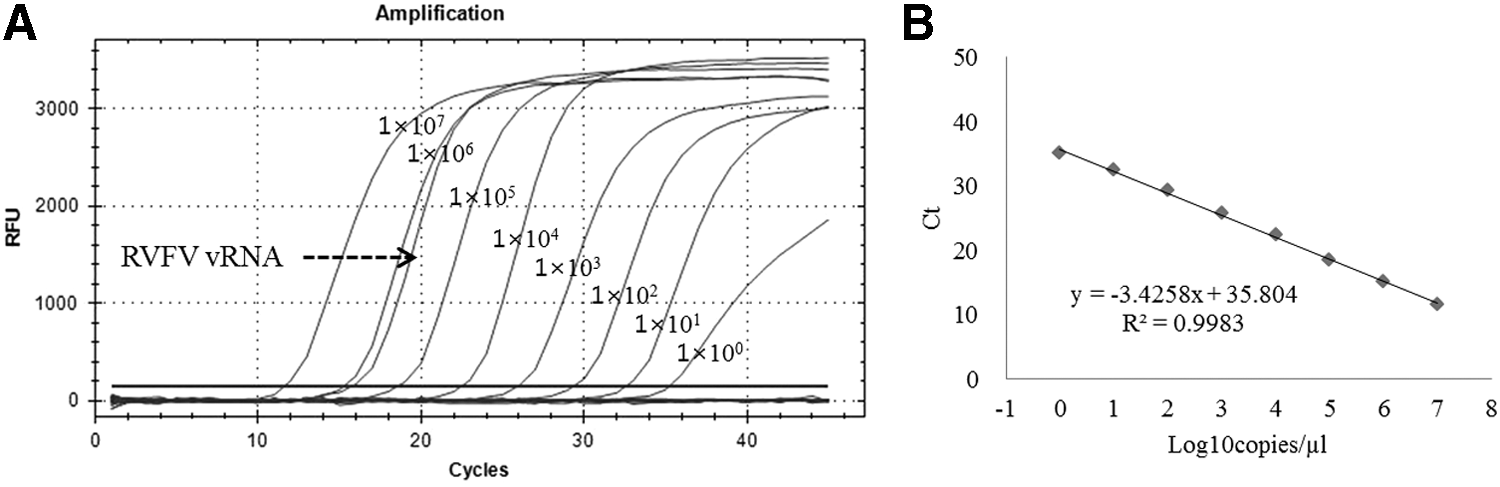
Graphs of the rRT-PCR assay for Rift Valley fever virus (RVFV) detection. (
Up to 30 specimens of mosquitoes were pooled based on the locality and time of their collection.
rRT-PCR, real-time RT-PCR; ND, not detected.
Discussion
RVF is one of the important mosquito-borne zoonotic diseases in human and ruminants, as well as a very important transboundary disease designated by the OIE in the trade of animals and related items. In the ROK, it has been designated as a List 1 notifiable infectious disease under the Act on the Prevention of Contagious Animal Diseases since 1997. Since RVFV was first identified in Kenya, it has been endemic in the African continent and was recently observed in the Arabian Peninsula and some Indian Ocean Islands (Balkhy and Memish 2003, Sissoko et al. 2009). With climate changes and the globalization of trade in animals and animal products, there is great concern that RVFV will spread worldwide to regions such as Europe, Asia, and the Americas. In this circumstance, the “One Health” concept has been applied to RVF for its prevention and control (Bird and Nichol 2012, Dar et al. 2013, Kortekaas 2014). The One Health approach has been used for the surveillance, control, and prevention of emerging diseases (Dehove 2010). Furthermore, it will lead all countries to make their animal health situation transparent and set up early warning systems. Eventually, the key element of One Health RVFV control approaches will be the early warning system. Regarding the vector, early detection of virus can be a key indicator or early warning for appropriate control and prevention to reduce outbreaks. Moreover, reliable information concerning the surveillance helps to gather resources for the potential risk of introduction and spread (Ochieng et al. 2013).
There are several potential pathways of RVFV spread via entry of an infected host or virus-carrying vector or intentional entry (Kasari et al. 2008, Chevalier et al. 2010, Hartley et al. 2011, Rolin et al. 2013, Salman 2013). Intentional introduction of RVFV would require careful planning; therefore, its probability is not high. Infected hosts, particularly ruminants can function as the initial amplifying host, but importation of ruminants is generally assumed to be low because of international trade restrictions and the veterinary check system. Finally, RVFV can be spread to a new geographic region via the movement of infected vectors. Infected vector introduction can be dispersed via wind or mechanical transport. The travel distance of the vector ranges from 110 to 1350 km within 24 h (Kasari et al. 2008). However, transcontinental movement of a vector using wind-borne transport is generally considered unfeasible because most vectors have a bioecology. In comparison, mechanical transport is more likely to be the potential mode; for example, numerous vectors have been discovered alive within aircraft and luggage after international flights (Rolin et al. 2013). With increasing intercontinental air or ship travel, the possibility of introduction using such a scenario has been highlighted. Thus, in this study, the mosquito vectors were captured in the six areas surrounding the airport and harbor in ROK.
rRT-PCR assays are widely recognized as being highly sensitive tests with many advantages over conventional RT-PCR methods. Several rRT-PCR methods have been developed and in some cases have been applied to mosquito vectors (Mwaengo et al. 2012). The rRT-PCR method employed in this study was selected because it has been validated and is a recognized OIE diagnostic method that can be used to detect RVFV in mosquito pools, as described in the OIE Manual of Diagnostic Tests and Vaccines for Terrestrial Animals (Drosten et al. 2002, World Organisation for Animal Health 2014). Our attempts to validate this test showed the rRT-PCR to be more sensitive than the results reported by Drosten et al. (2002) and showed good correlation between the cycle threshold (Ct) values and RNA concentrations. The difference of sensitivity in this study may be due to differences in the sample and RNA extraction method as reported by Drolet et al. (2012) and Wilson et al. (2013). Although, the performance of this rRT-PCR in low levels of viruses in mosquito samples cannot be estimated accurately, it can be assumed that despite some loss of sensitivity that would be expected due to inhibitory factors, such as the protein and lipid present in the samples, the test would be suitable for surveillance in mosquitoes due to its high sensitivity.
The results of this study, the presence of mosquitoes, such as Ae. vexans, Ae. albopictus, Cx. pipiens, and Cx. tritaeniorhynchus, was confirmed as previously reported (Kim et al. 2010, Seo et al. 2013). Aedes species are reservoir/maintenance vectors and Culex species are epidemic/amplifying vectors (Pepin et al. 2010). Kim et al. (2010) suggest that the use of more effective collection methods, such as the Mosquito Magnet®, are needed because a light trap could not collect another mosquito species like Ae. albopictus that are active day biters and are not attracted to light. Therefore, we used a Mosquito Magnet.
Due to the presence of these appropriate vector mosquitoes, RVFV is likely to be spread if introduced into the ROK; however, this study demonstrated the absence of RVFV in mosquito vectors from 2012 to 2013.
Conclusions
This study is the first report concerning the surveillance of RVFV in mosquitoes in the ROK. Surveillance in mosquito vectors is very crucial as part of an early warning system that could provide information for a rapid response. Additionally, it provides an opportunity to gain a better understanding of the ecology and epidemiology of RVFV, which are key points to improve the prevention and control of RVF with a One Health perspective. Therefore, we will conduct a continuous surveillance for early warning of RVF introduction.
Footnotes
Acknowledgment
This work was supported financially by a grant from the Animal and Plant Quarantine Agency (QIA), Ministry of Agriculture, Food and Rural Affairs, Republic of Korea.
Author Disclosure Statement
No competing financial interests exist.