




Abstract
Feline vector-borne diseases have increasingly become a focus of interest in recent years. Toxoplasma gondii, Dirofilaria immitis, and Chlamydia felis are common pathogens of cats that can affect humans among different countries all over the world. However, information about prevalence of T. gondii and C. felis is available in China, but information about coinfection of T. gondii, D. immitis, and C. felis in cats is limited. Thus, this study was conducted to estimate the prevalence of these pathogens' infection among stray and companion cats in northeastern and eastern China and identify the influence of age, gender, types, and regions on seropositivity. The circulating antigens of D. immitis and specific antibodies to T. gondii and C. felis were examined using kits commercially available. The overall prevalence of T. gondii, D. immitis, and C. felis was 15.43%, 1.93%, and 9.90%, respectively. Coinfection was common, and infection with both T. gondii and C. felis was the most common coinfection (22.32%). Stray cats have significantly higher seroprevalences than companion cats (p < 0.05). Moreover, the infection rates of these pathogens keep increasing year by year. This is the first report of T. gondii, D. immitis, and C. felis infection in cats in northeastern and eastern China. The findings of this study reveal that T. gondii, D. immitis, and C. felis are prevalent in stray and companion cats in northeastern China, which provided baseline data for the effective prevention and control of these parasites' prevalence in these regions and other parts of China.
Introduction
V
In recent years, feline vector-borne diseases (FVBD) have emerged, showing a wide range of geographic distribution and increased prevalence across the globe (Maia et al. 2014, Must et al. 2015). Environmental factors, human behavioral factors, and climate changes have played an important role in the changing epidemiology of these arthropod-borne diseases (Cong et al. 2016).
There are increasing numbers of cats in China in the last three decades along with raising public health problems in view of cats can transmit a number of zoonotic pathogens (Cong et al. 2016). Epidemiological data are necessary to define preventive, management, and therapeutical measures for stray, feral, and domestic cats. Previous serological or molecular surveys (Dubey et al. 2007, Zhang et al. 2009, Chen et al. 2011, Wu et al. 2011, Qian et al. 2012, Wang et al. 2012, Tian et al. 2014, Li et al. 2015, Yang and Liang 2015, Yang et al. 2015, Cong et al. 2016) have described infection with different vector-borne organisms in cats from some regions of China. Nonetheless, information about agents of FVBD and their prevalence in northeastern and eastern China is scarce. Moreover, the risk factors associated with exposure to these pathogens were extremely limited in China. Thus, the objectives of this study were to describe the seroprevalence of Toxoplasma gondii, Dirofilaria immitis, and Chlamydia felis infections in stray and companion cats in northeastern and eastern China, to clarify risk factors associated with prevalence of these pathogens, and to facilitate a more rational and efficient approach for controlling these pathogens' transmission in China.
Materials and Methods
Ethics statement
All operations were handled in strict accordance with the Good Animal Practice requirements of the Animal Ethics Procedures and Guidelines of the People's Republic of China. This study was approved by the Animal Ethics Committee of Jilin Agricultural University.
Sampling of cats
Between May 2012 and August 2015, a total of 1141 blood samples were obtained from stray and companion cats from Liaoning province (n = 336, 38° to 43°N, 118° to 125°E), Jilin province (n = 322, 41° to 46°N, 122° to 131°E), Heilongjiang province (n = 137, 43° to 53°N, 121° to 135°E), and Shandong province (n = 346, 34° to 38°N, 114° to 122°E) (Fig. 1). Information regarding the age, gender, and geographical origin of companion cats were obtained from their owners, and the biometric data of stray cats were estimated based on body condition and dental age (Table 1). Blood samples were kept at room temperature for 2 h, centrifuged at 3000 rpm for 5 min, and the separated serum samples were stored at −20°C until further analysis.
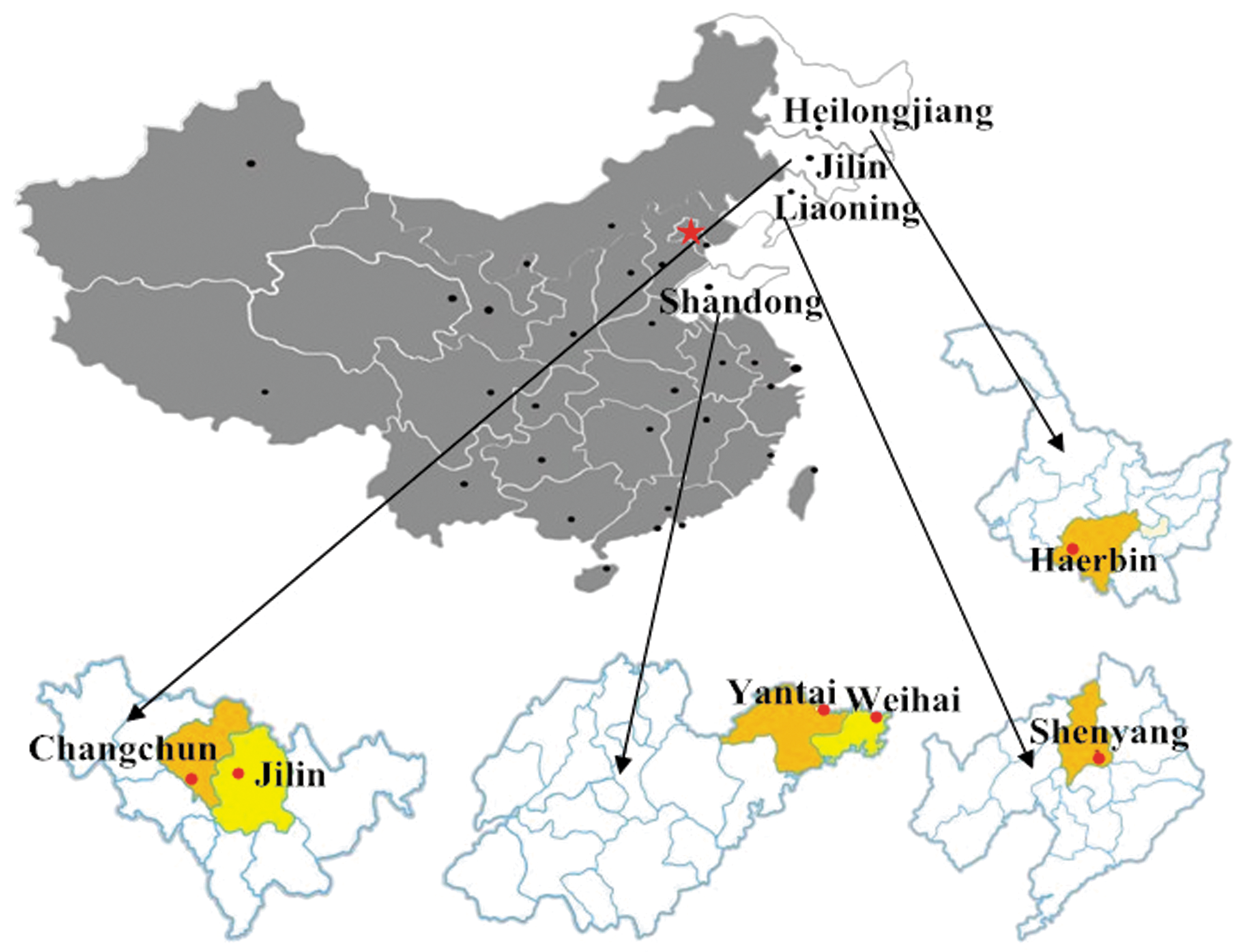
Geographic distribution of cats' sampled regions in northeastern and eastern China. Red star represents the capital of China (Beijing). Color images available online at
Serological examination
Antibodies against T. gondii from serum samples were detected by an indirect hemagglutination antibody (IHA) test using a commercially available kit obtained from Lanzhou Veterinary Institute, Chinese Academy of Agriculture Sciences. The detection procedures were carried out as previously reported (Zhang et al. 2015). The serum sample was judged as positive if a layer of agglutinated erythrocytes was observed in wells with dilutions of 1:64 or higher. All cat serum samples were analyzed for D. immitis antigen using the commercial SNAP®4Dx test kit (IDEXX Laboratories, Westbrook, ME) according to the manufacturer's instructions. Antibodies to C. felis in cats were measured using a commercially marketed IHA kit purchased from the Lanzhou Veterinary Research Institute of the Chinese Academy of Agricultural Sciences. The sensitivity and specificity values for the testing kit used in this study have been validated by ministry of agriculture of the People's Republic of China (NY/T 562-2002) (Wu et al. 2013).
Statistical analysis
All the factors (gender, age, types, and sampling regions) were studied in a multivariable logistic regression model, and probability p-value <0.05 was considered statistically significant between levels within factors and interactions. Odds ratios with 95% confidence intervals (CIs) were calculated. All statistical analyses were performed using SPSS (Release 18.0 standard version; SPSS, Inc., Chicago, IL).
Results
Antibodies to T. gondii were found in 176 (15.43%, 95% CI: 13.33–17.52) cats by IHA with titers of 1:1024 in 3, 1:512 in 38, 1:256 in 59, 1:128 in 39, and 1:64 in 37 cats. Positive cats were found in all districts with different seroprevalence (Table 1). T. gondii seroprevalence in different ages of cats ranged from 13.08% to 22.22%. With respect to gender, the seroprevalence in male cats (16.19%) was slightly higher than that in female cats (14.58%). Stray cats (22.57%) had a significantly higher seroprevalence than companion cats (10.74%) (p < 0.001). From 2011 to 2015, the seroprevalence of T. gondii infection in the tested cats was gradually increased (Table 1).
D. immitis antigen was detected in 22 (1.93%, 95% CI 1.13–2.73) cats, with a slightly higher prevalence in males (2.00%) than in females (1.85%). By age, positive animals were found in all age groups; the highest prevalence was found in the 2–3 year group (2.96%), while the lowest prevalence was found in the <1 year group (1.36%). By region, the prevalence of D. immitis was diverse in different administrative districts, ranging from 1.46% in Heilongjiang province to 2.31% in Shandong province. Stray cats (2.88%) had a higher prevalence than companion cats (1.31%). The increased prevalence of D. immitis antigen was found with the collection year (Table 1).
Of the 1141 samples tested, positive results for anti-C. felis antibodies were observed in 113 samples, representing a prevalence of 9.90% (95% CI 8.17–11.64) (Table 1). Of these, the seroprevalence of C. felis was diverse in different administrative districts, ranging from 8.03% in Heilongjiang province to 10.40% in Shandong province. Among different ages of cats, the highest seroprevalence of C. felis infection was seen in the cats aged >3 years (14.81%), while the lowest seroprevalence was found in the cats aged <1 year (8.17%). With respect to gender, the seroprevalence in female cats (9.96%) was similar to that in male cats (9.85%). Stray cats (14.38%) had a significantly higher seroprevalence than companion cats (6.97%) (p < 0.001). The highest C. felis seroprevalence was found in 2015 (12.78%) and the lowest C. felis seroprevalence was found in 2013 (8.57%) (Table 1).
The phenomenon of coinfection was found in this study. Fifty-two of 1141 (4.56%) cats were positive to T. gondii and C. felis, 8/1141 (0.70%) cats were positive to T. gondii and D. immitis, 10/1141 (0.88%) cats were positive to D. immitis and C. felis, and 4/1141 (0.35%) cats were positive to T. gondii, D. immitis, and C. felis (Table 2).
NA, not applicable.
Discussion
In China, with the accelerated process of urbanization and improvement of living standard, the number of pets raised (both in urban and rural areas) is increasing rapidly, and a series of problems are gradually emerging due to lack of quarantine and vaccination, ineffective market administration, nonstandard pet hospital, and environment contamination (Cong et al. 2014). Moreover, the growing number of cats in China increases the risk for pathogen infection in humans. In this study, the overall prevalence of T. gondii, D. immitis, and C. felis was 15.43%, 1.93%, and 9.90%, respectively. Coinfection was common and infection with both T. gondii and C. felis was the most common coinfection (22.32%) (Table 2). These data would be very useful for prevention and control of these pathogens' infection in cats, other animals, and humans in China.
This study shows, for the first time, the seroprevalence of T. gondii in cats from northeastern and eastern China, and this adds new information on the epidemiology of cat toxoplasmosis in China. The overall seroprevalence of T. gondii infection was 15.43% in this study, which was lower than those of Lanzhou (19.34%) (Cong et al. 2016), the central region of China (50%) (Yang et al. 2015), Guizhou (63.16%) (Li et al. 2015), Yunnan (25.14%) (Tian et al. 2014), Beijing (57.8%) (Qian et al. 2012), and Guangzhou (25.24%) (Zhang et al. 2009), but higher than that in cats in Shanghai (11.7%) (Wang et al. 2012). However, the various methodologies used and greatly different sample sizes and sample populations in the regions surveyed may contribute to these differences; so it is difficult to compare the reported prevalence.
In view of heartworm, the result indicates that 1.93% of cats tested have suffered from D. immitis. This is in agreement with our previous study in Lanzhou, northwest China where 3.04% of 362 cats were positive for D. immitis antigens (Cong et al. 2016). Since heartworms do not routinely develop patent infections with circulating microfilariae in cats, it is not surprising that very few cats in China were positive when blood was examined for the presence of microfilariae. Moreover, there was no cross-reaction in the SNAP® Feline Triple® Test between D. immitis and the other common canine Dirofilaria species, D. repens (Pantchev et al. 2009). D. immitis infection in cats appeared in these regions, although its incidence rate was low. Thus, heartworm therapy and/or prevention for cats is needed in these regions. Moreover, further studies with more samples and areas should be conducted to complete an accurate survey of feline dirofilariosis.
Information on the distribution of animal chlamydiosis in China is limited, especially for companion animals (pet cats and dogs). Companion animals are recognized as faithful friends of humans; however, cats and dogs could be important vectors of Chlamydia infection in humans (Wu et al. 2013). Thus, this study was conducted to evaluate the chlamydial seroprevalence in cats in northeastern and eastern China. The C. felis prevalences have been reported in various regions. For example, an overall 45.16% prevalence of C. felis was detected among cats in Slovak by direct immunofluorescence (Halánová et al. 2011). Moreover, a 27% C. felis seroprevalence was found in serum samples from European wildcats using the enzyme-linked immunosorbent assay (Millán and Rodriguez 2009). The overall seroprevalence of C. felis exposure in cats in this study was 9.90%, which is lower than those in the above-mentioned studies, but higher than that observed in cats in Dongguan (2.38%), southern China (Huang et al. 2010), and Lanzhou (5.9%), northwest China (Wu et al. 2013), using the same commercial IHA kit. Many differences may contribute to the differences in the seroprevalence of C. felis exposure in cats, including differences in ecological and geographical factors such as temperature, rainfall, or landscape differences; serologic methods used; number of tested cats; and living conditions of tested cats.
In this study, the type of cat has a positive effect on the diseases. Stray cats have a high risk for FVBD infection compared to companion cats. Considering that stray cats have more opportunities to contact with these pathogens than companion cats, it is not surprising that stray cats are at risk of infection with FVBD. In recent years, stray cats can be seen everywhere in much of China, which increases the risk for these pathogens' infection in humans. The infection rates of these pathogens keep increasing year by year, thus, effective control strategies should continue to be implemented to prevent and control FVBD infection in cats, other animals, and humans.
Coinfections with different feline vector-borne pathogens are common in cats living in geographic areas where the presence of competent vectors for the different pathogens overlap. In our previous study, coinfections with different feline vector-borne pathogens have been reported in cats in Lanzhou, northwest China (Cong et al. 2016). Moreover, T. gondii has been reported in cats coinfected with D. immitis in southern Portugal (Maia et al. 2014). Thus, it is not surprising that 74 cats coinfected with two or three agents/complex of FVBD were found in this study. However, it is important to remember that the occurrence of coinfections of vector-borne pathogens, with a possible dysregulation of the immune system, may cause serious and noncharacteristic clinical symptoms, which will further increase the difficulty in diagnosis, treatment, and prognosis of FVBD.
This study has provided interesting new data on zoonotic pathogens emerging from stray and companion cats. Additional epidemiological data with larger numbers of stray, companion, and domestic animals from more regions are needed so as to determine the real prevalence and distribution of these diseases in China, as well to analyze the differences between risk factors. Further researches are also warranted, aiming to isolate these pathogens and determine their clinical value.
Conclusion
In summary, we presented the first report of T. gondii (15.3%), D. immitis (1.93%), and C. felis (9.90%) in stray and companion cats in northeastern and eastern China. Given the potential detriment to humans and other animals, this information has important implications for preventing and controlling these pathogens' infection in cats, other animals, and humans in China.
Footnotes
Acknowledgments
Project support was provided by the project National Natural Science Foundation of China (grant no. 31201927) and the key scientific and technological project of Science and Technology Agency of Jilin Province (grant no. 20150204065NY).
Author Disclosure Statement
No completing financial interests exist. The findings and conclusions in this report are those of the authors and do not necessarily represent the views of the funding agencies.