




Abstract
Wild birds may play an important role in maintaining and transmitting Salmonella. Their ability to travel large distances and their proximity to human habitations could make them a vehicle for bridging Salmonella from wild and domestic animals to humans. To determine the potential public health risk presented by urban birds, we investigated the prevalence of Salmonella among great-tailed grackles (Quiscalus mexicanus) and other cohabiting urban bird species. Fecal samples were collected from 114 birds communally roosting in parking lots of retail locations in Brazos County, Texas, from February through July of 2015. Great-tailed grackles and European starlings (Sturnus vulgaris) were the predominant species sampled. Standard bacteriologic culture methods were used to isolate Salmonella from samples, and isolates were characterized by serotyping and antimicrobial susceptibility testing. Overall, 1.8% (2/114) of samples were confirmed positive for Salmonella. Both positive birds were great-tailed grackles sampled in June, yielding a 2.6% (2/76) apparent prevalence among this species. Isolates were serotyped as Salmonella Typhimurium and found to be pan-susceptible based on the National Antimicrobial Resistance Monitoring System (NARMS) panel of antimicrobial agents. The occurrence of Salmonella in great-tailed grackles represents a potential threat to public health, particularly considering their population size and tendency to congregate near human establishments such as grocery stores.
Introduction
S
Wild birds may play a critical role in disseminating Salmonella and other enteric pathogens across the landscape, given their ability to travel great distances during migrations, dispersals, or between feeding and roosting activities. Thus, wild birds have the potential to pose a substantial risk to public health (Callaway et al. 2014). To this end, there have been several studies involving birds near agricultural operations such as dairies and feedlots. For example, Callaway et al. (2014) conducted a survey of birds often associated with cattle in Brazos County, Texas, namely brown-headed cowbirds (Molothrus ater), common grackles (Quiscalus quiscula), and cattle egrets (Bubulcus ibis), and found 14.9% of these birds to be shedding Salmonella. Phalen et al. (2010) estimated a Salmonella prevalence ranging from 29% to 91% among cattle egret nestlings from various colonies in central Texas. The serotypes identified in these birds were also isolated from horses in the 2 years following their study, indicating that egrets and horses may be exposed to similar sources of Salmonella or that transmission may be occurring between them. In addition, Kirk et al. (2002) captured 892 birds at nine dairies in California and isolated Salmonella spp. from 1.2% to 3.2% of each avian species, with brown-headed cowbirds and house sparrows (Passer domesticus) having the highest prevalence. Fewer studies have been conducted in nonagricultural settings. In particular, there is a dearth of research on Salmonella shedding among bird species that congregate in urban locations with high human activity, such as great-tailed grackles (Quiscalus mexicanus). Hamer et al. (2012) collected fecal samples from 180 birds in the greater Chicago, IL area and found only one individual (0.6%) to be infected with Salmonella. Janecko et al. (2015) identified Salmonella in 1.7% (10/590) of samples from American crows collected in four states.
Great-tailed grackles spread from Mexico to reach southern Texas by the 1880s, and their range now extends as far north and west as South Dakota, Idaho, and California (Wehtje 2003). In the United States, the species is highly adapted to the urban environment and forms large aggregations of communally roosting individuals at night. The locations of these nocturnal roosts are frequently the trees of large, well-illuminated parking lots (Hall and Harvey 2007). The presence of heavy loads of avian feces beneath roost trees, coupled with raucous vocalizations, result in these birds and other urban bird species gaining a reputation as pests, with many establishments attempting to haze these birds away (Fitzwater et al. 1988). The objectives of this study were to estimate the prevalence of Salmonella shedding among roosting great-tailed grackles and other urban birds in the parking lots of retail locations in Brazos County, Texas, and characterize the isolates through serotyping and antimicrobial susceptibility testing.
Materials and Methods
Bird collection and processing
On nine evenings from February through July 2015, samples were collected from roosting birds in urban parking lots of retail buildings in College Station, Brazos County, located in eastern Texas. Great-tailed grackles have been established since the 1940s in many metropolitan areas of Texas, including College Station (Wehtje 2003). Sites were selected based on prior observations of Great-tailed Grackle and other urban bird aggregations for staging and roosting. The study area was ∼9 hectares in size and encompassed two gas stations, a bank, a grocery store, and several restaurants and other businesses. Nylon mist nets (12-meter length; Association of Field Ornithologists, Portland, ME) were erected next to communal roost trees as previously described (Hamer et al. 2012). As roost tree canopies were above the standard height of a mist net, we adapted this protocol by connecting two rigid conduit pipes with a threaded couplet to create 6.1-meter poles that supported the nets (Fig. 1A). Mist nets with 30 mm mesh size were used initially, but larger birds (e.g., male great-tailed grackles) were observed escaping from these nets; thus, we switched to 61 mm mesh size nets to improve capture success. The nets were erected 1–4 h before sunset as the communal birds were staging. Birds were captured in nets as they arrived at the roost trees and when 3-meter conduit poles were used to flush roosting birds into the nets. Birds were extracted immediately after being caught in many cases, and nets were monitored for additional captured birds every 15–20 min. A double layer of new paper bags was used to hold birds individually until they were ready to be processed.
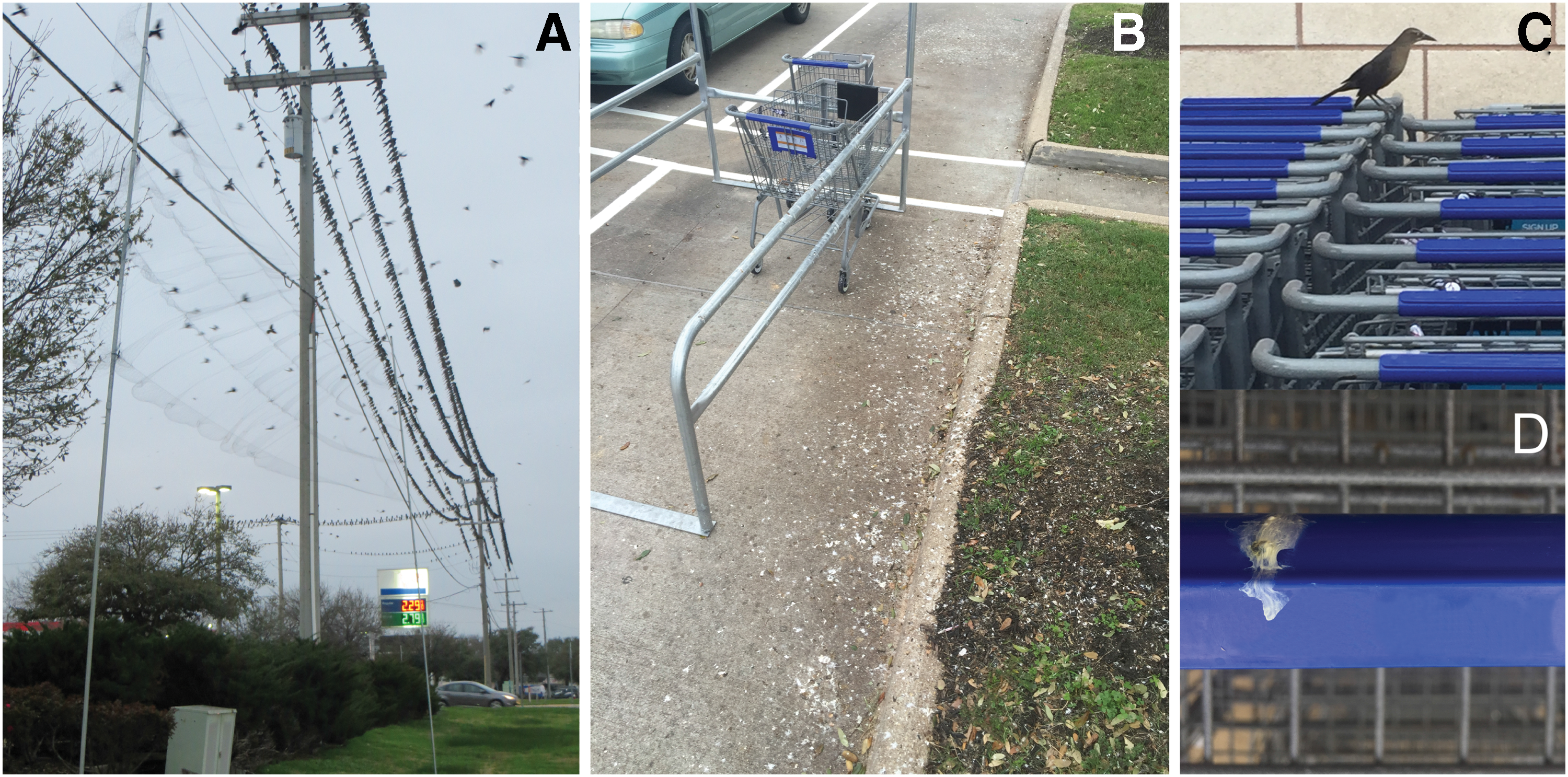
Nylon mist nets on 6.1-meter poles next to a roost tree in the foreground with staging great-tailed grackles (Quiscalus mexicanus) on power lines in the background
For each captured bird, the species, weight, wing chord, tail length, sex, and age class (hatch year or after hatch year) were recorded. Sterile cotton-tipped swabs were used to collect fecal samples from the inner paper bag holding the bird, directly from the cloaca, or in a few cases from processing tables or technicians; samples were then deposited into Amies media (Becton-Dickinson, Sparks, MD). When voided fecal samples were available, we attempted to collect the entire amount. Standard procedures were utilized to prevent cross-contamination of samples, such as changing gloves between handling individual birds. Up to two samples were collected per bird and kept in a cooler at ∼4°C. Following sample collection, birds were released at the site of capture after attaching a United States Fish and Wildlife Service (USFWS) metal leg band with a unique number, or in some cases, they were euthanized for unrelated research efforts. Fieldwork was conducted with approvals from the Institutional Animal Care and Use Committee at Texas A&M University, U.S. Fish and Wildlife Service, U.S. Geological Survey, Texas Parks and Wildlife Department, and private business owners.
Estimate of study population
Communal Great-tailed Grackle roosts are dynamic in the College Station, Texas, environment. The size and location of these roosts vary throughout the year, likely due to breeding activities and hazing practices to disrupt the large aggregations of birds. One technique to census communal roosting birds is to station multiple observers around the roost to count birds as they arrive (Rumbold et al. 2009). As great-tailed grackles arrive at their communal roost, however, they stage in large numbers and are prone to flight when disturbed. Mass departure from staging locations or roost trees occurs throughout dusk and into the evening, triggered by the many forms of disturbance that are common in parking lots of retail buildings in urban areas. To avoid duplicate counting of birds, we pursued an alternative method to estimate local population size. During the nine evenings of sampling (February through July 2015) and on frequent scouting visits before and during the sampling period, we became familiar with the trees utilized to roost by great-tailed grackles and the boundaries of the roost where trees were not used. Roost trees were primarily Southern live oaks (Quercus virginiana), with a typical height of ∼8 meters, located in parking lots near artificial lighting. We estimated that ∼55 roost trees were being utilized by great-tailed grackles in the study area on any given night, based on our experience in the field combined with satellite imagery. Dispersal of grackles from roost trees, in response to our sampling efforts or other human activity, allowed a conservative estimation of ∼40 birds per tree. Thus, we estimated a total of 2,200 great-tailed grackles within the study area, utilizing the communal roosts (Fig. 1A–D).
Microbiologic procedure for Salmonella detection
Within 1–5 h of collection, samples were brought to the research laboratory and enriched in 5 mL of tetrathionate (TT) broth (Becton, Dickinson and Company, Franklin Lakes, NJ) containing 0.1 mL of iodine solution. Enrichments were incubated at 42°C for 24 h and then plated to xylose lysine tergitol-4 (XLT-4) agar (Northeast Laboratories, Waterville, ME). Plates were incubated for 48 h at 37°C; these were examined for suspected colonies at 24 and 48 h. Following incubation, a single suspected colony was transferred to Kligler iron agar (KIA) slants (Becton, Dickinson and Company) and incubated for 18–24 h at 37°C. Colonies from positive slants were streaked onto trypticase soy agar (TSA) 5% sheep blood (Becton, Dickinson and Company) and incubated at 37°C for 18–24 h. After incubation, one positive colony was transferred to brain–heart infusion (BHI) broth (Becton, Dickinson and Company), incubated at 37°C for 16–24 h, and then frozen in a 15% glycerol solution at −80°C for further characterization.
Following the first month of sampling, samples were processed using the preceding method in parallel with an additional method based on Andrews and Hammack (2007). This second method was incorporated to allow future studies to characterize non-Salmonella bacteria that may be present in the samples and further improve Salmonella recovery. When two samples per bird were available, they were randomly allocated to each method. If only one sample was available, it was processed using the modified Andrews and Hammack (2007) method. This modified method consisted of the same steps as previously described, but with the addition of a nonspecific enrichment step in tryptic soy broth (TSB; Becton, Dickinson and Company) before the TT enrichment and an enrichment in Rappaport-Vassiliadis (RV) broth (Becton, Dickinson and Company) following TT enrichment. TSB enrichment consisted of incubating the swabs for 2 h at room temperature followed by at least 10-h incubation at 37°C. One milliliter of TSB was transferred to 9 mL of TT broth and incubated for 24 h at 37°C. The remaining TSB was incubated for an additional 12 h and then frozen in the same manner as BHI in the previously described method. Then, 200 μL of the TT broth was transferred to 5 mL of RV broth and incubated for 24 h at 42°C. After incubation, RV was plated to XLT-4. Steps following the 48-h incubation are the same as in the previously described method. In addition, presumptive Salmonella isolates were confirmed by amplification and detection of the invA gene using PCR as previously described (Kim et al. 2007).
Serotyping
Confirmed Salmonella isolates were sent to the Clinical Microbiology Laboratories at the University of Pennsylvania Veterinary Hospital for serotyping. The xMAP® Salmonella Serotyping Assay (Luminex, Austin, TX) was used to identify Salmonella isolates. The assay simultaneously determines O and H antigen genes and also identifies serotype-specific markers in the AT (Additional Targets) test. Salmonella template DNA was extracted using the InstaGene Matrix as described by the manufacturer (Bio-Rad, Hercules, CA). Multiplex PCR was performed, and the amplicons were hybridized with the oligonucleotide probe-coupled bead mixture and then labeled with streptavidin-R-phycoerythrin (SAPE) reporter. The assay plate was analyzed on a Luminex® LX200™ platform, and the data were exported to Excel (Microsoft, Redmond, WA) for analysis.
Antimicrobial susceptibility testing
Antimicrobial susceptibility of confirmed Salmonella isolates was determined by the broth microdilution method. Minimal inhibitory concentrations (MIC) were established for each isolate against the National Antimicrobial Resistance Monitoring System (NARMS) Gram-negative panel of 14 antimicrobial agents (plate code CMV3AGNF, Sensititre; TREK Diagnostic Systems, Cleveland, OH): amoxicillin/clavulanic acid, ampicillin, azithromycin, cefoxitin, ceftiofur, ceftriaxone, chloramphenicol, ciprofloxacin, gentamicin, nalidixic acid, streptomycin, sulfisoxazole, tetracycline, and trimethoprim/sulfamethoxazole. Clinical and Laboratory Standards Institute (CLSI) guidelines were used to interpret MIC values when available (CLSI 2008, 2012). Otherwise, MIC values were interpreted using NARMS breakpoints (FDA 2013). Quality control was performed weekly using Escherichia coli ATCC 25922.
Results
In total, 117 birds were captured, including 76 great-tailed grackles, 34 European starlings (Sturnus vulgaris), 4 house sparrows, 1 brown-headed cowbird, 1 cedar waxwing (Bombycilla cedrorum), and 1 Eurasian collared-dove (Streptopelia decaocto). The number of birds caught per night ranged from 1 to 22, with a median of 16 birds. Of the birds captured, 63 were female, 21 were male, and 33 were of unknown sex. The majority of birds captured (n = 109) were determined to have hatched before the calendar year of capture (Table 1). All birds were judged to be in adequate health condition based on gross appearance, with no overt signs of disease.
Spring includes February through April; summer includes May through July.
Fecal samples were collected from 114 birds, with 34 sampled solely from collection bags, 34 solely from cloacal swabs, 37 using both methods, 6 from other surfaces, and 3 with no record of collection method. Overall, 1.8% (2/114; 95% CI 0.2%–6.2%) of samples were confirmed positive for Salmonella. Both positive birds were great-tailed grackles sampled in June, yielding a 2.6% (2/76; 95% CI 0.3%–9.2%) apparent prevalence among this species. The great-tailed grackles were sampled at different roosting sites and by different methods (collection bag and cloacal swab). Both isolates were serotyped as Salmonella Typhimurium, and both were pan-susceptible to the antimicrobial agents included in the NARMS panel.
Discussion
The occurrence of Salmonella in great-tailed grackles represents a potential threat to public health, particularly in view of their population size and preferred habitat. Great-tailed grackles tend to congregate near human establishments, including grocery stores, restaurants, and gas stations, creating opportunities for zoonotic transmission through direct contact or foodborne exposure. Assuming that our sample is representative of the population of great-tailed grackles in the study area, we estimate that over 50 Salmonella-positive birds were present in this area on a given night during the study period, based on the apparent prevalence among this species (2.6%) and our conservative estimate of local population size (2,200). This is likely to be an underestimate, as fecal culture does not have perfect sensitivity for detecting the presence of Salmonella.
In addition to detection methods, sampling location and time of year influenced our results. Studies on Salmonella shedding among wild birds in agricultural settings have generated higher prevalence estimates (Callaway et al. 2014), suggesting that roosting near dairies and feedlots may be a risk factor for positive Salmonella status among birds. Birds in urban locations may have a lower risk of Salmonella exposure, relative to birds that are in contact with cattle and agricultural environments. While Salmonella is known to persist in the environment for long periods of time, this has primarily been documented in areas used for farming or areas where another source of contamination is present (Winfield and Groisman 2003, Toth et al. 2011). Another potential factor is the time of year during which samples were collected. Although we sampled birds from February through July, the two great-tailed grackles found to be positive for Salmonella Typhimurium were collected during the month of June. In cattle and horses, Salmonella shedding has been shown to follow distinct seasonal trends with summer and fall yielding the highest prevalence (Carter et al. 1986, Fossler et al. 2005, Cummings et al. 2009). It may be that Salmonella prevalence would increase if samples were collected during late summer and fall, as seen in livestock. As Salmonella thrives in warm, moist environments, this trend in seasonality is most likely related to temperature and moisture conditions that predominate in the summer and fall months (Strawn et al. 2013, Marine et al. 2015).
Resistance to antimicrobial agents that are included on the NARMS panel was not evident in the two study isolates. Presumably there is a lack of selection pressure for antimicrobial resistance among wild birds and other wildlife in most environments, relative to animals in agricultural settings. However, further research to generate a larger number of isolates would be necessary to evaluate the prevalence of antimicrobial resistance among Salmonella isolated from great-tailed grackles.
Both isolates were serotyped as Salmonella Typhimurium. According to the most recent CDC data, Typhimurium is the second most commonly reported serotype in human patients with laboratory-confirmed salmonellosis in the United States (Crim et al. 2015). This highlights the potential threat to public health posed by great-tailed grackles. Typhimurium is also the major cause of salmonellosis in wild birds and has been implicated in widespread outbreaks among songbirds in the United States (Hernandez et al. 2012) and other areas of the world (Alley et al. 2002, Fukui et al. 2014). Mortality among infected birds can be high (Hernandez et al. 2012), and evidence suggests that the proportion of avian mortality attributed to salmonellosis may be increasing (Hall and Saito 2008). On a broader scale, Typhimurium is reported to be one of the most common serotypes among clinical and nonclinical laboratory-confirmed nonhuman sources (CDC 2014), underscoring the wide host range and complex ecology of this serotype.
Footnotes
Acknowledgments
The authors would like to thank the students enrolled in Field and Lab Techniques in Vector-borne Disease Ecology (ENTO/VIBS 489-689) at Texas A&M University for their assistance with capturing and processing birds. The authors appreciate permission to capture birds from the parking lots of several businesses in College Station, Texas. This study was funded, in part, by teaching enhancement funds in the Department of Veterinary Integrative Biosciences, the Department of Entomology, and the Montague-Center for Teaching Excellence award to S.A.H.
Author Disclosure Statement
No competing financial interests exist.