




Abstract
Ehrlichiosis and anaplasmosis are important emerging tickborne zoonoses that affect both humans and animals. Knowledge of the geographic distribution and prevalence of Ehrlichia spp. and Anaplasma phagocytophilum in Wisconsin is important information as a baseline for future comparisons. Reported human cases between 2009 and 2015 were identified using the Wisconsin Electronic Disease Surveillance System (WEDSS) and mapped by county of residence. Vector surveillance was established using ticks collected from animals by partners, including veterinary medical clinics, domestic animal shelters, and wildlife rehabilitation centers from 40 Wisconsin counties. A total of 1835 Ixodes scapularis tick specimens (larvae, nymphs, and adults) were collected from 18 different domestic and wildlife species from July 2011 to November 2015. An additional 1136 nymphs were collected by drag sampling at 23 locations in 19 counties in 2015. A real-time PCR assay that detects and distinguishes several Ehrlichia species, including a pathogenic Ehrlichia muris-like agent (EMLA), and A. phagocytophilum was performed on adult and nymphal ticks. A total of 757 I. scapularis ticks (predominately adults) were tested from animal collections, with 67 (8.9%) individuals positive for A. phagocytophilum and 22 (2.9%) positive for EMLA DNA. Of the 1150 questing nymphs, 62 (5.4%) were positive for A. phagocytophilum and 10 (0.9%) were positive for EMLA DNA. Specimens of I. scapularis that were positive for A. phagocytophilum were found in 27 of the 33 counties surveyed. Specimens that were positive for EMLA were less common and were found in nine counties. This study provides the first statewide survey of I. scapularis ticks for these pathogens and indicates that the risk of human exposure is widely distributed.
Introduction
E
Ehrlichiosis and anaplasmosis are reportable diseases in Wisconsin, and state surveillance suggests that the incidence of these infections in humans has increased since 2005. With the discovery of EMLA in 2009, subsequent reports separated EMLA and HA, which helped to identify areas where risk of exposure might be elevated. However, regional variation in diagnostic testing places limits on the value of human case surveillance for defining the geographic range of potential exposure. Anecdotal evidence suggests that health providers may be unaware of the risk of exposure for tickborne rickettsiales outside of the northern and western regions of the state, the area where Ixodes scapularis-transmitted disease agents are most prevalent.
Determination of pathogen prevalence in the arthropod vectors is a useful method for mapping the range and risk of transmission. The enzootic cycle for the human infectious strain of A. phagocytophilum (Ap-ha) in the upper Midwest is maintained primarily among I. scapularis ticks and wild rodents (Nicholson et al. 2010). The primary vector for EMLA is also I. scapularis. This bacterium was detected through PCR in 38/1920 (1.9%) of I. scapularis ticks collected and tested from Minnesota and Wisconsin (Pritt et al. 2011), has been isolated from a blood-fed adult I. scapularis (Lynn et al. 2015), and has been transmitted by I. scapularis to laboratory mice (Karpathy et al. 2016).
The objectives of this study were to examine the incidence and prevalence of these rickettsial pathogens in Wisconsin through human and tick surveillance to establish baselines for these parameters. We also sought to better understand the risk of tickborne infections to Wisconsin residents among different regions of the state. In this article, we present (1) results of surveillance of human infection with EMLA and Anaplasma since 2009, (2) the analysis of I. scapularis specimens (mostly adults) collected during 2011–2015 from domestic and wildlife species in collaboration with veterinary medical clinics, domestic animal shelters, and wildlife rehabilitation centers, and (3) the infection status of questing I. scapularis nymphs collected from 23 locations in 2015.
Materials and Methods
The Wisconsin Electronic Disease Surveillance System (WEDSS) based in the Wisconsin Division of Public Health (DPH) is a secure web-based system designed to facilitate reporting, investigation, and surveillance of communicable diseases in Wisconsin. WEDSS was queried for all cases of ehrlichiosis and HA reported during 2009–2015 using the CSTE surveillance case definition (
Veterinarians, domestic animal shelters, and licensed wildlife rehabilitation centers in the state of Wisconsin were contacted to request participation in the tick surveillance program (hereafter referred to as the SWAT program; Surveillance of Wisconsin Animals for Ticks). Collection materials (vials containing ethanol, data sheets, labeled mailers) were provided to all SWAT participants. Study participants removed ticks from domestic and wild animals and placed all specimens from an individual animal in one 2-mL plastic vial containing 70% ethanol. A few participants also provided ticks removed from human associates. Participants recorded the name of the facility and county, the date the tick specimen was removed, the host species on which the tick was found, dog breed (if applicable), exact or approximate location where the tick was picked up (where known), travel history (for domestic animals) within the preceding 2 weeks, approximate number of ticks removed, and any other information the recorder believed important. Samples and datasheets were returned to the UW Madison Medical Entomology Laboratory for tick identification and testing.
All tick specimens were identified by use of standard taxonomic keys (Keirans and Litwak 1989, Clifford et al. 1996, Durden and Keirans 1996). Poor condition of some submitted specimens made morphologic identification difficult; these specimens were recorded to genus level or marked as unknown. A unique identification number was assigned to each entry. After identification, tick specimens were placed in 70% ethanol and then stored at room temperature until DNA extraction and PCR testing were performed.
Additional collections of questing nymphs were carried out at 23 sites across the state in 2015. At each location, forested habitats were selected and then drag sampling was carried out. Drags were constructed of white flannel (1 m2) with the trailing edge weighted with washers. Drags were pulled across the vegetation for 800–1000 meters at each site with stops every 10 meters for tick removal. Ticks were stored in 70% ethanol at room temperature until DNA extraction occurred.
Unengorged or partially engorged I. scapularis specimens from SWAT surveys were selected for DNA extraction and PCR analysis. DNA was extracted from 757 I. scapularis (728 adults, 29 nymphs) from the SWAT program and from 1150 questing nymphs from the 2015 drag samples. DNA was extracted using the Qiagen DNeasy Blood and Tissue kit (QIAGEN, Valencia, CA) following the manufacturer's protocol for purification of total DNA from animal tissues (spin column protocol). To minimize risks for contamination, the locations for DNA extraction, PCR setup, and PCR product handling were physically separated. Certified DNA, DNAse/RNAse, and pyrogen-free filter pipette tips were used to prevent aerosol contamination. PCRs were set up in a class II, type B2, biological safety cabinet that was UV irradiated for 15 min before and after each use.
DNA extracted from tick specimens was tested for E. chaffeensis, E. ewingii/Ehrlichia canis, EMLA, and A. phagocytophilum DNA with the use of a real-time multiplex PCR assay described in Bell and Patel (2005) using primers and probes that target a conserved region of the GroEL heat shock protein operon. Differentiation of the four target species is achieved in a single reaction by analysis of the predefined melting temperature ranges (Pritt et al. 2011).
To confirm the identity of the amplified Anaplasma and Ehrlichia spp. detected by real-time PCR, additional PCR assays were performed on a subset of positive samples, followed by sequencing of the amplified products. A 495-base pair fragment of the 16S rRNA (rrs) gene was amplified using primers EHR01F (5′-GCC TAA CAC ATG CAA GTC GAA CG-3′) and EHR02R (5′ GCC CAA TAA TTC CGA ACA ACG-3′) (Telford et al. 2011). PCR conditions for reactions using the 16S rRNA primers were as follows: an initial denaturation step at 95°C for 1 min; 36 cycles at 94°C for 15 s, 57°C for 15 s, and 72°C for 20 s; and a final extension at 72°C for 10 min.
Samples from the 2012–2015 SWAT program that tested positive for A. phagocytophilum were sequenced to determine the prevalence of the infectious human agent (Ap-ha) strain and the variant 1 (Ap-v1) strain that is noninfectious to humans. PCR targeting a 546 bp fragment of the 16S rRNA was done according to Massung et al. (2003).
For sequencing, PCR amplicons were excised from agarose gels and gel purification and extraction were performed using a QIAQuick® gel extraction kit (QIAGEN, Valencia, CA) according to the manufacturer's protocol. DNA sequencing for both strands of the PCR amplicons was performed using Big Dye 3.1, with purification using G50 Sephadex beads and Sanger sequencing by the University of Wisconsin-Madison Biotechnology Center.
Results
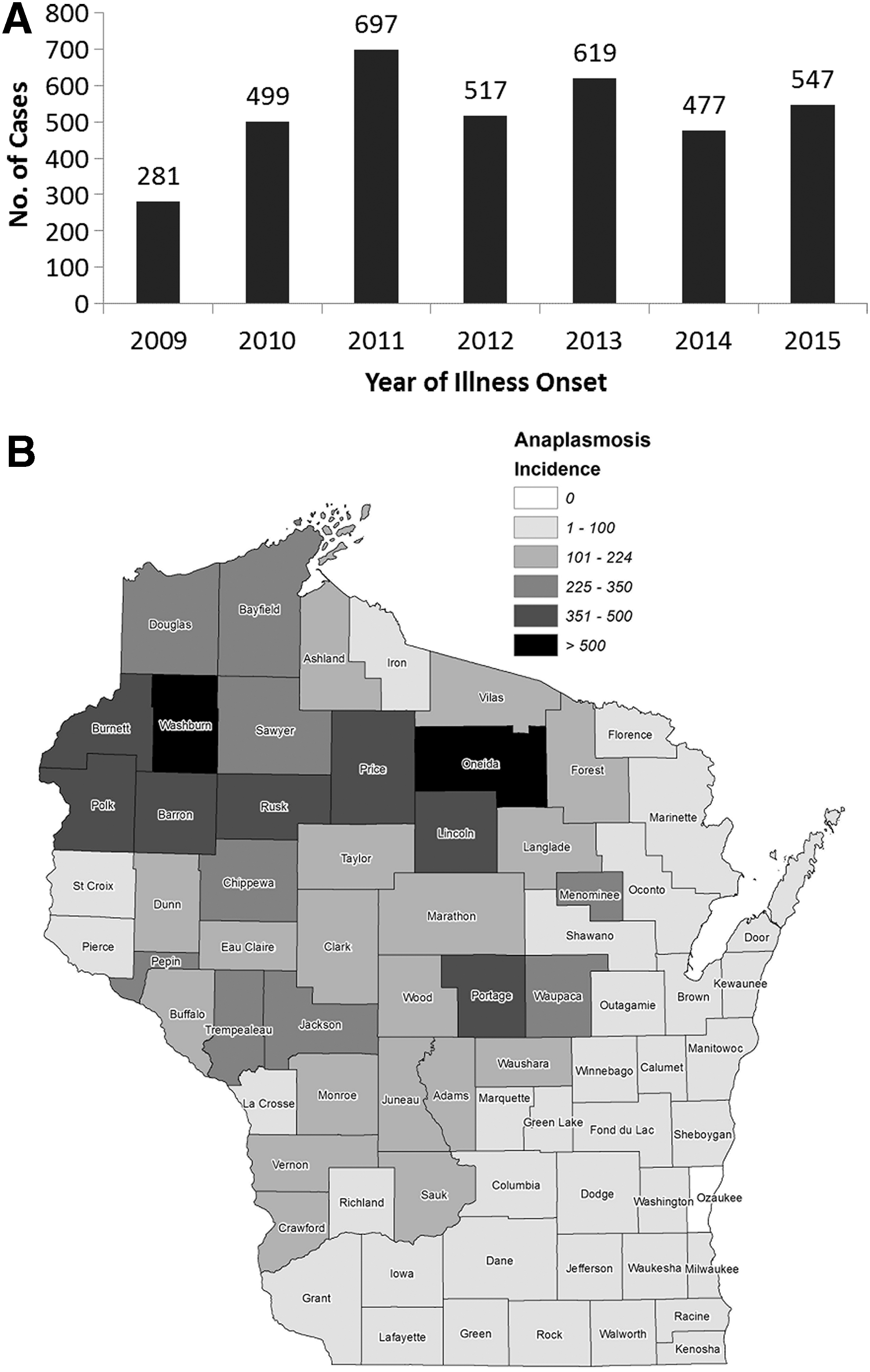
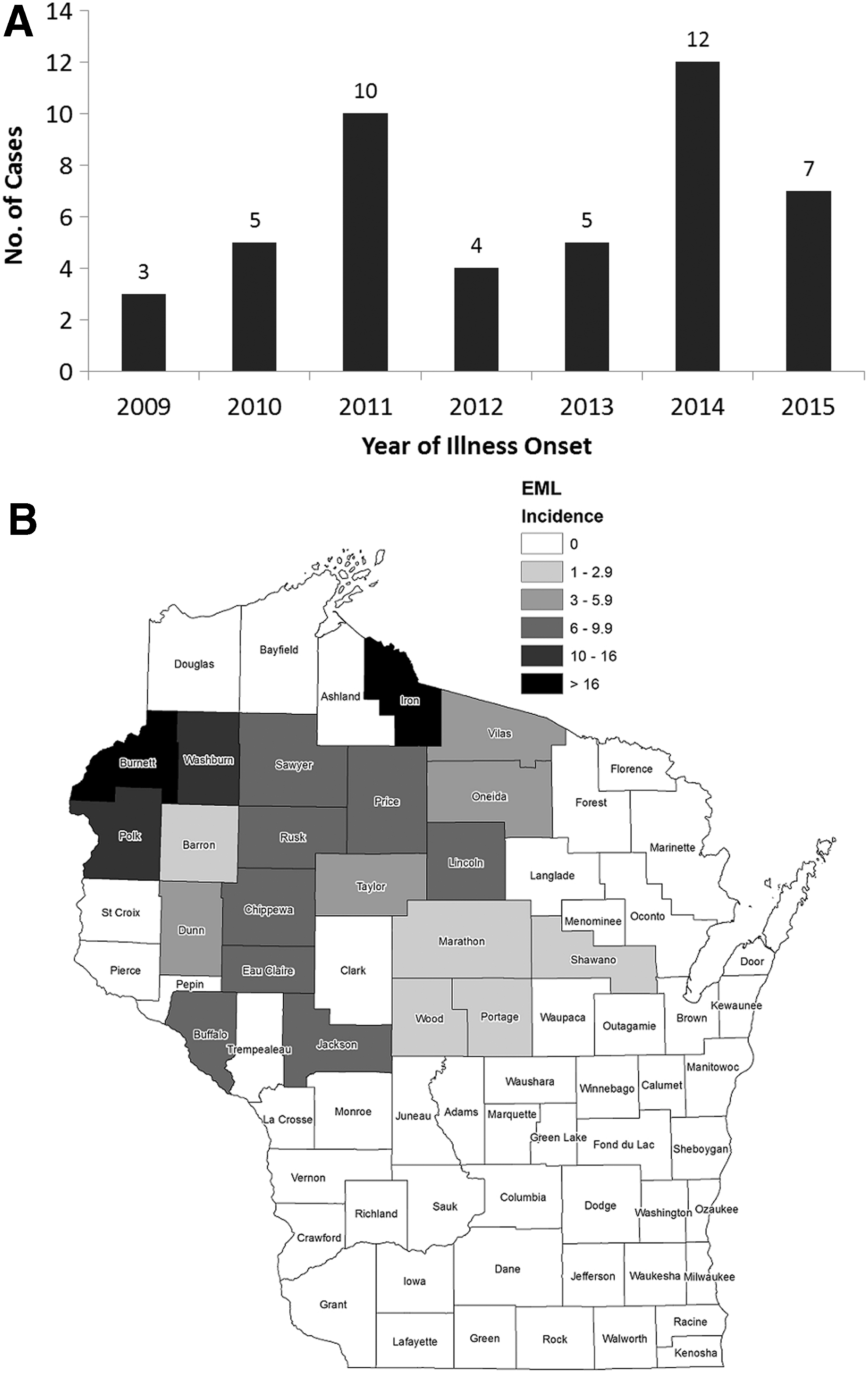
From 2005 to 2008, there were 942 confirmed and probable cases of human ehrlichiosis or anaplasmosis, with an average of 231 cases annually. During 2009–2015, 3976 confirmed or probable cases were reported, with an average of 568 cases annually (Fig. 1). These reports include a small number of infections identified as E. chaffeensis as well as cases of ehrlichiosis/anaplasmosis undetermined using the anaplasmosis and ehrlichiosis national surveillance case definition. Ninety-one percent of the total anaplasmosis/ehrlichiosis cases (3976 confirmed and probable) reported during 2009–2015 were HA (3637) (Fig. 2A). Reported HA cases were widely distributed in the state during this period (Fig. 2B). A total of 46 confirmed and probable cases attributed to EMLA were reported from 2009 to 2015 in patients with probable exposure in Wisconsin (Fig. 3A, Hoang Johnson et al. 2015). The majority of cases were reported from the northwestern region of Wisconsin (Fig. 3B).

Cases of confirmed or probable ehrlichiosis or anaplasmosis in Wisconsin residents reported to the state of Wisconsin communicable disease surveillance database, 2005–2015.
Tick specimens were collected and submitted by 22 veterinary medical clinics, 22 domestic animal shelters, and 8 wildlife rehabilitation clinics in 33 Wisconsin counties from July 2011 to November 2015. Dogs (48%), cats (14%), eastern cottontail rabbits (18%), and raccoons (13%) were by far the most common sources of submissions. We also received submissions taken from people associated with the collaborating shelters or clinics. I. scapularis, Dermacentor variabilis, Ixodes texanus, Haemaphysalis leporispalustris, Ixodes cookei, and Ixodes dentatus were the most frequently observed tick species; animal survey results and associated ticks will be summarized in another publication.
A total of 1835 I. scapularis (1350 females, 254 males, 175 nymphs, 56 larvae) specimens were submitted and identified. The number of I. scapularis ticks collected per animal ranged between 1 and 44 and 254 submissions contained more than one I. scapularis specimen. Tick specimens were collected from July 2011 through November 2011 and from April through November for 2012–2015. Submissions of I. scapularis ticks were highest from April through May and September through November, which corresponds with peak adult activity periods in Wisconsin. I. scapularis were collected from 33/40 counties with contributing locations and from three additional counties (Clark, Manitowoc, and Sheboygan) where the animal originated, but was brought to the participating location where the tick was then removed. From these submissions, unengorged or barely engorged I. scapularis ticks from 28 counties were tested. The tested ticks were nearly all from dogs, cats, and humans with the exception of a small number removed from coyotes (all negative) and a nymph that was removed from a raccoon (positive for A. phagocytophilum).
A total of 757 I. scapularis (424 adult males, 304 adult females, and 29 nymphs) from SWAT surveillance and 1150 questing nymphs from the 2015 drag sampling (Fig. 4) were tested through real-time PCR. The distribution and infection prevalence profiles for A. phagocytophilum and EMLA by area or county are illustrated in Figures 5 and 6 and Tables 1 and 2. From the SWAT ticks, 67/757 (8.9%; 41 adult males, 24 adult females, and 2 nymphs) were positive for A. phagocytophilum (Fig. 5 and Table 1), while 22/757 (2.9%; 13 adult males and 9 adult females) were positive for EMLA (Fig. 6 and Table 1). Three adult male ticks were coinfected with A. phagocytophilum and EMLA. From the questing nymphs collected during 2015, 62 (5.4%) and 10 (0.9%) were positive for A. phagocytophilum and EMLA, respectively (Table 2 and Figs. 5 and 6). A subset of the Ehrlichia-positive samples was sequenced to confirm that they were EMLA. Sequences from the 16S rRNA PCR assay were obtained for four putative Ehrlichia amplicons. Resulting DNA sequences were blasted against GenBank and found to have a 99% sequence similarity to E. muris 16S rRNA partial gene sequence previously reported by Telford et al. (2011) (GenBank acc. no. HQ660491.1) and Pritt et al. (2011) (GenBank acc. no. HM543745).

Prevalence of Anaplasma phagocytophilum

Wisconsin map highlighting counties where ticks that were positive for A. phagocytophilum were collected by the Surveillance of Wisconsin Animals for Ticks project, tick dragging, or prior studies (Michalski et al. 2006, Steiner et al. 2008, Lovrich et al. 2011). Some counties yielded both infected adults from the SWAT program and infected questing nymphs (see Tables 1 and 2 for details).

Wisconsin map highlighting counties where ticks that were positive for EMLA were collected by the Surveillance of Wisconsin Animals for Ticks project, tick dragging, or prior studies (Stromdahl et al. 2014). Marathon County had both infected adults from the SWAT program and infected questing nymphs.
One nymph collected from a raccoon was positive for Ap-v1; it is not included here, but is noted in the text as one of eight positive samples.
Some samples failed to reamplify for sequence analysis for Ap-ha and Ap-v1.
EMLA, Ehrlichia muris-like agent.
Of the 67 samples that tested positive for A. phagocytophilum from the 2012–2015 SWAT program, 50 samples were successfully sequenced. Sequencing of the 16S rRNA resulted in eight sequences that were identical to the Ap-v1 strain, while the other 42 samples were identical to the Ap-ha strain.
The prevalence of A. phagocytophilum in adult ticks from the western (Barron, Burnett, Chippewa, Clark, Dunn, Eau Claire, Jackson, La Crosse, Rusk, and Washburn), northeastern (Brown, Marinette, and Oconto), and northern (Langlade, Marathon, Oneida, Portage, Price, Sawyer, and Wood) regions was 12.8% (37/288), 14.6% (13/89), and 5.4% (9/166), respectively. Adult ticks submitted from the southern half of the state (Columbia, Dane, Iowa, Milwaukee, Rock, Sauk, Walworth, and Waukesha) had a prevalence of 3.7% (8/214). Prevalence in questing nymphs collected from four counties in the southern half of the state was 9.8% (34/346), while it was 2.5% (6/243) in the five counties sampled in the western region and 7.6% (18/237) in the four northern counties sampled.
Discussion
This study summarizes human disease surveillance data and reports the distribution of the EMLA and A. phagocytophilum bacteria in host-associated adult and questing nymphal I. scapularis collected from Wisconsin. The prevalence of EMLA was as high as 10% in adult ticks from locations in the northwestern or central counties. Overall, the western, northern, and northeastern regions of Wisconsin were similar, with 3.8%, 4.2%, and 4.5% prevalence of EMLA in adult ticks. None of the adults submitted from the southern region of the state were positive and diagnosis of questing nymphs also failed to detect EMLA in ticks from the southeast. The majority of confirmed cases of EMLA infections in Wisconsin residents are concentrated in those residing in the northwestern region of the state. However, this is likely a result of the limited availability of the real-time PCR assay in other regions since only two commercial laboratories and the Wisconsin State Laboratory of Hygiene are able to perform the test. Our tick data suggest that risk of human infection with EMLA also exists in the northeastern and southwestern regions. To improve human surveillance for EMLA in Wisconsin, appropriate diagnostic testing should be made available to a wider geographic area of the state.
In addition to EMLA, the real-time PCR assay also identifies infection with A. phagocytophilum. Nearly 9% of adults collected from animal hosts and 5% of questing nymphal I. scapularis ticks tested by real-time PCR harbored A. phagocytophilum. Several genetic variants of A. phagocytophilum have been isolated and described based on molecular subtyping, but only one variant (Ap-ha) is currently associated with clinical disease in both humans and domestic dogs in North America (Massung et al. 2003, Morrissette et al. 2009). In this study, we identified the Ap haplotype for samples from ticks collected from animals during 2012–2015 and found that 84% of the sequences were identical to Ap-ha. This result is similar to other studies of infected nymphal and adult ticks in Wisconsin (Michalski et al. 2006, Steiner et al. 2008, Lee et al. 2014; unpublished data). Ap-ha-positive adult ticks (23 males, 19 females) were collected from dogs and cats, which were the most commonly sampled animals in the study, and from humans. Seven Ap-var1-positive adult ticks (four males, three females) were collected from dogs and a single positive nymph was collected from a raccoon. We did not sequence the positive samples from the statewide nymphal collection, but more than 80% are likely to be Ap-ha based on prior studies (Lee et al. 2014; Larson and Paskewitz unpublished data).
The prevalence of A. phagocytophilum in adult ticks from the western, northeastern, and northern regions ranged from 5.4% to 14.6%. Ticks submitted from the southern half of the state (Columbia, Dane, Iowa, Milwaukee, Rock, Sauk, Walworth, and Waukesha) had a prevalence of 3.7%. Small numbers of ticks from the counties along the eastern edge of the state reduced the likelihood of detecting this pathogen in that region. However, one location in southeastern Wisconsin (Walworth County) supported a population of questing nymphs with a high prevalence of A. phagocytophilum (17.7%). This site, a managed red pine plantation in the South Kettle Moraine State Forest, has previously been identified as a hotspot for this pathogen (Lee et al. 2014).
The results reported here encompass most of the state and are in agreement with results from prior more localized studies. Pritt et al. (2011) and Stromdahl et al. (2014) detected EMLA in 2.1–7.5% of adults and 0–2% of nymphs collected from Wisconsin and Minnesota. Published results also document the prevalence of A. phagocytophilum as 12%, 14%, and 8.9% of adult ticks collected in the Wisconsin counties La Crosse, Monroe, and Buffalo, respectively (western region; Michalski et al. 2006, Steiner et al. 2008, Lovrich et al. 2011), and as 11.8% of adult ticks infected in Waupaca County (central region, Michalski et al. 2006). These data support the idea that infection rates in adult ticks have been stable over the past 10 years in areas where the tick has been established since at least the 1980s.
The numbers of nationally reported anaplasmosis cases have more than doubled during the last decade and the majority of these cases as well as the EMLA cases occur in Wisconsin and Minnesota. The increasing incidence of human infection with these tickborne pathogens in the upper Midwest might be the result of several variables, including ecological changes influencing vector geographic distribution and enzootic cycles between reservoir hosts, tick populations, and disease transmission, the availability of new diagnostic assays, and changes in diagnostic approaches that alter detection rates, revised national surveillance case definitions that provided distinct classifications for EMLA and HA, increased physician awareness and reporting, and improved state and local surveillance and reporting for vectorborne diseases. The expansion of I. scapularis distribution into the heavily populated southeastern region of the state (Lee et al. 2013) suggests that increases in reported human incidence for tickborne disease will continue.
Tick surveillance has been shown to be an effective and sensitive method for early detection of the emergence of newly established tick populations and pathogens as well as the mapping of tickborne disease risk (Ogden et al. 2006, 2010, Rand et al. 2007, Koffi et al. 2012). In the current study, infection of questing nymphs by the EMLA pathogen was detected at three of the 23 drag locations, while the SWAT program yielded positive adults from seven locations or counties. The SWAT program enabled tick collections from a broader geographic range and required fewer resources for implementation in comparison with statewide drag sampling for questing nymphs. Archived DNA from this study may also be valuable for rapid determination of the geographic range of newly discovered pathogens, including Borrelia mayonii (Pritt et al. 2016). In addition to pathogen risk mapping, SWAT results can be used for detection of invasive tick species and for mapping the current geographic distribution and diversity of tick species (Smith et al. 1992, Walker et al. 1998). Future reports will summarize the diversity of ticks and the animals sampled and will describe collections of Amblyomma americanum (the lone star tick) resulting from the SWAT program.
Footnotes
Acknowledgments
The authors would like to thank all the Wisconsin veterinary medical clinics, domestic animal humane shelters, wildlife rehabilitation centers, and volunteers for their participation in this study. They also thank undergraduate research assistants, Gretchen Gantz, Elizabeth Hemming, Lauren Leopold, Carlie Deziel, and Kayla Sippl, for assisting in DNA extraction and PCR testing of tick specimens. This work was supported by funding from the Wisconsin Department of Health Services Epidemiology Laboratory and Capacity Cooperative Agreement and the University of Wisconsin Graduate School.
Author Disclosure Statement
No competing financial interests exist.