




Abstract
This study was conducted to investigate the possible role of camels and attached ticks in the epidemiology of Francisella spp. including Francisella tularensis. For this purpose, a total of 319 ticks (248 Hyalomma dromedarii and 71 Amblyomma spp.) as well as 100 blood and 50 fecal samples collected from camels were screened for the presence of Francisella spp. by PCR through amplification of Francisella 16S rRNA gene. Positive samples were then tested for F. tularensis by PCR. In addition, serum samples from 75 camel abattoir workers were examined for the presence of IgG antibodies against F. tularensis using enzyme-linked immunosorbent assay (ELISA). Of the examined ticks, 15 were positive for Francisella spp. with prevalence of 4.7%, all positive results were recorded in Hyalomma dromedarii (6%). Neither blood nor fecal samples from camels yielded Francisella spp. even camels which carried Francisella spp. positive ticks. Moreover, F. tularensis could not be detected among Francisella-positive ticks. Phylogenetic analysis of some Francisella 16S rRNA gene sequences obtained in this study points out that these sequences are closely related to Francisella-like endosymbionts. In contrast, seroprevalence of F. tularensis antibodies among examined abattoir workers was 9.3% with significantly high prevalence among workers frequently exposed to tick bites (20.7%) rather than occasionally exposed workers (2.2%). In conclusion, however, F. tularensis could not be detected in this study; the high seroprevalence among camel abattoir workers especially those frequently exposed to tick bites underlines the possible role of ticks attached to camels in transmission of tularemia to humans.
Introduction
I
F. tularensis is a Gram-negative facultative intracellular pathogen that can be transmitted to humans in a variety of ways, including arthropod bite likewise ticks, ingestion of contaminated food and water, and contact with infected animals mainly lagormophs and rodents (Keim et al. 2007). Moreover, F. tularensis has the ability to produce severe illness among humans through the air-borne route with low infectious dose (about 25 organisms). Because of this, Centers for Disease Control and Prevention classified F. tularensis as a category A bioweapon (Rotz et al. 2002).
Of note, F. tularensis was isolated from more than 250 animal species, whereas ticks are considered an important biological vector for such pathogen, particularly Ixodes spp., Dermacentor spp., and Ambylomma spp., considering tick bites a prevalent mode of infection to humans in certain settings (Genchi et al. 2015). Camels usually live in desert and rural communities where ticks are present in abundance, although there are no data available about the occurrence of Francisella spp. among camels worldwide. Abattoir workers are occupationally liable to many zoonotic diseases including tularemia as they are in intimate contact with animal carcasses and wastes, and may be exposed to bite of ticks attached to the slaughtered animals (Rom and Markowitz 2007). Therefore, this study was carried out to investigate the occurrence of Francisella spp., including the most virulent species (F. tularensis) among camels and attached ticks as well as the seroprevalence of IgG antibodies against F. tularensis among camel slaughterhouse workers to give insight into such important topic to draw more in the epidemiology of Francisella spp.
Materials and Methods
A total of 319 ticks (248 Hyalomma dromedarii, 19 Amblyomma variegatum, 46 Amblyomma hebraeum, and 6 Amblyomma gemma) were collected from camels (Camelus dromedaries) that arrived for slaughtering at camel section in Basatin abattoir, Cairo, Egypt. Ticks were removed carefully from animals' skin by using sterile medium size steel forceps with serrated inner surfaces and blunt points; the collected ticks were placed in sterile screw capped tubes (Walker et al. 2003). Moreover, blood and fecal samples were gathered from all camels from which ticks were collected. All animal and tick samples were transported in an icebox to the laboratory where ticks were identified on the basis of their morphology using standard taxonomic keys for adult ticks (Walker et al. 2003). In addition, blood specimens were obtained from 75 apparently healthy slaughterhouse workers who came into daily contact with camels. Blood sample from each participant was collected in a sterile tube without anticoagulant, immediately transferred in an icebox to the laboratory for separation of serum. All human samples were collected through voluntary participations with informed consents. Both human sera and animal samples including ticks were stored at −20°C till processing.
Molecular detection of Francisella spp. and F. tularensis among ticks and camel samples
DNA extraction from the collected ticks was done by using DNeasy Blood and Tissue kit (Qiagen, Germany). In addition, DNA samples were extracted from selected 100 blood and 50 fecal samples of camels including those that carried Francisella spp.-positive ticks. Genomic DNA was extracted from whole blood by using DNeasy Blood and Tissue kit, but QIAamp DNA Stool Mini kit (Qiagen) was used for fecal samples. The extraction was conducted according to the manufacturer's instructions. The extracted DNA from ticks were screened for the presence of Francisella spp. using the following primers: forward primer 5′-GCCCATTTGAGGGGGATACC-3′ and reverse primer 5′-GGACTAAGAG TACCTTTTTGAGT-3′ to amplify 1151bp of the Francisella 16S rRNA gene (Duzlu et al. 2016). The reaction was carried out with EmeraldAmp GT PCR kit (Takara, Japan) using the following amplification conditions: after 2 min of initial denaturation at 95°C, 40 cycles of 94°C for 30 s, 60°C for 45 s, and 72°C for 60 s were conducted, then followed by 5 min of final extension at 72°C. The amplicons entered electrophoresis step and specific bands were noted at 1151 bp (Fig. 1) (Barns et al. 2005). Afterward, extracted DNA samples from camels' blood and fecal samples were also tested for the detection of Francisella spp. using the aforementioned procedure. Furthermore, DNA from all Francisella spp.-positive samples were subsequently examined for the presence of F. tularensis through amplification of F. tularensis 17-kDa lipoprotein gene using primers TUL4-435/TUL4-486 and the reaction was done as described by Sjöstedt et al. (1997).
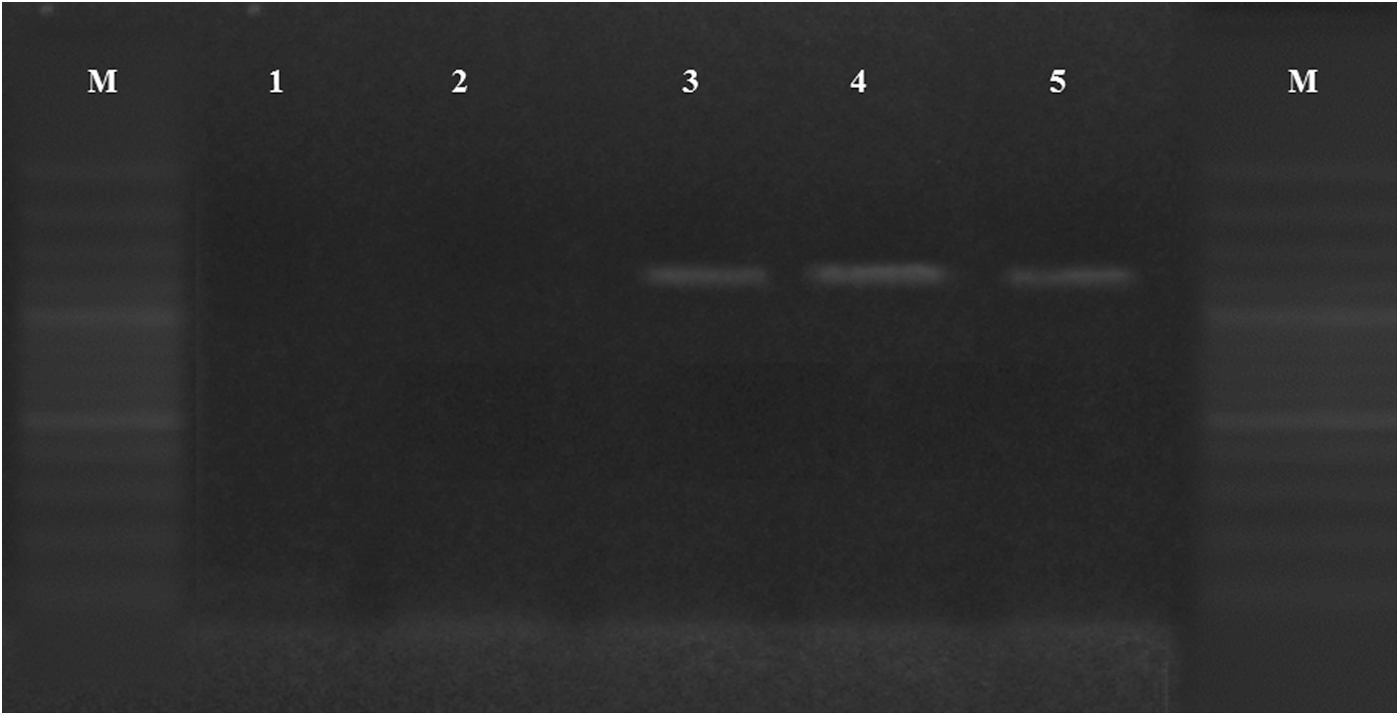
Molecular detection of Francisella spp. among ticks attached to camels. Lane M, DNA ladder 100 bp; lane 1, negative control; lane 2, negative sample; lanes 3–5, positive samples for Francisella 16S rRNA gene with specific bands at 1151 bp.
Francisella 16S rRNA gene sequencing and phylogenetic analysis
PCR products of four Francisella 16S rRNA gene-positive samples from ticks were first purified using QIAquick kit (Qiagen) before entering sequencing step, which was performed with Big Dye Terminator V3.1 kit (Applied Biosystems). The obtained sequences were compared with those available in the GenBank database using NCBI, BLAST server and were deposited in GenBank under the following accession numbers KY274572–KY274575.
Consequently, the obtained sequences were aligned against each other as well as some similar sequences retrieved from GenBank using Clustal W, BioEdit software version (7.0.9). Phylogenetic tree was constructed through the neighbor-joining approach using Mega6.06 software (Fig. 2).
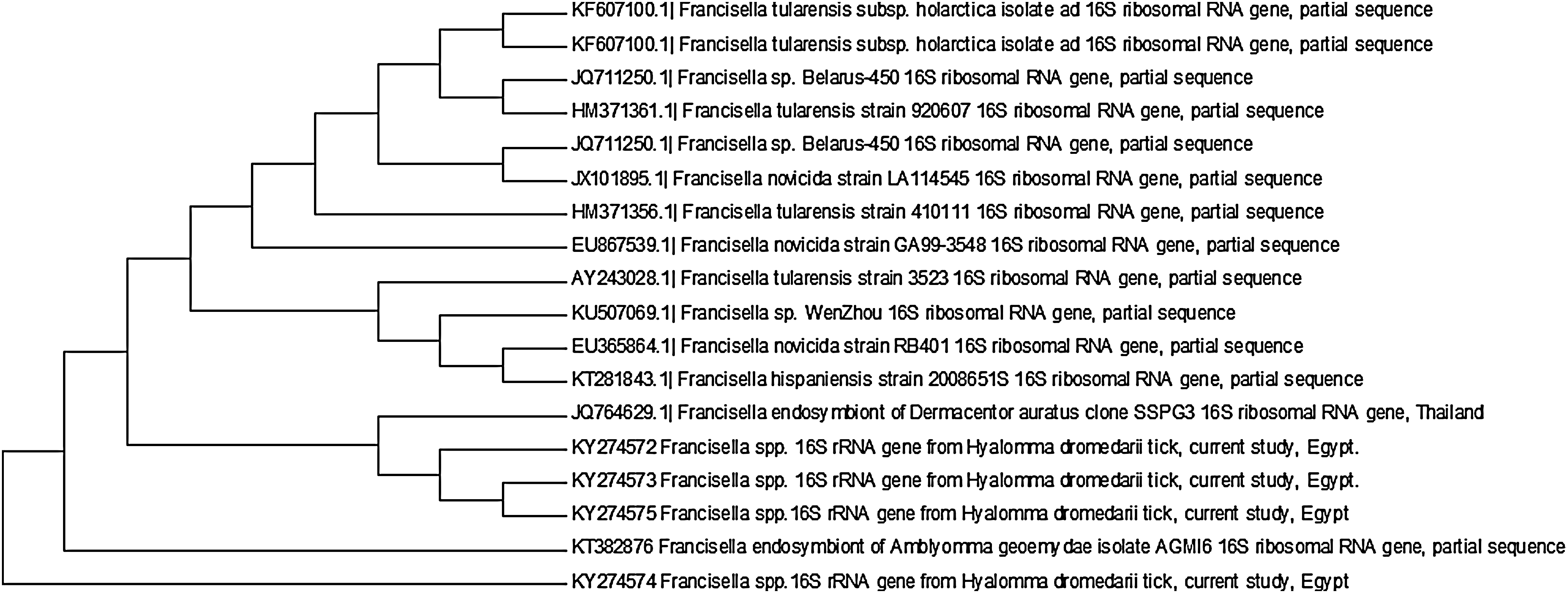
Phylogenetic bootstrap consensus tree shows the evolutionary history of the obtained Francisella spp. sequences and similar sequences retrieved from Genbank. The analysis was carried out with the neighbor-joining approach using Mega 6 software and based on the partial sequence of Francisella 16S rRNA gene.
Serological test
Human sera were tested for the presence of IgG antibodies against F. tularensis, using a commercially available enzyme-linked immunosorbent assay (ELISA) kit (Virion/Serion, Germany). The test was carried out according to the manufacturer's protocol.
Statistical analysis
The results of ELISA were analyzed by SPSS software (version 16.0) using chi-square test. p < 0.05 was considered statistically significant.
Results
Francisella spp. was detected only among ticks, whereas none of the examined camels yielded positive result. A total of 15 of 319 examined ticks were positive, that is with prevalence of 4.7%. All positive samples were obtained from Hyalomma dromedarii ticks (6%), whereas none of the examined Amblyomma ticks was positive (Table 1). Moreover, F. tularensis was not identified among Francisella spp.-positive ticks.
In contrast, 7 of 75 examined persons showed positive IgG antibodies against F. tularensis, that is a percentage of 9.3%. The seroprevalence of F. tularensis IgG antibodies among persons with frequent exposure to tick bites (countless exposure on regular basis) is 20.7%, whereas that among occasionally bitten persons (few times throughout their life) is 2.2% (Table 2).
Discussion
In the past few decades, several studies have investigated the epidemiology of Francisella spp. in European countries, whereas studies in African countries are too limited and scarce (Scoles 2004, Brevik et al. 2011). The results of this study revealed the detection of Francisella spp. among examined ticks with prevalence rate of 4.7%. All positive samples could be identified only in H. dromedarii but not in Ambylomma ticks. The prevalence rates obtained in this study were higher than those obtained by Duzlu et al. (2016) in Turkey who did not find Francisella spp. among examined ticks, those by Ivanov et al. (2011) in Bulgaria (2.5%), and those by Szigeti et al. (2014) in Ethiopia (0.3%). Seriously, we could not identify F. tularensis among all Francisella spp.-positive samples. Similar negative results for F. tularensis were recorded by Sreter-Lancz et al. (2009) in Hungary, by Bonnet et al. (2013) in France after screening different species of ticks likewise, D. marginatus, D. reticulatus, and I. ricinus, and by Toma et al. (2014) in Italy after examination of H. m. marginatum, H. m. rufipes, Amblyomma spp., and I. ricinus.
It is noteworthy that the results of BLAST analysis of randomly selected four Francisella 16S rRNA gene sequences revealed high identity with FLEs rather than other pathogenic Francisella spp. Moreover, the phylogenetic consensus tree demonstrated that three sequences (KY274572, KY274573, and KY274575) are grouped within the same clade with close genetic relatedness to Francisella endosymbiont described in Dermacentor auratus collected from wild boar in Thailand (GenBank: JQ764629) (Sumrandee et al. 2016), whereas F. tularensis and other pathogenic Francisella spp. occupied another cluster but the fourth sequence KY274574 is considered an out-group.
Interestingly, neither blood nor fecal samples from examined camels yielded positive results to Francisella 16S rRNA gene, even in camels that carried Francisella spp.-positive ticks. These negative results prompt us to assume that camels may not be an important reservoir for Francisella spp., also such results may reflect that the obtained Francisella strains in this study seem to be FLEs that usually inhabit the reproductive tissues but did not reach the salivary gland of ticks and accordingly cannot infect animals (Ivanov et al. 2011).
In contrast, our findings revealed the presence of IgG antibodies against F. tularensis in 9.3% of the examined slaughterhouse workers; such seroprevalence is higher than those recorded in other studies, Esmaeili et al. (2014) 6.5% in Iran, Jenzora et al. (2008) 2% in Germany, but it was lower than that obtained by Clark et al. 2012 (15.5%) in Azerbaijan. Of note, a significantly high seroprevalence of F. tularensis IgG antibodies (20.7%) was recorded among slaughterhouse workers with history of frequent exposure to tick bites rather than workers occasionally exposed to tick bites (2.2%) (p = 0.007). Such results underline a strong correlation between the frequent exposure to bites of ticks attached to camels and harboring F. tularensis infection. Therefore, despite F. tularensis DNA could not be detected in the examined ticks, the role of ticks attached to camels in the transmission of tularemia to humans cannot be ruled out. Accordingly, F. tularensis may be circulated among ticks attached to camels, but it may be in low prevalence that could not be detected in this study.
In conclusion, this study provides serological evidence about the occurrence of F. tularensis among slaughterhouse workers in camel abattoirs especially those frequently exposed to tick bites to underscore the probable role of such ticks in transmission of tularemia, whereas camels may not be a serious reservoir for F. tularensis.
Footnotes
Author Disclosure Statement
No competing financial interests exist.