




Abstract
During 2007 and 2010, an extensive entomological survey was performed to assess the distribution of mosquitoes and mosquito-borne arboviruses at Lancang River and Nu River watersheds in southwestern China. A total of 20,450 mosquitoes consisting 20 species was trapped and submitted 261 pools according to species and location. Culex tritaeniorhynchus and Anopheles sinensis were the most abundant species. Eighty-seven isolates representing 11 virus species in 8 genera were obtained from 6 mosquito species. The new isolates were identified as Getah virus (GETV), Japanese encephalitis virus (JEV), Yunnan Culex-related flavivirus (YNCxFV), Yunnan Aedes-related flavivirus (YNAeFV), Banna virus (BAV), Yunnan orbivirus (YUOV), Banna orbivirus (BAOV), Yunnan totivirus (YNToV), Nam Dinh virus (NDiV), Menghai rhabdovirus (MRV), and Anopheles minimus iridovirus (AMIV). These viruses included confirmed or potential pathogen of human disease, such as JEV, BAV, and NDiV, and several novel or reassortant arboviruses, such as YNAeFV, MRV, AMIV, and BAOV. GETV, JEV, YNCxFV, and NDiV were widely prevalent in the whole basin of the two rivers. The findings contribute to our understanding of the diversity and wide distribution of mosquito-borne arboviruses in the area, and are helpful to explore pathogenic evidence for fevers and viral encephalitis of unknown etiology.
Introduction
A
In recent 30 years, nearly 20 new arboviruses have been isolated and identified from field materials or patients and at least 10 new species of viruses originated from the Yunnan Province (Gao et al. 2010, Liu et al. 2011, Wang et al. 2011). These virus species related to six genera belonging to five families of virus, including Chikungunya virus, Sindbis virus, and Getah virus (GETV) of genus Alphavirus, Kyasanur forest disease virus of genus Flavivirus, Kadipiro virus, and Banna virus (BAV) of genus Seadornavirus, Batai virus of genus Orthobunyavirus, Yunnan orbivirus (YUOV) of genus Orbivirus, and Culex pipiens pallens densovirus of genus Densovirus (Table 1). In addition, fevers and viral encephalitis of unknown etiological agents are reported annually during the mosquito activity season in Yunnan Province (Wang et al. 2011).
The Lancang River and Nu River run through north and south of the western Yunnan Province locating in southwestern China. The Lancang River, known as section of Lancang-Mekong River in China, runs for 1227 km in Yunnan Province. Lancang-Mekong River, dubbed as the “Danube of the East,” is a unique international river and an important trade route connecting the southwestern China to five countries of southeastern Asia, including Myanmar, Laos, Thailand, Cambodia, and Vietnam (Feng et al. 2013, Ejiri et al. 2014). The two river basins, with over 10 million of the population, are main areas of Hengduan Mountains with complex geographical features in southwestern China, the terrain of which is broken and steep (Zhang et al. 2001). Additionally, the Lancang River and Nu River watershed is one of the richest areas of global biodiversity and ecological landscape reservation, which has a tropical to subtropical climate and is one of the core and key areas of the mosquito fauna and species distribution, supporting circulation of numerous arthropod-borne viruses (arboviruses) (Wang et al. 2009c, Zhang et al. 2013).
However, previous studies mainly focused on south and southwest of the two river basins with lower elevation or southern border areas to date, such as Xishuangbanna region and the China–Myanmar–Laos border (Tao et al. 2003, Zhou et al. 2009, Wang et al. 2011, Feng et al. 2012, 2014). Few investigations on mosquitoes and mosquito-borne viruses were performed in northwestern Yunnan Province (Sun et al. 2009a). With global warming, population mobility increasing, people's production and lifestyle changing, particularly the Lancang-Mekong River international shipping, it is necessary to enhance investigation on distributions of mosquitoes and mosquito-borne viruses in the two river basins. In the present study, we performed an extensive entomological survey during 2007 and 2010 to provide preliminary information regarding the presence and distribution of mosquito-borne viruses and to understand potential arboviral diseases in this region.
Materials and Methods
Sample collection
From 2007 to 2010, sampling of mosquitoes was conducted at 19 counties or cities along the Lancang River and Nu River watersheds in Yunnan Province during the mosquito activity season (from June to September). The Lancang River locates in latitude 21°56′ N to 28°72′ N, longitude 98°69′ E to 101°15′ E in Yunnan Province. The Nu River locates in latitude 24°07′ N to 28°23′ N, longitude 98°07′ E to 100°02′ E in Yunnan Province and runs for 618 km. The sampling sites were chosen between latitude 21°94′ N and 27°37′ N and longitude 97°67′ E and 101°99′ E with an altitude range from 545 to 2536 m. The sampling sites included 5 in upper reach (altitude from 841 to 2536 m) of the Lancang River, 10 in middle reach (altitude from 751 to 1477 m), and 4 in lower reach (altitude from 545 m to 1 064 m) (Fig. 1). Each site was sampled overnight or for 12 h during daytime. Mosquitoes at night were collected from cattle pens, hog pens, or hen houses using light traps (version CDC, LTS-M02B, Kongfu Dude, Wuhan JiXing Medical Technology, Co., Ltd.) baited with CO2. Mosquitoes during daytime were collected with mosquito suction devices by investigator in the mosquito nets. Collected mosquitoes were frozen at −20°C for 30 min and mosquito species were identified on an ice plate under the anatomical lens. The blood-fed and male mosquitoes were excluded. The mosquito samples were then grouped on the basis of collection site and mosquito species. A group of ∼200 mosquitoes was handled as one mosquito pool and stored in liquid nitrogen until test.
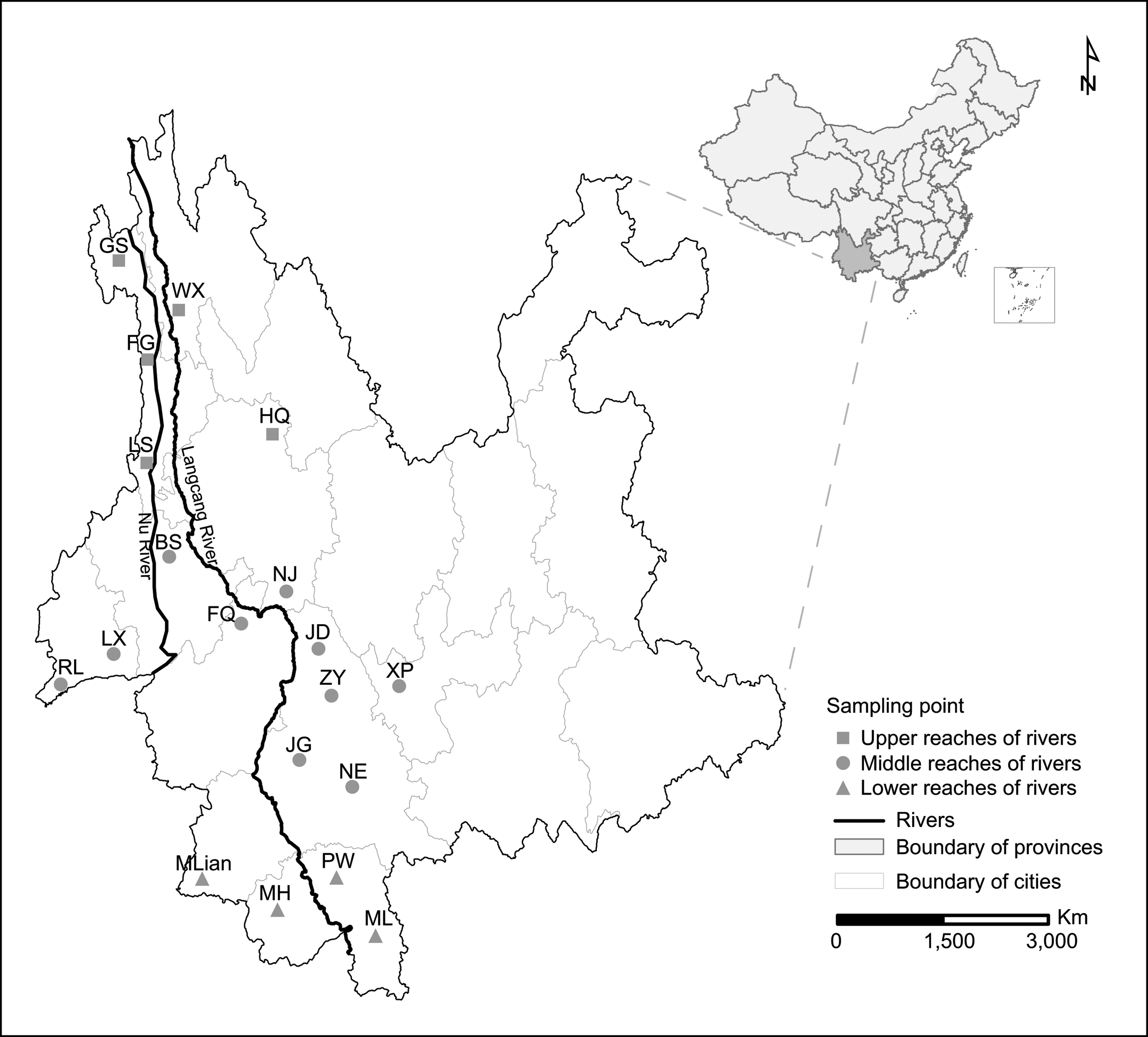
Sampling sites of mosquitoes in different reaches of Yunnan Lancang River and Nu River. Quadrate, roundness, and triangle represent upper, middle, and lower reach, respectively.
Viral isolation
Each mosquito pool was removed from the liquid nitrogen and immediately homogenized with RPMI-1640 medium containing 2% fetal calf serum and centrifuged. The supernatant was filtered through a 0.22 μm Millipore filter (25 mm diameter) and added to a 25-cm2flask with Aedes albopictus C6/36 cells and cultured at 32°C with 5% CO2 for 7–10 days. The cells were examined daily for evidence of a virally induced cytopathic effect (CPE). The culture supernatant was then filtered with the 0.22 μm filter and was blind passaged three times. A specimen was recognized as a positive isolate if it caused CPE in three successive cell passages.
Viral identification and nucleotide sequencing
Infected cell culture supernatant was harvested and identified by RT-PCR. Briefly, total RNA was extracted from the culture using the QIAamp Viral RNA Kit (QIAGEN, USA) according to the manufacturer's instructions, and then was reverse transcribed with a random hexamers to obtain the first-strand complementary DNA. Positive isolates were identified by PCR methods with genus- or species-specific primers (Table 2). A semi-nested PCR was first performed using JEV-specific primers (J1–J3, J2–J3) to screen JEV. Positive isolates for JEV nucleotide were further amplified for full envelope (E) gene of the virus with a pair of primers EF and ER. Specimen negative for JEV was tested by PCR with genus-specific primers, such as FU1 and CFD2 for Flavivirus, M2w and cMw3 for Alphavirus, as well as species-specific primers to detect BAV, YUOV, and Omono River virus (ORV). PCR products were directly sequenced using an automated DNA sequencer (ABI PRISM 373; PerkinElmer, USA). The DNA was sequenced using both forward and reverse primers to verify the sequences. The sequences were subjected to a BLAST search to compare with the GenBank database.
BAV, Banna virus; E, envelope protein; JEV, Japanese encephalitis virus; NS, nonstructural protein; ORV, Omono River virus; RdRp, RNA-dependent RNA polymerase; S, small segment; YUOV, Yunnan orbivirus.
If new isolate was not identified using the above strategy, total RNA was extracted from the filtered supernatant using the High Pure Viral RNA Kit (Roche, Switzerland) according to the manufacturer's instructions. A sequencing library was constructed using an Ion Total RNA-Seq Kit v2 (Thermo Fisher Scientific, USA) according to the manufacturer's instructions. High-throughput sequencing was performed using an Ion Torrent Personal Genome Machine (Thermo Fisher Scientific) to obtain complete sequence of the isolates.
Results
Mosquito collection
A total of 20,450 mosquitoes representing 20 species, belonging to the Culex (Cx.), Aedes (Ae.), Anopheles (An.), and Armigeres (Ar.) genera, was trapped. As shown in Figure 2, Cx. tritaeniorhynchus was the dominant species, accounting for 77.24% of the total, followed by An. sinensis (13.70%), Ae. albopictus (2.30%), Ar. subalbatus (1.15%), and Ae. vexans (1.10%). Less abundant species (under 1%) were Cx. fuscocephalus, An. kunmingensis, Cx. annulus (1.0–0.5%); An. minimus, Cx. quinquefasciatus, Cx. gelidus, An. kochi, An. vagus, Ae. aegypti, Cx. whitmorei (0.5–0.1%); An. tessellates, An. barbirostris, Ae. annandalei, and An. peditaeniatus (under 0.1%). Five mosquito species were trapped in upstream and 13 in midstream and downstream each. There were 2678, 11,585, and 6187 mosquitoes in upper, middle, and lower reaches, respectively. The dominant species for each area were Cx. tritaeniorhynchus and An. sinensis species mosquito, which were similar with that in the whole watershed.
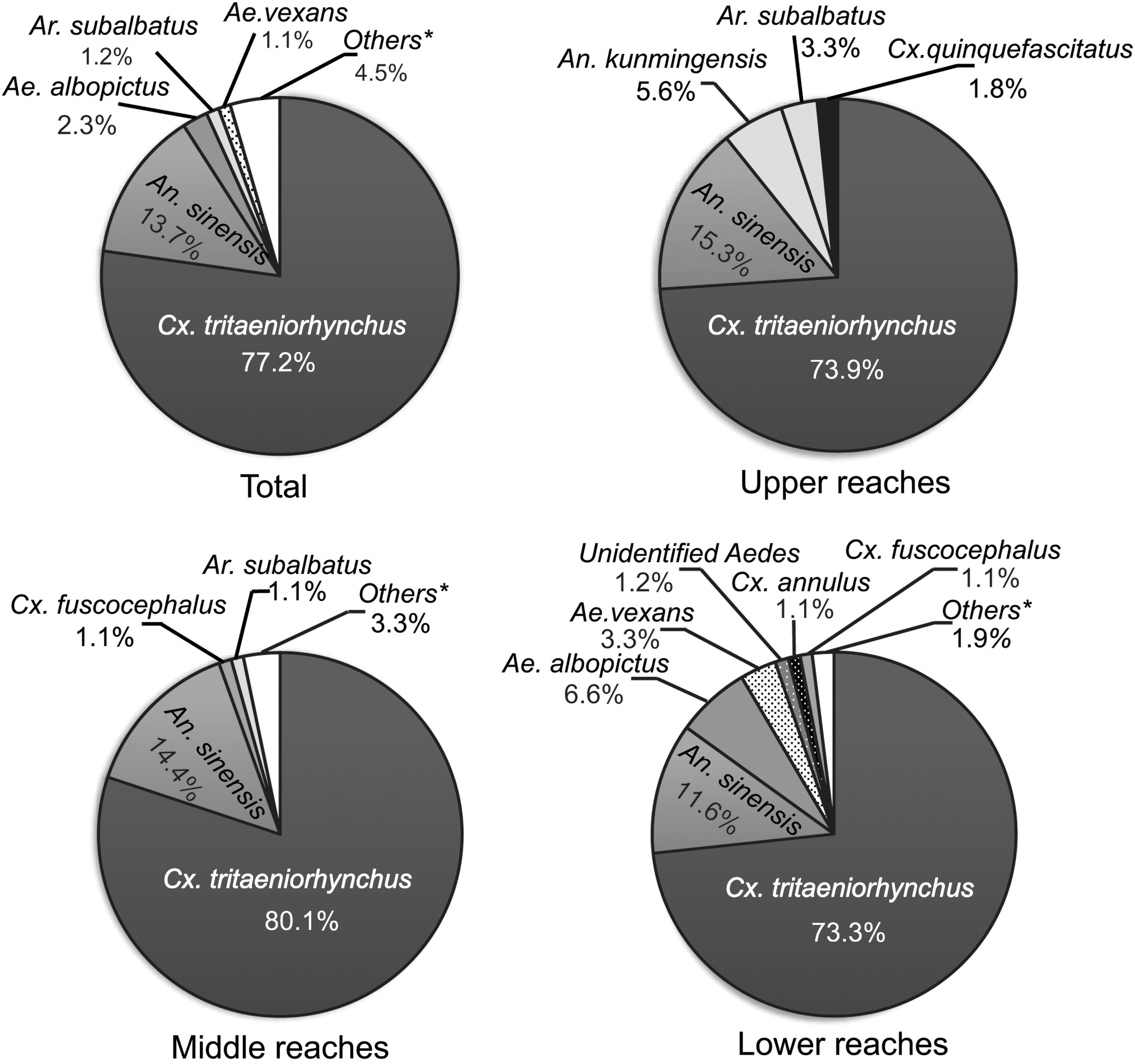
Constituent condition of mosquito species collected in the total and different reaches of Yunnan Lancang River and Nu River. *“Others” represents mosquito species <1% of the mosquitoes.
Virus isolation and identification
All mosquitoes collected were submitted in 261 pools according to species, location, and date of collection for viral isolation. A total of 87 isolates was obtained from the 19 sites. Positive rate of viral isolation and minimum infectious rate were about 33.33% (87/261) and 4.25‰ (87/20,450), respectively. All 87 isolates showed obvious CPE on C6/36 cells, and 85 of them had been identified.
When the RT-PCR was used, 29 isolates were identified as JEV, and 17 were positive using universal primers of Flavivirus. After sequencing the PCR products, 11 and 6 isolates were identified as Culex- and Aedes-related flavivirus, tentatively named as Yunnan Culex flavivirus (YNCxFV) and Yunnan Aedes flavivirus (YNAeFV), respectively. Five isolates were positive with about 400-bp for RT-PCR using universal primers of Alphavirus (M2w-cMw3) and identified as GETV by blast search. Using the virus-specific primers, eight and six isolates were identified as BAV and YUOV, respectively. Two isolates were identified as totivirus-related virus, tentatively named as Yunnan totivirus (YNToV) with ORV-specific primers. Surprisingly, when BAV-specific primers were used, a positive product was obtained in an isolate from Cx. tritaeniorhynchus. Its nucleotide sequence was found similar to an insect nidovirus Nam Dinh virus (NDiV) reported in Vietnam in 2011.
When high-throughput sequencing was used, six isolates were identified as YNCxFV; one isolate from An. minimus mosquitoes was identified as a member of iridovirus, named as Anopheles minimus iridovirus (AMIV); and one isolate from Cx. tritaeniorhynchus mosquitoes trapped from Xishuangbanna region was identified as Tibet orbivirus (TiBOV)-related virus, named as Banna orbivirus (BAOV). In addition, for five positive pools, two viruses were simultaneously detected. YNAeFV and a member of family Rhabdoviridae, named as Menghai rhabdovirus (MRV), were included in three pools; one pool included both MRV and YNCxFV; another pool included both NDiV and YNCxFV. Sequences of the representative isolates have been submitted to GenBank, and the details are listed in Table 3. Thus, the newly identified isolates were related 11 virus species belonging to 8 genera of virus, including GETV (Alphavirus); JEV, YNCxFV, and YNAeFV (Flavivirus); BAV (Seadornavirus); YUOV and BAOV (Orbivirus); YNToV (Totivirus); NDiV (Alphamesonivirus 1); MRV (Rhabdoviridae); and AMIV (Iridovirus) (Fig. 3).
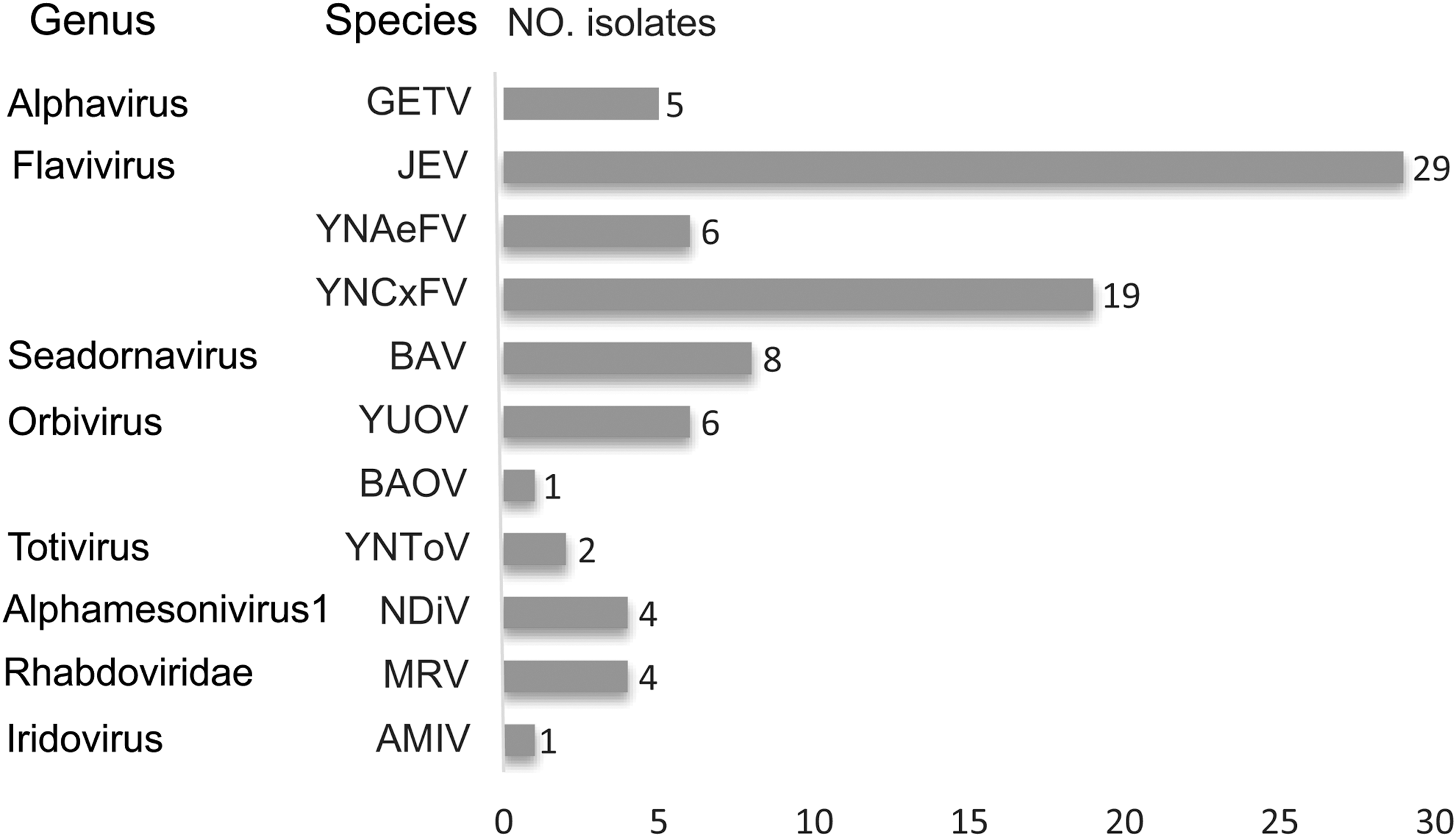
Number of virus isolates obtained in the present investigation based on virus genera and species. AMIV, Anopheles minimus iridovirus; BAOV, Banna orbivirus; BAV, Banna virus; GETV, Getah virus; JEV, Japanese encephalitis virus; MRV, Menghai rhabdovirus; NDiV, Nam Dinh virus; YNAeFV, Yunnan Aedes-related flavivirus; YNCxFV, Yunnan Culex-related flavivirus; YNToV, Yunnan totivirus; YUOV, Yunnan orbivirus.
AMIV, Anopheles minimus iridovirus; BAOV, Banna orbivirus; GETV, Getah virus; MRV, Menghai rhabdovirus; NDiV, Nam Dinh virus; YNAeFV, Yunnan Aedes-related flavivirus; YNCxFV, Yunnan Culex-related flavivirus; YNToV, Yunnan totivirus.
Distribution of the new isolates
The spatial distribution of the new isolates is summarized in Figure 4. Six (22 strains), nine (41 strains), and seven (24 strains) mosquito-borne virus species were isolated in upper, middle, and lower reaches in the survey area, respectively. GETV, JEV, YNCxFV, and NDiV were isolated from the whole basin of the Lancang River and Nu River. YUOV, BAV, and MRV were obtained from two reaches. AMIV and YNToV were only isolated from middle, and YNAeFV and BAOV were only isolated from the downstream.
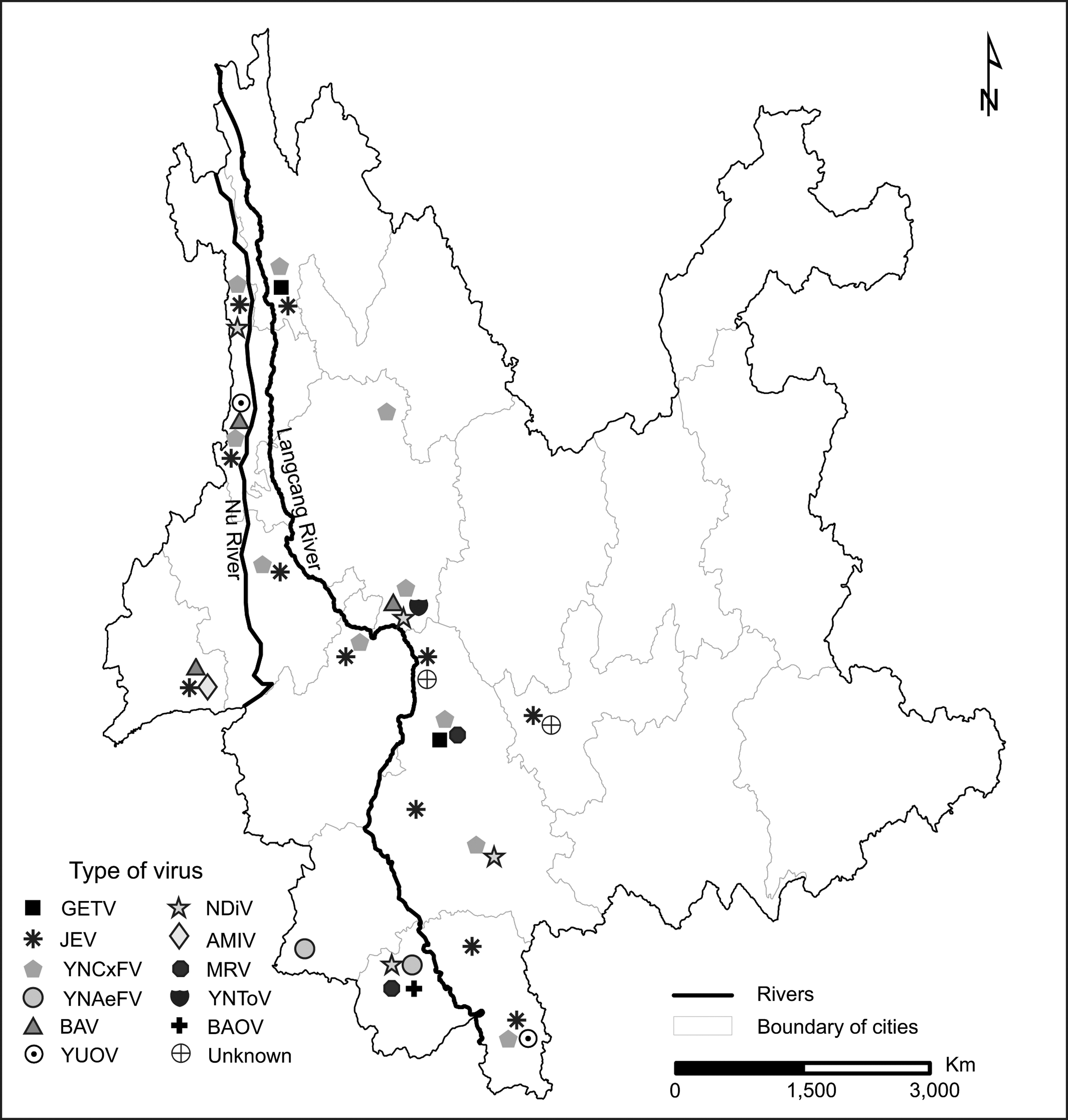
Distribution of new isolates in Yunnan Lancang River and Nu River watershed.
The new isolates were obtained from six mosquito species, including Cx. tritaeniorhynchus, An. sinensis, An. minimus, Ae. albopictus, Ae. Annandalei, and an unidentified Aedes species. Cx. tritaeniorhynchus was detected to carry most of the species of the virus, including GETV, JEV, YNCxFV, BAV, YUOV, YNToV, NDiV, and BAOV, followed by An. sinensis with GETV, JEV, YNCxFV, BAV, and YUOV. These 2 mosquito species carried most of the 11 virus species other than YNAeFV and AMIV. Of the 87 isolates, 62 were from Cx. tritaeniorhynchus, and 14 from An. sinensis (Table 4).
In this column, figures before the capital letter represent number of the new isolates.
Discussion
In the present study, 20 mosquito species were trapped in Yunnan Lancang River and Nu River watersheds. Cx. tritaeniorhynchus mosquito was the dominant species, followed by An. sinensis and Ae. albopictus. Five mosquito species were found in the upper reach and 13 in the middle and lower reach each. It is consistent with the previous study that the mosquito species increased with drop in latitude (Tao et al. 2003, Gong et al. 2005). From these mosquito samples, we obtained 11 species of arboviruses related to 8 virus families. Five virus species were first reported (their molecular characteristics published elsewhere), including three insect-related flaviviruses YNCxFV (Zuo et al. 2014), two insect-related flaviviruses YNAeFVs (Fan et al. 2016, Zhang et al. 2017), a novel iridovirus (Huang et al. 2015), a novel mosquito-borne rhabdovirus (Sun et al. 2017), and a novel reassortant Tibet orbivirus (Xing et al. 2017). Together with previous investigation data, over half of newly found arboviruses in China originated from the survey area, suggesting that mosquito and mosquito-borne viruses had rich diversity in the area (Liu et al. 2011, Feng et al. 2012, Zuo et al. 2014).
GETV, JEV, YNCxFV, and NDiV were isolated from the whole basin of the Lancang River and Nu River, which reflects the wide distribution of these viruses in this region. Japanese encephalitis is a common and frequently occurring disease in children with high mortality and morbidity rate and mainly distributes in Southeast Asia and China (Pan et al. 2011, Zheng et al. 2012, Gao et al. 2013, Kim et al. 2015). We isolated 29 strains of JEV from 261 mosquito pools, with a high isolation rate (11.11%). Previous studies showed that the isolation rate of JEV was from 4.63% (13/281) to 16.45% (25/152) in southern China from the year of 2005–2013 (Sun et al. 2009a, Liu et al. 2013, Yan et al. 2014), whereas few positive results of JEV isolation were reported in northern China (Li et al. 2010, Cao et al. 2011, Kou et al. 2016). Our results implied a high risk for human infection in the area. It is essential that the JEV vaccination to susceptible population and surveillance of human immune level and mosquito vector should be enhanced. The NDiV belongs to the family Mesoniviridae, order Nidovirales (Zirkel et al. 2013, Vasilakis et al. 2014) and was first reported in a patient from Southeastern Asia, which is potentially pathogenic to human beings (Nga et al. 2011). Our data indicated a wide prevalence along the whole Nu River and Lancang River. Whether the NDiV could infect animals or humans or cause disease requires further biological and seroepidemiological studies in local animal and human populations.
BAV, a member of genus Seadornavirus, family Reoviridae, was recognized as a deterministic pathogen causing fever and viral encephalitis was first isolated from the serum of a patient with fever in 1987 in Yunnan Xishuangbanna Autonomous Prefecture (Xu et al. 1990, Liu et al. 2010, 2016a, 2016b). The present study showed that BAV was distributed widely in the two river basins, which was consistent with previous researches (Gao et al. 2010, Liu et al. 2011). In addition, there were reports that patients infected with BAV may be misdiagnosed as Japanese encephalitis or neglected when JEV and BAV infected simultaneously (Liu et al. 2010). So in the future, etiological detection of BAV should be conducted for patients with unknown fever and viral encephalitis.
In the present research, six mosquito species were found to carry the newly isolated viruses, of which Cx. tritaeniorhynchus was detected to carry the most arbovirus species, followed by An. sinensis. Cx. tritaeniorhynchus and An. sinensis carried most of the 11 virus species other than YNAeFV and AMIV, suggesting that they were main vectors of local mosquito-borne virus, and may play an important role in the virus transmission. In addition, both the mosquito species were collected from cattle pens, hog pens, or hen houses, which are closely related to human activities, and accounted for >90% of all collected mosquitoes. Our findings highlight that mosquito surveillance and control of pathogenic and potential pathogenic arboviruses, such as JEV, BAV, and NDiV should be enhanced in Lancang River and Nu River watersheds in southwestern China.
Several novel or reassortant arboviruses, such as MRV, AMIV, and BAOV, were first found worldwide in the present study. Rhabdoviridae is within a diverse family of nonsegmented, negative-sense single-stranded RNA viruses which can infect a wide range of plants, invertebrates, vertebrates, and humans, and is transmitted by arthropod vectors, such as mosquitoes, ticks, and sandflies (Tesh et al. 1972, Dietzgen et al. 2012). The family includes several fatal pathogens of humans, livestock, and farm products, such as rabies virus, vesicular stomatitis Indiana virus, and Chandipura viruses (Kuzmin et al. 2009, Gurav et al. 2010). BAOV is a Tibet orbivirus-like virus within the genus of Orbivirus in the family Reoviridae (Li et al. 2014, Lei et al. 2015). This genus includes a number of important pathogenic viruses, such as Bluetongue virus and African horse sickness virus (Mertens 1999, Attoui et al. 2011). The whole genetic analysis revealed that BAOV is a reassortant of several Tibet orbivirus strains. Further studies on biological characteristics of these novel arboviruses should be carried out.
In summary, this was the first comprehensive and systematic survey on mosquito-borne arbovirus at the entire watersheds of Lancang River and Nu River in southwestern China. The findings contribute to our understanding of the diversity and wide distribution of mosquito-borne arboviruses, including several confirmed or potential pathogens of human disease. Our findings are also helpful to explore pathogenic evidence for patients with fever and viral encephalitis of unknown etiology.
Footnotes
Acknowledgments
This research was financially supported by the National Natural Science Foundation of China (grant nos. 81273138 and 30660160) and the National Natural Science Foundation's regional science fund (grant no. 81560548).
Authors' Contributions
J.Z. and L.L. conceived and wrote the article. X.G. and Q.Z. performed most of the experiments and collected the mosquito samples. Y.T., H.F., Q.S., and S.X. carried out virus separation identification experiments. H.Z. participated in epidemiological information collection. All authors read and approved the final article.
Author Disclosure Statement
No competing financial interests exist.