




Abstract
The presence of free-ranging urban birds is a risk factor for transmitting pathogens to captive animals and humans alike, including Salmonella spp. and diarrheagenic Escherichia coli. Cloacal swabs from 156 synanthropic Great egrets (Ardea alba) and feral pigeons (Columba livia domestica) that inhabit the surroundings of an urban zoo were processed for the identification of Salmonella spp. and diarrheagenic E. coli pathotypes. Bacterial species identification and genotypic characterization employed the matrix-assisted laser desorption ionization-time of flight mass spectrometry and PCR techniques, respectively, comparing their phylogenetic profiles through amplified fragment length polymorphism (AFLP) analysis. A total of 11 birds were positive for Salmonella Typhimurium (7%) and 9 individuals (5.8%) for diarrheagenic E. coli (enteropathogenic E. coli/Shiga-toxin producing E. coli [EPEC/STEC]) strains. S. Typhimurium strains presented highly similar AFLP profiles (85–100%), whereas EPEC/STEC strains showed more polymorphism. The results show free-ranging birds as carriers for both microorganisms in a zoo environment in Brazil for the first time and suggest these species as possible sources of infection to other animals as well as exposing personnel and visitors to potential zoonotic microorganisms. The presence of carriers highlights the importance of a surveillance system and the need for preventive measures to avoid attracting growing number of synanthropic avian species.
Introduction
U
In addition to representing a threat to animals in captivity, urban avian species have been linked with emerging infectious pathogens, including diarrheagenic Escherichia coli (DEC) and Salmonella spp. that represent important health hazards to humans (La Ragione et al. 2002, Reed et al. 2003, Gargiulo et al. 2014, Haesendonck et al. 2016). The exposure between humans and urbanized wildlife increases the risks of pathogen dissemination, although there is still much to be understood about how these processes develop (Hassell et al. 2017). Therefore, synanthropic birds can be useful as sentinels, identifying potential pathogens while they are still maintained in the avian host (Sacristan et al. 2014).
Given the possible risks that synanthropic birds may represent to captive animals and humans, particularly when it comes to the context of a direct or indirect interaction in a zoological setting, we evaluated the population of two urban adapted bird species: Great egrets (Ardea alba) and feral pigeons (Columba livia domestica), which inhabit the area of an urban zoological park as possible infection sources of Salmonella spp. and DEC pathotypes (enteropathogenic E. coli [EPEC], Shiga-toxin producing E. coli [STEC], enteroinvasive E. coli [EIEC], and enterotoxigenic E. coli [ETEC]), and further assessed the genetic similarity between the isolates.
Materials and Methods
The surveyed area included the Sorocaba Zoo, Brazil (permit 5600130614). Free-ranging asymptomatic wild adults of Great egrets and feral pigeons were captured using a walk-in trap, and bacterial samples were collected from the cloaca using a sterile swab that was kept at 10°C until processing. A total of 38 Great egrets and 118 domestic pigeons (n = 156) were sampled (November 2014 to March 2015).
Standard culture procedures were employed using commercial culture media (DIFCO™). For Salmonella spp., the swabs were pre-enriched in peptone water, followed by the enrichment step in tetrathionate broth and subculturing on XLT4 agar. E. coli culture methods included an incubation step in Brain Heart Infusion (BHI) broth, and culturing on MacConkey agar.
The isolated colonies were subjected to the protein extraction for matrix-assisted laser desorption-ionization-time of flight (MALDI-TOF) mass spectrometry identification and the captured spectra were loaded in MALDIBioTyper™ 3.0 software (Bruker Daltonik) for bacterial identification.
The disk diffusion method was employed to characterize the resistance pattern for the isolates, following the protocol of the Clinical and Laboratory Standard Institute (CLSI 2013). Ampicillin, cefotaxime, cefoxitin, chloranfenicol, amikacin, gentamicin, tetracycline, sulfamethoxazole-trimethoprim, fosfomycin, enrofloxacin, nalidixic acid, streptomycin, and imipenen were tested.
PCR was performed after DNA extraction, aiming for the detection of Salmonella enterica serovar Enteritidis and Typhimurium, and E. coli diarrheagenic pathotypes (Alvarez et al. 2004, Costa et al. 2010). Shiga-toxin type 2 (stx2) positive isolates were additionally subtyped (subtypes a through g) (Scheutz et al. 2012).
The amplified fragment length polymorphism (AFLP) followed the protocol of McLauchlin et al. (2000) employing the restriction enzyme HindIII (New England BioLabs). The analysis was performed with Bionumerics™ 7.6 (Applied Maths, Belgium) employing the Dice coefficient, and dendrograms were constructed with the unweighted pair-group method using arithmetic average.
Results
MALDI-TOF confirmed a total of 11 Salmonella enterica strains from the two avian species, whereas E. coli were found in 144 samples. All Salmonella enterica strains were identified as serotype Typhimurium by PCR with six strains obtained from egrets and five from pigeons. Pigeons had a higher positivity for DEC pathotypes (08/118, 6.8%) (Table 1). Typical and atypical EPEC were identified according to the presence or absence of the eae and bfp encoding gene, as well as the shiga-toxin gene for STEC strains (stx2f positive). Great egrets were solely positive for an atypical EPEC (1/38, 2.6%), whereas pigeons showed positivity for both typical and atypical EPEC and for STEC (Table 2). None of the isolates was positive for the EIEC or ETEC pathotypes.
None of the samples showed positivity for S. Enteritidis.
None of the samples showed positivity for enteroinvasive E. coli and enterotoxigenic E. coli.b
EPEC, enteropathogenic E. coli; STEC, Shiga-toxin producing E. coli (subtype stx2f).
The antibiogram revealed an overall low degree of resistance with only one strain of S. Typhimurium showing resistance to nalidixic acid and enrofloxacin. None of DEC exhibited a resistance profile.
The isolates identified as S. Typhimurium, typical and atypical EPEC, were phylogenetically characterized by AFLP. The results segregated S. Typhimurium pigeon strains in one cluster with all five strains grouped in one profile (A1), whereas two clusters were observed for the egret strains (A2 and A3), sharing 85% of similarity (Fig. 1). For the E. coli isolates, varied profiles were observed (>60% of similarity). Two clusters that included typical EPEC and STEC were observed among pigeon strains. The sole egret EPEC strain clustered separately, presenting a low degree of similarity with the pigeon isolates (Fig. 2).

AFLP dendrogram of the Salmonella Typhimurium strains. The level of genetic relatedness (%) is shown at the top. AFLP, amplified fragment length polymorphism. Color blocks represent a AFLP pattern.
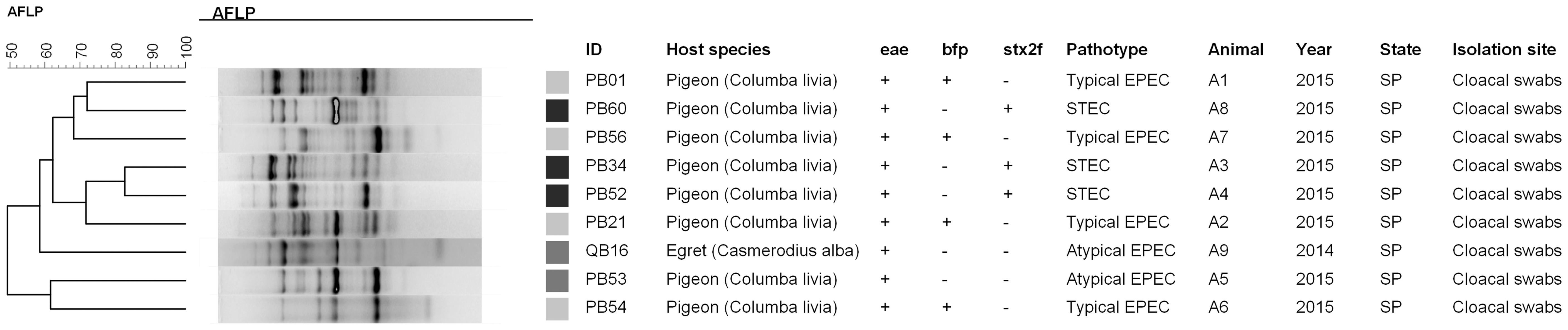
AFLP dendrogram of the Diarrheagenic Escherichia coli strains. The level of genetic relatedness (%) is shown at the top. EPEC, enteropathogenic E. coli; STEC, Shiga-toxin producing E. coli. Color blocks represent a AFLP pattern.
Discussion
Urban wildlife is an important source of pathogens due to the dynamic interface of the disease risks resulting from human activities in the environment. The increasing rate of contact between humans and synanthropic wildlife potentially leads to the transmission of zoonotic microorganisms (Hassell et al. 2017).
We have identified two synanthropic species that could act as sources of infection for captive animals, other wildlife, and humans. A prevalence of 7% as carriers for S. Typhimurium was observed, with egrets having a higher percentage than pigeons (Table 1). Both species had no diversity of serotypes and the strains were originated from asymptomatic adult individuals. Cattle egret nestlings (Bubulcus ibis) in urban colonies showed positivity for Salmonella spp. of varying serotypes with high mortality rates highlighting the risks to humans living near to these areas (Phalen et al. 2010).
Pigeons have been described as important, yet overlooked sources of infection for Salmonella spp. in the urban setting (Haesendonck et al. 2016). Although our pigeon samples showed 4.23% of positivity for S. Typhimurium, another Brazilian study surveying a city center described a similar positivity rate (7.94%) and varied serotypes (de Sousa et al. 2010).
Here, STEC and typical EPEC strains were found solely in pigeons, whereas atypical EPEC was found in a single pigeon and one egret strain. A survey for DEC in synanthropic birds in Japan identified atypical EPEC in pigeons and Little egret (Egretta garzetta) and STEC exclusively in pigeons (Kobayashi et al. 2009). A recent study in Brazil with urban pigeons showed 2% positivity only for atypical EPEC, whereas none was positive for STEC (Borges et al. 2017).
All our pigeon STEC strains belonged to the stx2f subtype that has been connected to emerging human gastrointestinal infections, and pigeons have been identified as the possible reservoirs (Murakami et al. 2014).
Although we report these synanthropic birds as carriers for the first time in Brazil regarding the context of the surroundings of a zoo, other investigations determining synanthropic avian species as sources of infection for Salmonella spp. and DEC in an urban zoo are also scarce. Cano-Terriza et al. (2015) surveyed a zoological institution in Spain and did not isolate Salmonella spp. in 152 feral pigeons but did find the bacteria in 6.8% of the captive animals. It is likely that the variable sanitary conditions at each studied area may facilitate some synanthropic birds to become carriers and acquire these microorganisms from environmental sources of anthropogenic pollution, contributing to the circulation of these bacteria (Hassell et al. 2017). Therefore, sampling synanthropic birds may illustrate their importance as sentinel species for pathogens of zoonotic and economic concern (Halliday et al. 2007).
Salmonella genotypic analysis resulted in highly similar profiles independently of the sampled bird species. Interestingly, egrets shared 85% of similarity with the pigeon strains. Despite this similarity, different cluster groups could be recognized for each species, suggesting an intraspecies strain adaptation (Fig. 1), whereas the diversity was more pronounced for E. coli isolates in both species. Pigeons yielded two different typical EPEC strains clustering with two STEC strains each (Fig. 2). This diverse clustering may represent that there is not a direct link between these groups and pathotypes when analyzing these particular E. coli strains.
Cases of salmonellosis and colibacillosis affecting the captive zoo collection have been observed, although a connection with the synanthropic birds cannot be made at this stage as comparisons with strains from clinical cases were not available. Although we report a low percentage of antimicrobial resistance for both bacteria, there is also the need to continue to monitor the environmental risks that these species may represent in the near future in case they become possible sources of virulent or multidrug-resistant strains besides being carriers for potentially zoonotic bacteria.
In the zoo surveyed, a degree of contact between the visitors and the synanthropic species in search for food is observed. Comparatively, urban passerines have been implicated in reported cases of human salmonellosis, and preventive hygiene measures were recommended to the public (Lawson et al. 2014). Attempts to discourage the conglomeration of these species in the zoological setting are a priority by the means of changing the way that food and shelter are easily accessible.
Conclusions
We report two synanthropic avian species that have been experiencing an exponential populational growth easily adapting to the urban environment in Brazil, particularly where other animals are maintained in captivity, as asymptomatic carriers for two bacterial microorganisms of importance. Additional studies establishing a link between Salmonella and DEC strains from synanthropic birds and clinical cases at zoos, as well as comparing with human isolates from local outbreaks, would be important to better understand the risks involving the presence of these synanthropic species to humans and captive wild animals.
Footnotes
Acknowledgments
We are thankful to the Parque Zoológico Municipal Quinzinho de Barros for allowing the collection of the samples. This work was supported by Fundação de Amparo à Pesquisa do Estado de São Paulo (Grant numbers FAPESP 14/11523-7, FAPESP 15/26159-1, and FAPESP 16/12641-9), CNPq (Conselho Nacional de Desenvolvimento Científico e Tecnológico), and CAPES (Coordenação de Aperfeiçoamento de Pessoal de Nível Superior).
Author Disclosure Statement
No competing financial interests exist.