




Abstract
Background:
Rare investigation on tick-borne pathogens was carried out in Yunnan, China. In this study, we did a survey on Ehrlichia infection in small mammals and ticks. A total of 40 small mammals and 49 ticks were collected from Tengchong, Yunnan province. PCR targeting 16S ribosomal RNA (rRNA), citrate synthase, GroEL heat-shock protein operon, and major outer membrane protein genes was performed and positive amplicons were sequenced.
Results:
The 40 small mammals were identified as 10 species, 2 (5.0%) of which were infected with Ehrlichia, 4 (10.0%) were infected with Anaplasma phagocytophilum and another 2 (5.0%) were infected with Candidatus Neoehrlichia mikurensis. Six (12.2%) ticks were positive for Ehrlichia and another two (4.1%) were infected with A. phagocytophilum. Neither small mammals nor ticks had coinfection. The detected Ehrlichia was named as Ehrlichia sp. YN04, which was in the same clade of Ehrlichia sp. 360 by phylogenetic analysis. The sequences of the pathogen recovered from small mammals and ticks were identical with each other.
Conclusion:
The study reports one Ehrlichia species first detected from small mammals and ticks in mainland China. As Yunnan is a famous “Global Biodiversity Hotspot” in the world, we may expect much more tick-borne infectious pathogens existing and declare more public health attention in this region.
Introduction
E
In China, other tick-borne pathogens, such as Rickettsia, Anaplasma, and Babesia, are widely distributed and frequently investigated (Fang et al. 2015), whereas only a few studies report on E. chaffeensis and E. canis infection in animals and ticks (Cao et al. 2000, Hua et al. 2000). In this study, Ehrlichiae were detected in ticks and small mammals from one neglected area, Yunnan. Yunnan is one of China's most diverse provinces, biologically as well as culturally. The special topographic range combined with tropical moisture sustains extremely high biodiversity and high degrees of endemism. However, there are few reports on tick-borne pathogens in this area on ticks and small mammals. In 2015, we did a survey on ticks and small mammals to investigate the existence of Ehrlichia in Yunnan.
Methods
Sample collection
In June 2015, small mammals were captured by trapping with peanuts as bait in Tengchong (about 1260 meters above sea level), Yunnan province, southern China (Supplementary Fig. S1; Supplementary Data are available online at
DNA extraction
Genomic DNA was extracted from small mammal tissues and individual ticks using a Tissue DNA Extraction Kit (Tiangen Biotechnique, Beijing, China). Briefly, ≈500 mg of tissues from each small mammal or individual tick was first ground in 300 μL Buffer GA with 5 mm stainless steel beads using a tissue lyser (JingXin, Shanghai, China). The DNA was then extracted according to the manufacturer's instructions.
PCR amplification and sequence analysis
Nested PCR for the Anaplasmataceae-specific rrs gene (620 bp) was used to screen all samples, using the Thermo Scientific DreamTaq Green PCR Master Mix (Thermo Scientific, Waltham, MA) (Supplementary Table S1). A negative control (distilled water) was concurrently included in each amplification. Positive Ehrlichia samples were further amplified of the full-length rrs gene (1478 bp), citrate synthase gene (gltA; 474 bp), GroEL heat-shock protein operon gene (groEL; 345 bp), and major outer membrane protein gene (omp-1; 680 bp) (Supplementary Table S1). The sequences were obtained from the positive amplification and compared against the NCBI nt/nr database. Phylogenetic trees were constructed by using Mega 5.0 software. We assessed the phylogenetic relationship of the new Ehrlichia species with other members of the Anaplasmataceae family on the basis of rrs, GroEL, and gltA genes using the maximum composite likelihood method.
Results and Discussion
A total of 40 small mammals were captured and identified as 10 species, including Rattus flavipectus (n = 15), Suncus murinus (n = 4), Rattus fulvesence (n = 1), Eothenomys miletus (n = 1), Apodemus chevrieri (n = 2), Rattus bowersi (n = 1), Rattus rattus sladeni (n = 7), Anourosorex squamipes (n = 1), Mus pahari (n = 6), and Hylomys suillus Muller (n = 2). A total of 49 ticks were collected from 8 small mammals and identified as engorged adult Ixodes granulatus; 5 of them were male and others were female.
Nested PCR for the Anaplasmataceae-specific rrs gene was positive in 8 (20%) small mammals. Sequence analysis revealed the 1396 bp amplicons obtained from one R. rattus sladeni and one M. pahari were identical between each other and with 1 bp difference of the 16S rRNA gene for Ehrlichia sp. 360 (GenBank no. AB428564). Sequences from one R. bowersi, two R. flavipectus, and one R. rattus sladeni were identical between each other and with the fragment of Anaplasma phagocytophilum gene (GenBank no. KC916731). The analysis from two R. rattus sladeni indicated they were infected with Candidatus Neoehrlichia mikurensis (GenBank no. JQ359053) (Supplementary Table S2).
As for tick infections with the bacterial in the family of Anaplasmataceae, we found eight (16.3%) positive samples and all of them were female. We compared the sequences and found six were identical between each other and with 1 bp difference of the 16S rRNA gene for Ehrlichia sp. 360 and the other two were identical to the corresponding gene of A. phagocytophilum (Supplementary Table S2).
We further amplified the nearly full-length rrs gene (n = 7), gltA gene (n = 5), groEL gene (n = 7), and omp-1 gene (n = 7) from Ehrlichia-infected two small mammals and six tick samples. The sequences obtained from different samples showed 100% identity by each gene. The amplified sequences of full-length rrs and groEL genes showed most similarity to Ehrlichia sp. 360 (99.9%, 99.7%, respectively). The gltA and omp-1 gene sequences of Ehrlichia sp. 360 were not available, and our sequence showed 98% and 93% similarity to Ehrlichia sp. HF (Fig. 1). We named this detected Ehrlichia as Ehrlichia sp. YN04. The infection of Ehrlichia sp. YN04 in small mammals and ticks was summarized in Supplementary Table S3. All the 6 Ehrlichia sp. YN04-infected ticks were collected from 1 R. bowersi; however, both R. bowersi and other 20 ticks collected on the same time from this rodent were negative with the Ehrlichia (Supplementary Table S3).
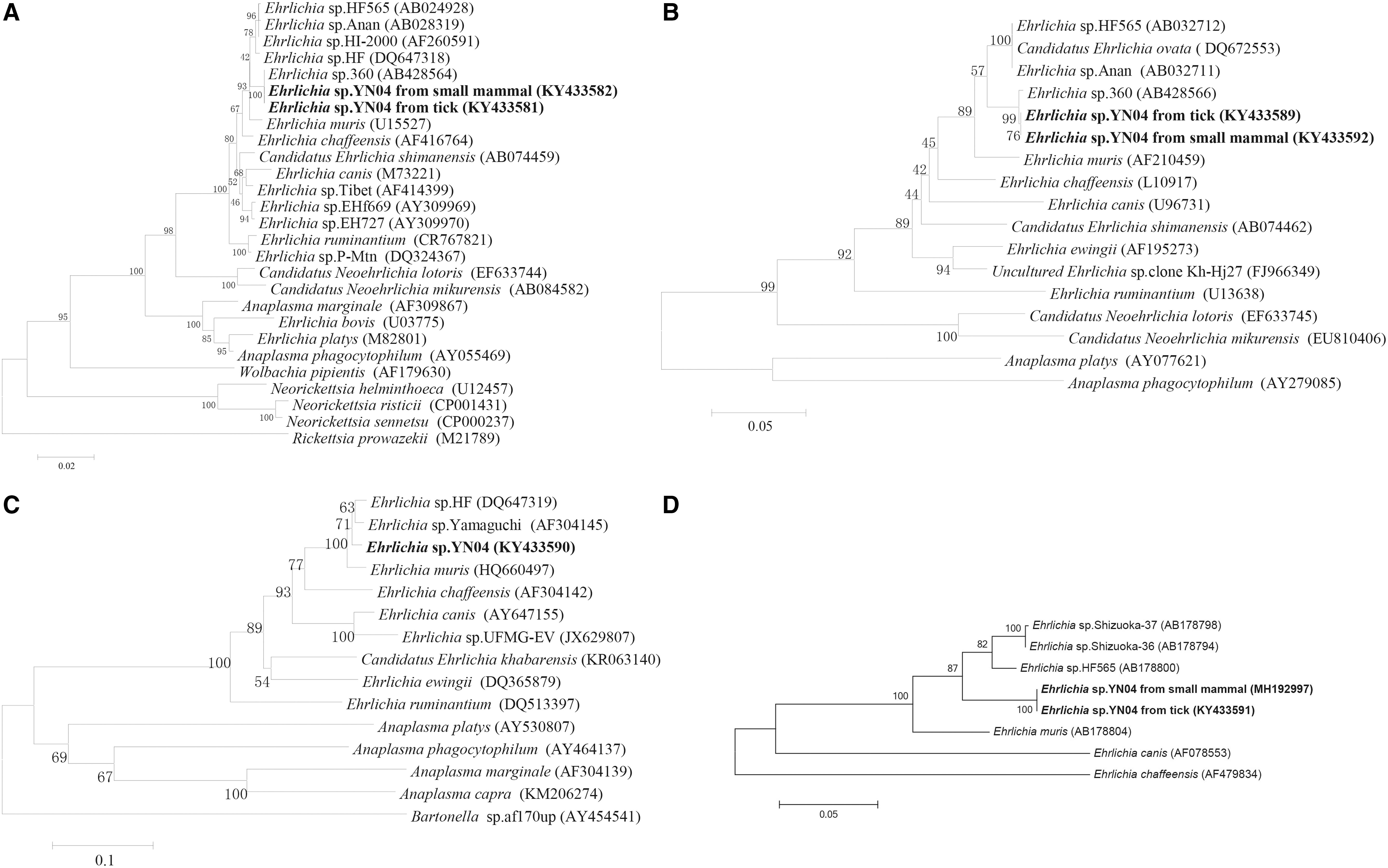
Phylogenetic analyses based on nucleotide sequences of the rrs (1340 bp)
Ehrlichia sp. 360 was at first identified in I. granulatus in Japan by Takano et al. However, they only obtained groEL and 16S rRNA sequences from I. granulatus and did not detect Ehrlichia sp. 360 in any small mammals (Takano et al. 2009). Ehrlichia sp. YN04 reported in this study was most close to Ehrlichia sp. 360, and we further amplified and sequenced gltA and omp-1 genes. In addition, we also identified the bacterial infection in small mammals. We found one R. rattus sladeni and one M. pahari were positive for Ehrlichia sp. YN04, but no tick was collected from these two small mammals for testing. Based on the literature and our study, R. rattus sladeni and M. pahari were the hosts for I. granulatus (Xu et al. 2002). So, the small mammals, in particular, R. rattus sladeni and M. pahari, may be the potential reservoir of Ehrlichia sp. YN04. The limitation is that the study size is small. Some previous studies have indicated the infection of Rickettsia, Anaplasma, and Ehrlichia in cats, goats, and cattle in Yunnan (Zhang et al. 2014, 2016, Qiu et al. 2016). However, compared with the previous studies, this study focused on ticks and small mammals, which are important vectors and hosts of tick-borne pathogens, respectively. It would be better to investigate more Yunnan provinces on ticks and tick-borne pathogens in the future.
Conclusion
Yunnan is famous as a “Global Biodiversity Hotspot” in the world and borders Vietnam, Laos, and Myanmar countries. The rich natural environment and frequent traveler movement made the zoonosis as a great public health burden locally. In this small scale of survey, we found 10 kinds of small mammals. One Ehrlichia species were first reported from ticks and small mammals in mainland China. With the globalization and advanced tourism development, tick-borne infectious disease should not be neglected anymore in this area.
Footnotes
Acknowledgments
This study was financially supported by the State Key Research Development Program of China (2016YFC 1200301, 2016YFC1201902, 2016YFC1202701), the Natural Science Foundation of China (81621005, 81773492, 81673235, and 81760607), and Technical Innovation Training Program of Yunnan Province (2014HB093).
Author Disclosure Statement
The authors declare that no competing interests exist.
References
Supplementary Material
Please find the following supplemental material available below.
For Open Access articles published under a Creative Commons License, all supplemental material carries the same license as the article it is associated with.
For non-Open Access articles published, all supplemental material carries a non-exclusive license, and permission requests for re-use of supplemental material or any part of supplemental material shall be sent directly to the copyright owner as specified in the copyright notice associated with the article.
