




Abstract
Objectives:
The purpose of this study was to explore the relationship between the information seeking about Ebola virus disease (EVD) and media channels, then to provide theory evidence for working out the health education transmission strategy in similar public health emergency events.
Materials and Methods:
We used a cross-sectional survey model, data were collected through questionnaire over telephone calls, and R × c chi-square test was used to identify factors associated with knowledge and media channels for choosing to get the information about EVD prevention and control.
Results:
Most of the respondents said they heard of EVD (84.9%). A total of 82.1% of respondents knew that Ebola virus outbreak occurred in Africa in 2014. Less than half of the respondents knew “EVD can be transmitted through contact with the body, or bodily fluids of an infected person directly” (43.8%). More than half of respondents preferred getting EVD-related information through television, making it the most favored method (60.9%). Information through newspaper was in second place (15.6%) and community propaganda was the third (11.3%). The top three modes of demanding to receive information about EVD mentioned by the respondents were television (55.0%), networking (18.8%), and newspaper (12.1%).
Conclusions:
Television should be used to disseminate relevant accurate health information to the public. The public health organization should strengthen existing partnerships with news media and social media.
Introduction
E
Guangzhou in China is the city that has the most direct flights and transfer flights to Africa. Ebola outbreak occurred in March 2014 in West Africa, and on August 14, 2014, WHO declared Kenya as high-risk country to export Ebola (Shuaib et al., 2014), and Kenya to Guangzhou is directly linked by flight in China. We took this survey to find public knowledge and source of information on EVD and provide theory evidence for working out the health education transmission strategy in similar public health emergency events.
Materials and Methods
Data sources
A cross-sectional analytical study was conducted using a structured questionnaire to collect data, including sociodemographic characteristics, active knowledge on EVD, and source of information, as to understand the influencing factors about the choice of getting the relevant information and demand of the relevant knowledge.
Sampling methods
Multi-stage sampling was used, sampling respondents from 11 districts in the city, whose family telephone number was registered in Guangzhou.
Study design
A structured questionnaire was used and was completed through telephone. The survey evaluated citizen's knowledge of symptoms, transmission, attitudes toward EVD, and beliefs concerning the government's involvement in the outbreak. Sources included news media (e.g., television, radio, and newspaper); social media (e.g., wechat); website (e.g., sina and sohu); and friends, family, or community.
To guarantee the reliability of the questionnaire, three experts were invited to check and approve.
To guarantee the accuracy of the questionnaire, 10 staff members of the Guangzhou health hotline (12320) were trained about the questionnaire and some interview technology before the investigation. And presurvey was done.
Data collection and analysis
Questionnaires were manually sorted out followed by data cleaning. Data were entered into the SPSS software version 17.0 after ensuring validity check through double entry, random checks, and looking for outlier variable. Frequency table and charts were generated including calculation of relevant summary indices.
Result
Sociodemographic characteristics
We interviewed 780 respondents in the 11 districts. More than half of the respondents were female (59.4%) and more than half were 25 to 45 years (55.1%), with secondary education (31.8%) and more than half refused to tell their income (Table 1).
EVD infections and related awareness
Most of the respondents said they heard of EVD (84.9%). A total of 82.1% of respondents knew that EVD outbreak occurred in Africa in 2014. Less than half of the respondents knew “EVD can be transmitted through contact with the body, or bodily fluids of an infected person directly” (43.8%) (Fig. 1).
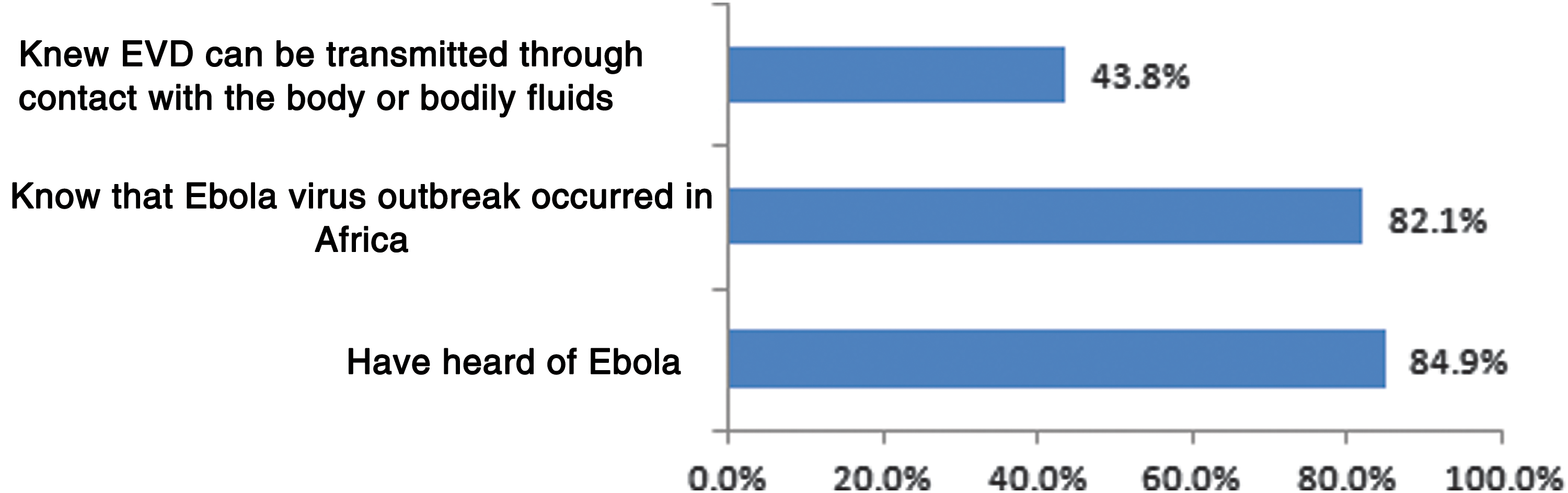
Ebola infections and related awareness. Color images available online at
Primary channel of receiving information about EVD
More than half of respondents prefer getting EVD-related information through television, making it the most favored method (60.9%). Newspaper was in the second place (15.6%) and community propaganda (11.3%) was in the third (Fig. 2). There was no difference among different age groups, different educational degree, and different districts (p > 0.05). Among the choice of television channels, most of the respondents prefer choosing the traditional television channels (89.7%). Among the choice of newspaper, 78.7% of the respondents chose “Guangzhou Daily.” Among the choice of website, 60.6% of the respondents chose “QQ News” (Table 2).
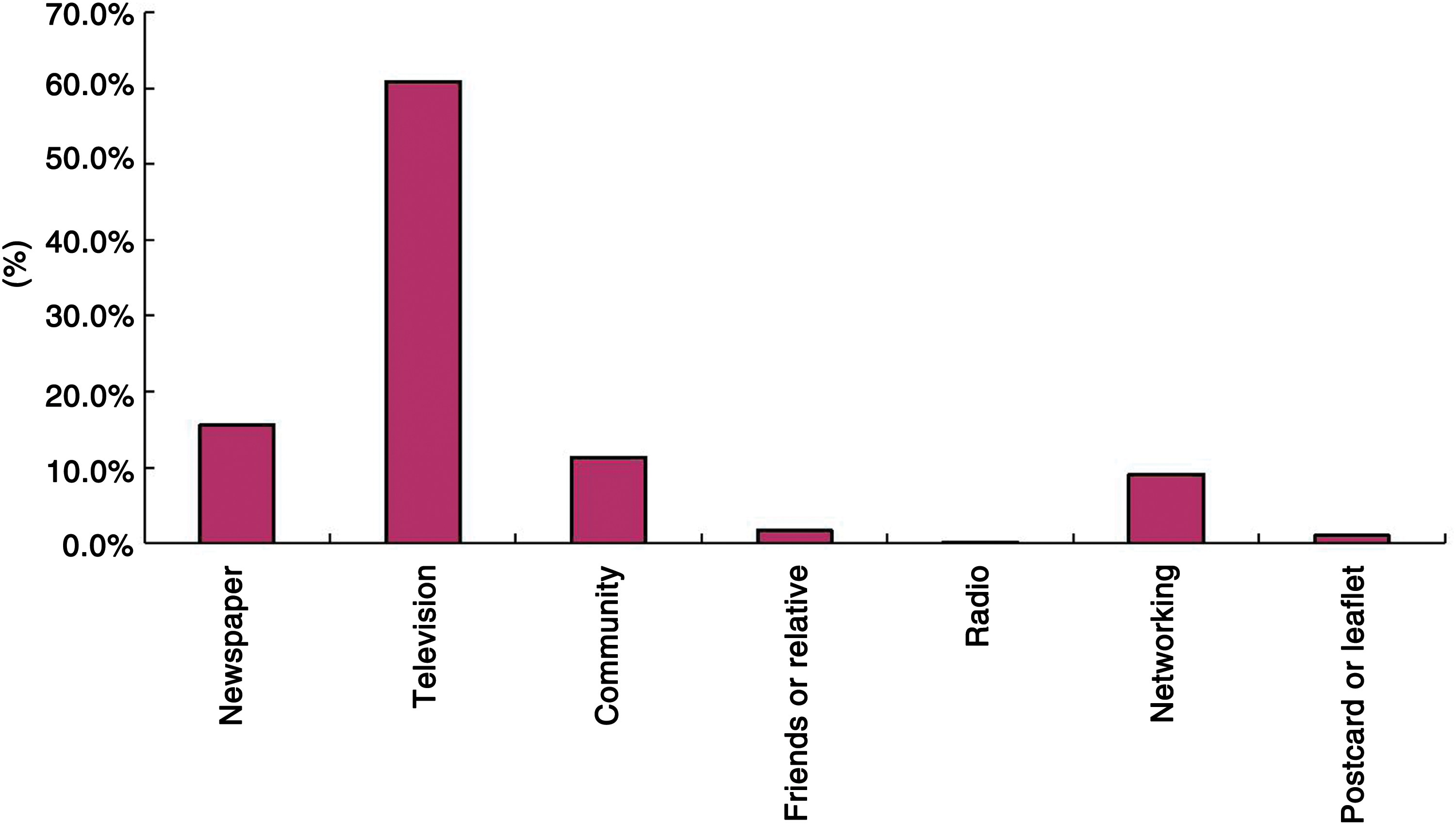
Primary channel of receiving information about EVD. EVD, Ebola virus disease. Color images available online at
Primary channel of demanding to receive information about EVD
The top three modes of demanding to receive further information about EVD mentioned by the respondents were television (55.0%), networking (18.8%), and newspaper (12.1%) (Fig. 3). There is difference between the different educational groups to receive further information about EVD (χ2 = 46.079, p < 0.05). The people whose education level is beyond graduation prefer to receive further information about EVD by Internet (χ2 = 41.629, p < 0.05), and the people whose education level is below graduation prefer to receive further information about EVD by television (x 2 = 23.101, p < 0.05).

Primary channel of demanding to receive information about EVD. Color images available online at
Discussion
The risk of imported infectious disease, like EVD, Dengue Fever and Multi-Element Radiometer System, is increasing nowadays, while Guangzhou becoming the Integrated Transportation Hub in the Silk Road Economic Belt and the 21st-Century Maritime Silk Road Initiative. We need to formulate an accurate health information transmission strategy according to different knowledge demands. Our study is a preliminary baseline survey. We may be the first to report on EVD awareness and acceptability of media channels among Chinese citizens. Our study revealed that the percentage of respondents who have ever heard about Ebola (89.4%) was lower than the finding from Guinea (96.4%) (Buli et al., 2015) and Sierra Leone (100%) (CRS/Focus 1000/UNICEF, 2014), where Ebola outbreak occurred. A total of 82.1% of respondents knew that Ebola virus outbreak occurred in Africa, and only 43.8% of respondents knew EVD can be transmitted through “contact with the body, or bodily fluids of an infected person directly” (43.8%). Findings indicate that community members with good knowledge on how EVD is spread are more likely to adopt appropriate measures to prevent community spread (Janjua et al., 2007). As we know, Guangzhou faces the risk of imported EVD.
Our survey indicated that more than half of respondents prefer getting EVD-related information through television, and demanded it the most favored method to get further information. This finding is similar to the situation of Lagos Nigeria (Gidado et al., 2015). We need another study to know which TV channel is the most favorite, and which type of program is most popular to transfer the relevant knowledge to the masses. Networking is the second choice to get further information. We can also find that there is difference between the different education groups for receiving further information about EVD. The people whose education level is above graduation prefer to receive further information about EVD by Internet, and the people whose education level is below graduation prefer to receive further information about EVD by television in Guangzhou.
Finding in a similar research in Kashgar shows that citizens get relevant health information mainly through the Community Hygiene Service Center (Zhang et al., 2017). Finding in Nigeria shows that television and radio should be the target to disseminate public health information on EVD and other diseases in future outbreaks (Gidado et al., 2015). Another finding in Nigeria revealed that the social network media was the first source of information on EVD among many of respondents. This may be so because of the easiness of dissemination of health information generally by the social media at the click of a button, even when the owner of the handset is not there. Because information on social network rapidly spreads, a large number of youths would have received such information and continue to pass the same to others. It is, therefore, important for government that is the custodian of this technology to assume monitoring and evaluation roles to regulate this industry, and prevent episodes of misinformation (Adebimpe et al., 2015). An analysis in the United States points to the importance of expertise, which underpins CDC's powers of suasion in a fragmented system with multiple incentives who have incentives to act. Authoritative knowledge, which CDC is usually presumed to have, is a powerful force to inform, standardize behavior, and formulate appropriate response (Greer and Singer, 2016).
Conclusions
Television should be used to disseminate relevant accurate health information to the public. The public health organization should strengthen existing partnerships with news media and social media.
Footnotes
Acknowledgments
We sincerely thank all the participants who willingly devoted their time and energy, especially the 12320 Guangzhou health hot line's staff. We thank all the experts who validated the content of the tool.