




Abstract
Introduction:
Piroplasms are hemoprotozoa comprising heterogeneous tick-borne parasites, which are differentiated into three genera, namely Babesia, Theileria, and Cytauxzoon. The aim of this study was to determine the prevalence, molecular identification, and phylogenetic relationship of both Theileria spp. and Babesia spp. in tick species isolated from different domestic animals from two different geographical locations of Iran.
Materials and Methods:
A total of 930 ticks collected from goats, sheep, and cattle were examined for the presence of Theileria spp. and Babesia spp. using PCR targeting 18S rRNA gene followed by sequencing. Sequence analysis was performed based on the data published in the GenBank on Theileria spp. and Babesia spp. isolates using bioinformatic tools, such as the standard nucleotide BLAST.
Results:
A 390 or 430 base pair fragment of 18S rRNA gene of Theileria and Babesia species was successfully amplified in 17.2% of the examined ticks (16of 93). Genome of Theileria or Babesia species was detected in 4 ticks collected in Heris, including 3 Dermacentor marginatus and 1 Rhipicephalus sanguineus, and also in 12 ticks collected in Chabahar, including 10 R. sanguineus and 2 D. marginatus. Partial analysis of 18S rRNA gene sequence of the four D. marginatus, collected from goats and sheep in Heris, showed that they were infected with Theileria spp. that were 95–97% identical to Iranian Theileria ovis present in the GenBank database (GenBank acc. no. KP019206.1). While the five R. sanguineus, collected from sheep and goats in Chabahar, were infected with Babesia spp. that were 91–97% identical to Iranian Babesia ovis present in the GenBank database (GenBank acc. no. AY362829.1: KT587794.1).
Conclusion:
The prevalence of Babesia and Theileria is different in southeastern and northwestern parts of Iran, with higher prevalence of babesiosis in the southeastern region and that of theileriosis in the northwestern region. Sequence analysis of 18S rRNA gene revealed that T. ovis and B. ovis are genetically polymorphic in these regions.
Introduction
T
Theileria spp., including Theileria separate, Theileria ovis, Theileria recondite, Theileria lestoquardi, Theileria hirci, Theileria spp. (China 1), and Theileria spp. (China 2), are recognized as the species that cause ovine theileriosis in sheep and goats in tropical and subtropical regions (Nagore et al. 2004, Ahmed et al. 2006, Niu et al. 2009), whereas ovine babesiosis is normally caused by Babesia ovis, Babesia motasi, and Babesia crassa (Schnittger et al. 2003, Ranjbar-Bahadori et al. 2012). Depending on the pathogenicity, Theileria annulata and Theileria parva are thought to be the most pathogenic species and are transmitted by Hyalomma spp. and Rhipicephalus appendiculatus ticks. These species cause lymphoproliferative disease with high mortality rates, whereas other Theileria species are suggested to be pathogenic parasites transmitted by Rhipicephalus and Haemaphysalis ticks in cattle and small ruminants (Onuma et al. 1998).
Several tick species, including Ixodes ricinus, Ixodes scapularis, Rhipicephalus microplus, and Haemaphysalis longicornis, have been described as the vectors that transmit the pathogens of babesiosis to livestock and wild animals (Michel et al. 2014). The precise identification of both Theileria and Babesia genera is essential to understand their epidemiology and classification (Nagore et al. 2004). The advanced molecular techniques enable the genotypic characterization and have been shown to be very useful for the identification and classification of many hemoparasite species of the Theileria/Babesia group (Caccio et al. 2000). A broad range 18S rRNA gene PCR assay followed by partial sequencing of this gene has been successfully used to identify and classify several previously unknown piroplasms, such as Babesia and Theileria parasites (Ranjbar-Bahadori et al. 2012).
Although we have recently reported molecular characteristics and phylogenetic position of Anaplasma/Ehrlichia spp. isolated from various ticks in both southeastern and northwestern regions of Iran (Jafar Bekloo et al. 2018), these information for Theileria/Babesia spp. isolated from various tick species have yet been investigated in different geographical locations of Iran.
The aim of this study was to determine the prevalence of Theileria/Babesia spp. and to investigate the molecular characterization of Theileria/Babesia spp. in various tick species isolated from goats, sheep, and cattle in southeastern and northwestern regions of Iran for the first time. In addition, the genetic characteristics of isolated Theileria/Babesia spp. was compared with other Theileria/Babesia collected from various hosts. To determine the species within the Theileria/Babesia genera circulating among domestic animals in both northeastern and southwestern regions of Iran, phylogenetic analysis was performed on the 18S rRNA gene of any Theileria/Babesia species isolated from sheep, goats, and cattle in these regions.
Materials and Methods
From June 2015 to September 2015 in rural areas of Heris (the northwestern region of Iran at 38°14′50′′N 47°06′59′′E) and Chabahar (the southeastern region of Iran at 25°17′31′′N 60°38′35′′E), a total number of 3000 animals, including 1550 goats, 950 sheep, and 500 cattle, were inspected for tick infestation. The animals without any clinical signs of illness were included in this study. The whole body of each animal was inspected, and ticks were removed from animals' body using a forceps at different time intervals. The sampling was carried out in a period corresponding to seasonal tick activity. The isolated ticks were kept in labeled dry plastic tubes, with the geographical origin and the origin of the animals, containing 70% alcohol. The samples were referred to the Entomology Laboratory, Tehran University of Medical Sciences. Based on morphological characteristics of isolated ticks, the shape of capitulum, eyes, festoons and hypostome, genital groove, scutum, spiracle, adanal shield, and spur of coxa were identified (Saghafi pour et al. 2014). Totally, 93 engorged ticks, at least 3 ticks from each species, were randomly selected and examined for the presence of theilerial/babesial DNA using PCR.
DNA extraction
After a 5 min incubation in the liquid nitrogen tank, each isolated tick was grinded in an Eppendorf microtube using a glass pestle, and total DNA was extracted using G-spin™ Genomic DNA Extraction Kit (iNtRON Biotechnology, Korea), as previously explained by Khazeni et al. (2013).
PCR assay
The extracted DNA was resuspended in sterile distilled water and then stored at −20°C until used in PCR. A 390–430 base pair (bp) domain of 18S rRNA gene from Theileria/Babesia species was amplified using PCR. To amplify the hypervariable V4 region of the 18S rRNA gene of Theileria and Babesia genera, the following sequence of the forward and reverse primers are used in PCR: RLB-F (5′-GAGGTAGTGACAAGAAATAACAATA-3′) and RLB-R (5′-TCTTCGATCCCCTAACTTTC-3′) (CinnaGen, Tehran, Iran), respectively. A total of 20 μL PCR mixture was prepared, containing 30 mM KCl, 1.5 mM MgCl2, 10 mM Tris-HCl (pH 9.0), 0.5 μM of each primers (CinnaGen), 250 mM of each deoxynucleoside triphosphate (dNTP) (Roche, Penzberg, Germany), and 1 U Taq DNA polymerase (CinnaGen; 2 mL of DNA and nuclease-free H2O to bring the volume up to 20 μL). The thermal stages of PCR were performed using a thermocycler (Eppendorf AG, Hamburg, Germany) as follows: 5 min at 94°C to denature genomic DNA, 30 cycles of 30 s at 94°C for further denaturation, 30 s at 67°C for annealing, and 1 min at 72°C for extension, and the last step consisted of 5 min of final extension at 72°C. The PCR products were electrophoresed on 1.5% agarose gel. Theileria and Babesia DNA, obtained from the Faculty of Veterinary Medicine, Tehran University (Khazeni et al. 2013), and double-distilled water were also run on each gel as the positive and negative controls, respectively. The size of each PCR product was estimated using a 100–1500 bp molecular weight “ladder” (Roche) ran on the same gel as the marker.
DNA sequencing and phylogenetic analysis
Positive electrophoresed PCR products obtained from 18S rRNA gene (three samples for each region) were purified using the Roche High PCR Purification Kit (Bioneer). The purified PCR products were directly subjected to sequencing by Seqlab (GmbH, Germany). Sequence analysis was performed based on the data published in the GenBank (GenBank acc. no. KT587794.1, KT587793.1, KT851446.1 and AY150058.1, KU714608.1, KP019206.1 [Iran], KJ850942.1) on Theileria/Babesia spp. isolates using bioinformatic tools, such as the standard nucleotide BLAST (Altschul et al. 1990). Sequence alignment was performed using the ClustalW program (Thompson et al. 1994). To have a global and clear visualization of the strains' genotypes and their relationships, the phylogenetic trees were constructed based on sequencing of 18S rRNA applying treetop software using two algorithms, including clustering and topological by using the average distance algorithm. The phylogram was presented in PHYLIP format (Misawa and Tajima 2000). The GenBank accession numbers of the 18S rRNA gene of Theileria and Babesia sequences were used to analyze the percent identity and to construct a phylogenetic tree (Fig. 2).
Results
From 3000 inspected animals, including 950 sheep, 1550 goats, and 500 cattle, a total of 930 ticks of various species were isolated and identified in the study areas (Table 1). The frequency rate of ticks infesting animals in both regions is also shown in Table 1.
NTC, number of collected ticks.
Molecular findings
Ten percent (93 of 930) of engorged ticks, at least 3 ticks from each species, was randomly tested for the presence of theilerial and babesial DNA. Since the pair of primers used in the present study could amplify a target fragment in both species, PCR and gel analysis revealed that 17.2% (16 of 93) of ticks examined were positive for either Theileria or Babesia. The amplicon size was found to range between 390 and 430 bp corresponding to the V4 hypervariable region of Theileria and Babesia species, respectively. No amplification product was detected in the negative controls (Fig. 1). Genome of Theileria or Babesia species was detected in 4 ticks collected in Heris, including 3 Dermacentor marginatus and 1 Rhipicephalus sanguineus, and also in 12 ticks collected in Chabahar, including 10 R. sanguineus and 2 D. marginatus.
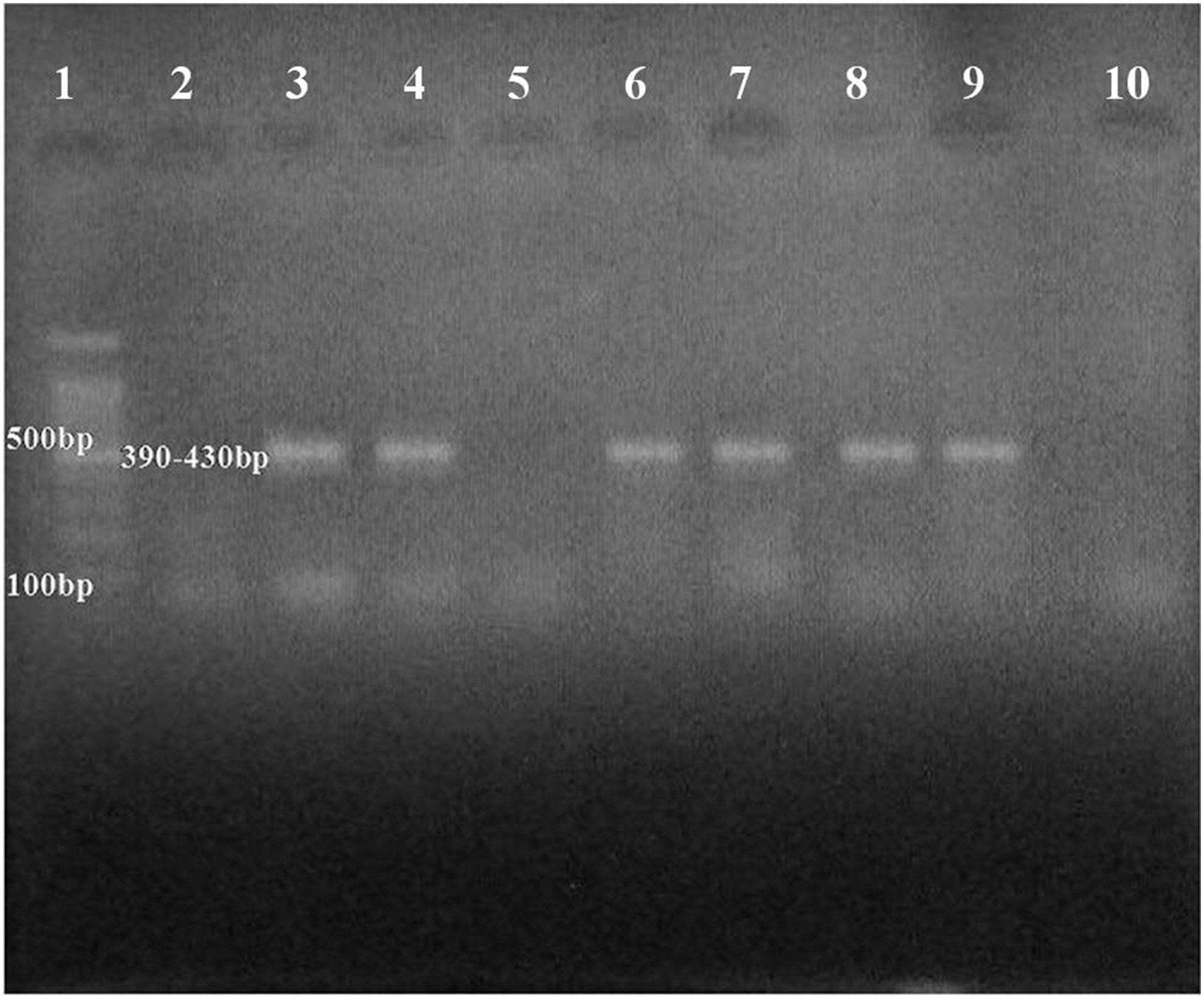
Results of the electrophoresis of the products of the nested-PCR-based amplification of 18S rRNA gene extracted from the various ticks. The 10 lanes contain a molecular weight “ladder” (lane 1), the products from Theileria/Babesia (lanes 3–9), and a negative control (lane 10).
To characterize the Theileria/Babesia species detected in ticks from various animals, all the 16 positive PCR samples against Theileria/Babesia were sequenced using both the forward and reverse primers. All the 16 amplicons were sequenced, of which 9 sequences were of good quality and the other 7 sequences were of poor quality. The poor quality sequences, likely resulted from poor separation of the fragments in the gel electrophoresis steps, were excluded from further analysis. The good quality sequences were submitted to the GenBank and analyzed subsequently. The partial analysis of 18S rRNA gene sequence showed that three D. marginatus collected from goats and sheep in Heris (isolates 7, 8, and 9) as well as one D. marginatus (isolate 6) collected in Chabahar were infected with Theileria spp. that were 95–97% identical to Iranian T. ovis present in the GenBank database (GenBank acc. no. KP019206.1) (Fig. 2). Furthermore, four R. sanguineus collected from sheep and goats in Chabahar (isolates 1, 2, 3, and 4) as well as one R. sanguineus collected in Heris (isolate 5) were infected with Babesia spp. that were 91–97% identical to Iranian B. ovis present in the GenBank database (GenBank acc. no. AY362829.1: KT587794.1, AY150058.1). These sequences were also aligned with those of Theileria/Babesia existing in the GenBank database, and their similarity percentages were calculated. The BLAST search results of Theileria/Babesia 18S rRNA sequence against those published previously for other Theileria/Babesia spp. revealed the highest similarity with those of ovine Theileria and ovine Babesia. Based on the patterns of 18S rRNA partial sequencing, the phylogeny tree grouped the nine genotypes into five clusters (Fig. 2). Cluster I contained Rhipicephalus sanguineus (GenBank acc. no. KP830113.1), Babesia bigemina (GenBank acc. no. Ku206297.1 and EF458191.1), and Iranian Babesia caballi (GenBank acc. no. KM882893.1), which were used as outgroup isolates.
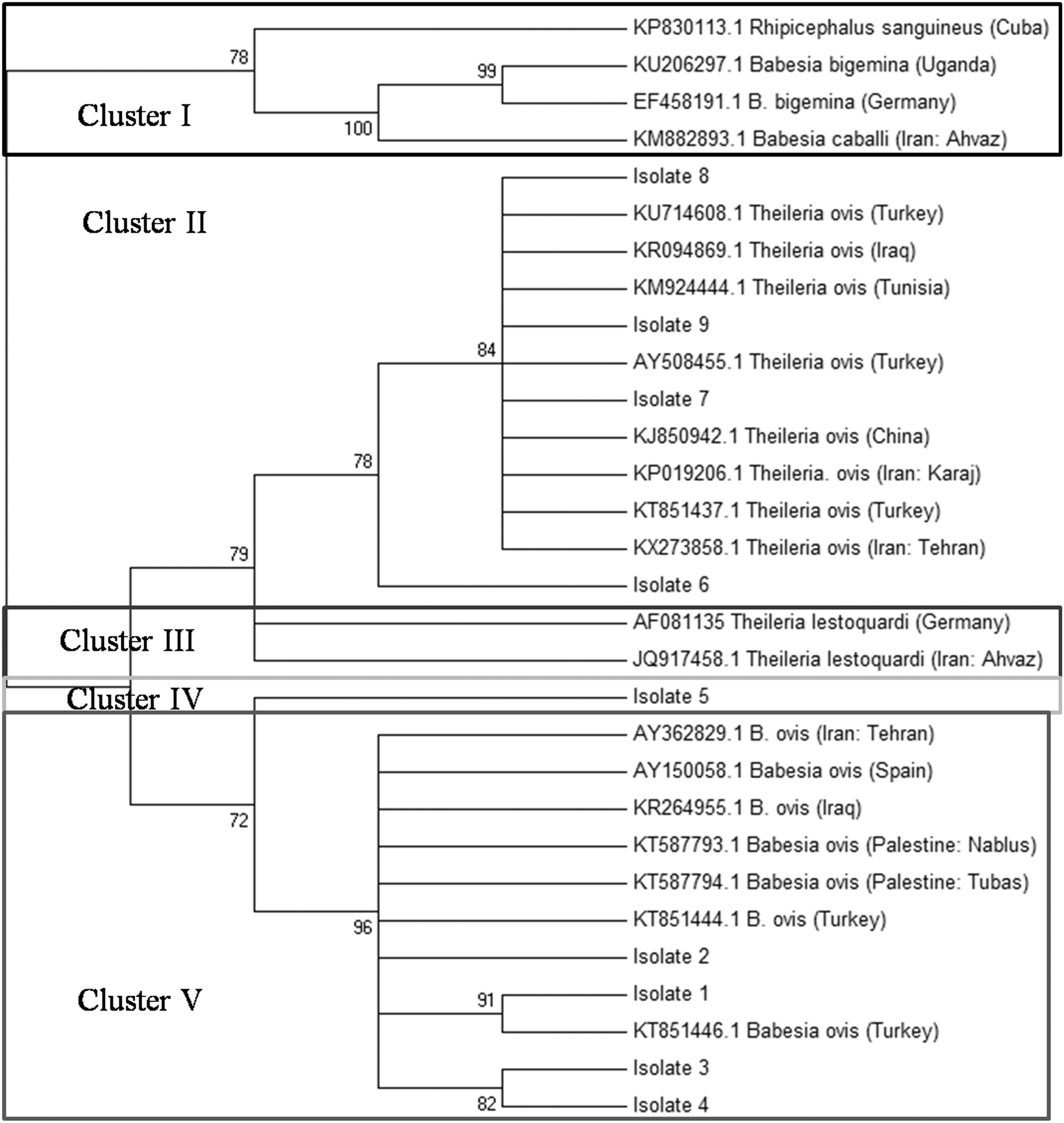
A phylogenetic relationship between all Theileria/Babesia isolates using the average distance algorithm. Babesia bigemina (GenBank acc. no. Ku206297.1 and EF458191.1), Rhipicephalus sanguineus (GenBank acc. no. KP830113.1), and Iranian Babesia caballi (GenBank acc. no. KM882893.1) were used as outgroup to root the tree. Only bootstrap values higher than 50% are indicated on each branch.
Cluster II contained isolated strains 7, 8, and 9 that were collected from goats and sheep of same geographical region (Heris). This cluster also contained isolated strain 6 that was collected from goats in Chabahar. Moreover, the other selected T. ovis spp. present in the GenBank database were located in cluster II. Cluster III contained T. lestoquardi spp. present in the GenBank database (GenBank acc. no. AF081135 and JQ917458.1). Isolated strain 5 was located in cluster IV. Isolated strains 1, 2, 3, 4, and other selected B. ovis spp. present in the GenBank database were located in cluster V.
Discussion
The primary aim of this study was to determine the prevalence of Theileria/Babesia spp. as well as to investigate the molecular characterization of the detected Theileria/Babesia spp. in various tick species isolated from goats, sheep, and cattle in two different geographical regions, including southeast and northwest of Iran. Previous studies have investigated the presence of ovine theileriosis in limited geographical areas, east and north, of Iran (Spitalska et al. 2005). Moreover, the genetic and phylogenetic characteristics of 18S rRNA gene of any isolated Theileria/Babesia from the domestic animals in these regions were investigated. Molecular approaches, including PCR and sequence analysis, have been effectively used for epidemiological study and phylogenetic analysis of tick-borne pathogens, such as piroplasms family (Aydin et al. 2015). In this study, PCR was used to detect the theilerial and babesial DNA targeting the 18S rRNA gene. A broad range 18S rRNA gene PCR assay followed by partial sequencing of this gene have been successfully used to identify and classify several previously unknown Babesia and Theileria parasites (Ranjbar-Bahadori et al. 2012, Aydin et al. 2013, Liu et al. 2016). The target fragment of 18S rRNA gene of Babesia/Theileria species was amplified in 16 of 93 (17.2%) ticks. The results showed that 25% (4 of 16) of infected ticks belonged to Heris, which is situated in northwest of Iran, and the others were collected in Chabahar (75%, 12/16), which is situated in southeast of Iran. In Chabahar, 26.9% of sheep, 66.6% of goats, and 6.5% of cattle were infested with various species of ticks, whereas the percentages of tick-infested sheep, goats, and cattle in Heris were 26.8%, 57.6%, and 15.6%, respectively. Based on the findings of this study, the prevalence of Babesia and Theileria in Chabahar is higher than that in Heris. The presence of 18S rRNA gene was only detected in samples that belonged to the R. sanguineus and D. marginatus ticks collected from goats and sheep. The partial 18S rRNA gene sequence analysis of infected ticks showed that the sequences of isolated Theileria and Babesia from D. marginatus and R. sanguineus collected from the study areas are highly similar to those of the T. ovis and B. ovis present in the GenBank database. T. ovis and B. ovis are tick-borne pathogens of sheep, goats, and wild ruminants. Theileriosis and babesiosis are important diseases causing high economical losses (Ranjbar-Bahadori et al. 2012). Based on the findings of this study, R. sanguineus and D. marginatus are the predominant vectors responsible for babesiosis and theileriosis in Chabahar and Heris, respectively.
To identify the genetic heterogeneity of the species within the genera Theileria/Babesia circulating among the animals, the 18S rRNA gene sequence of any isolated parasites from various ticks was also analyzed. The 18S rRNA gene is a ubiquitous molecular marker for the identification of piroplasms species, and ever-expanding databases of sequence information is a useful tool for piroplasms strains identification (Jalali et al. 2014). Intra- and interspecies genetic variations and evolutionary relationships within genera of piroplasms have been also characterized using the 18S rRNA gene sequences, especially in the case of those causing human and animal diseases (Jalali et al. 2014, Vanstreels et al. 2015). Based on the patterns of 18S rRNA partial sequencing, the phylogeny tree grouped the nine genotypes into five clusters.
Cluster II contained three isolated T. ovis strains (isolates 7, 8, and 9) that have been collected from Heris or northwestern part of Iran. Isolated T. ovis strain 6 that was collected from southeastern part of Iran or Chabahar was also located in this cluster. However, this strain had less similarity to other T. ovis present in this cluster.
Cluster IV contained four isolated B. ovis strains (isolates 1, 2, 3, and 4) that have been collected from Chabahar or southeastern part of Iran. Other selected B. ovis strains present in the GenBank database were located in this cluster. Isolated B. ovis strain 5 that collected was from northwestern part of Iran or Heris was also located in this cluster. However, this strain had less similarity to other T. ovis present in this cluster. Sequencing and phylogenetic analyses presented in this study demonstrated that there are at least four distinct Theileria and five distinct Babesia genotypes infecting the collected ticks from goat and ovine population. Finally, the genotypes that had close similarity are from same geographical origin.
Conclusion
R. sanguineus and D. marginatus are the predominant vectors responsible for babesiosis and theileriosis in Chabahar and Heris, respectively. The demonstration of babesiosis and theileriosis in ticks isolated from sheep and goats implies the possible role of these ruminants in the epidemiology of the diseases. The information about pathogen outbreak and genotypes in different hosts and regions helps for the establishment of surveillance and control programs of these pathogens. The prevalence of Babesia and Theileria is different in southeastern and northwestern parts of Iran, with higher prevalence of babesiosis in the southeastern region and theileriosis in the northwestern area. The sequence analysis of the 18S rRNA gene revealed that T. ovis and B. ovis are genetically polymorphic in these regions. Finally, the genotypes that had close similarity are from same geographical origin.
Footnotes
Acknowledgment
The authors thank the Chabahar Gulf Marine Company for its support.
Author Disclosure Statement
No competing financial interests exist.