




Abstract
We detected neutralizing antibodies of Getah virus (GETV) in serum specimens of domestic animals collected from Yunnan Province in China. Antibodies were detected in serum specimens of chicken, duck, dairy cattle, pig, and beef cattle. The positive rate of antibodies in pig and beef cattle was high (46–72%), with titers of 1:640–1:2560. These results suggest that there may be a large number of host animals for GETV in the local area. It is important to improve the monitoring of the incidence of GETV infection in domestic animals, in particular among pigs and beef cattle, by surveillance for animal illness and testing of sick animals.
Introduction
G
China is located in the middle eastern region of the Asian continent. The first GETV strain in China was isolated from mosquitoes collected on Hainan Island in 1964; GETVs have been isolated subsequently from mosquitoes collected in more than 10 provinces and cities in China. About 20 strains of GETV have been isolated and identified from various mosquito samples collected in mainland China since 2000. The geographical distribution of these virus strains ranges from 15 to 40°N and from 95 to 125°E, which indicates that GETV has a very wide geographical distribution in China (Zhai et al. 2008, Li et al. 2017b).
Yunnan Province is located in southwestern China. In recent years, the majority of GETV strains in China have been isolated from mosquito specimens belonging to seven species of four genera in Yunnan Province (Zhai et al. 2008, Li et al. 2017b). However, questions remain about whether GETV infection exists in domestic animals in Yunnan Province and, if so, which animals have been affected. These questions not only are relevant from a virological perspective but also have important public health implications. In this study, to characterize GETV infection among domestic animals in Yunnan Province, we analyzed serum specimens from chicken, duck, pig, and cattle for the presence of GETV neutralizing antibodies.
Methods
Whole blood specimens from pig, beef cattle, dairy cattle, chicken, and duck were collected in the only slaughterhouse and farmers' market in the county town of Jiangcheng County, Yunnan Province (N 22.2924, E 101.4234) from June 29 to July 19, 2015. All serum samples were separated by centrifugation and stored at −40°C for later analysis. Neutralizing antibody titers in serum were measured using a plaque reduction neutralization test 90 (PRNT90). After inactivation at 56°C for 30 min, serum specimens were diluted 1:5–1:2560 and mixed with an equal volume of 200 plaque-forming units (pfu) of GETV suspension (Cao et al. 2016). After incubation at 37°C for 1 h, the mixture was added to individual wells in a six-well plate containing a BHK-21 cell monolayer and incubated for 1 h. Subsequently, 1.3% methyl cellulose-MEM medium containing 2% FBS was added (5 mL per well), and the cells were cultured for a further 2–3 days. The plaques were stained with crystal violet and counted. The highest dilution of serum that reduced plaque formation by 90% was considered the neutralizing antibody titer (Cao et al. 2016).
Results
A total of 196 serum specimens were collected from five species of animals (chicken, duck, dairy cattle, pig, and beef cattle). The number of serum specimens for each animal was 46, 18, 15, 85, and 32, respectively. Positive rates of the GETV neutralizing antibody (serum dilution 1:10) ranged from 2% (1/46) to 72% (23/32). Positive rates of the GETV neutralizing antibody were 2% (1/46; 95% CI: 0–12), 6% (1/18; 0–27), 13% (2/15; 2–40), 46% (39/85; 35–57), and 72% (23/32; 53–86) in chicken, duck, dairy cattle, pig, and beef cattle, respectively (Fig. 1A).
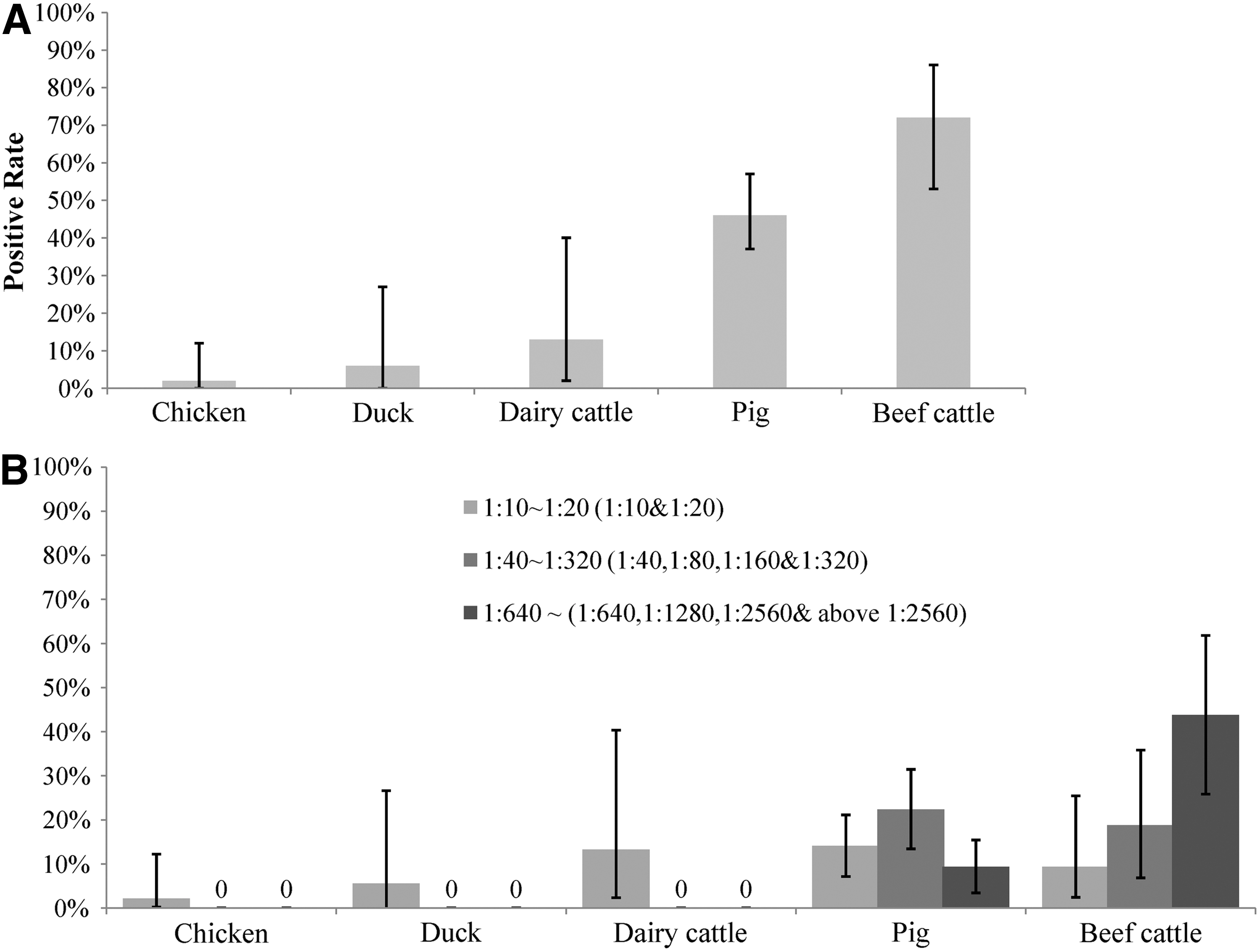
Serological survey of GETV in domestic animals in Yunnan Province, China.
To compare the difference in the titer of GETV neutralizing antibodies among various animal specimens, we determined the titer range of neutralizing antibodies for the positive serum specimens. Figure 1B shows that the GETV neutralizing antibody titer varied by specimen: Low titers (1:10–1:20) were detected in serum samples from chicken, duck, and dairy cattle, whereas most serum samples from pig and beef cattle had titers of 1:640 to more than 1:2560 and accounted for 21% (8/39; 95% CI: 9–36) and 61% (14/23; 39–80) of the total positive specimens, respectively. Positive rates of the GETV neutralizing antibody were significantly higher (p < 0.05; Supplementary Table S1; Supplementary Data are available online at
Discussion
The first strain of GETV in China was isolated on Hainan Island in 1964, and investigations of the serum epidemiology of GETV infection among local animals revealed that pigs, horses, and goats were positive for the GETV neutralizing antibody at rates of 17.6% (3/17), 25% (4/16), and 37.5% (6/16), respectively (Li et al. 1992). However, Hainan Island is separated from the mainland by the Qiongzhou Strait and differs from the mainland in terms of its climate, environment, and ecology. In this study, results of a serological survey of GETV in various domestic animals in Yunnan Province showed that positive rates of GETV neutralizing antibodies varied from 2% to 79% in five domestic animals (Fig. 1). Of these animals, poultry (chickens 2%, ducks 6%) had low positive rates, whereas the positive rates for pigs (46%) and beef cattle (79%) were relatively high (p < 0.05; Supplementary Table S1). Because these animals, in particular pigs and beef cattle, are the most common breeding species in Yunnan's vast rural areas, GETV may have a large number of host animals in Yunnan Province.
Previous studies have shown that the positive rate of GETV antibodies in horses averaged 17% (10–28%) in India (Sugiyama et al. 2009) and 37–47% in South Korea (Rhee et al. 1986). The infection rates of horses in Japan before and after the epidemic of GETV infection ranged from 7.5% to 93%, and the infection rate of GETV was 47.8% (43/90) in boars (Yago et al. 1987). In this study, the titer of GETV neutralizing antibodies in pigs was relatively high as well, similar to the results for Japan and Korea. Furthermore, for the first time the antibody was found in serum samples from beef cattle, dairy cattle, and poultry (chicken and duck), which shows that a variety of domestic animals can potentially act as hosts for GETV.
The results of this study showed that dairy and beef cattle differed in their rates of positivity for the antibody (13.3% [2/15] vs. 71.9% [23/32], respectively) as well as in their antibody titers. Only a few dairy cattle were detected in the 1:20 titer range, whereas the titers of most beef cattle specimens were between 1:40 and 1:320 or even higher than 1:2560. This suggests that different subspecies can have different responses to GETV infection.
Researchers had continuously detected the GETV neutralizing antibodies in pigs and horses in Ibaraki and Chiba of Japan (Bannai et al. 2017). The results showed that in south Ibaraki, the seroprevalence of neutralizing antibody in pigs ranged from 0% to 1.6% in 2012–2013, but it was 28.8% and 65.0% in 2014 and 2015, respectively; In north Chiba, it ranged from 0% to 1.6% in 2010–2012, and was 14.1%, 17.8%, and 48.0% in 2013–2015, respectively. Meanwhile, outbreaks of GETV infection occurred among racehorses in 2014 and 2015 in these regions. And a GETV strain isolated from a pig was closely related to GETVs isolated from horses during this period, suggesting that GETV can circulate among pigs and horses simultaneously in specific areas. Thus, the positive rate of neutralizing antibody is related to the prevalence of GETV.
Several GETV outbreaks have occurred in horses and swine in Japan (Bannai et al. 2016), India (Broen and Timoney 1998), and China (Yang et al. 2018). The results of this study revealed that there is a high titer of the GETV neutralizing antibody in many domestic animals in Yunnan Province, which suggests that GETV may cause infections in domestic animals in the local area. However, until now there has been no report on the prevalence of animal diseases caused by GETV in Yunnan Province. Also, the limited number of samples for some animals (e.g., ducks and dairy cattle) in this study may lead to an underestimation of the actual seroprevalence level in the local area, and so, a long-term serological survey with large samples is further needed. Therefore, it is essential to improve the detection and monitoring of GETV infections in animals, in particular horses, pigs, and beef cattle, by surveillance for animal illness and testing of sick animals.
Footnotes
Acknowledgments
This work was supported by the National Key R&D Program of China (2016YFC1201904), the National Natural Science Foundation of China (81501757), the National Key Plan for Scientific Research and Development of China (2016YFD0500300), and the Development Grants of State Key Laboratory of Infectious Disease Prevention and Control (2014SKLID103, 2015SKLID505). The founders had no role in the study design, data collection and analysis, and decision to publish or preparation of the article.
Author Disclosure Statement
No conflicting financial interests exist.
References
Supplementary Material
Please find the following supplemental material available below.
For Open Access articles published under a Creative Commons License, all supplemental material carries the same license as the article it is associated with.
For non-Open Access articles published, all supplemental material carries a non-exclusive license, and permission requests for re-use of supplemental material or any part of supplemental material shall be sent directly to the copyright owner as specified in the copyright notice associated with the article.
