




Abstract
In sub-Saharan Africa, few studies have addressed the environmental determinants of the incidence of Toxoplasma gondii infection. Free-range chickens are regarded as sensitive indicators for environmental contamination with T. gondii oocysts due to their ground-feeding behavior and have been used as sentinels. A cross-sectional study was conducted from January to April 2018 to estimate the seroprevalence of T. gondii infection in free-range chickens from Senegal, West Africa, using the modified agglutination test. Sampling was performed in two regions of the country: Saint-Louis, a Sahelian area in the North, and Kedougou, a forest and rainy area in the South. A questionnaire was administered to chicken owners to assess potential risk factors for T. gondii seropositivity, and univariable and multivariable logistic regression analyses were used to determine the statistical significance of risk factors. The seroprevalence in chickens was 7.67% (51/665; 95% confidence interval [CI]: 5.51–9.52). The multivariable logistic regression model indicated that the odds to test T. gondii seropositive was higher in chickens provided well water (odds ratio [OR] = 3.17, 95% CI: 1.45–6.93; p = 0.004) than in chickens provided tap water, and in hens having chicks (OR = 80.15, 95% CI: 22.79–281.95; p < 0.001) than in chickens (male or female) not having chicks. The possible role of contaminated well water in the acquisition of infection in chickens—and hence in human—merits consideration and should be addressed in future studies.
Introduction
Toxoplasmosis is a widespread parasitic zoonosis, caused by an obligate intracellular protozoan parasite Toxoplasma gondii. Felids are the definitive hosts, while intermediate hosts virtually include all warm-blooded animals (Frenkel et al. 1970, Dubey 2009).
Cats shed unsporulated oocysts in the environment, where they sporulate and become infective within 1–5 days depending upon temperature and aeration (Dubey 2009). Birds and mammals, including humans, develop persistent tissue cysts after ingestion of these sporulated oocysts. Raw or undercooked meat from animals harboring infective tissue cysts can be another source of infection for humans and other meat-consuming species (Dubey 2009). In humans, T. gondii infection is often nonsymptomatic, except in some risk groups (developing fetus in case of congenital infection and immunocompromised patients), for which toxoplasmosis may be a serious health threat (Montoya and Liesenfeld 2004). In veterinary medicine, toxoplasmosis in a major abortive disease of small ruminants (Buxton et al. 2007).
Worldwide, the geographic variability of the sources of infection in humans is likely due to differences in eating habits and hygiene levels (Tenter et al. 2000). In sub-Saharan Africa, meat is usually well cooked before consumption. It appears that infection by T. gondii often occurs at an early age (Duong et al. 1992), the most probable source of infection being the oocysts contaminating the environment (Adou-Bryn et al. 2004, Uneke et al. 2007, Abu et al. 2015). Levels of environmental contamination with oocysts are probably determined by several abiotic (e.g., climate and type of soil) and biotic (e.g., host density) factors (Afonso et al. 2013, Simon et al. 2017). In Senegal, where our study was conducted, T. gondii seroprevalence ranges from 31.15% to 46.03% among pregnant women and women of childbearing age (Faye et al. 1998, Ndiaye et al. 2011, 2016, Lo et al. 2012), suggesting a high potential risk of seroconversion in case of infection during pregnancy for this population.
Chickens are considered good indicators of the levels of environmental contamination with oocysts around human dwellings, given that they feed on the ground and they rarely become sick from T. gondii infection (Dubey et al. 2015). In addition, their usually limited living area compared to other domestic animals may help in accurately evaluating environmental contamination at a local scale.
In this study, we conducted an epidemiological survey in free-range chickens from Senegal to estimate the seroprevalence of T. gondii infection and assess the risk factors predictive of seropositivity.
Materials and Methods
Description of the studied regions
Senegal is a West African country, which is located at the Western extremity of the continent, between 12°5 and 16°5 North latitude and 11°5 and 17°5 West longitude. With a population of more than 16 million inhabitants, it covers an area of 196,712 km2 (Senegalese National Agency for Statistics and Demography - ANSD - 2015). Senegal occupies an intertropical position, straddling the Sahel belt to the North and the tropical African forest to the South. It is characterized by the alternation of a dry season from November to May and a rainy season from June to October. The annual average rainfall follows a growth gradient from North to South of the country. It increases from 300 mm in the Sahel north to 1200 mm in the south, with variations from 1 year to another (Ndong 1995, Senegalese National Agency for Statistics and Demography - ANSD - 2015).
In this study, sampling was performed in two climatic regions of Senegal: Saint-Louis, a Sahelian area in the North, and Kedougou, a forest and rainy area in the South (Fig. 1).
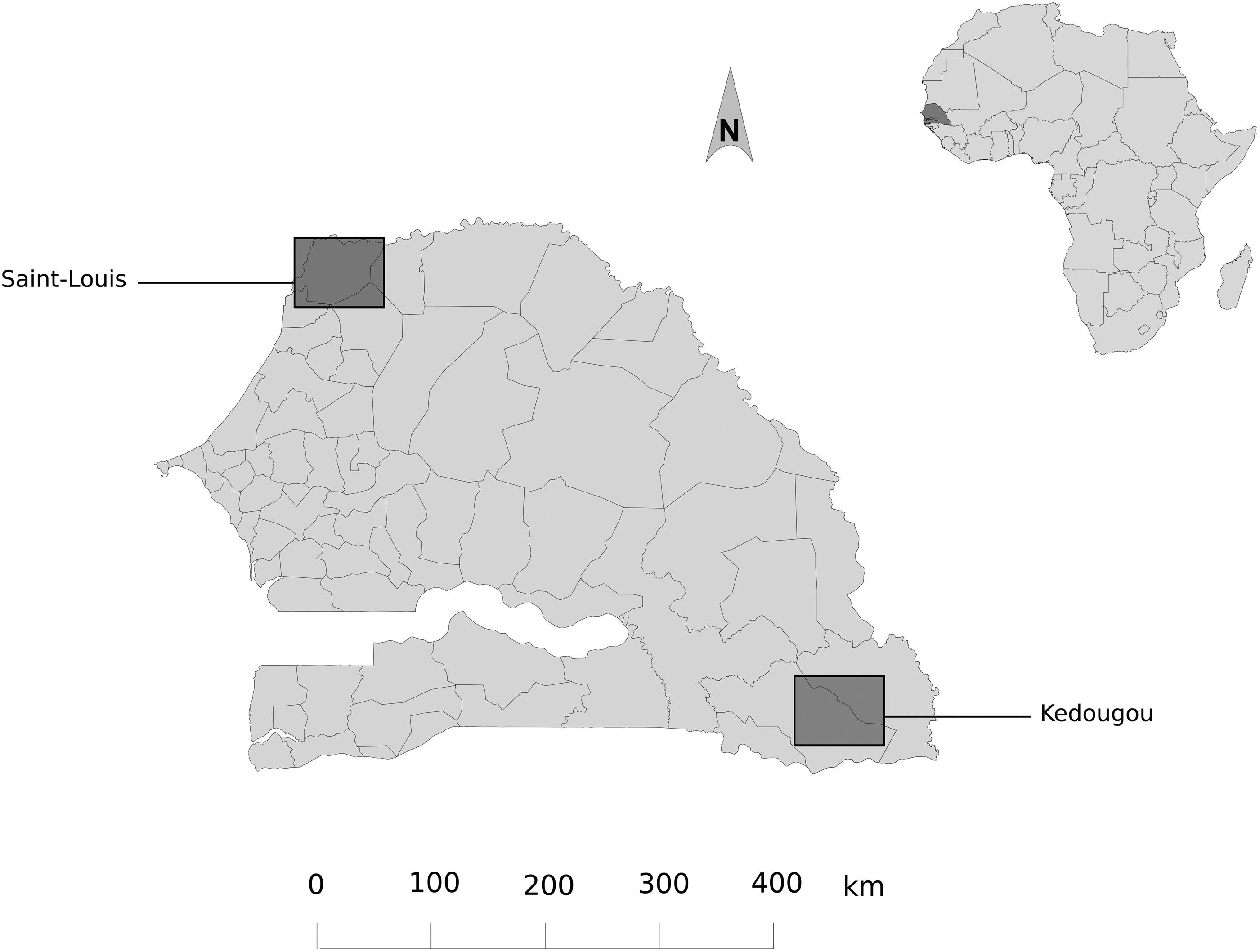
Sampling regions. The two studied regions of Senegal are highlighted on the map.
The Kedougou region is the most mountainous region in Senegal, with a peak at 581 meters in Sambagallou. It is also one of the rainiest regions in the country with at least 1300 mm/year. The climate is Sudano-Guinean with an average annual temperature of 28°C. In this region, tropical ferruginous soils and slightly eroded soils predominate. Nevertheless, other types of soils are present such as raw mineral erosion soils, hydromorphic, halomorphic or vertisol soils.
The Saint-Louis region is a region with a sahelian climate. The average annual temperature is 25°C. The total annual precipitation is 346 mm. Sampling efforts were focused on the villages surrounding the Djoudj National Park, at 60 km from the coastal city of Saint-Louis, at the Senegal River Delta. Sandy soils are found in the upper parts of the valley, and much more clayey soils in the settling zone of the river. Large-scale agricultural projects have been developed in this region since the 1980s, with the construction of the Diama dam at the mouth of the Senegal River. In the center of this region is the Djoudj National Park, which covers 16,000 hectares and is home to nearly 3 million migratory birds of more than 400 different species each year (Sauvage and Rodwell 1998, Noba et al. 2010).
Study design and sample size
A cross-sectional study was conducted between January and April 2018 to estimate the seroprevalence and identify the risk factors of T. gondii infection in chickens from Kedougou and Saint-Louis regions. In the absence of prevalence data concerning T. gondii infection in chickens from Senegal or from neighboring countries, a 50% expected seroprevalence (p) and a 95% confidence interval (CI) (Z = 1.96) with a 5% desired absolute precision (d) was retained to calculate the required sample size, using the following formula:
A total of nine villages in Saint-Louis region and seven villages and two urban districts in Kedougou region were selected according to their accessibility and according to the information obtained from local guides on the presence of chicken farming. Given the poor road accessibility and the difficult access to some localities, sampling was conducted generally only during 1 day for each locality. Within each locality, all chickens for which we obtained an oral consent from owners were sampled.
Epidemiological questionnaire
The owners were interviewed individually regarding the rearing system used (free range/backyard/cage), the water source (well/borehole/canal or river/tap water), the presence of cats (permanent/frequent/occasional/absent), the type of soil (sandy/clayey/lateritic), age (≤6 months, 7–11 months, and ≥12 months), and sex (male/female). Hens having chicks (yes/no) at the time of sampling were also recorded. In households and around households, slaughtering of sheep as part of some traditional celebrations is common in Senegal. The offal of these animals can be a source of infection for cats circulating around dwellings. The oocysts shed by those cats could be a source of infection for chickens. Hence, data were also collected on home rearing (yes/no) and recent slaughtering (<1 year) of sheep (yes/no) from each owner. Finally, the type of environment (urban/rural) and the region (Kedougou/Saint-Louis) were also included as independent variables.
Serological screening
During visits to the localities, blood samples (0.5–1 mL) were collected from the brachial vein of live chickens. After separation by centrifugation, sera were tested for the presence of anti-T. gondii antibodies using the modified agglutination test (MAT) (Dubey and Desmonts 1987). A slightly modified previously published protocol (Bolais et al. 2017) using four serial dilutions (1:20, 1:40, 1:100, and 1:800) of the serum was followed, with a cutoff dilution at 1:20. Serological controls were fresh blood from seronegative and experimentally infected seropositive Swiss mice (Mus musculus, Janvier, Le Genest-Saint-Isle, France). Although these control sera were not chicken sera, they represent a quality control for each series of serological tests.
The Research Ethics Committee of The Cheikh Anta Diop University authorized the procedures performed in this study (protocol no. 0278/2018/CAR/UCAD).
Statistical analysis
To analyze risk factors predictive of seropositivity, the data collected through the epidemiological questionnaire were used. The risk factor analysis was conducted in two steps: univariable and multivariable analyses. In the univariable analysis, each independent variable was cross-correlated with the dependent variable (seropositivity). Noncollinear variables that presented p ≤ 0.25 through the chi-squared test were selected for multivariable analysis, using multiple logistic regression. The model was constructed using backward stepwise exclusion method. Model fitness was assessed by the Hosmer–Lemeshow goodness-of-fit test (Dohoo et al. 2003). The receiver operating characteristic curve was used to evaluate the reliability of the model. The 95% confidence level was used and results were considered significant at a p value of ≤0.05. The occurrence of interactions between the variables of the final model was tested. All the analyses were performed using XLSTAT 2017 for Windows.
Results
In this study, almost all of the chickens (99.40%) were in free range traditional rearing system. Nearly 70% were hens and 30% were roosters. The mean age was 8.3 months. Almost half of the chickens (43.76%) were young (under 6 months of age). Young adults (6 months to 1 year of age) and older adults (over 1 year of age) represented 29.55% and 26.75% of the population, respectively. The majority of respondents (96.54%) reported slaughtering a sheep in their homes in the last 5 months and 78.95% raising sheep at home.
Seroprevalence
The overall seroprevalence was 7.67% (95% CI: 5.51–9.52). It was 10.42% (95% CI: 7.24–13.60) in Kedougou region and 4.52% (95% CI: 2.20–6.83) in Saint-Louis region. Within Kedougou region, it ranged from 0.00% in the village of Samecouta to 33.33% (95% CI: 13.17–53.50) in Dandemayo district. With Saint-Louis region, it ranged from 0.00% in the village of Pompage-Debi to 7.14% (95% CI: 0.40–13.89) in the village of Debi.
Risk factors
By univariable analysis only, the variable age and environment showed a statistically significant association (p < 0.05) with the seroprevalence of T. gondii infection (Table 1). Region variable was dropped relative to water source due to collinearity (r = 0.94). By both univariable and multivariable analyses, “rearing of chicks” and “water source” variables showed a statistically significant association (p < 0.05) with T. gondii seropositivity. There was no significant interaction between these two variables.
Results of Logistic Regression Analysis of Toxoplasma gondii Seropositivity in Chickens from Senegal
Hosmer–Lemshow χ2 = 0.58, p = 0.75, ROC = 0.78.
CI, confidence interval; OR, odds ratio; ROC, receiver operating characteristic curve.
Hens having chicks accounted for a small proportion (3%) of the total chicken population included in the survey, but they alone accounted for 30% of the seropositive chickens (males and females). Of these hens, more than three-quarters (76.19%) were seropositive. Rearing of chicks variable was significantly related to T. gondii seropositivity in domestic chickens in Senegal (p < 0.001, odds ratio = 80.15, 95% CI: 22.77–281.95).
Almost half (43.76%) of the chickens lived in localities where the water source is tap water, and all were from Saint-Louis region. In contrast, 26.91% and 24.81% of chickens were provided well or borehole water, respectively, all being from Kedougou region. A small proportion was provided water from irrigation canals or natural streams (4.51%). Water source was found to be a significant risk factor for T. gondii seropositivity. The odds to test T. gondii seropositive was 3.17 (95% CI: 1.45–6.93; p = 0.004) times higher in chickens exposed to well water compared to chickens exposed to tap water.
Although region was not entered in the final model due to its collinearity with water source, its contribution was assessed by running a separate analysis in which water source was removed from the final model. In this model, region showed no significant association with T. gondii seropositivity. The odds to test T. gondii seropositive was 2.40 (95% CI: 1.16–4.94; p = 0.018) times higher in chickens from Kedougou compared to chickens from Saint-Louis.
Discussion
Out of 665 domestic chickens collected in 2 regions of Senegal, we found a seroprevalence of 7.67% (95% CI: 5.51–9.52). Our results, using a diagnostic test validated for this species (Casartelli-Alves et al. 2014, Dubey et al. 2016, Schares et al. 2018), show that T. gondii is circulating in Senegal, even if the sampled areas are far from representing the entire country. In Senegal, a previous seroprevalence survey performed on rodents had a more comprehensive sample coverage (Brouat et al. 2018), but the relevance of the results was limited by the poor reliability of serological tests for some species of rodents (Galal et al. 2019).
Our apparent seroprevalence estimate (no adjustment was made) is relatively low in comparison with estimates obtained using MAT from other African countries, such as Nigeria and Gabon, where the seroprevalence levels were 44.8% (Aganga and Belino 1984) and 50.6% (Mercier 2010), respectively. The distribution of natural infection of T. gondii is partly determined by climate and environmental conditions (Dubey 2010). Soil moisture favors the sporulation and the long-term viability of oocysts in the soil. Therefore, the lower rainfalls observed in Senegal in comparison to Nigeria and Gabon and the arid climate prevailing during most of the year could explain these differences in seroprevalence levels.
However, higher levels of seroprevalence have been previously reported in chickens from subtropical countries such as Egypt (28.1% at a cutoff of 1:20) (Dubey et al. 2003) or Ethiopia (17.6% at a cutoff of 1:20 in Addis Ababa) (Tilahun et al. 2013), in which rainfalls are lower or comparable to Senegal. This suggests that climate factor does not solely shape the patterns of T. gondii seroprevalence. Other factors such as cat density may explain these differences (Ortega-Pacheco et al. 2011, Gotteland et al. 2014, Bastien et al. 2018), as previously shown in other species of intermediate hosts.
The odds to test T. gondii seropositive in chickens mainly exposed to well water was more than three times higher compared to chickens provided tap water (p = 0.001). This result suggests a possible contamination of well water by oocysts of T. gondii in sampled localities. Untreated water (by chemical, thermal, or filtration treatment) from various sources has been identified by many epidemiological studies as a risk factor significantly associated with a higher seroprevalence of T. gondii infection in humans (Bahia-Oliveira et al. 2003, Dattoli et al. 2011, Andiappan et al. 2014, Mahdy et al. 2017, Muflikhah et al. 2018), but also in several species of domestic animals (Gilot-Fromont et al. 2009, Gebremedhin et al. 2013, Mendonça et al. 2013). In particular, well water use has been identified as an important risk factor for T. gondii seropositivity in several previous studies (Mendonça et al. 2013, Krueger et al. 2014, Vieira et al. 2015, Tian et al. 2017). Sroka et al. (2010) found that 64.6% of domestic wells in farms in Lublin province (eastern Poland) were contaminated with T. gondii. In this study, a positive correlation was observed between the consumption of water from shallow or poorly hygienic wells and the presence of anti-T. gondii antibodies in chickens living around those wells. In the Kedougou region, uncovered wells constitute the main mode of household water supply (77%), and more than 85% of these wells are not covered (Senegalese National Agency for Statistics and Demography - ANSD - 2015).
During the humid season, rainfalls could contribute to the spread of oocysts through runoff water. Cracks, corrosion, or damage to the well casing and the absence of a slope around the wells could facilitate the contamination of well water by this runoff water. In addition, well water is consumed directly, without treatment or filtration. This water could therefore be a source of infection for chickens, but also for humans and domestic animals drinking this water. This may represent an important concern for both human and animal (especially small ruminants) health.
In the Saint-Louis region, tap water is the main source of water for the population and it was mainly implemented as a control measure against schistosomiasis; it could also help in decreasing the incidence of T. gondii infection. Nevertheless, it seems important to note that due to their mode of exploitation, some of the water drawn from wells is often unintentionally spread on the ground and forms puddles of water around wells, from which domestic chickens can drink. This water spread on the ground is probably more exposed to oocyst contamination than well water drawn directly from its source. It could be a source of infection for chickens and other domestic animals, but less likely for humans.
No previous study had included rearing of chicks as a possible risk factor for chicken infection with T. gondii. Here, the odds to test T. gondii seropositive in hens rearing chicks was nearly 81 times higher compared to chickens not rearing chicks (male or female) (p < 0.001). Often poorly or not fed by farmers, free-range domestic chickens in Senegal are forced to actively seek for feed by scratching the soil to feed their growing offspring. This behavior could increase the risk of infection for these hens because they would be likely to dig out cat feces buried in the ground and possibly contaminated by oocysts.
The limitations of our study included, for a number of variables (environment, rearing system, recent home slaughtering of sheep, and rearing of chicks), important imbalance in sample sizes between categories within variables. It did not permit a robust assessment of the potential influence of these variables as predictors of seropositivity. For the variable rearing of chicks in particular, hens having chicks represent only 3% of the sampled population. This could explain the wide CI of the odd ratio for this variable in the multivariable model. Moreover, only hens having chicks at the time of our sampling were reported and we hence probably missed hens that had chicks in the past. This result deserves further investigation in future studies. In addition, a more extensive sampling across different regions of Senegal would help in assessing the influence of regional differences (which is associated to climatic variability) on the levels of seroprevalence.
Conclusion
In this first report of T. gondii seroprevalence in chickens from Senegal, the apparent seroprevalence estimate was 7.67% (95% CI: 5.51–9.52). Water source and rearing of chicks were found to be significant predictors for T. gondii seropositivity in chickens. Contaminated well water could be an important source of infection for chickens. Further epidemiological studies aiming to identify risk factors of human infection will help in determining the importance of water source in the incidence of T. gondii infection in Senegal.
Footnotes
Acknowledgments
We would like to thank Dr. Laurent Granjon (debuty director at CBGP, IRD), Dr. Laurent Vidal (the director of the Institut de Recherche pour le Développement [IRD] de Dakar), and Dr. Amadou Sall (the director of the Institut Pasteur de Dakar for their collaboration). We also thank the director of the Djoudj National Bird Sanctuary, Mr. Issa Sidibé, for his collaboration. We would like to thank Dr. Julien Magne for helpful discussions. We are very grateful to the chicken owners in Senegal for their participation and for their help in the field study. We thank the Laboratory of Parasitology, Centre Hospitalier Universitaire de Reims, for providing us with T. gondii antigen, and the French Agence Nationale de la Recherche (ANR project IntroTox 17-CE35-0004), the University of Limoges, and the Nouvelle-Aquitaine region for funding this research.
Author Disclosure Statement
No conflicting financial interests exist.