




Abstract
Leptospirosis is a zoonosis of public health concern in Thailand. Human leptospirosis presents severe illness and can be fatal due to pulmonary hemorrhage, kidney failure, or cardiac impairment. Infected animals show no clinical signs and play an important role in the Leptospira infection of humans and other hosts. The prevalence of leptospirosis in stray animals in Thailand is unknown. The aim of this study was to investigate the incidence of Leptospira infection in stray animals including dogs and cats in Songkhla province, Thailand. A total of 434 blood samples were collected from 370 stray dogs and 64 stray cats during a population control program from 2014 to 2018. Screening the serum samples using the latex agglutination test to detect antibodies against Leptospira interrogans showed that 29.26% (127/434) were positive. There were 120 positive samples for stray dogs and 7 positive samples for stray cats. The detection of positive samples by polymerase chain reaction specific to the LipL32 of L. interrogans showed 1.61% (7/434) were positive. Stray cats (5/64) showed a higher prevalence than stray dogs (2/370), which might be because they are more likely to come into contact with rodents in their habitat. Although the active infection detected was low, the seroprevalence was high. This result indicated that the stray animals might not have been infected at the time of sample collection, but that they had been infected in the past or were in a latent period of infection. Therefore, they might serve as a leptospirosis reservoir for domestic animals and humans present in the same environment. The results show that stray animals need health care, such as vaccination, surveillance, and treatment, when infected to prevent or reduce the risk of transmission to humans.
Introduction
Leptospirosis is an important zoonotic disease, cause of infection by the spirochete bacteria Leptospira spp., and it is considered as an emerging or re-emerging infectious disease or neglected tropical disease in different regions of the world with tropical climates. The bacteria are hosted in animal kidneys for months or even years, and are released into the environment in the urine of these animals. Infections are usually caused by direct contact with an environment contaminated with the urine of infected animals, such as soil or water. The carriers can spread the pathogens for months or years. The animals often found to be a source of the disease are rodents, cattle, sheep, dogs, rats, mice, and wild animals. The incidence of leptospirosis in Thailand impacts society, culture, the economy, and the environment. The risk areas occur where a large number of animals live, either freely moving or on farms.
Most human cases have been reported in Southeast Asia including India, Indonesia, Thailand, and Sri Lanka during the rainy season (Pappas et al. 2008). In Thailand, leptospirosis has seasonal outbreaks and is frequently reported after flooding and ecotourism based on natural water sources (Gallardo et al. 2015). The highest number of deaths was 362 from 14,285 cases in 2000, representing a mortality rate of 2.53%. The highest reported number of cases occurred in the northeast region, with a peak incidence in September and October associated with a male farmer (Tangkanukul et al. 2005). A previous study indicated leptospirosis infection in people participating in rafting in southern of Thailand accounting for 7.3% (Chusri et al. 2012). In 2018, the report of human leptospirosis in Songkhla province by office of disease prevention and control region 12 Songkhla was 70 cases with 1 death (The Office of Disease Prevention and Control Region 12, Songkhla 2018).
In Thailand, leptospirosis has been increasingly observed in urban areas. However, the prevalence of leptospiral infection in stray animals is unknown. According to the report by the Bureau of Animal Disease Control and Prevention, the Department of Livestock Development reported that in 2016, there were >86,511 stray dogs and 38,529 stray cats in Songkhla province (DLD 2018). Therefore, this study aimed to investigate the prevalence of Leptospira infection in stray dogs by detecting the presence of LipL32 of Leptospira, a method used by many previous studies (Krishna et al. 2013, Ferreira et al. 2014, Guven Gokmen et al. 2016, Vinod Kumar et al. 2016) for the surveillance of disease status to reduce the spread of infection to other animals including humans. The results of this study will encourage people to be aware of animal health and to apply animal welfare practices to stray dogs such as vaccination, disease treatment, and permanent castration. It will also promote the One Health concept for controlling stray dogs in the community, improve environmental health, and reduce the risks to human health.
Materials and Methods
Ethics statement
The study was submitted to and approved by the ethics committee and decision board of Prince of Songkla University (No. 416/2017).
Study design and samples
The number of samples required to determine the true prevalence of an 11% infection rate with the estimated number of stray animals in Songkhla being 149,087 (from the website of livestock office information:
DNA extraction
In total, 200 μl of whole blood with EDTA was extracted using a commercial kit (QIAamp® genomic DNA and RNA kits; Qiagen) according to the manufacturer's instructions. The purified DNA was stored at −20°C for specific PCR analysis. The serum samples were separated from clotted blood and kept at −20°C until undergoing serological tests.
Screening test
The sera obtained were used for screening for Leptospira infection using the Lepto-latex test developed by the Department of Medical Sciences, Thailand, following the instructions provided. The reaction was graded as nonagglutinate (negative), slight (+1), mild (+2), moderate (+3), or high (+4) agglutination by visual inspection.
Polymerase chain reaction
Extracted and purified DNA from the stray animals was assessed by traditional PCR to detect the LipL32 of Leptospira as previously described (Haake et al. 2000, Amutha et al. 2007) and given in Table 1. The PCR products were electrophoresed in a 2% agarose gel at 100 V for 30 min to identify fragments 790 bp in size.
PCR Primers and PCR Conditions
Results
From 2014 to 2017, blood samples were collected from a total of 370 stray dogs and 64 stray cats during a stray animal population control and rabies vaccination campaign in Songkhla province, Thailand. The animals lived in both urban and rural areas without owner and were not previously vaccinated. The screening test using latex agglutination for the detection of antibodies against Leptospira interrogans (Fig. 1) in serum samples showed 29.26% (127/434) of the samples were positive. The percentage of positive stray dogs and stray cats was 32.43% (120/370) and 10.93% (7/64), respectively. Positive results were identified in Hatyai (112/300) and Klong Hoi Kong (15/53). The result of the PCR specific to the LipL32 of Leptospira (Fig. 2) showed a total positive result of 1.61% (7/434). The positive percentage in stray dogs was 0.54% (2/370) and that in stray cats was 7.81% (5/64). All of the positive samples were from the Hatyai subdistrict, as given in Table 2.
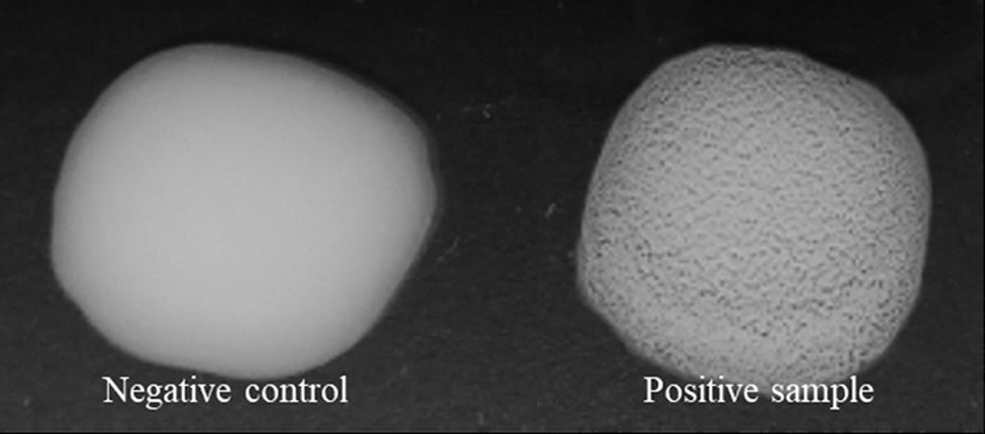
Lepto-latex agglutination test, negative control and positive results.
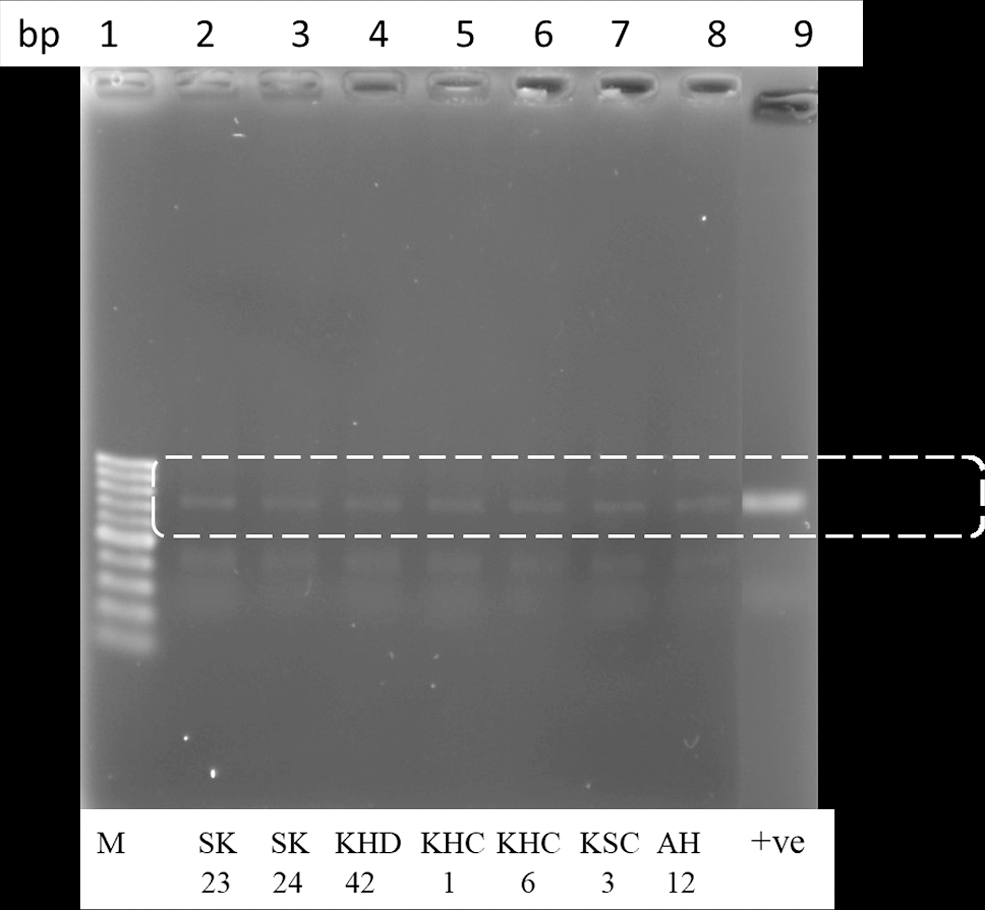
Gel electrophoresis of the PCR products of positive samples.
Positive Result in Different Subdistricts of Songkhla Province, Thailand
Discussion
A total of 434 samples of blood from 370 stray dogs and 64 stray cats were collected during the stray animal population control program between 2014 and 2018, which was carried out by the Songkhla provincial livestock office. Overall incidence of infection in stray animals was 1.61%, whereas the seroprevalence was 29.26%. The incidence in stray cats (7.81%) was higher than that in stray dogs (0.54%). This might be because cats still have a strong prey drive and an instinctive desire to hunt small prey including rodent. The results suggest that the stray animals might not have been infected at the time of sampling, but had been infected in the past or were in the latency period of infection. The number of positive samples with antibodies against Leptospira spp. in dogs was higher than that in cats, whereas stray cats were more likely to have an active infection than stray dogs. The highest number of seropositive samples was found in Hatyai, followed by the Klong Hoi Kong subdistrict. Both of these subdistricts are located in the central region of Songkhla province; Hatyai is the main area for tourist shopping and Klong Hoi Kong is the location of an airport. As the results of this study demonstrate, stray dogs and cats are potential maintainers of leptospirosis. Although the governor has encouraged people to be aware of animal welfare, there are many stray animals and the number is still rising. This might be because some owners are not responsible when it comes to dog or cat population control. When the number of animals increases and owners do not have the funds to care for them, they will leave those animal outside their residence, or at temples, markets, universities, schools, trash collection areas, etc. Therefore, the number of stray animals in Thailand is high, including in Songkhla province. In addition, there are many construction campsites for workers, who feed the animal but then leave without them. After that, some merciful people feed them but do not bring them to their house or shelter. The stray animal population is increasing every year and there are many zoonotic diseases in Thailand such as rabies and leptospirosis. The results of this study showed a higher seroprevalence than that found in other regions for stray dogs. A previous study in Chiang Mai province showed the prevalence of Leptospira antibodies in dog was 11%. According to the detection by microagglutination test in Serbia, the seroprevalence was 5.45% (Vijinovic et al. 2015). The molecular detection of Leptospira spp. antigens in the blood of dogs found a prevalence of 1.61% (septicemia), which was lower than that detected in the urine of dogs (Sant'anna et al. 2017, Zaidi et al. 2018) since Leptospira spp. targets the kidney and is eliminated in the urine. The animals with septicemia were in Hatyai, and might transfer the antigen to humans and other animals in the environment.
In Thailand, the prevalence of human infections of leptospirosis was 9.4%, and the circulating serovars were Australis, Sejroe, Shermani, Panama, Javanica, Cynopteri, Mini, Bataviae, Grippotyphosa, and Autumnalis (Petkanchanapong et al. 2005). The prevalence of Leptospira antibodies in dogs from Chiang Mai was 11%, and the most prevalent Leptospira serogroups were Bataviae, Canicola, Australis, Icterohemorrhagiae, Ballum, Djasimani, Javanica, Mini, and Sejroe (Meeyam et al. 2006). The prevalence was found to be 9.9% in cattle, 30.5% in buffalos, and 10.8% in pig. The most common serovars in cattle were Ranarum, Sejroe, and Mini, those in buffalo were Mini, Sejroe, and Bratislava, and those in pigs were Samin, Ranarum, Bratislava, and Pomona (Suwancharoen et al. 2016). Rodents are the main source of the infectious serovars Pyrogenes, Autumnalis, Bataviae, Javanica, and Australis (Tangkanukul et al. 2005). A study in Southeast Asia that assessed the presence of LipL32 in the kidney of rats found a prevalence of 7%. The species detected were Leptospira borgpetersenii, L. interrogans, Leptospira kirschneri, and Leptospira weillii (Cosson et al. 2014). The relationship between the occurrence of serovars in humans and animals is unclear. There are differences by region and environment; however, there are six serovars, Australis, Sejroe, Javanica, Mini, Bataviae, and Autumnalis, found in both humans and dogs. However, leptospirosis is a preventable disease. Control measures must include risk communications, improvement in sanitation and living conditions, and rodent control, as well as both prophylactic and therapeutic medical and veterinary interventions.
Conclusion
This study suggests that both stray dogs and cats act as an important reservoir for the transmission of leptospirosis to humans and other animals through soil or water contaminated with urine. To reduce the risk of infection, the One Health concept should be adopted, in addition to effective vaccination and an increase in public health awareness and concern about animal welfare. The presence of serovars in stray animals should be investigated.
Footnotes
Acknowledgments
The research team thanks the staff of the Livestock Department in Songkhla for providing help in collecting samples from stray animals in Songkhla province. Thank you to the faculty of Veterinary Science, Prince of Songkla University, for providing assistance in the use of laboratories for this research.
Author Disclosure Statement
No competing financial interests exist.
Funding Information
This project was accomplished thanks to research grants from the research office of Prince of Songkla University for the fiscal year 2017.