




Abstract
Rift Valley fever virus (RVFV) causes severe disease in domestic ungulates (cattle, goats, and sheep) and a febrile illness in humans (with ∼1% case fatality rate). This virus has been spreading geographically, and there is concern of it spreading to Europe or the Americas. Environmental temperature can significantly affect the ability of mosquitoes to transmit an arbovirus. However, these effects are not consistent among viruses or mosquito species. Therefore, we evaluated the effect of incubation temperatures ranging from 14°C to 30°C on infection and dissemination rates for Culex tarsalis and Aedes taeniorhynchus allowed to feed on hamsters infected with RVFV. Engorged mosquitoes were randomly allocated to cages and placed in incubators maintained at 14°C, 18°C, 22°C, 26°C, or 30°C. Although infection rates detected in Cx. tarsalis increased with increasing holding temperature, holding temperature had no effect on infection rates detected in Ae. taeniorhynchus. However, for both species, the percentage of mosquitoes with a disseminated infection after specific extrinsic incubation periods (4, 7, 10, 14, 17, or 21 days) increased with increasing incubation holding temperature, even after adjusting for the apparent increase in infection rate in Cx. tarsalis. The effects of environmental factors, such as ambient temperature, need to be taken into account when developing models for viral persistence and spread in nature.
Introduction
The introduction of West Nile virus (WNV) in 1999 (Lanciotti et al. 1999), chikungunya virus in 2013 (Cassadou et al. 2014), and Zika virus (Lednicky et al. 2016) into the Americas illustrates the potential for an exotic virus to expand its range. Of particular concern is Rift Valley fever virus (RVFV), genus Phlebovirus, family Phenuiviridae, order Bunyavirales, which was responsible for numerous outbreaks of severe disease in ruminants and humans in sub-Saharan Africa over the past 80 years (Meegan and Bailey 1988, Gerdes 2004, Bird et al. 2009, Jansen van Vuren et al. 2018). Infection in pregnant animals usually results in abortion, and infection of newborn animals is nearly always fatal (Easterday et al. 1962, Easterday 1965, Meegan and Bailey 1988, Bird et al. 2009).
In humans, most infections result in an undifferentiated febrile illness. However, ∼1% of infections result in hemorrhagic complications, which are often fatal, and an additional 1% develop encephalitis from which the patient usually recovers. Ocular sequellae that can cause retinal damage, including blindness, have also been documented (Schrire 1951, Siam and Meegan 1980, Al-Hazmi et al. 2005).
Before an outbreak in Egypt in 1977, which caused an estimated 200,000 human cases and having devastating effects on the sheep and cattle industry, RVFV was only known from sub-Saharan Africa (Laughlin et al. 1979, Meegan 1979). The continued potential of RVFV to cause economic disruption was demonstrated when it spread in the Arabian Peninsula (Jupp et al. 2002, Shoemaker et al. 2002, Balkhy and Memish 2003, Madani et al. 2003), and recent outbreaks in East and South Africa (Métras et al. 2013, Himeidan et al. 2014, Fafetine et al. 2016, Jansen van Vuren et al. 2018). This has raised concerns regarding the agricultural and medical impact this zoonotic disease agent might have if it were introduced into Europe or the Americas (House et al. 1992, Britch et al. 2007, Hartley et al. 2011, Dente et al. 2018).
Although most members of the genus Phlebovirus are transmitted by sand flies, RVFV has been associated almost exclusively with mosquitoes in nature, with the virus isolated from at least 50 species in eight genera (Meegan and Bailey 1988, Logan et al. 1991, Fontenille et al. 1998, Sang et al. 2010, Ba et al. 2012). Various studies have indicated that a number of North American mosquito species are competent vectors of RVFV (Gargan et al. 1988, Turell et al. 2008, 2010, 2013, Iranpour et al. 2011). However, nearly all these studies were conducted at a constant temperature of 26°C or 27°C. The few studies that examined the effect of environmental temperature (Turell et al. 1985, Turell 1989, 1993, Brubaker and Turell 1998) have indicated that the temperature at which mosquitoes are maintained after virus exposure can significantly affect their ability to transmit RVFV.
Similar laboratory results with other viruses (e.g., WNV) have demonstrated that environmental temperature not only affects the ability of mosquitoes to transmit virus in the laboratory, but also more importantly, affects the ability to transmit virus in nature (Reisen et al. 2006, Ruiz et al. 2010). The effects of environmental temperature have not been consistent between mosquito species or between viruses. Although most viruses are transmitted more efficiently at warmer temperatures, increased environmental temperatures are associated with lower efficiency of transmission of western equine encephalitis virus (WEEV) by Culex tarsalis Coquillett in the laboratory (Kramer et al. 1983, Reisen et al. 1996), and warmer spring temperatures are associated with decreased case rates in the western United States (Hess et al. 1963).
Because Cx. tarsalis is one of the most competent vectors of RVFV in the laboratory (Gargan et al. 1988, Turell et al. 2010) and environmental temperature has had different effects on the transmission of WEEV (Kramer et al. 1983) and WNV (Reisen et al. 2006) by Cx. tarsalis, we evaluated the effect of environmental holding temperature on the ability of Cx. tarsalis to transmit RVFV under laboratory conditions. As a control species, we also tested the effect of environmental temperature on the ability of Aedes taeniorhynchus to transmit RVFV. Because of the potential for severe consequences during outbreaks, RVFV is considered a major zoonotic threat and is classified as a Category A overlap Select Agent by the Centers for Disease Control and Prevention (CDC) and the U.S. Department of Agriculture (USDA) (CDC 2013).
Materials and Methods
Mosquitoes
For Cx. tarsalis, we used a colony provided by the Arthropod-Borne Animal Diseases Research Laboratory, Laramie, WY (now located in Manhattan, KS), originally from the University of California-Davis, and for Ae. taeniorhynchus, we used specimens from a colony provided by the USDA-ARS Center for Medical, Agricultural and Veterinary Entomology, Gainesville, FL. Before use in this study, both species were maintained in colonies in a BSL-2 insectary at U.S. Army Medical Research Institute of Infectious Diseases (USAMRIID) and at 26°C with a 16:8 (L:D) photoperiod.
Virus and virus assays
We used the ZH501 strain of RVFV, isolated in 1977 from the blood of a 10-year-old Egyptian girl who had a fatal RVFV infection (Meegan 1979). This strain was passed twice in fetal rhesus monkey lung cells and once in Vero (African green monkey kidney) cells before use in this study.
Mosquito specimens were triturated in 1 mL of diluent (10% heat-inactivated fetal bovine serum in Eagle's minimal essential medium [Mediatech, Inc., Manassas, VA] and antibiotics) and then frozen at −80°C until tested for infectious virus by a plaque assay on Vero cell monolayers. Virus titers were expressed as log10 plaque-forming units (PFU) per specimen.
Determination of the effect of environmental temperature on vector competence
Adult female Syrian hamsters were inoculated intraperitoneally with 0.2 mL of a suspension containing between 103.8 and 104.9 PFU of RVFV to provide a source of viremic blood. These hamsters were anesthetized 1 day later and placed individually (i.e., one per cage) on top of cages each containing 100–200 mosquitoes. Immediately after mosquito feeding, a blood sample was collected from the anesthetized hamsters by cardiac puncture and the hamsters were then killed by CO2 exposure. The blood suspensions (0.2 mL of blood added to 1.8 mL of diluent) were frozen at −80°C until assayed on Vero cell monolayers (as described previously for the mosquito suspension) to determine viremias at the time of mosquito feeding.
Immediately after exposure to the viremic hamsters, the engorged mosquitoes were removed and randomly placed into three or four 3.7 L cardboard cages. These cages were then placed in incubators maintained at 14°C, 18°C, 22°C, 26°C, or 30°C and apple slices or 10% sucrose solution were provided as a carbohydrate source. Unengorged mosquitoes were killed by freezing at −20°C. Samples, consisting of 5–10 mosquitoes each, were removed at 4, 7, 10 or 11, 14, 17, 21, and 25 days after virus exposure. These mosquitoes were killed by freezing at −20°C for at least 5 min, and their legs and bodies triturated separately in 1 mL of diluent. These suspensions were then frozen at–80°C until assayed for RVFV.
The extent of virus infection in mosquitoes was determined by assaying a mosquito's body separately from its legs. If virus was detected in its body, but not its legs, the mosquito was considered to have a nondisseminated infection limited to its midgut. In contrast, if virus was detected in both the body and leg suspensions, the mosquito was considered to have a disseminated infection (Turell et al. 1984).
The infection rate was the percentage of mosquitoes tested that contained virus after feeding on the original viremic hamsters. The dissemination rate was the percentage of mosquitoes tested that contained virus in their legs (regardless of their infection status) after feeding on the original viremic hamsters. Rates between various groups were compared with a Fisher's exact test. A moving average (Anderson 1994) was used to adjust for the variability associated with the small sample sizes of infected mosquitoes at some of the time points for graphing the effect of time and temperature on the development of a disseminated infection in infected mosquitoes.
Ethics statement
Research was conducted under an Institutional Animal Care and Use Committee (IACUC) approved protocol in compliance with the Animal Welfare Act, PHS Policy, and other Federal statutes and regulations relating to animals and experiments involving animals. The facility where this research was conducted is accredited by the Association for Assessment and Accreditation of Laboratory Animal Care International and adheres to principles stated in the Guide for the Care and Use of Laboratory Animals, National Research Council, 2011.
Results
Hamster viremia
Viremias in the hamsters at the time of Cx. tarsalis feeding ranged from 106.9 to 1010.5 PFU/mL of blood, whereas those for the Ae. taeniorhynchus feedings ranged from 108.7 to 1010.2 PFU/mL. For Cx. tarsalis, infection and dissemination rates were similar at each temperature for those mosquitoes that fed on hamsters with viremias of 109.3 or 109.5 PFU/mL or for those that fed on hamsters with viremias of 1010.3 or 1010.5 PFU/mL (Fisher's exact test, p ≥ 0.068). However, mosquitoes fed on the higher viremias had a significantly higher dissemination rate than those mosquitoes fed on the lower viremia when they were held at 26°C (p = 0.015) or 30°C (p = 0.029). Therefore, the data were analyzed for three separate groups, those feeding on a viremia of 106.9, 109.3 or 109.5, and 1010.3 or 1010.5 PFU/mL. Because infection and dissemination rates were similar for Ae. taeniorhynchus that fed on hamsters with viremias of 108.7 or 1010.2 PFU/mL (p ≥ 0.10), these data were combined for further analysis.
Effect of holding temperature on the vector competence of Cx. tarsalis
Of interest, each of the eight mosquitoes held at 14°C for 7 days still contained undigested blood and ≥105 PFU of RVFV was recovered from each of these mosquitoes. However, virus was not recovered from the legs of any of them. The detected virus from these mosquitoes was attributed to the original blood meal and these mosquitoes were not used in the calculation of an infection rate. Although infection rates in mosquitoes held at each temperature remained relatively constant over the entire incubation period tested, infection rates increased consistently with increasing holding temperatures and increasing exposure dose (Table 1). In contrast, dissemination rates increased with increasing period of incubation and with both increasing holding temperature and increasing exposure dose (Table 2). These differences were statistically significantly different, however, only for dissemination rates between those mosquitoes held at 14°C or 18°C and those held at
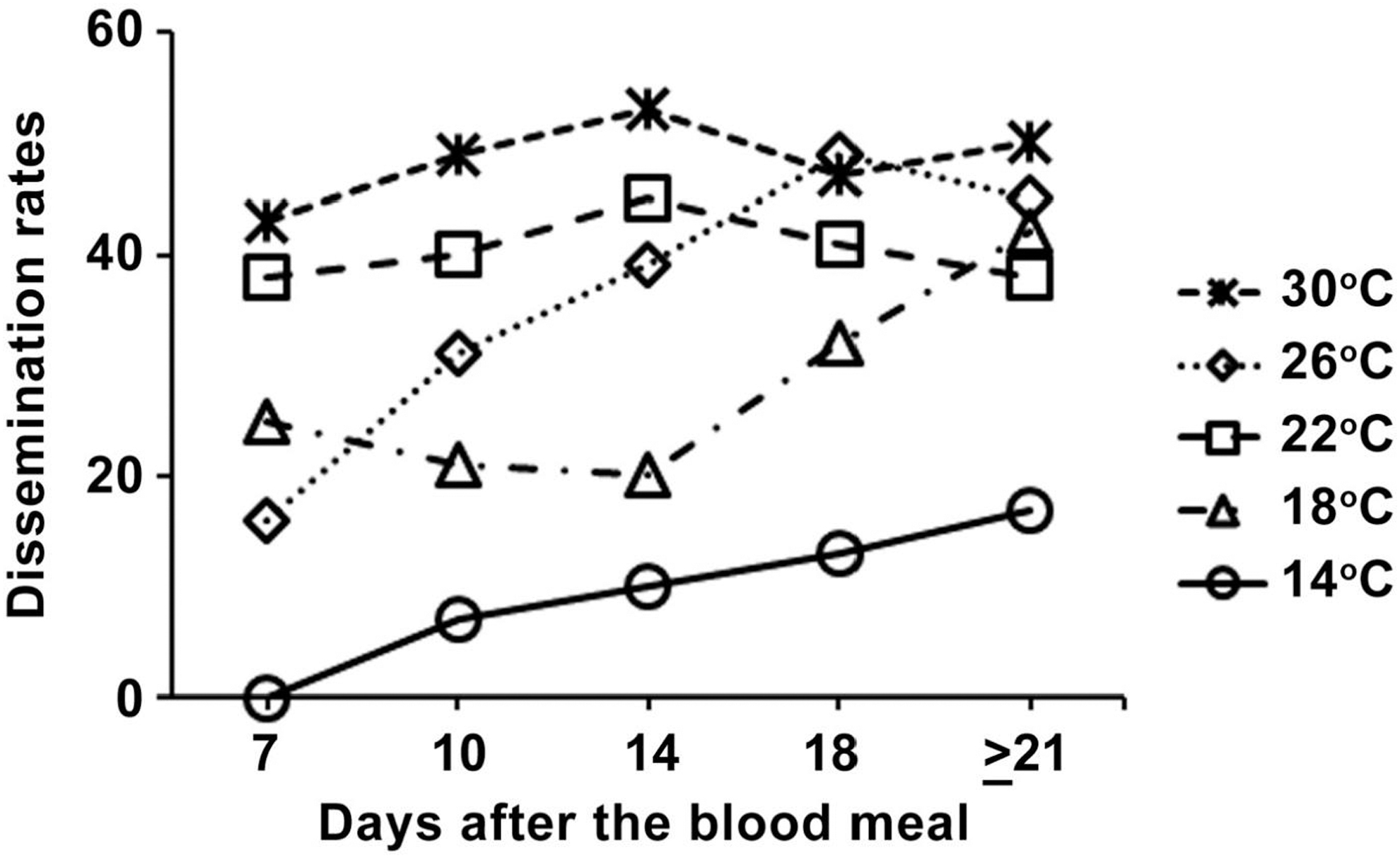
Effect of environmental temperature on dissemination rates in Culex tarsalis infected with RVFV by day after the infectious blood meal. A moving average (Anderson 1994) was used to adjust for the variability associated with the small sample sizes of infected mosquitoes at some of the time points. RVFV, Rift Valley fever virus.
Infection Rates in Culex Tarsalis by Day After Feeding on a Hamster Infected with Rift Valley Fever Virus
Viremia level (PFU/mL) at the time of mosquito feeding.
Combined infection rates for all specimens tested at that holding temperature. Rates followed by the same letter are not significantly (α = 0.05) different by Fisher's exact test.
Each of the eight mosquitoes still contained undigested blood and the virus recovered from these mosquitoes was attributed to the original blood meal.
NT, not tested; PFU, plaque-forming units.
Dissemination Rates in Culex Tarsalis by Day After Feeding on a Hamster infected with Rift Valley Fever Virus
Dissemination rates for mosquitoes held ≥14 days at that temperature (number tested). Rates followed by the same letter are not significantly (α = 0.05) different by Fisher's exact test.
Viremia level (PFU/mL) at the time of mosquito feeding.
Dissemination rate = percentage of mosquitoes tested, regardless of infection status, containing virus in their legs (number tested).
Effect of holding temperature on the vector competence of Ae. taeniorhynchus
The detected infection rates were not affected by either holding temperature or the period of incubation (Table 3). As with the Cx. tarsalis, dissemination rates increased both with increasing temperature and with increasing periods of incubation (Table 4). When only the infected mosquitoes were analyzed, the effect of time and temperature on dissemination rates was even more dramatic (Fig. 2).
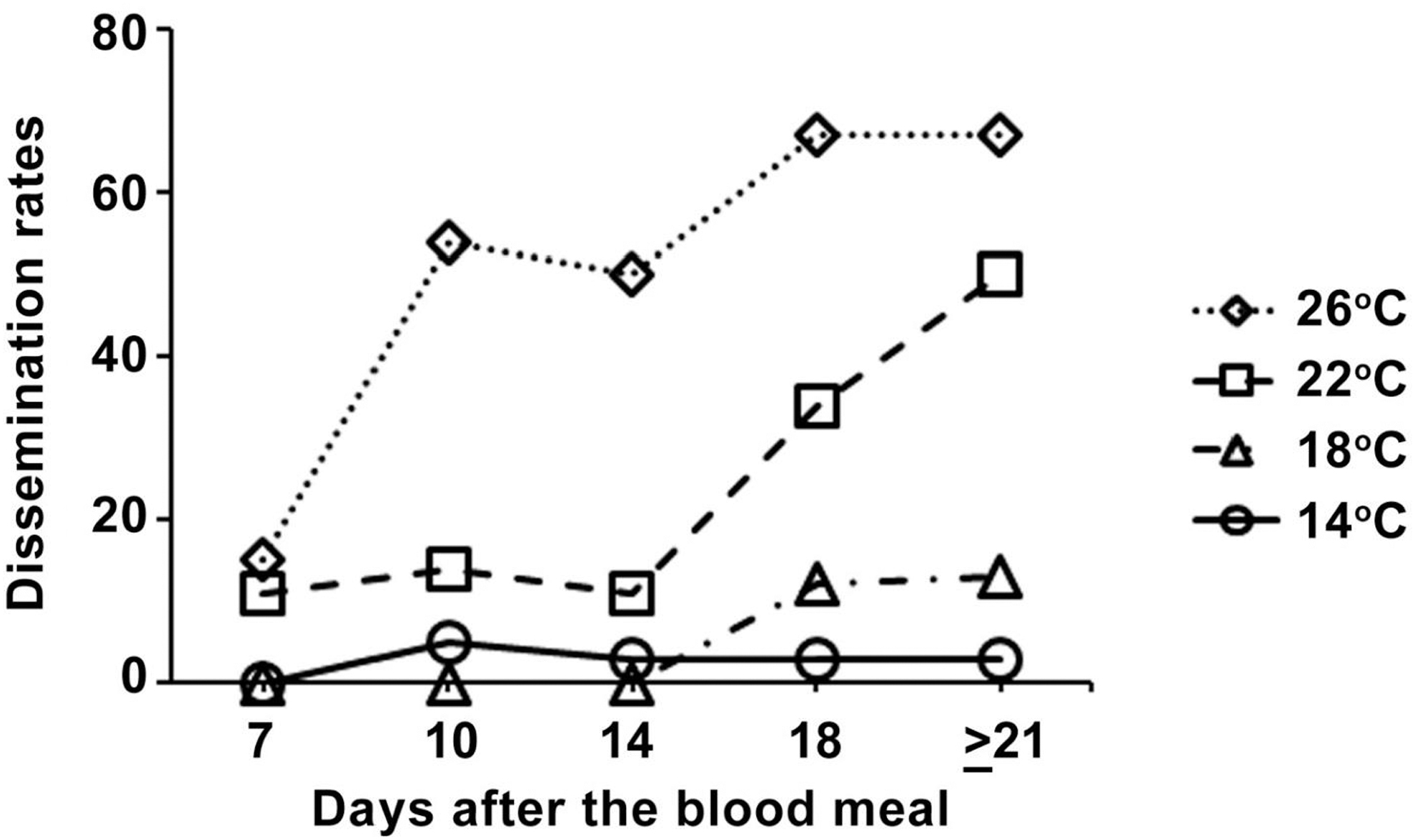
Effect of environmental temperature on dissemination rates in Aedes taeniorhynchus infected with RVFV by day after the infectious blood meal. A moving average (Anderson 1994) was used to adjust for the variability associated with the small sample sizes of infected mosquitoes at some of the time points.
Infection Rates in Aedes Taeniorhynchus by Day After Feeding on a Hamster with a Rift Valley Fever Viremia ≥108.7 Plaque-Forming Units/mL
Infection rates at the various temperatures were not significantly different (p ≥ 0.19).
Infection rate = percentage of mosquitoes containing virus in their bodies (number tested).
Dissemination Rates in Aedes Taeniorhynchus by Day After Feeding on a Hamster with a Rift Valley Fever Viremia ≥108.7 Plaque-forming Units/mL
Dissemination rates for mosquitoes held ≥10 days at that temperature (number tested). Rates followed by the same letter are not significantly (α = 0.05) different by Fisher's exact test.
D.R.i = percentage of infected mosquitoes held ≥14 days containing virus in their legs (number tested). Rates followed by the same letter are not significantly (α = 0.05) different by Fisher's exact test.
Dissemination rate = percentage of mosquitoes tested, regardless of infection status, containing virus in their legs (number tested).
Discussion
For both species tested, increased holding temperature was associated with more rapid and more efficient development of a disseminated infection, and thus increased potential transmission of RVFV. Although environmental temperature affected vector competence in both species, the effect differed between the two species. With Cx. tarsalis, holding the mosquitoes at a lower temperature was associated with lower detectable infection rates. This is similar to what was observed with Culex pipiens exposed to RVFV (Turell et al. 1985, Brubaker and Turell 1998) and to Cx. pipiens (Dohm and Turell 2001, Dohm et al. 2002) and Cx. tarsalis (Danforth et al. 2016) exposed to WNV. In the studies with Cx. pipiens, it was determined that the reduction of infection rate in mosquitoes held at lower temperatures was because of an inability to detect the virus, rather than infectious virus not being present. When these mosquitoes were transferred to a warmer temperature, infectious virus readily reappeared and infection rates were not significantly different from in mosquitoes held at the warmer temperature for the entire time (Turell et al. 1985, Brubaker and Turell 1998, Dohm and Turell 2001, Dohm et al. 2002). However, the effect of holding temperature on RVFV infection rates in Cx. pipiens was much greater than that was observed in this study with Cx. tarsalis. This may be because of the overall greater susceptibility of Cx. tarsalis to infection and dissemination with RVFV than Cx. pipiens (Turell et al. 1984, 2010, Gargan et al. 1988). In contrast, we did not observe any consistent pattern of infection rates and holding temperature in Ae. taeniorhynchus. This is similar to what was reported in an earlier study with this species and in Aedes fowleri (Turell et al. 1985, Turell 1989). Although apparent infection rates in Cx. tarsalis increased with increasing hamster viremia and holding temperature, infection rates remained essentially constant at each time point for mosquitoes of both species held at each of the temperatures tested.
For both Ae. taeniorhynchus and Cx. tarsalis, RVFV disseminated more rapidly and reached higher rates in those mosquitoes held at warmer temperatures. However, with Cx. tarsalis, this appeared to be a combination of an effect of temperature on both infection and dissemination rates and when only the apparently infected mosquitoes were used in the analysis, the effect of temperature on viral dissemination was not as consistent (Fig. 1). In contrast, when only the infected Ae. taeniorhynchus were included in the analysis, the role of environmental temperature was even more dramatic (Fig. 2). Although not tested in the current experiment, previous studies have indicated that nearly all Cx. tarsalis with a disseminated RVFV infection transmitted virus by bite (Gargan et al. 1988, Turell et al. 2010, Iranpour et al. 2011, MJT, unpublished data), and ∼50% of the Ae. taeniorhynchus with a disseminated RVFV infection transmitted this virus by bite (Turell et al. 1985, Turell and Bailey 1987, Gargan et al. 1988). Therefore, we would expect that nearly all the Cx. tarsalis and about 50% of the Ae. taeniorhynchus with a disseminated infection in this study would have transmitted virus if allowed to feed.
Increased infection and dissemination rates with warmer temperatures in Cx. tarsalis was similar to findings when this species was exposed to other viruses including WNV (Reisen et al. 2006) and St. Louis encephalitis virus (Reisen et al. 1993). In contrast, holding at increased temperatures was associated with decreased transmission rates in Cx. tarsalis exposed to WEEV (Kramer et al. 1983, Reisen et al. 1993). These findings will impact RVF mathematical models. Several recent RVF models account for the effect of environmental temperature on mortality, reproduction, and other traits of Culex and Aedes mosquitoes. However, these models hold infection, dissemination, and transmission rates constant (Xue et al. 2012, 2013, Mweya et al. 2014, Xiao et al. 2015), regardless of temperature, whereas others only looked at potential vectors and did not account for effects of temperature on either the mosquito or vector competence (Golnar et al. 2014). Environmental temperature affects other factors related to vectorial capacity such as shorter extrinsic incubation resulting in mosquitoes being infectious for more of their lifespan, thus influencing the overall efficiency of transmission. Therefore, these models likely underestimate the transmission rates of mosquitoes to mammals under warmer climatic conditions. Similarly, global climate change and environmental models predicting the impact of disease on wildlife and the future risk to humans may also have to be adjusted to account for increased transmission risk in warmer areas (Barker et al. 2013).
Conclusion
For both species tested, increased holding temperature was associated with more rapid and more efficient development of a disseminated infection, and thus increased potential for transmission of RVFV. Although environmental temperature affected vector competence in both species, the effect differed between the two species. With Cx. tarsalis, holding the mosquitoes at a lower temperature was associated with lower detectable infection rates, whereas holding temperature did not appear to affect infection rates in Ae. taeniorhynchus.
Footnotes
Acknowledgments
The authors thank D. Klein, USDA-Center for Medical, Agricultural and Veterinary Entomology, Gainesville, for providing the Ae. taeniorhynchus used in this study; and K. Olson, Colorado State University, for providing the California Cx tarsalis used to initiate the colony used in this study. The authors also thank D. Nash for rearing the mosquitoes used in this study; J. Williams for caring for the hamsters; L. Farinick for drawing the figures, and D. Dohm, S. Pisarcik, S. Padilla, and J. Hinson for assisting in the testing of the mosquitoes.
Disclaimer
The views expressed in this article are those of the authors and do not necessarily reflect the official policy or position of the Department of Defense, Department of Agriculture, or the U.S. Government. The use of any specific product does not constitute endorsement of that product, and the opinions, interpretations, conclusions, and recommendations are those of the authors and are not necessarily endorsed by the U.S. Army or the U.S. Department of Agriculture. All authors are current or former employees of the U.S. Government. This study was prepared as part of their official duties.
Author Disclosure Statement
No conflicting financial interests exist.
Funding Information
This project was funded through interagency agreements with the Science and Technology Directorate of the U.S. Department of Homeland Security under award no. HSHQDC-07-00982 and the USDA Agricultural Research Service project no. 5430-32000-005-00D.