




Abstract
Rickettsia species cause rickettsioses, which are zoonotic diseases found worldwide, and are transmitted by arthropods such as lice, fleas, ticks, and mites. In Thailand, flea infestations are common among cats and dogs. This study aimed at determining the exposure to spotted fever group rickettsiae (SFGR) of cats in surrounding areas of Rajabhat Maha Sarakham University, Muang district, Maha Sarakham province and rickettsial infection among cat fleas, Ctenocephalides felis, collected from dogs of the surrounding area of Waeng Noi district, Khon Kaen province. Forty-two cat sera were assessed for IgG antibody titers against SFGR by a group-specific enzyme-linked immunosorbent assay. The prevalence of seroreactive cats was 4.76% (2/42). DNA preparations from 23 individual cat fleas from three dogs were assessed by Rickettsia genus-specific, group-specific, and species-specific quantitative real-time PCR (qPCR) assays. Positive results were confirmed by ompB gene fragment sequencing. Twenty-one of 23 cat fleas were positive for Rickettsia asembonensis, and the other two DNA preparations were negative for rickettsial DNA. This study's finding indicates that companion cats and dogs in Northeast Thailand are exposed to SFGR and that exposure may be due to infection with R. asembonensis, an organism known to infect humans, monkeys, and dogs. Clinicians for humans and animals in Northeast Thailand should be aware of rickettsial infections among their patients.
Introduction
In Thailand, the first detection of a spotted fever group rickettsia (SFGR) occurred in 1962. The rickettsia (Rickettsia species TT118) was isolated from a mixed pool of larval ticks of Ixodes sp. and Rhipicephalus sp. collected from Rattus rattus trapped in Chiang Mai Province (Robertson and Wisseman 1973). Since then, several studies have serologically documented SFG rickettsioses in Thailand (Sirisanthana et al. 1994, Strickman et al. 1994, Blacksell et al. 2015, Takhampunya et al. 2019) and surrounding countries (Tay et al. 2003, Kasper et al. 2012, Mayxay et al. 2015, Trung et al. 2017). In addition, evidence of tick-borne SFGR cases have been reported in Thailand to include human infections with Rickettsia helvetica, Rickettsia japonica, and Rickettsia honei (Parola et al. 2003a, Fournier et al. 2004, Jiang et al. 2005b, Gaywee et al. 2007, Takada et al. 2009).
Flea-borne rickettsial diseases include those due to infections with TGR and SFGR (Azad 1990). The flea-borne TGR only includes R. typhi, the causative agent of murine typhus, a disease well known to be endemic to Thailand. R. typhi is most commonly transmitted by the Oriental rat flea (Xenopsylla cheopis), which is commonly associated with the rat species, Rattus exulans and R. rattus (Sankasuwan et al. 1969, Silpapojakul et al. 1993, Parola et al. 2003a, Bhengsri et al. 2016, Linsuwanon et al. 2018, Wangrangsimakul et al. 2018, Luvira et al. 2019).
Though flea-borne SFGR are known to be present in Thailand, only three cases of flea-borne spotted fever have been reported (Parola et al. 2003a, Edouard et al. 2014). This may be due to the limited presence of the causative agent, Rickettsia felis, in flea vectors, mainly the cat and dog fleas (Ctenocephalides felis and Ctenocephalides canis, respectively) (Foongladda et al. 2011, Assarasakorn et al. 2012, Takhampunya et al. 2019). However, there have been reports of the R. felis-like organisms (RFLOs) present in Thailand, including the first report of RFLOs from Kanchanaburi province near the central Thai-Myanmar border. The two agents discovered were Rickettsia isolates RF2125 and RF31 (Parola et al. 2003b), now believed to have been Rickettsia asembonensis and Ca. R. senegalensis, respectively (Maina et al. 2019). The presence of these agents has been described only in Bangkok (Foongladda et al. 2011) and Nan Province in North Thailand (Takhampunya et al. 2019). Thus, further investigations of the presence and distribution of these agents throughout Thailand is needed. This article describes the investigation of SFGR in two districts within the two northeast provinces, Maha Sarakham and Khon Kaen.
Maha Sarakham and Khon Kaen are tropical provinces where flea infestations are common among cats and dogs (Personal observations S.P. and F.S.). Although these companion animals are likely to be exposed to fleas and flea-borne pathogens, only a few studies investigating the domestic animals and their ectoparasitic fleas have been reported to date (Parola et al. 2003b, Foongladda et al. 2011, Assarasakorn et al. 2012, Takhampunya et al. 2019). This study aimed at determining the cats' exposure to SFGR in the surrounding areas of Rajabhat Maha Sarakham University, Muang district, Maha Sarakham province and fleas of dogs from Waeng Noi district, Khon Kaen province.
Materials and Methods
Cat sera and SFGR IgG-ELISA
Blood samples from 42 client-owned and stray cats from the surrounding areas of Rajabhat Maha Sarakham University, Muang district, Maha Sarakham province during April–August 2015 were available for this study following their use in clinical evaluation of the cats. These excess blood samples were not linked to individual cats, so the relationship between the blood samples and the clinical status of the cats is unknown or whether they were from client-owned or stray cats. The blood samples were collected as per veterinarian humane procedures of Thailand.
Sera were separated from blood samples and stored at −20°C. They were subsequently assessed for IgG antibody titer against SFGR by a group-specific enzyme-linked immunosorbent assay (ELISA), as previously described (Jiang et al. 2015) except that a 1:2000 dilution of goat anti-cat antibody conjugated to HRP was used instead of a goat anti-human antibody conjugated to HRP. The whole-cell ELISA antigen preparation was derived from Rickettsia conorii Moroccan, as previously described (Jiang et al. 2015).
Cat fleas, DNA extraction, and qPCR
Twenty-three fleas (C. felis) were obtained from three dogs as convenience samples in 2013 in Waeng Noi district, Khon Kaen province. Fleas were stored in 75% ethanol for 2 months until they were morphologically identified by using the entomological taxonomic keys of Segerman (1995). DNA was extracted from individual flea triturates by DNeasy blood and tissue kit (Qiagen, Valencia, CA) as per manufacturer's instructions. Two microliters of individual DNA preparations were tested by the Rickettsia genus-specific assay (Rick17b), as previously described (Jiang et al. 2012). Positive samples were subsequently tested by the group-specific qPCR assay (RfelG), the qPCR assay that detects R. felis and Candidatus Rickettsia senegalensis (RfelB), and the species-specific qPCR assays for Rickettsia typhi (Rtyph) and R. asembonensis (Rasemb) as previously described (Henry et al. 2007, Odhiambo et al. 2014).
PCR and sequencing
A subset of 11 samples positive for rickettsia using the genus-specific assay, Rick17b, and the species-specific assay for R. asembonensis (Rasemb) were subsequently assessed by sequence typing using a fragment of the variable gene, ompB. Amplicons of these fragments were produced by PCR and nested PCR (nPCR) with primers (Table 1) and methods previously described (Jiang et al. 2013). The amplicons were cleaned and processed for sequencing by methods previously described (Jiang et al. 2013).
Oligonucleotide Primers Used for Polymerase Chain Reaction and Sequencing of Rickettsia ompB
Primers used for PCR.
Primers used for sequencing.
Phylogenetic analysis
Partial ompB sequence, a 3631 bp fragment, obtained from the DNA extract designated as Rickettsia sp. CF13, from C. felis flea number 13 of Waeng Noi District, Khon Kaen was deposited in GenBank (accession number: MK862574). Blast searches were carried out for the gene fragments on the NCBI website (
Results
The prevalence of seroreactivity to SFGR among cats assessed was determined to be 4.76% (2/42). The two positive cat serum samples had IgG titers of 1600 each against SFGR ELISA antigen preparation.
The prevalence of R. asembonensis in cat fleas based on genus-, group-, and species-specific qPCR assays was 91.3% (21 of 23 individual fleas) from three free roaming companion dogs. The identity of the Rickettsia sp. DNA within the positive fleas was confirmed to be R. asembonensis by sequencing ompB gene fragments of a subset of positive flea DNA preparations [11 of 21 (52.4%)]. The ompB sequences from 11 fleas were identical with each other. Blast search using a 3631 bp fragment of the ompB showed that Rickettsia sp. CF13 was 99.8% (3624 bp/3631 bp) identical to R. asembonensis isolate VGD7. A phylogenetic tree was developed by using the ompB sequence, and the sequences obtained from fleas collected from Northeast Thailand were clustered with R. asembonensis (Fig. 1).
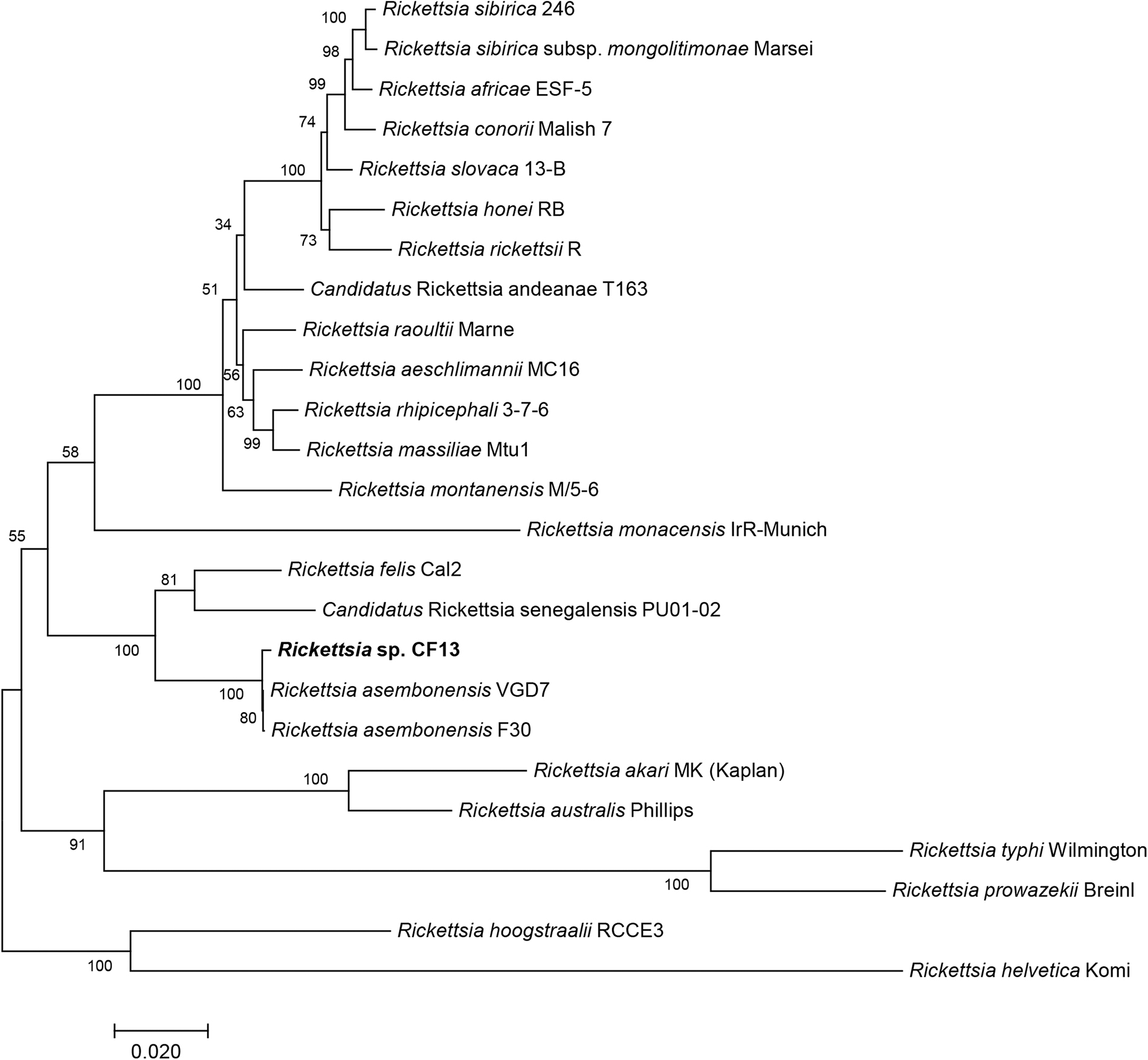
Phylogenetic tree of ompB gene fragments (3631 bp) from various rickettsiae and a representative isolate (Rickettsia asembonensis CF13 GenBank # MK862574) from a Ctenocephalides felis (CF13) DNA preparation from a dog of Waeng Noi district, Khon Kaen province, Northeast Thailand.
Discussion
The study findings indicate that companion cats in Maha Sarakham are exposed to SFGR, possibly due to infection with R. asembonensis and/or other flea-borne SFGR such as R. felis, a human pathogen and/or Candidatus “Rickettsia senegalensis” and an agent of unknown pathogenicity vectored by cat fleas (Mediannikov et al. 2014, Legendre and Macaluso 2017). SFGR infections of the cats could also have been due to tick-borne SFGR such as R. honei (TT118) (Robertson and Wisseman 1973, Jiang et al. 2005b), R. helvetica (Fournier et al. 2004), and R. japonica (Gaywee et al. 2007, Takada et al. 2009). Unfortunately, there is limited information on SFGR that infect cats, dogs, or, for that matter, humans in Thailand and therefore the need to conduct additional investigations of SFGR infections of humans and animals is warranted.
In addition, the results described herein showed that the specific identification of the flea-borne SFGR, R. asembonensis, was found in 21 of 23 cat fleas from three dogs. The cat fleas were collected from free-ranging companion dogs of Khon Kaen, an adjoining province to Maha Sarakham (Fig. 2). It is not unusual to find a high prevalence of R. asembonensis and low prevalence of R. felis among cat (and dog) fleas, as this has been shown in various reports in various regions, including such diverse locations as Thailand (Parola et al. 2003b, Foongladda et al. 2011, Assarasakorn et al. 2012, Takhampunya et al. 2019), Kenya (Jiang et al. 2013), Kazakhstan (Sansyzbayev et al. 2017), Israel (Rzotkiewicz et al. 2015), and Peru (Kocher et al. 2016), though R. asembonensis has yet to be reported from Australia even though R. felis infection of humans has been reported (Maina et al. 2019). Interestingly, in locations in the United States where murine typhus occurs in suburban and urban settings (southern and central Texas and southern California) the rat flea-rat cycle of murine typhus has been replaced by a cat flea-cat and cat flea peri-domestic animal (e.g., opossums) cycles in the same locations as the cat flea-cat/peri-domestic animal cycle of flea-borne spotted fever (Maina et al. 2016, Nelson et al. 2018, Blanton et al. 2019); there is a larger prevalence of R. felis than R. asembonensis among the fleas.
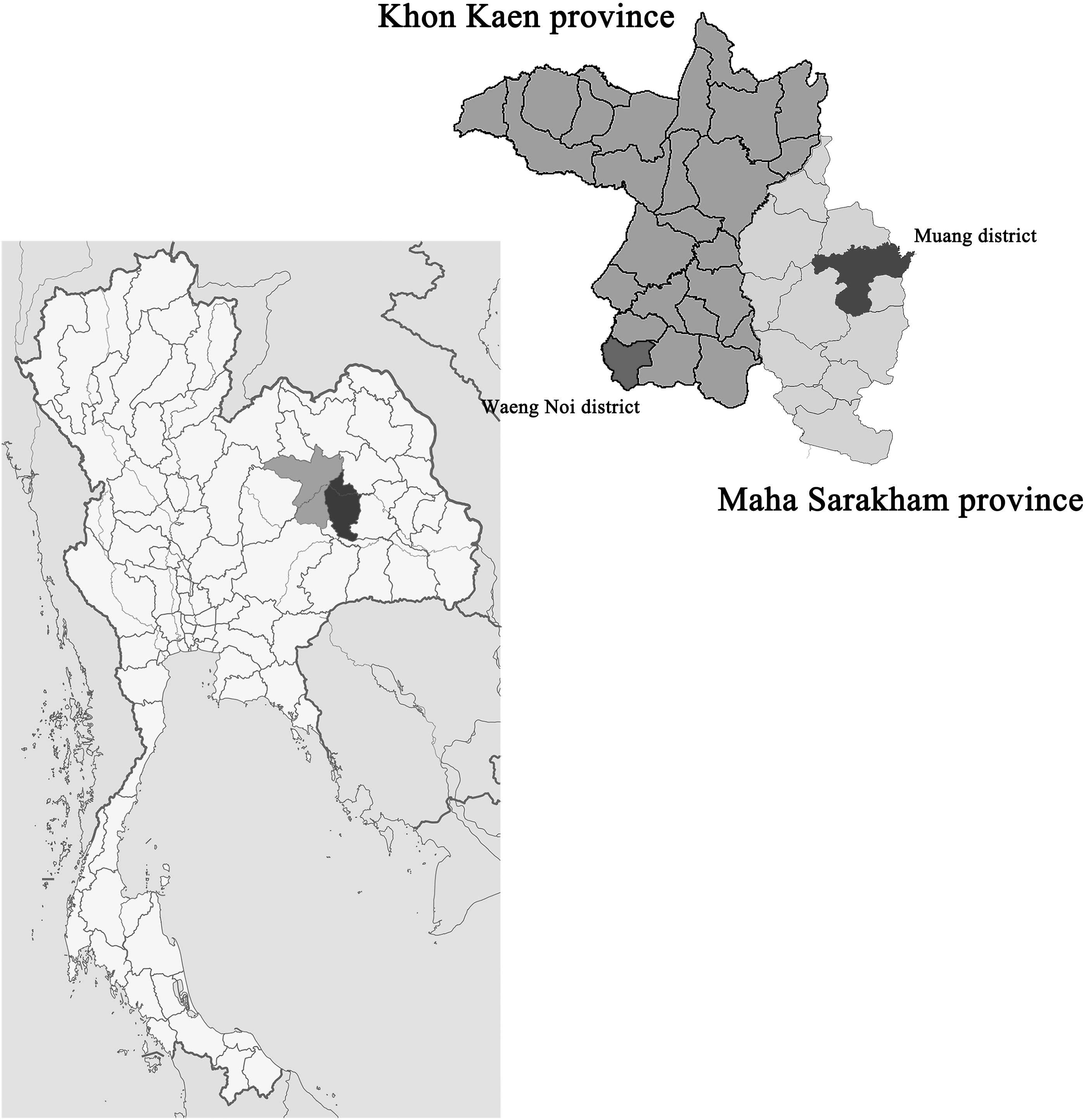
Map of Thailand with collection districts Muang and Waeng Noi in the provinces of Maha Sarakham and Khon Kaen, respectively, highlighted.
The other flea-borne SFGR, R. felis and Ca. R. senegalensis, and the flea-borne TGR, R. typhi were not detected in the limited number of fleas assessed in this study. This may be due to the limited presence of R. felis and Ca. R. senegalensis in cat fleas in Thailand (Parola et al. 2003a, Foongladda et al. 2011, Takhampunya et al. 2019) and of the low prevalence of R. typhi usually found in rural areas and in cat fleas (Azad 1990).
In conclusion, the results of this project show the presence of SFGR in general and R. asembonensis, specifically in Northeast Thailand. With the recent reports associating R. asembonensis with human infection in Malaysia (Kho et al. 2016), Thailand (Rodkvamtook et al. 2018), and Peru (Palacios-Salvatierra et al. 2018) and in animals (dogs and monkeys) (Tay et al. 2015, Kolo et al. 2016) health care providers should consider both flea- and tick-borne SFGR as emergent threats to human and animal health in this important region of Thailand.
Footnotes
Acknowledgment
Part of the material provided in this article was presented at the 2016 KVAC conference, Khon Kaen, Thailand.
Author Disclosure Statement
There is no conflict of interest for all authors, thus no competing financial interests exist.
Disclaimer
The views expressed in this article are those of the authors and do not necessarily reflect the official policy or position of the Department of the Navy, Department of Defense, or the U.S. Government. Dr. Richards was an employee of the U.S. Government, and this work was prepared as a part of his official duties. Title 17 U.S.C. §105 provides that “Copyright protection under this title is not available for any work of the United States Government.” Title 17 U.S.C. §101 defines a U.S. Government work as a work prepared by a military service member or employee of the U.S. Government as a part of that person's official duties.
Funding Information
Allen L. Richards was supported in part by the International Visiting Scholar Fund of Khon Kaen University and by the Global Emerging Infections Surveillance (GEIS) section of the Armed Forces Health Surveillance Branch, work unit # A1402.