




Abstract
Coxiella burnetii is the causative agent of query fever (Q fever), and distributes broadly in environment. Livestock are identified as main reservoirs, which may infect people through their contaminative urine, feces, milk, and birth products. Wild animals can also be the potential carriers and transmitters of C. burnetii. To understand the geographic distribution and host species of C. burnetii in China, we investigated the prevalence of C. burnetii in hedgehogs (Erinaceus amurensis) in Hubei Province. Hedgehogs were tested for C. burnetii with PCR targeting three genes (com1, rrs, and icd) followed by multispacer sequence typing (MST). We found that 12.2% (5/41) hedgehogs were PCR positive for C. burnetii. MST revealed presence of two novel genotypes and phylogenetic analysis revealed that the strains were similar to a group of isolates from chronic Q fever patients and mammals. This study showed that C. burnetii are highly prevalent in hedgehogs in Hubei Province in central China, suggesting that hedgehogs may play an important role in the ecology and transmission of C. burnetii to humans because it is captured and used as traditional medicine in China.
Introduction
Q
Previous studies indicated that C. burnetii is widely spread in environment, primarily in water and air, and ingestion of contaminative milk and inhalation of contaminative aerosol are probably the main mode of transmission (Fishbein and Raoult 1992). Livestock, especially cattle, goats, and sheep, are commonly identified as reservoirs, which may transmit C. burnetii to people through contaminated urine, feces, milk, and birth products (Berri et al. 2000, Guatteo et al. 2007). On the other hand, arthropod-borne and person-to-person transmission are rare (Raoult and Stein 1994, Beaman and Hung 2010). Hedgehogs are known to be a common or potential reservoir of numerous pathogens (Silaghi et al. 2012, Sangster et al. 2016). There were reports about detection of C. burnetii in ectoparasites from hedgehogs, but no report about detection of C. burnetii in hedgehogs (Leulmi et al. 2016, Bolaños-Rivero et al. 2017).
Multispacer sequence typing (MST) is a genotyping method based on intergenic regions, which are potentially variable (Enright and Spratt 1999). The researchers who described C. burnetii MST in 2005 selected 10 spacers that exhibited the most variation among 68 spacers and yielded 30 different genotypes (Glazunova et al. 2005). Since then, many studies have used this technique to identify C. burnetii genotypes around the world (Rahal et al. 2013; Kumsa et al. 2015). According to the method, some genotypes have regional restriction and host specificity.
C. burnetii has a wide distribution, including America, Europe, Asia, Africa, and Oceania (IRONS et al. 1947, Spelman 1982, Yarrow et al. 1990, Dupont et al. 1992). In China, since the first report of Q fever in the 1950s, there were a few investigations of C. burnetii infections in people and domesticated animals. Cattle, goats, dogs, pigs, mice, and ticks had high prevalence of C. burnetii by indirect immunofluorescence assay (IFA), enzyme-linked immunosorbent assay (ELISA), and PCR tests (El-Mahallawy et al. 2015). However, most of studies focused on serological evidence, and molecular evidence was deficient. In addition, these researches only cover domesticated animals in a few provinces, mainly in north China, but the prevalence C. burnetii in other provinces and in wild animals is unknown in China. The aim of this study is to investigate the prevalence and genetic diversity of C. burnetii in wild hedgehogs from Hubei Province in central China.
Materials and Methods
Sample collection
In May and October 2018, hedgehogs were captured in the forest sites near cesspools with meat bait from Xianning and Wuhan cities, Hubei Province, and identified through morphological observation after being anesthetized by injection of chloral hydrate (Corbet 2010). The hedgehogs were euthanized with chloral hydrate to collect hearts, livers, spleens, kidneys, and lungs and the specimens were stored at −80°C.
DNA extraction and PCR amplification
Total DNA was extracted from spleen tissues using QIAamp DNA Mini Kit (Qiagen, Hilden, Germany) according to the manufacturer's introduction. Nested PCR was used to amplify the highly conservative region of outer membrane protein gene (com1). On the basis of com1 amplification results, positive samples were further amplified with 16S rRNA gene (rrs) and isocitrate dehydrogenase gene (icd) primers by PCR. All the primers are listed in Table 1. In each set of PCR, nuclease-free water was used as a negative control. All PCR reactions were performed under the following conditions: 1 denaturing cycle for 5 min at 95°C followed by 35 cycles of denaturation for 30 s at 95°C, annealing for 30 s at 55°C, extension for 90 s (first round) or 1 min (second round) at 72°C, and an additional final extension for 10 min at 72°C.
PCR Primers Used for Amplification of Coxiella burnetii Genes and Gene Spacers
PCR products were analyzed with 1.2% agarose gel electrophoresis and detected with ethidium bromide under UV light. PCR products with expected sizes were excised from gels and extracted with a Gel Extraction Kit (TSINGKE, Beijing, China), and were cloned into the pMD19-T vector (TaKaRa, Kusatsu, Japan). The recombinant plasmids were sequenced on both strands.
Genotyping of C. burnetii detected in hedgehogs
MST was used to determine the genotypes of C. burnetii in hedgehogs. The 10 gene spacer regions, including cox2, cox5, cox18, cox20, cox22, cox37, cox51, cox56, cox57, and cox61, were amplified by PCR and sequenced to genotype C. burnetii in hedgehogs as previously described (Glazunova et al. 2005). PCR primers are listed in Table 1. The genotypes identified by MST were compared with existing genotypes in the C. burnetii MST database (
Phylogenetic analysis
Sequence chromatograms were examined with Chromas 2.5.1 (Technelysium, Tewantin, Australia) and sequences were analyzed by Blast (
Ethical approval
This study was approved by the Ethics Committee of Wuhan University (2018010). Hedgehogs were handled in accordance with good animal practices required by the Animal Ethics Procedures and Guidelines of the People's Republic of China.
Results
Hedgehog collection
A total of 41 hedgehogs were collected from Xianning and Wuhan cites, Hubei Province of China, in which 22 were captured in May and 19 were captured in October. All hedgehogs were identified through morphological observation as Erinaceus amurensis.
Detection of C. burnetii in hedgehogs by PCR
In this study, we screened C. burnetii by PCR in the spleens of hedgehogs. We found that 5 out of 41 (12.2%) spleen samples were positive to C. burnetii with com1 gene. On the basis of com1 amplification results, two (4.9%) spleen samples were positive to C. burnetii with rrs and icd gene. Sequences obtained in this study were deposited in GenBank with the following accession numbers: MK388244–MK388248 (com1), MN267693–MN267694 (rrs), and MN263245–MN263246 (icd).
Multispacer sequence genotyping of C. burnetii
We used hedgehog spleen DNA rather than DNA from isolates to type C. burnetii; the results were arduous to obtain. Only the two samples that were positive for both rrs and icd were successfully amplified for all the 10 spacers (cox2, cox5, cox18, cox20, cox22, cox37, cox51, cox56, cox57, and cox61), and other samples failed to be amplified for any sequence of each spacer. The comparison results showed the presence of two novel STs: NEW1 and NEW2 (Table 2). Phylogenetic analysis revealed that the two novel STs clustered in the same branch and close to MST1 (Fig. 1).
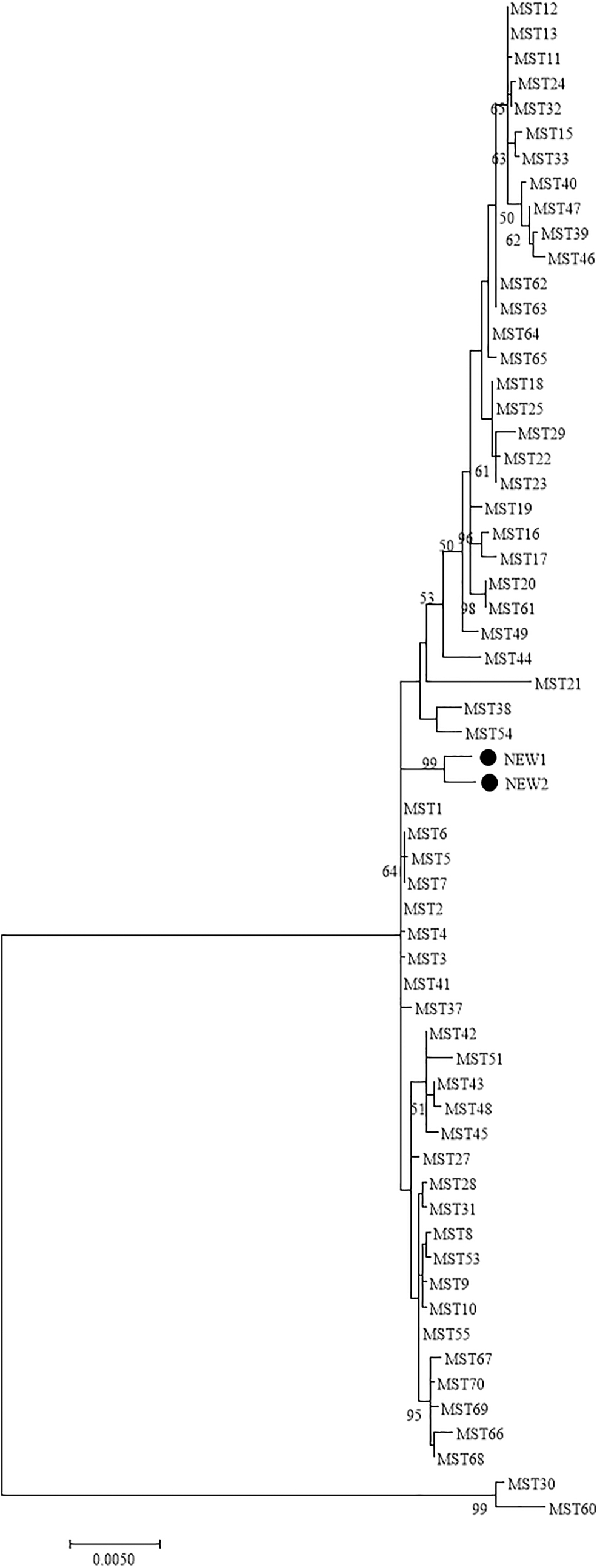
Maximum likelihood phylogenetic tree of Coxiella burnetii genotypes identified with MST. The tree was constructed by using the Kimura 2-parameter model with MEGA 7.0 (
Multispacer Sequence Types Found in Hedgehogs in China
MST, multispacer sequence typing.
Sequencing and phylogenetic analysis
BLAST analysis showed that the partial sequences of com1, rrs, and icd genes of C. burnetii were highly homologous among the hedgehogs with 99.1–100% homology. The phylogenetic trees based on sequence icd were conducted and showed that these isolated separated into three main groups (Fig. 2). Group I contained isolates from chronic human Q fever patients, livestock, and ticks. Group II contained isolates from acute human Q fever patients and mammals. Group III included isolates from chronic Q fever patients in Canada and the United States. The sequences detected in this study belonged to group II.
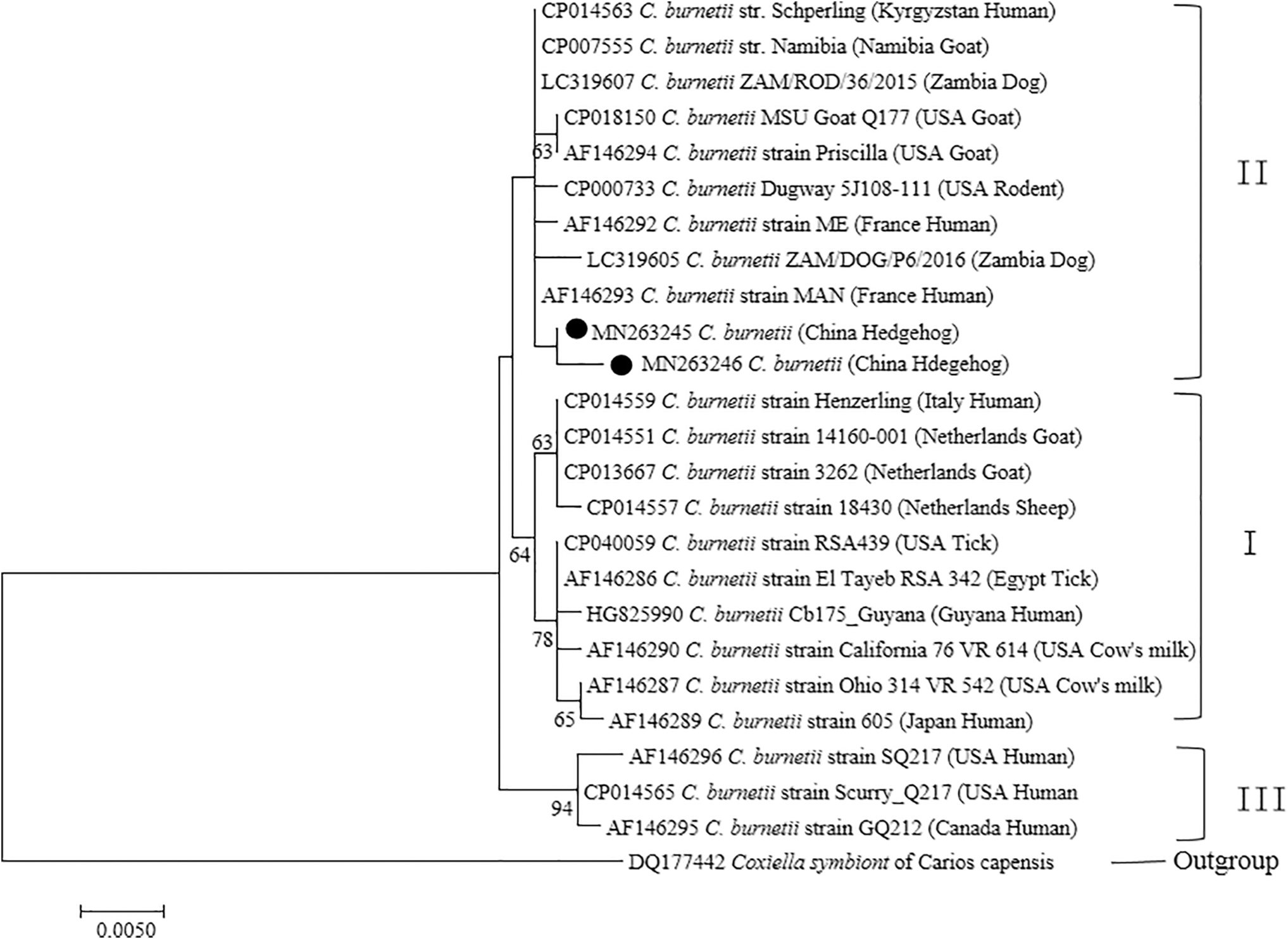
Maximum likelihood phylogenetic tree of Coxiella burnetii based on the sequence of icd. The tree was constructed by using the Kimura 2-parameter model with MEGA 7.0 (
Discussion
C. burnetii is a common pathogen that distributes in almost every country, and it may be the result of its resistance to many environment factors such as high temperature and ultraviolet light (Angelakis and Raoult 2010). Since the first description of Q fever in Australia in 1937 (Derrick 1983), knowledge about C. burnetii has increased dramatically. However, the prevalence of C. burnetii is usually underestimated because the infection often causes nonpathognomonic signs and there are few convenient diagnostic tools. Therefore, misdiagnosis occurs frequently. Humans are susceptible to C. burnetii, and infection in humans may cause acute or chronic Q fever ranging from asymptomatic to fatal disease (Georgiev et al. 2013). From 2007 to 2010, a large outbreak of Q fever in Netherlands indicated that the disease might become a severe public health problem (Delsing et al. 2010).
The epidemiological features of C. burnetii vary among the geographic areas, including situations of endemics and occurrence of large outbreaks (Eldin et al. 2017). Currently, serology methods, including immunofluorescence assay and enzyme-linked immunosorbent assay, are most commonly used for diagnosis of C. burnetii, and detection of DNA by PCR is often used in research. The infection rates of C. burnetii in wild and domesticated animals around the world varied in different places. With molecular detection, the infection rate of C. burnetii was 16.7% in red foxes in Thailand (Sumrandee et al. 2016), 45.0% in rodents and 10.0% in dogs in Zambia (Chitanga et al. 2018), 48.0% in cattle and 23.0% in goats in Turkey (Can et al. 2015), and 0.3% in pigs in South Korea (Seo et al. 2016). The seroprevalence was even higher than PCR-positive rate, ranging from 6% to 60%. In China, there were several molecular investigations about C. burnetii. The prevalence of C. burnetii in goats from Xinjiang Province and Beijing City had been reported as 25% and 5%, respectively (Pan et al. 2013). The prevalence of C. burnetii in ticks from four provinces in Northwestern China had been reported as 10% overall (Zhang and Liu 2011). In this study, the prevalence of C. burnetii in hedgehogs was 12.2% (5/41). The phylogenetic trees indicated that the C. burnetii detected in this study belonged to “chronic” group II.
MST is an effective method to determine C. burnetii genotypes. This method is discriminant and convenient without the need for enrichment by a culture step. Until now, there have been 65 STs of C. burnetii identified by MST in humans and animals all over the world (Angelakis et al. 2013). In this study, we detected the presence of two novel STs in hedgehogs from central China. Both samples were consistent with previous STs in several spacers and showed diversity in the other spacers. The disparity may result from the difference of region and host.
In traditional Chinese medicine, hedgehogs are considered tonic and used in treatments for hemorrhoids. Hedgehogs are frequently captured from wild and eaten across central China. People may be infected with C. burnetii when contacting with hedgehogs such as inhaling the contaminative aerosol in the process of capturing or slaughtering. Previous studies have demonstrated that hedgehogs can serve as animal hosts for pathogenic Leptospira and severe fever with thrombocytopenia syndrome virus (SFTSV) in China (Sun et al. 2017, Ma et al. 2020). Therefore, increased awareness and protective measures are needed to prevent infection of pathogenic bacteria and viruses from hedgehogs in China.
Conclusion
We identified two novel genotypes of C. burnetii and demonstrated high prevalence of C. burnetii in hedgehogs from central China, suggesting that hedgehogs might be important in the transmission of C. burnetii.
Footnotes
Author Disclosure Statement
No competing financial interests exist.
Funding Information
This study was supported by a grant from National Natural Science Funds of China (grant nos. 31570167 and 81971939).