




Abstract
The geographical and climatic conditions, hot and humid in Côte d'Ivoire, are favorable to the prolonged survival of leptospira in the environment. In this country, cases of human leptospirosis are underestimated and the wild reservoirs unknown. In this study, 16S rDNA PCR-sequencing and variable number of tandem repeats typing investigations were performed in kidneys collected from 60 grasscutters (Thryonomys swinderianus) around the city of Yamoussoukro, including 10 bred grasscutters and 50 bush meat grasscutters. One sample was positive for Leptospira borgptersenii and another one for Leptospira interrogans; both collected from wild animals. Our study suggests that grasscutters, which are abundant wild rodents hunted and bred for culinary preparations in this region, can be healthy carriers of leptospira. Thus, hygiene measures should be taken, particularly by hunters and cooks.
Introduction
Leptospirosis is a zoonotic infectious disease caused by spirochetes bacteria whose animal reservoirs (domestic and wild) are numerous and often asymptomatic. Man is an accidental host who becomes infected either directly (contact with an infected animal) or, most often, indirectly (contact with water or soil contaminated with urine or infected animal tissues).
Leptospira can survive up to 6 months in water and muddy soils with a slightly alkaline pH, very low salinity, and no ultraviolet radiation (Adler and de la Peña 2010, Marquez et al. 2017).
Leptospirosis is a widespread disease, especially in tropical countries. It is a neglected but potentially serious cause of febrile syndrome in sub-Saharan Africa (de Vries et al. 2014, Allan et al. 2018). In Burkina Faso, human leptospirosis diagnosed by microagglutination test (MAT) and LipL32 PCR was detected in 23/703 (3.2%) cases of febrile jaundice (Zida et al. 2018). In the neighboring Côte d'Ivoire, a survey using MAT found that 36/384 (9.4%) of the sera collected from apparently healthy humans were positive to anti-Leptospira antibodies (Koffi et al. 2018). In this country, to date, no investigation has been conducted on the epidemiological role played by synanthropic animals. As rodents are the main reservoirs of leptospira, we conducted a preliminary study in grasscutters (Thryonomys swinderianus), also called greater cane rat, by comparing the carriage of Leptospira spp. between farm and wild animals.
Materials and Methods
In April 2019, kidney samples from 60 grasscutters were collected. Ten grasscutters (age: 4–12 months) were from a farm located in Toumodi (6°33′24.2″N–4°58′25.6″W), 50 km from Yamoussoukro (6°50′08.4″N–67 5°19′55.6″W), a city located in the center of Côte d'Ivoire. Healthy animals were slaughtered for meat sale. The remaining 50 samples were taken from fresh carcasses supplied by hunters who develop their hunting activities and sell grasscutter meat to restaurants in the vicinity of Yamoussoukro. The samples were stored at −20°C at the Kongouanou care center and then transported at +4°C to the laboratory in Lyon. Animal samples were collected in accordance with Ivorian regulations (declaration to the ministry of the environment and sustainable development of the Republic of Côte d'Ivoire of March 19, 2018).
PCR assays were used to demonstrate Leptospira spp. presence in the extracted DNA samples of grasscutter kidneys (Mérien et al. 1992, Zilber et al. 2014). The analysis consisted in the identification of positive DNAs by PCR of the 16S rRNA gene, typing and identification of Leptospira spp. and possibly the serovars involved by variable number of tandem repeats (VNTR). After extraction using the DNeasy Blood and Tissue Kit (Qiagen), PCR tests were performed on pure and 10-fold diluted extracted DNA according to the standardized protocol of the laboratory, which included negative control in which DNA was replaced by sterile DNA-free water. Strategy used also two other controls: one to ensure efficiency of DNA extraction and the later to ensure absence of inhibitors in samples. The presence of a 331-bp PCR product on ethidium bromide-stained 1.5% agarose gel was considered as positive period DNA of Leptospira interrogans serovar Australis was used as positive control.
PCR products were sequenced on both strands using the Sanger method and the sequences obtained were analyzed using the basic local alignment search tool against the National Center for Biotechnology Information database. A selection of 25 sequences of different Leptospira spp. was made and the alignment was performed using MEGA7 software. Their access numbers are included in Figure 1. A 16S rRNA gene sequence-based phylogenetic tree for of Leptospira spp. was constructed, including the sequences detected in two grasscutters in this study, using the neighbor-joining method.
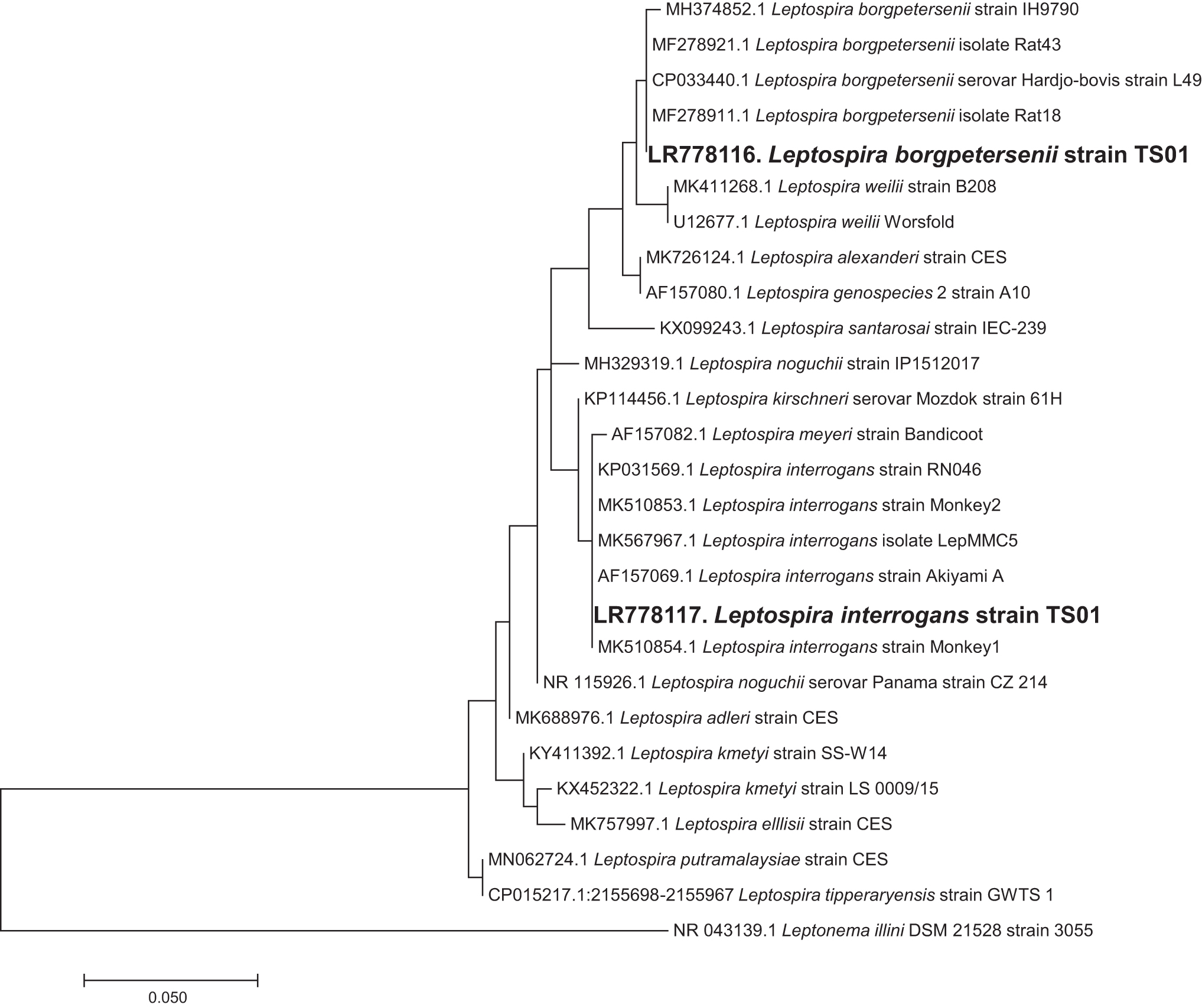
16S rDNA sequence-based phylogenetic tree for Leptospira spp. detected in two wild grasscutters, Côte d'Ivoire, 2019. The evolutionary history, based on 16S rRNA gene partial sequences, was inferred using the neighbor-joining method. The evolutionary distances were computed using the Tamura–Nei method and are in the units of the number of base substitutions per site. The differences in the composition bias among sequences were considered in evolutionary comparisons. The analysis involved 27 nucleotide sequences. All positions containing gaps and missing data were eliminated. There were a total of 267 positions in the final data set. Evolutionary analyses were conducted in MEGA7.
Results
PCR-based detection of Leptospira DNA was positive in 2/50 (4%) of the wild hunted animals (both pure and diluted DNAs), and was negative in the kidneys collected from the 10 farmed grasscutters. Analysis of sequences confirmed the identity of the samples as Leptospira borgpetersenii in one animal and L. interrogans in the other one, with 100% of 16S rDNA sequence identity with the reference sequences from the GenBank (CP047520.1 for L. borgpetersenii and CP047510.1 for L. interrogans). Unfortunately the VNTR PCRs were negative resulting in the absence of serovar precision. The obtained 16S rRNA sequences were deposited in the GenBank under the following access numbers: Leptospira borgptersenii LR778116 and Leptospira interrogans LR778117. The phylogenetic tree based on the 16S rRNA gene shows that the two sequences obtained in this study corresponded to these Leptospira spp. (Fig. 1).
Discussion
Our unprecedented results indicate carriage of two different pathogenic species of Leptospira by wild grasscutters, in this region of Côte d'Ivoire, including L. borgepetersenii, which is rarely described in literature. These animals live in wetlands where they consume plants, mainly stems, but also grasses (Ibitoye et al. 2019). They are in close contact with rural populations mostly grasscutter hunters and farmers (e.g., rice field workers), who have their skin exposed to standing water possibly contaminated by urine of Leptospira-carrier animals.
Furthermore, there is a risk of direct transmission of leptospira during hunting and culinary preparation activities before cooking grasscutters, since operators' hands can be contaminated primarily with urine. Seaweed meat is highly valued by the people of West and Central Africa. Livestock farms have been set up, particularly in Benin and Côte d'Ivoire. So far, the involvement of seaweed in outbreaks, or sporadic cases, of leptospirosis has not been described. This is certainly due to the difficulty of establishing an accurate diagnosis in rural areas. A few years ago, epidemiological knowledge about leptospirosis became more precise during studies based on screening (MAT serology and PCR) for cases of fever of unknown origin in this region of Africa (Zida et al. 2018).
In Côte d'Ivoire, there has been a significant seroprevalence (9.4%) of human leptospirosis in several regions of the country, including the region of Yamoussoukro where the two Leptospira-positive grasscutters were found in this study, however, the sources of the infection remain unknown (Kofi et al. 2018). Epidemiology of the disease is undoubtedly linked to the relationship between humans, animals, and the environment, as suggested by the One Health concept (Ullmann and Langoni 2011). Grasscutters could be reservoirs of bacteria that are pathogenic to humans; thus, the culture-based demonstration of live leptospiras that in this study were detected by PCR-based methods is pending. Our preliminary results must now be confirmed by determining the serogroups involved, with MAT results and culture strains of Leptospira spp. isolated from kidneys or urine of domestic and wild animals. This study should lead to further research into the sources of human leptospirosis in Côte d'Ivoire and sub-Saharan Africa.
Footnotes
Acknowledgments
The authors thank Gédéon Amian and Emilien Drancourt for their help.
Author Disclosure Statement
The authors declare no other competing interests.
Funding Information
This study was supported by the Compagnie Fruitière Endowment Fund, Marseille, France, and also by the Institut Hospitalo-Universitaire (IHU) Méditerranée Infection, the National Research Agency under the program “Investissements d'avenir,” reference ANR-10-IAHU-03, the region Provence-Alpes-Côte d'Azur and European funding FEDER PRIMI. The funders had no role in study design, data collection and analysis, decision to publish, and preparation of the article.