




Abstract
Borrelia miyamotoi, a hard tick-borne relapsing fever agent, was sampled in Ixodes ricinus and Ixodes persulcatus ticks from the Tver province in Russia (a sympatric region of both tick species) and examined by TaqMan-PCR targeting the 16S rRNA gene. Borrelia was detected in 4 out of 168 ticks: 2 out of 58 I. ricinus ticks (infection rate 2.9%) and 2 out of 110 I. persulcatus ticks (1.8%). The agent was identified as B. miyamotoi on the basis of the 16S and 23S rDNA intergenic spacer and glycerophosphodiester phosphodiesterase gene sequencing analyses. Interestingly, the genes sequences detected from one I. ricinus tick were identical to those of Asian-type B. miyamotoi from I. persulcatus. This tick was identified as I. ricinus by sequencing analysis of internal transcribed spacer 2 and mitochondrial cytochrome oxidase subunit 1. The results suggest that the I. ricinus ticks were infected with Asian-type B. miyamotoi in a sympatric region for I. ricinus and I. persulcatus.
Borrelia miyamotoi is an emerging tick-borne pathogen that causes tick-borne relapsing fever transmitted by Ixodes ticks. B. miyamotoi was initially isolated from Ixodes persulcatus ticks and Apodemus mice in Hokkaido, Japan (Fukunaga et al. 1996). Furthermore, B. miyamotoi in Ixodes ricinus in Europe, I. persulcatus in Asia, and Ixodes scapularis in North America have been detected and are genetically different from each other. We previously showed that I. ricinus and I. persulcatus ticks collected in Tver province, Russia, were infected with both Borreliella spp. (former Borrelia burgdorferi sensu lato) and Anaplasma phagocytophilum (Masuzawa et al. 2008). In this study, detection and genetic characterization of B. miyamotoi from these ticks were carried out to confirm the relationship between vector tick species and genotypes of B. miyamotoi.
Adult I. ricinus and I. persulcatus ticks were collected by the dragging method using 1 m2 flannel flags from vegetation in the Tver province located 110–150 km northwest from Moscow (Masuzawa et al. 2008). DNA was isolated from whole tick tissues using the Quick Gene DNA tissue kit (Fuji film, Tokyo, Japan) as described previously (Masuzawa et al. 2008). The prepared DNA was subjected to TaqMan-PCR targeting borrelial 16S rDNA (Barbour et al. 2009) with minor modifications (Takano et al. 2014) using Premix Ex Taq (Takara, Otsu, Japan) on the ABI PRISM 7500 system (Applied Biosystems, Foster City, CA).
TaqMan-PCR–positive samples were subjected to nested PCR targeting the 16S–23S rDNA intergenic spacer (IGS) and glycerophosphodiester phosphodiesterase (glpQ) gene. The first-step primer sets, nested primer sets, and PCR thermal conditions employed have been previously described (Bunikis et al. 2004, Takano et al. 2011). The nested PCR amplified ca. 420 bp of IGS and 610 bp of glpQ. Nested PCR products were then subjected to DNA cycle-sequencing analysis using nested PCR primers as the sequencing primer and the BigDye Terminator v3.1 cycle sequencing kit (Applied Biosystems) with an ABI 3130-Avant Genetic Analyzer (Applied Biosystems). Phylogenetic analysis was performed by the Clustal W algorithm using the sequence analysis software, MegAlign (DNASTAR, Inc., Madison, WI). Sequences are deposited into DDBJ/EMBL/GenBank under accession numbers LC538349 to LC538352 and LC540656 to LC540659.
TaqMan-PCR targeting rrs detected relapsing fever borreliae in 2 out of 110 I. persulcatus (positive rate 1.8%) and 2 out of 58 I. ricinus (2.9%) ticks. Lyme disease Borreliella spp. was detected in 50 out of 110 I. persulcatus (45.5%) and 25 out of 58 I. ricinus (42.1%) ticks by TaqMan-PCR. The infection rates correspond with the results previously obtained by PCR targeting IGS (Masuzawa et al. 2008). In total, 4 out of the 168 ticks were infected with relapsing fever borreliae. In Europe, the infection rate of B. miyamotoi among I. ricinus ticks varied between 0% and 4.8% (Siński et al. 2016). The infection rate of B. miyamotoi in I. persulcatus was found to be 1.7–4.2% in Asian countries (Takano et al. 2014). Infection rates found in Tver, Russia, resemble those from these previous reports.
Previous studies indicated that B. miyamotoi is classified into three groups by rrs, IGS, and flaB sequencing analysis, designated as the Asian type, American type, and European type that are derived from the vector ticks, I. persulcatus, I. scapularis, and I. ricinus, respectively (Crowder et al. 2014, Takano et al. 2014). In this study, glpQ and IGS sequences showed that two I. persulcatus ticks (R8-8, R3-15) were related to those detected from I. persulcatus and patients in Asia (Asian type, Fig. 1). The sequences detected from I. ricinus individual R12-2 also formed a cluster with sequences from I. ricinus in Europe (European type). In contrast, the sequences from I. ricinus individual R2-1 clustered with the Asian-type clade. These results led us to speculate the misidentification of the tick species based on morphology. Natural hybridization between I. ricinus and I. persulcatus ticks has been reported in Estonia (Kovalev et al. 2016); 11% of I. ricinus and I. persulcatus ticks in Estonia were shown to be interspecific hybrids with mating pair, female I. ricinus X male I. persulcatus, or male I. ricinus X female I. persulcatus. Ribosomal RNA internal transcribed spacer 2 (ITS2) and mitochondrial cytochrome oxidase subunit 1 (Cox1) gene sequences of the R2-1 tick were identical to those from I. ricinus, and no sequences genetically related to I. persulcatus were detected (data not shown). This result supports that the R2-1 tick was not a hybrid.
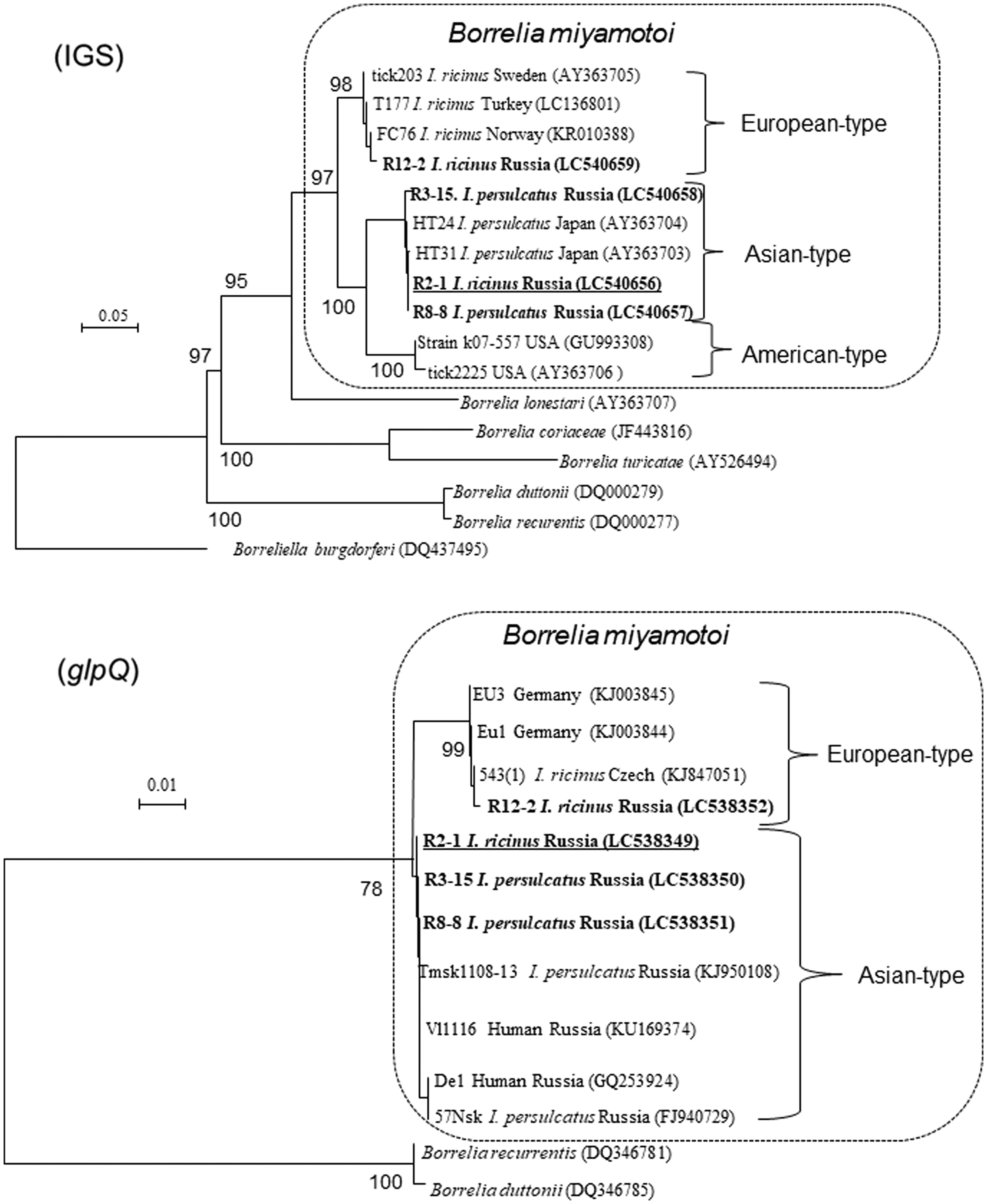
Phylogenetic tree of the 16S–23S rDNA IGS and glpQ gene of Borrelia miyamotoi in Tver, Russia. Sequences determined in this study are indicated with boldface type and R2-1 is displayed with underline. glpQ, glycerophosphodiester phosphodiesterase; IGS, intergenic spacer.
It was previously reported that the European type of B. miyamotoi sequences was obtained only from I. ricinus, whereas the Asian type was detected in both I. persulcatus and I. ricinus ticks in Estonia, which is a sympatric region of both tick species (Geller et al. 2012). The results obtained in our present study are similar to the previous finding in Estonia.
We herein demonstrated for the first time that I. ricinus and I. persulcatus ticks sampled in Tver, Russia, were infected with B. miyamotoi. Moreover, the Asian type of B. miyamotoi was detected from I. ricinus.
Footnotes
Author Disclosure Statement
No conflicting financial interests exist.
Funding Information
This study was supported by a Grant-in-Aid for Scientific Research B (no. 20406011) from the Japan Society for the Promotion of Sciences (JSPS) for Toshiyuki Masuzawa.