




Abstract
Pathogens transmitted by ticks cause several important diseases in humans, including Lyme disease, the incidence of which has been increasing in Belarus. Between April and October 2017, a total of 504 questing Ixodid ticks (77% Ixodes ricinus and 23% Dermacentor reticulatus) were collected from six regions and city of Minsk, in Belarus. All ticks were analyzed by RT-PCR amplification for the presence of Borrelia burgdorferi sensu lato, tick-borne encephalitis virus (TBEV), Anaplasma phagocytophillum, Ehrlihia muris, and Borrelia miyamotoi. B. burgdorferi s.l. and Rickettsia spp. were the most commonly detected tick-borne pathogens, with prevalence rates of 31.08% and 33.7%, respectively. A. phagocytophillum was found in 104 (20.63%), and 107 (21.2%) ticks were positive for E. muris. TBEV was detected in 83 (16.47%). Circulation of Borrelia miyamotoi spirochete in I. ricinus ticks in Brest, Gomel, and Minsk region was detected for the first time. Our data provide a basis for further studies to determine the distribution and abundance of different tick species in Belarus and therefore a capacity to predict where cases of important tick-borne diseases may occur.
Introduction
Ticks (Acari: Ixodidae) are the principal vectors of viral, bacterial, and protozoan zoonotic diseases that are abundant and widely distributed in the Northern hemisphere, and can be infected by numerous different microorganisms (European Food Safety Authority 2010) and effectively transmit some of these simultaneously to vertebrates causing coinfection (Diuk-Wasser et al. 2016). Tick-borne diseases are recognized as significant and increasing public and animal health issues worldwide. Data on these diseases and tick vectors in Belarus are very limited (Vedenkov et al. 2008-2017; Krasko et al. 2013; Kniazeva and Krasko 2014). Belarus was included in the 2017 review of vector-borne diseases risks to the European Union (Braks et al. 2017), but not in 2017 surveillance report for tick-borne encephalitis (TBE) (European Center for Disease Prevention and Control 2017).
The transmission cycle is complex since it depends on the interactions of the vectors with the reservoir hosts and the pathogenic agents, which are influenced by several biotic and abiotic factors that vary in space and time (Wint et al. 2018). Understanding the cycle and collection of data on the pathogens and vectors, is critical for disease diagnosis and for risk management. The most significant pathogens transmitted by ticks are Borrelia burgdorferi sensu lato—a group of bacteria species that cause Lyme disease, and tick-borne encephalitis virus (TBEV), a member of the genus Flavivirus cause of TBE (Zlobin et al. 2015).
A recent report by the United States Center for Disease Control and Prevention described a significant increase in the number of reported cases and the distribution of tick-borne diseases in the United States, notable of Lyme diseases (Rosenberg et al. 2018). The primary tick vector associated with Lyme disease outside of North America, namely Ixodes ricinus is widely distributed (European Center for Disease Control and Prevention: Tick Maps 2019-
A relatively newly identified human pathogen, Borrelia miyamotoi, which belongs to the relapsing fever clade within the Borrelia genus, was first described in 1994 in Japan with its detection in Ixodes persulcatus ticks from Hokkaido, Japan (Fukunaga et al. 1995). Its potential to cause human disease was not realized until 2011 when Platonov and colleagues described a series of cases of B. miyamotoi infection in Russia (Platonov et al. 2011). Subsequently, sporadic human cases were described in Europe, the United States, and Asia in both immunocompromised and nonimmunocompromised individuals suggesting that B. miyamotoi is an emerging human pathogen (Krause and Barbour 2015; Cutler et al. 2019; Henningsson et al. 2019). The first B. miyamotoi infection in patients in Belarus was diagnosed in 2015 (Anisko et al. 2015). To date, there are no data about natural reservoirs and vertebrate hosts of B. miyamotoi in Belarus.
There is an increasing number of reports related to the presence of obligate intracellular bacterial pathogens belonging to the order Rickettsiales uniting the families Rickettsiaceae and Anaplasmataceae in ticks (Kang et al. 2014; Castro et al. 2015; Thomas, 2016). Intensive investigations have reported human diseases caused by Rickettsia raoultii, Rickettsia helvetica, Rickettsia slovacai, and others in Russia (Rudakov 2016). All age groups of humans and animals are at risk of potentially fatal infections by Anaplasma phagocytophillum, Ehrlihia muris, Candidatus Neoehrlichia, and Rickettsia spp. in Europe (Thomas 2016). While the medical impact of these recently detected pathogens is expected to be low compared with Lyme borreliosis (LB) and TBE, knowledge of their occurrence may nevertheless prove important, as coinfections with different pathogens can cause unpredictable, more severe diseases. Coinfections with B. burgdorferi s.l., A. phagocytophillum and R. helvetica have recently been reported in ticks collected in Bratislava, Slovakia (Vaculova et al. 2019).
The aim of the present study was to provide insight into the diversity and prevalence of tick-borne pathogens circulating in Belarus, carried/transmitted by Ixodidae ticks. The studies described here reveal the widespread distribution of ticks and provide new prevalence data for B. burgdorferi s.l., TBEV, A. phagocytophillum, E. muris, B. miyamotoi, with 18.6% coinfected with two or more pathogens.
Methods
Belarus is a landlocked country of eastern Europe with a population of 9.4 million, 78.4% of which reside in urban areas bordered by Lithuania and Latvia to the northwest, by Russia to the north and east, by Ukraine to the south, and by Poland to the west. The country of Belarus is divided into six administrative districts (Brest, Gomel, Grodno, Minsk, Mogilev, Vitebsk regions) each centered around a major city (Minsk): Much of the country consists of flat lowlands separated by low-level topped hills and uplands. Its terrain is generally flat—the highest point, Dzyarzhynskaya Hill, is only 1135 feet (346 meters) above sea level, and more than half the surface area of Belarus lies below 660 feet (200 meters), about 40% of the country is covered by forest. The most common tick species in Belarus are I. ricinus and Dermacentor reticulatus (Reye et al. 2013).
Tick collection
Ticks were collected by dragging a 1 M2 white canvas cloth along the ground in wooded and grassy habitat (Vassallo et al. 2000) by entomologists of centers of hygiene, epidemiology, and public health during the season of peak activity between April and October 2017 in all administrative districts (Brest, Gomel, Grodno, Minsk, Mogilev, Vitebsk regions) of the territory of the Republic of Belarus (Fig. 1). Ticks were identified to species and sex, and then pools of up to 10 individual ticks were maintained alive in collection tubes, with moist filter paper and sand to provide a suitably humid environment to keep the ticks alive until processing. Tubes were labeled with species, sex, location, and date of collection.
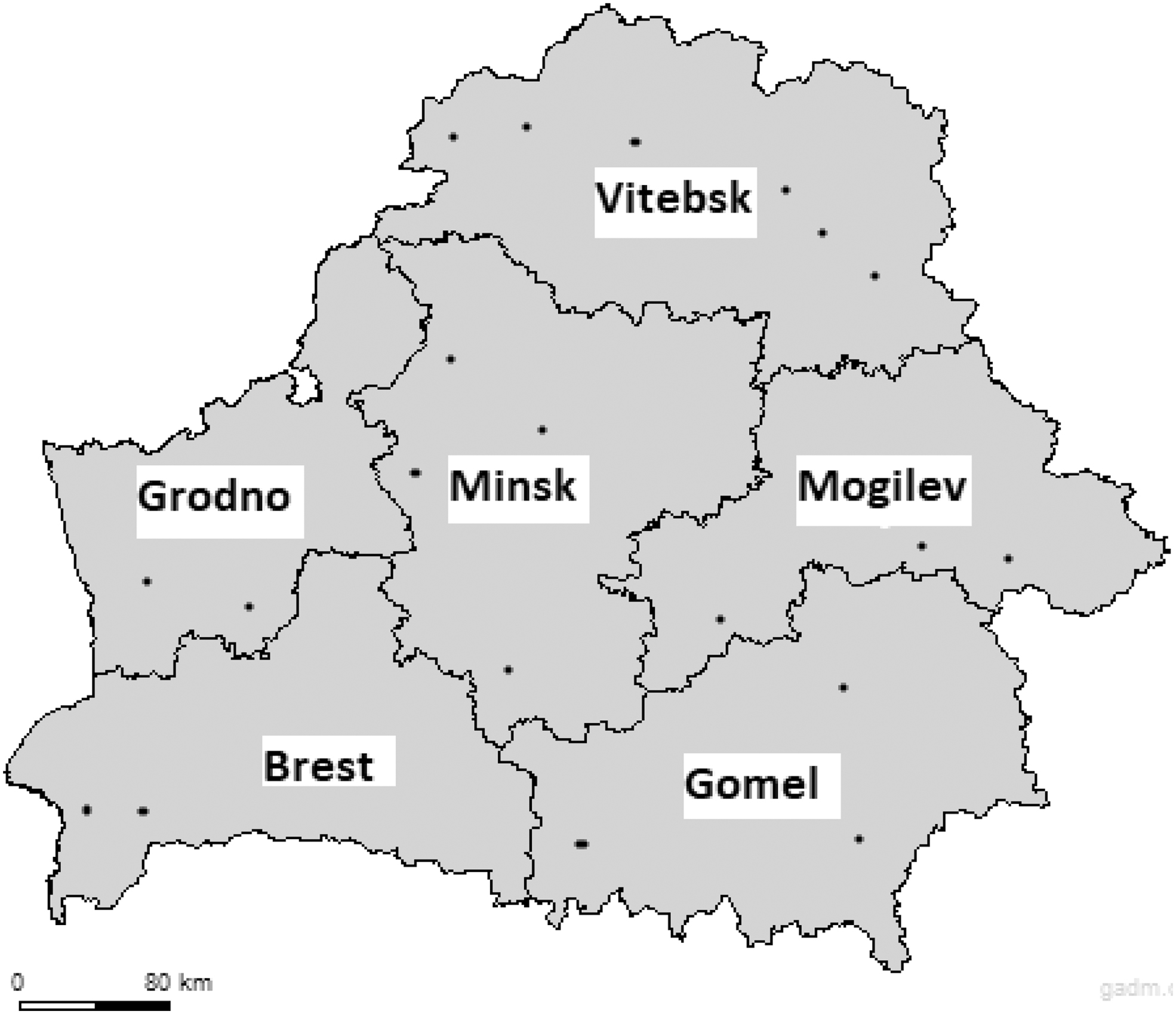
Tick collection sites in this study. Ticks were collected in the areas shown by black dots.
Laboratory methods
After delivery to the laboratory, ticks were washed in 70% ethanol and PBS buffer (pH 8.0), sorted individually into vials labeled with information on species, sex, the collection site, and date of collection. The number of ticks (72) analyzed was chosen artificially for the equivalence of the analysis of ticks received from each administrative region due to the limitations ability of tick collection. The ticks were then homogenized by grinding using a XENOX motor handpiece MHX/E.
Nucleic acids were extracted from individual ticks using the AmpliSens® RiboPrep Reagent Kits (InterLabService Ltd., Russian Federation) following the manufacturer's instructions. Complementary DNA was obtained by using the Reverta-L® Kit (InterLabService Ltd., Russian Federation) following the manufacturer's instructions.
All ticks were analyzed by RT-PCR amplification for the presence of B. burgdorferi s.l., TBEV, A. phagocytophillum, and E. muris using the commercial kit BelarTBD-PCR/RT® (RRPCEM, Belarus), Bio-Rad CFX96 machine (Semizhon et al. 2014).
Samples were also screened for the presence of Rickettsia spp. by quantitative PCR using primers CS-F (5′-TCG CAA ATG TTC ACG GTACTT T-3′) and CS-R (5′-TCG TGC ATT TCT TTC CAT TGTG-3′) and the probe CS-P (5′-6-FAM-TGC AAT AGC AAG AAC CGT AGG CTG GAT G-BHQ-1-3′) as described by Stenos et al. (2005) to detect spotted fever and typhus group rickettsiae using the citrate synthase gene as the target. The assay amplified rickettsial members of the spotted fever and typhus group, including Rickettsia akari, Rickettsia australis, Rickettsia conorii, Rickettsia honei, “Rickettsia marmionii,” Rickettsia sibirica, Rickettsia rickettsii, Rickettsia typhi, and Rickettsia prowazekii and for the presence of B. miyamotoi Bmp41F (5′TTG CTT GTG CAA TCA TAG CC3′), Bmp41R (5′GCA AAT CTT GGT GCT TTT CAA3′) and CSR41P (5′ By5-AGA TGC CAC AAT TTC ATC TGT CAT TA-BHQ-3-3′) as described by Venczel et al. (2016).
The positive controls were provided by “The Specialized Collection of Viruses and Bacteria Pathogenic for Humans of Republican Research and Practical Center for Epidemiology and Microbiology,” Minsk, Belarus.
Results
A total of 504 questing Ixodid ticks (77% I. ricinus and 23% D. reticulatus) were collected in every administrative unit of the Republic of Belarus. Ticks were individually identified by species and sex (Table 1) and individually PCR analyzed for B. burgdorferi s.l., TBEV, A. phagocytophillum, E. muris, B. miyamotoi.
Ticks Collected in the Republic of Belarus in 2017 for the Study
B. burgdorferi s.l. and Rickettsia spp. were the most commonly detected tick-borne pathogens, with prevalence rates of 31.08% and 33.7%, respectively. A. phagocytophillum was found in 104 (20.63%), and 107 (21.2%) ticks were positive for E. muris. TBEV was detected in 83 (16.47%). Circulation of B. miyamotoi spirochete in I. ricinus ticks in Brest, Gomel, and Minsk region was detected for the first time. Four hundred seven (80.8%) analyzed ticks were infected at least with one pathogen. The study also revealed mixed infections in ticks, with two or more pathogens being detected in 94 samples (18.6%). The most frequent association was the combination of B. burgdorferi s.l. and Rickettsia spp. The number of ticks with no detectable infection was 97 (19.2%). Table 2 shows the distribution of infected and uninfected ticks by regions in Belarus.
Presence of Causative Pathogens in Ticks in Republic of Belarus in 2017 in the Study
Figures in bold are statistically significant p < 0.05.
TBEV, tick-borne encephalitis virus.
Discussion
The results revealed the circulation of a wide variety of infectious agents, some of a zoonotic concern, in hard ticks from Belarus. According to our investigation, in 80.8% of the analyzed ticks we detected at least one human pathogenic microorganism. A relatively high percentage of ticks collected in Brest, Vitebsk, and Minsk city were infected with B. burgdorferi s.l. The most significant foci of TBEV-infected ticks were found in Vitebsk, Gomel, and Mogilev regions. These data on tick infections demonstrate endemic presence of B. burgdorferi s.l. and TBEV and provide confirmation to suggest local transmission as suggested by annual public health care official statistics report on the number of cases of Lyme disease and TBE in Belarus (Table 3).
The Prevalence Borrelia burgdorferi sensu lato, Tick-Borne Encephalitis Virus, Rickettsia spp. in Ixodid Ticks in the Study and Incidence of Tick-Borne Infection Cases in the Republic of Belarus in 2017
Data of annual public health care statistics report (Public Health in the Republic of Belarus. An official statistics collection, 2017).
With respect to tick infections with Rickettsia spp. we observed a relatively high incidence of infection in ticks from all regions, however, remarkably only one human case of the disease was reported during 2017 in The Republic of Belarus by official annual public health care statistics report. We believe that this disparity reflects an insufficient capacity for diagnosis of rickettsioses in Belarus due to the lack of standardized and government-approved tests, exacerbated by low awareness of infection disease specialists about the symptoms associated with these infections. A similar situation exists for anaplasmosis, ehrlichiosis, and B. miyamotoi infection.
Further studies should be conducted to better characterize (genetically and phenotypically) the microorganisms detected, both with respect to their potential pathogenicity toward vertebrates, and to assist the implementation of effective control strategies for the management of ticks and human and animal tick-borne pathogens.
Footnotes
Acknowledgments
The authors would like to acknowledge entomology departments of the Republican and Regional Centers for Hygiene, Epidemiology, and Public Health of the Republic of Belarus for the assistance in tick collection, Lyme disease study group (ESCBOR), and The European Society of Clinical Microbiology and Infection Diseases for their encouraging research and financial support in attending ESCMID summer schools and ECCMIDs to present and discuss the results, and the United States Department of Defense, Defense Threat Reduction Agency (DTRA), and Cooperative Biological Engagement Program (CBEP) for their assistance and financial support in publication of this article. While DTRA/CBEP did not support the research described in this publication, the Program supported the article publication. The contents of this publication are the responsibility of the author and do not necessarily reflect the views of DTRA or the United States Government.
Author Disclosure Statement
The authors declare that they have no conflict of interest.
Funding Information
This research did not receive any specific grant from funding agencies in the public, commercial, or not-for-profit sectors.