




Abstract
Swimmer's itch or human cercarial dermatitis (HCD) appears as a skin rash caused by an allergic reaction to larval (cercariae) flatworm parasites of the family Schistosomatidae. In our study, two cases of HCD were analyzed; both of them were reported in people swimming in Lake Pluszne. In the summer of 2018, a sample of 397 snails was collected at swimming sites in that area. Five Lymnaea stagnalis (1.9%) were found to host cercariae of bird schistosomes. Positive samples were selected by amplification of the Internal Transcribed Spacers (ITS) gene region. Sequence analysis confirmed that they were homologous with European isolates of Trichobilharzia szidati. The cases reported in this article are the first confirmed cases of HCD in this lake. This study demonstrates that there is a rationale for conducting screening studies of regions with a high recreational potential.
Introduction
Swimmer's itch or human cercarial dermatitis (HCD) is an inflammatory skin reaction caused by the cercariae of schistosomatid flukes (Kolářová et al. 2013a). In Europe, the most common agents involved in HCD are members of the genus Trichobilharzia (Soldánová et al. 2013). To date, of over 40 species identified globally (Horák et al. 2012), six have been reported in Europe, including: T. szidati (Neuhaus 1952), T. franki (Müller and Kimmig 1994); T. regenti (Horák et al. 1998), T. salmanticencis (Simon-Martin and Simon-Vicente 1999), T. anseri (Jouet et al. 2015), and T. mergi (Kolářová et al. 2013b).
In the life cycle of Trichobilharzia spp., humans are accidental hosts, while intermediate hosts are freshwater snails, and definitive hosts are water birds (Horák et al. 2002). Cercariae released from snails come in contact with the skin of people engaging in recreational water activities, such as swimming. The larvae have the ability to penetrate the human epidermis, but most of them die and degenerate within 24 h, and their tissues undergo degradation in the epidermis (Haemmerli 1953). Research shows a chemical similarity between skin lipids in humans and lipids occurring in water birds, which could be one of the factors that stimulate the cercariae of bird schistosomes to penetrate human epidermis (Haas et al. 1998, Horák and Kolárová 2001).
Although cercarial dermatitis had been previously reported by other researchers, it was Cort who related the symptoms of the disease with the etiological factor in 1928. Cercarial dermatitis is characterized as having low detection rates, what may be explained by the nonspecificity of its symptoms, its lack of severity, and its short-lasting clinical manifestation. The predominant symptoms include intense pruritis, and maculopapular skin eruptions on uncovered body parts (Kolářová et al. 2013a). Moreover, in severe infections, a generalized reaction may occur such as fever, nausea, cough, diarrhea, and local lymph node swelling (Horák et al. 2015). These symptoms are often mistaken for insect bites, allergic reactions, or nodular prurigo (prurigo nodularis) (Hoeffler 1977, Chao-Hwei and Chung-Hsing 2002). Swimmer's itch is not merely perceived as a health problem, but as an issue of economic importance as well, particularly in the regions where tourism relies heavily on recreational water activities (Verbrugge et al. 2004, Soldánová et al. 2013).
In Europe, cases of cercarial dermatitis have been reported in a number of countries, including Poland (Marszewska et al. 2016), Great Britain (Fraser et al. 2009), Germany (Selbach et al. 2016), Belgium (Caron et al. 2017), Austria (Hörweg et al. 2006), The Czech Republic (Soldánová et al. 2013), Holland (Schets et al. 2008), and Denmark (Berg and Reiter 1960). The aim of this study was to determine the etiology of skin lesions in people swimming in Lake Pluszne, using molecular and phylogenetic analyses.
Materials and Methods
Medical case description
On June 5, 2018, a boy, 13 years of age, and his father, 46 years of age, presented at our Department complaining of skin lesions on the torso and limbs accompanied by intense pruritus. A few hours before the symptoms appeared, the boy and his father had been bathing in Lake Pluszne. A few hours following their interaction with the water, the only initial symptom in both cases was itching. However, several hours later, multiple, round skin eruptions appeared, of about 1–1.5 centimeters in diameter. The lesions were erythematous (bright red) and edematous, while some of them contained centrally located vesicles filled with serous content. They were mostly located on the lower limbs and the buttocks, with a smaller number of lesions found on the forearms and lower body, and only a few isolated eruptions on the remaining body parts (Figs. 1, 2). Neither the boy nor his father had a history of skin diseases or allergies. They had never developed a rash following contact with the water, for example, while swimming in freshwater bodies, the sea, or swimming pools. Moreover, they had no chronic diseases in their medical histories. Before swimming in the lake, they did not apply any cosmetics to the skin and they did not take any medication. The dermatological history together with the clinical presentation were indicative of swimmer's itch. The treatment included oral antipruritic agents (antihistamines) and topical anti-inflammatory agents (mometasone) in the form of ointment. In both cases, the symptoms resolved after 10 days following the first reaction.
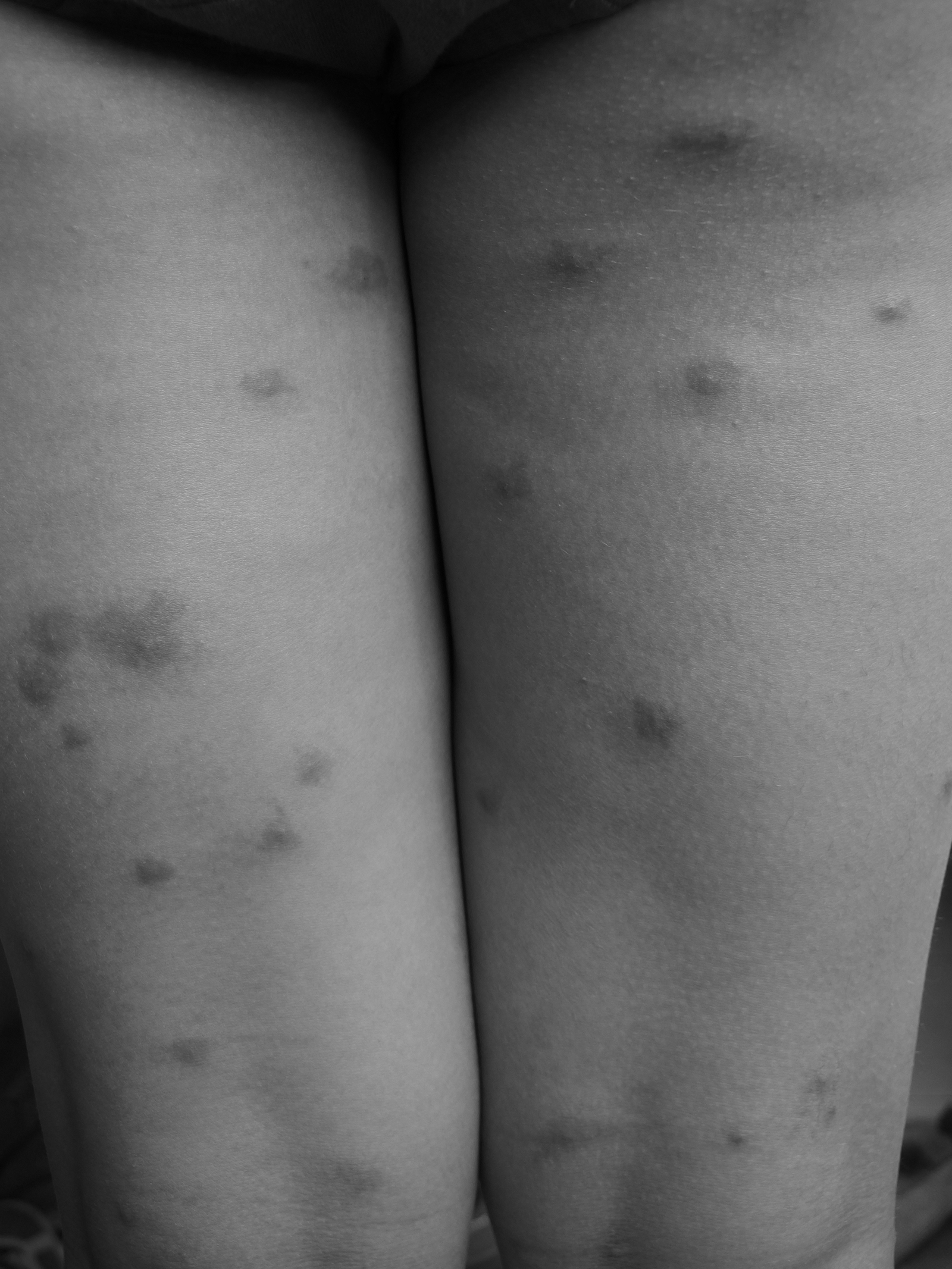
Multiple erythematous papules 1 day after infection on the legs of a 13-year-old boy.

Multiple erythematous papules 1 day after infection on the leg of a 46-year-old man.
Snail and cercariae collection
Lake Pluszne, located in north-eastern Poland (53°35′26″N, 20°23′55″E), is one of the largest (903.3 ha) water bodies of the Olsztyn Lake District. It has an important recreational function during the summer. The most popular leisure activities pursued in the region are swimming, sailing, and fishing. In the summer of 2018, a sample of 397 snails (Lymnaea stagnalis, Radix spp., Planorbarius corneus) was obtained from four bathing sites (Table 1). The snails were collected in the morning, manually or using a plastic sieve, and were then transported in lake water to a laboratory. Keys were used to identify the snails (Piechocki and Wawrzyniak-Wydrowska 2016). Each snail was then placed in a glass beaker with distilled water and subjected to a 1-h light stimulation to induce cercariae release. Cercariae were identified using light microscopy according to morphological criteria (Combes et al. 1980). Furcocercariae with pigmented eye spots were collected into 1.5 mL tubes with 95% ethanol and frozen (−20°C) until DNA extraction was performed.
The Number of Snails Infected by Trichobilharzia Szidati in Lake Pluszne, Summer of 2018
Total prevalence including all collected snails from Lake Pluszne.
L. s, Lymnaea stagnalis; P. c, Planorbarius corneus; R. spp., Radix spp.
Molecular identification of parasites and phylogenetic analysis
DNA extraction was conducted using the QIAamp DNA Mini Kit (Qiagen, Hilden, Germany) according to the manufacturer's protocol. DNA was eluted in 50 μL of elution buffer.
The PCR reaction was performed using a Veriti 96-well thermal cycler (Applied Biosystems) in a total volume of 25 μL. The PCR mixture contained the following: 15–100 ng DNA, 0.2 μM of each primer, 2.5 μL of 10X Ex Taq Buffer (Mg2+ free), 2.0 μL MgCl2 (25 mM), 2.0 μL dNTP Mixture (2.5 mM each), and 0.13 μL TaKaRa Ex Taq (5 U/μL). The Internal Transcribed Spacers (ITS) gene region of furcocercariae was amplified using the primers its5Trem (5′-GGAAGTAAAAGTCGTAACAAGG-3′) complementary to the conserved region at the 3′ end of the 18SrRNA gene and its4Trem (5′-TCCTCCGCTTATTGATATGC-3′) complementary to the conserved region at the 5′ end of the 28S rRNA gene. PCR conditions for the amplification were based on a study by Dvorák et al. (2002). The obtained PCR products were visualized by means of electrophoresis in 1% agarose gel with Midori Green Advance (Genetics) added. The products, purified with Clean-Up (A&A Biotechnolgy, Gdynia, Poland), underwent sequencing in both directions by Macrogen Humanizing Genomics Europe (Amsterdam, The Netherlands). Consensus sequences were aligned using BioEdit Sequence Alignment Editor v. 7.1.10 and analyzed using BLAST (
The phylogenetic tree was constructed using 5 isolates from Lake Pluszne (80, 81, 90, 91, 92) and 13 European sequences of the Trichobilharzia species from the GenBank database. Moreover, the country of origin and intermediate/definitive host were also taken into consideration. The phylogenetic tree was based on the partial sequence of the ITS region (ITS1, 5.8S rDNA, ITS2, and 28SrDNA). The tree was constructed using Mega X software. The alignment of sequences was performed using ClustalW. Neighbor-joining analysis was conducted using a Kimura two-parameter model with 1000 bootstrap sampling. There were a total of 661 positions in the final dataset. The scale bar indicates equivalence of distance between sequences. Schistosoma edwardiense (AY197344) and Schistosoma hippopotami (AY197343) sequences were used as an outgroup to root the trees. The sequences are deposited in GenBank under the following accession numbers: MT041668-MT041672.
Results
Cercariae of bird schistosomes were detected in three out of four studied bathing sites in Lake Pluszne. The greatest number of infected snails (2.97%) was found at site 4. Out of the entire sample of 397 snails subjected to study (which was made up of 251 L. stagnalis, 137 Radix spp., and 9 P. corneus), only 5 L. stagnalis (1.99%) revealed the presence of T. szidati. None of the remaining snail species was found to host cercariae causing swimmer's itch (Table 1). All of the positive samples selected by means of amplification of the ITS gene region of ribosomal DNA underwent genotyping, and five sequences were obtained. Sequence 80 showed 100% homology to T. szidati isolates from Poland (MH190227, MH190225), Denmark (KP271014), the Czech Republic (AY713972, GU233735), and Finland (FJ609409). Sequences 81 and 90 showed 100%, and sequence 91 over 99% homology to isolates (T. szidati) from The Czech Republic (AY713972, GU233737, GU233735). In turn, sequence 92 was over 99% homologous to isolates (T. szidati) from Poland (MH190225) and to those from The Czech Republic (AY713972, GU233735). Moreover, the analysis demonstrated that European DNA sequences show low variation within and between the T. szidati populations. It is also of note that there is no variation regarding the intermediate host. For the T. szidati species, the host is primarily L. stagnalis (Fig. 3).

The phylogenetic tree of isolates of European bird schistosomes based on the partial sequences of ITS region. The tree includes definitive and intermediate host species infected and the country of occurrence. NL, Netherlands; PL, Poland; CZ, Czech Republic; FJ, Finland; DE, Germany; IS, Iceland; NO, Norway; DK, Denmark; CH, Switzerland; ITS, Internal Transcribed Spacers.
Discussion
In this study, swimmer's itch was reported in summer on a hot sunny day, which is similar to other studies (Lévesque et al. 2002, Verbrugge et al. 2004, Marszewska et al. 2016). The main factors increasing/adding to the risk of infection include the following: the time spent in shallow water in the coastal zone of a water body, the abundance of aquatic vegetation, bathing in the morning, a high temperature of the water and air, wind and increased water movement, and eutrophication of the water body (Soldánová et al. 2013). All of the four swimming sites of Lake Pluszne cover coastal areas of shallow water, which create ideal conditions for swimming and water recreation, especially for children. In addition, the coastal parts of the lake have a variety of water plants. The presence of tame water birds near swimming sites is also a problem. The intensity of symptoms and the speed of the immune response depend on individual sensitivity, the number and duration of exposures, as well as the number of furcocercariae penetrating the human epidermis (Horák and Kolárová 2001). Cercariae prefer skin wrinkles and hair follicles for penetration (Haas and Haeberlein 2009). T. szidati cercariae take only 82 s to cross the skin barrier in humans (Haas and van de Roemer 1998). The locations of lesions on the human body for swimmer's itch vary. However, the cases presented in this study as well as those reported by other authors have shown that the lesions are mostly found on the lower and upper limbs; however, some are also found on the torso (Fraser et al. 2009, Frew et al. 2016, Marszewska et al. 2016, Lévesque et al. 2002). In an unusual case reported by Tremaine et al. in 2009, the cheeks and forehead were also involved.
Clinical symptoms and signs vary. Kourilová et al. (2004) demonstrated that in the course of cercarial dermatitis, there is initially a type I immediate hypersensitivity response, followed by a late phase reaction induced by the presence of cercarial larvae in the skin.
In previous studies conducted in Poland, the infection rate of intermediate hosts with bird schistosomes was reported at 1.8–1.24% (Marszewska et al. 2016, 2018), which is in line with the data presented in our study, at 1.25%. In our studies, no case of infection in the snails representing Radix spp. was noted. A low infection rate (0.44% per 890 of the Radix spp. studied) was demonstrated in a study by Marszewska et al. (2018), where T. regenti was detected. In addition, in these snails, both in Poland and in other European countries, a quite commonly recognized species is T. franki (Żbikowska 2004, Ferté et al. 2005, Cipriani et al. 2011, Christiansen et al. 2016).
Żbikowska (2003) confirmed in her experimental studies that T. szidati cercariae obtained from naturally infected L. stagnalis are capable of causing the symptoms of cercarial dermatitis. The species occurring in Poland that are at present recognized to potentially cause swimmer's itch include the following: T. szidati, T. franki, and T. regenti, with T. szidati being the most commonly found in water bodies (Żbikowska 2004, Żbikowska et al. 2006, Marszewska et al. 2016, 2018). Generally, the infection rate of L. stagnalis with cercariae of T. szidati in European countries remains low. For instance, it is 2.96% in Germany, 0.5% in Denmark, and 0.4% in France (Ferté et al. 2005, Christiansen et al. 2016, Selbach et al. 2016). Nevertheless, regionally, the prevalence may be much higher at 5% to 12%, which was demonstrated in a study conducted in Holland (Schets et al. 2010).
Primary infections may be asymptomatic or be limited in their manifestations to mild skin reactions with macules or maculopapules (1–2 mm in diameter). This phase lasts 12–48 h on average p.i.; however, delayed reaction may be observed in some cases with small papules as late as 8 days p.i. If the sensation of itchiness is present, it is much less intense than in reinfections (Olivier 1949, Kolářová et al. 2013a, Macháček et al. 2018). Repeated reinfections result in a sensitization phenomenon that precipitates a hypersensitivity reaction (Lévesque et al. 2002), and consequently, the course of infection is characterized by greater specificity than is observed in primary infections, due to the intensity of skin symptoms. After 4–20 min, most people develop macules (up to 10 mm in diameter) with primary itching. After 10–15 h, the macules are replaced by papules (3–8 mm in diameter), with central spots and an erythematous zone. At that time, the pruritus becomes more intense (secondary itching). In 2–3 days after infection, the formation of vesicles on papules (1–8 mm in diameter) can be observed. Also, scratching may lead to secondary infections with their specific manifestations. Skin symptoms begin to resolve after about 10 days (Kolářová et al. 2013a, Horák et al. 2015).
Furthermore, what should be noted is a large number of cercariae being released, where expulsion from one L. stagnalis individual per day was 2621 cercariae, as reported by Soldánová et al. (2016). To date, no case has been reported in humans of bird schistosomes successfully crossing the barrier of the human epidermis and settling in other tissues or organs. However, the research conducted on mice has shown that schistosomula T. regenti were found in the gray and white matter of the spinal cord. Histological studies have demonstrated dystrophic and necrotic lesions within those neurons where the parasite was located; perivascular eosinophilic inflammation in the matter was also observed (Kolárová et al. 2001). In turn, in a study by Chanová et al. (2007) schistosomula of T. szidati were identified in mice in the alveolar wall tissue of the lungs, which caused congestion, edema, and infiltrates of lymphocytes distributed mainly in the peripheral parts of the lung lobes.
Scientists emphasize that environmental factors such as climate change, particularly climate warming, and eutrophication of waters may significantly increase the risk of cercarial dermatitis occurrence in people (Larsen et al. 2004, Soldánová et al. 2013).
Conclusion
Swimmer's itch has been reported in many parts of the world. To minimize the risk of human infection, the following recommendations should be followed: swimming should be avoided in coastal areas that abound with water plants, which are likely to be habitat for snails, bathing during morning hours should be avoided, particular care should be taken to dry the skin with a towel immediately after leaving the water, and protective cream formulations should be used. An important aspect is dermatological diagnostics, which primarily relies on history-taking and examining skin lesions. In our view, there is a rationale behind developing a fast and sensitive test, which would serve as diagnostic support. Moreover, a reasonable solution would seem to be the cooperation of doctors and health care facilities with tourist centers, as well as regular monitoring of those bathing areas where a substantial number of swimmer's itch cases have been reported.
Footnotes
Author Disclosure Statement
No conflicting financial interests exist.
Funding Information
No funding was received for this article.