




Abstract
Bovine tuberculosis (bTB) is a major chronic bacterial disease in cattle and is the major economic and animal welfare issue in the world. Although the economic costs and public health safety risks associated with the disease are considerable, the overall epidemiology of the Chinese yak (Bos grunniens) bTB is unclear. To fully reveal the basic prevalence of yak bTB in different regions of China, we searched five databases including PubMed, Science Direct, CNKI (China National Knowledge Infrastructure), Wanfang and Chongqing VIP. Based on the incidence and prevalence of yak tuberculosis in China from 1982 to 2020, a meta-analysis of yak bTB in China was established for the first time. By formulating the search formula, 97 studies were searched in five databases. According to the established exclusion criteria and excluded comments and repeated and irrelevance research, we finally selected 19 cross-sectional studies, which showed the prevalence of bTB in Chinese yaks. Random-effect meta-regression model analysis showed that the estimated prevalence of 122,729 yaks in China was 1.0 (95% confidence interval [CI]: 0.0–1.0). The regional prevalence varies greatly, northwest China prevalence rate 0. 39% (95% CI: 0.2–0. 64) and southwest China prevalence rate 2.59% (95% CI: 1.94–3.34); in terms of province level, the prevalence was highest in Tibet 2.59% (95% CI: 1.94–3.34), followed by Xinjiang 2.36% (95% CI: 0.86–4.58), and Shanxi has the lowest 0.00% (95% CI: 0.00–0.98). This systematic review and meta-analysis identified the estimated prevalence of bTB in Chinese yaks and estimated the underlying factors associated with bTB, including geographic location, sampling year, age, and TB detection method. Provide evidence to plan corresponding disease control strategies for policymakers and to assess future economic risks accurately.
Introduction
Bovine tuberculosis (bTB) is a chronic wasting zoonotic infectious disease caused by Mycobacterium bovis, which is classified as a second-class animal disease in China. The pathogen is present in cattle herds around the world, and there is often a potential wild animal host (Sichewo et al. 2020), which greatly limits animal productivity. (Smith et al. 2009, Muller et al. 2013). Between 2015 and 2016, 179 countries and regions reported their status on bTB to the (English: World Organization for Animal Health; French: Office international des épizooties, OIE). More than half of these areas have reported the disease in livestock and/or wildlife, suggesting that it is widely distributed (World Health Organization 2018). According to reports, the global epidemic rate of bTB is about 9% (Vordermeier et al. 2016). M. bovis has higher human tuberculosis cases in developing countries, posing a major threat to global health (Olea-Popelka et al. 2017). To eliminate tuberculosis by 2030 as part of the United Nation Sustainable Development Goals, future prevention and control strategies must focus on all forms of tuberculosis in humans, including its interface animals (World Health Organization 2019).
The total global amount of yak is about 14 million, of which 13 million (93%) of the cattle live in China (Mi et al. 2014). The yak (Bos grunniens or Yak) is a unique breed of cattle distributed on the Qinghai-Tibet Plateau and its adjacent alpine and subalpine regions (Anonymous 1989). It is the highest ever (except human) mammal living in the world (Wilson and Reeder 2005), and it is also the Tibetan Plateau and important livestock species indispensable to the animal husbandry economy in alpine grassland pastoral areas (Gyamtsho 2000). M. bovis is prevalent in cattle-consuming herds on the Tibetan Plateau. The transmission of bTB also poses a potential threat to the production and life of people in pastoral areas (Han et al. 2012).
Some yak epidemiological surveys have been conducted in China (Zhao 2012, Dao 2013, Yuan et al. 2015) to estimate the prevalence of yak tuberculosis. These studies are fragmented using previous results, so there is a superfluous place in investigating yak tuberculosis. Besides, China has not conducted a national-level summary report on yak tuberculosis. China is the country with the most yaks in the world, and the lack of more detailed control plans poses a potential threat to bTB in yak infection and transmission. This systematic review and meta-analysis of yak tuberculosis prevalence in China aim to provide national-level yak tuberculosis prevalence estimates by summarizing yak tuberculosis reports in different regions of China. Such an estimate will provide a reference for accurately assessing risks in the future and for developing effective control strategies. This systematic review complies with the Preferred Reporting Items for Systematic Reviews and Meta-Analysis (PRISMA) guidelines for systematic reviews and meta-analysis (Liberati et al. 2009) (Supplementary Table S3).
Methods
Literature search strategy
The languages were restricted to English and Chinese. We searched PubMed, ScienceDirect, Chinese Web of Knowledge (China National Knowledge Infrastructure [CNKI]), Wanfang, and Chongqing VIP for studies reporting bTB infection in yak in China from inception to May 30, 2019. Searched for the term “bTB [All Fields] AND (“cattle”[MeSH Terms] OR “cattle”[AllFields] OR “yak”[All Fields]) AND (“China”[MeSH Terms] OR “china”[All Fields])” in PubMed. In Science Direct, the keywords “bTB,“yak,” and “China.” were used. A systematic search of three Chinese electronic databases VIP Chinese journal database, CNKI, and Wanfang Data was conducted. In the VIP Chinese journal database, the search strategy has been set to “Title or Keywords: Yak with tuberculosis,” and in CNKI and Wanfang data, the search strategy is “Subject: Yak with tuberculosis.” In the three Chinese databases, all search processes include synonym expansion, and there are no restrictions on the publication date. In addition, we did not contact the authors of the original study for more information. No attempt was made to identify unpublished reports.
Literature screening
The analysis was carried out by following the PRISMA statement (Moher et al. 2009). The data collected from 1982 to present on the prevalence of tuberculosis in Chinese yak were studied. Endnote X9 was used to edit retrieved articles. Four independent reviewers reviewed the purpose abstracts from the selected articles to determine whether the study met the inclusion criteria and, if so, a full review of the entire article. Reviews, duplicate reports, and research on other species (e.g., cattle, dairy cows) are excluded, while studies and reports that provide general results without major data and concentrated outside of China are excluded from the scope of research. Samples suspected of being sick or studies of animals dying from disease and entry quarantine are also excluded because they may not reflect the seroprevalence of Chinese yak tuberculosis. The studies with too few samples (n ≤ 30) were excluded, as they often lead to significant heterogeneity (Wang et al. 2017). In addition, meta-analysis includes some articles on building new detection methods. Finally, all included studies were cross-sectional in nature. Regarding the test methods used, included studies used common diagnostic techniques for bTB testing, including the single intradermal test (SIT), single intradermal comparative tuberculin test (SICT), enzyme-linked immunosorbent assay (ELISA), eye detection, and Ziehl–Neelsen (ZN) staining.
Data extraction
Use standardized data collection tables to extract data: two of the authors independently extracted and recorded data from each selected study. When reviewers find discrepancies in the form or uncertainty about research eligibility, the authors discuss and further evaluate them before reaching a final consensus. Use the data collection form to collect the following data from each study: first author, year of publication, study location, study time, number of positive samples, sample size, prevalence of different production systems, prevalence of male and female animals, and age range.
Quality assessment
The assessment was carried out according to the criteria derived from the “Grading of Proposal Evaluation, Development and Evaluation Methodology” (Guyatt et al. 2008). The quality of the publications is scored using a scoring method. In short, when elaborating the information, the scores of the following items are determined as 1 point: clearly explain the detection method used, clearly indicate the sampling year, whether to randomly sample, describe the sample collection method in detail, or identify the tuberculin injection site and whether there are four or more risk factors. Articles can be assigned 0–5 points based on criteria, articles with 4 or 5 points are considered high quality, articles with 2–3 points are considered medium quality, and articles with 0–1 points are considered low quality (Gong et al. 2020).
Statistical analysis
All of our quantitative analyses were performed using RStudio 3.5.2, in which “meta” package was used to estimate the model (Schwarzer 2007, Viechtbauer 2010, Wang 2018). According to previous research, the public code was obtained on
Publication bias was evaluated visually with a funnel plot. Potential sources of heterogeneity were investigated by subgroup analysis. We use individual models or multivariate models to further estimate factors that lead to heterogeneity between studies. The factors included sampling year (articles published before 2009 vs. 2009 or later), geographical region (include Northwest China and Southwest China), and breeding methods (comparison of Breeding farming with other breeding methods) (Sibhat et al. 2017, Srinivasan et al. 2018).
Results
Studies included
We found 97 articles in five databases, and after screening through the exclusion criteria, a total of 19 qualified studies were included (Fig. 1). When there are multiple levels of data in a study, such as province, gender, year, or production system, we treat these levels as separate data. We extracted a total of 139 levels of data from 19 studies for meta-analysis. These studies provide Chinese yak bTB prevalence data from 1982 to 2020. The total sample size of yak is 122,729 (Table 1). Twelve studies were of high quality (4 or 5 points), seven studies were of medium quality (2 or 3 points), and zero studies were of low quality (0–1 points) (Tables 1 and 2).
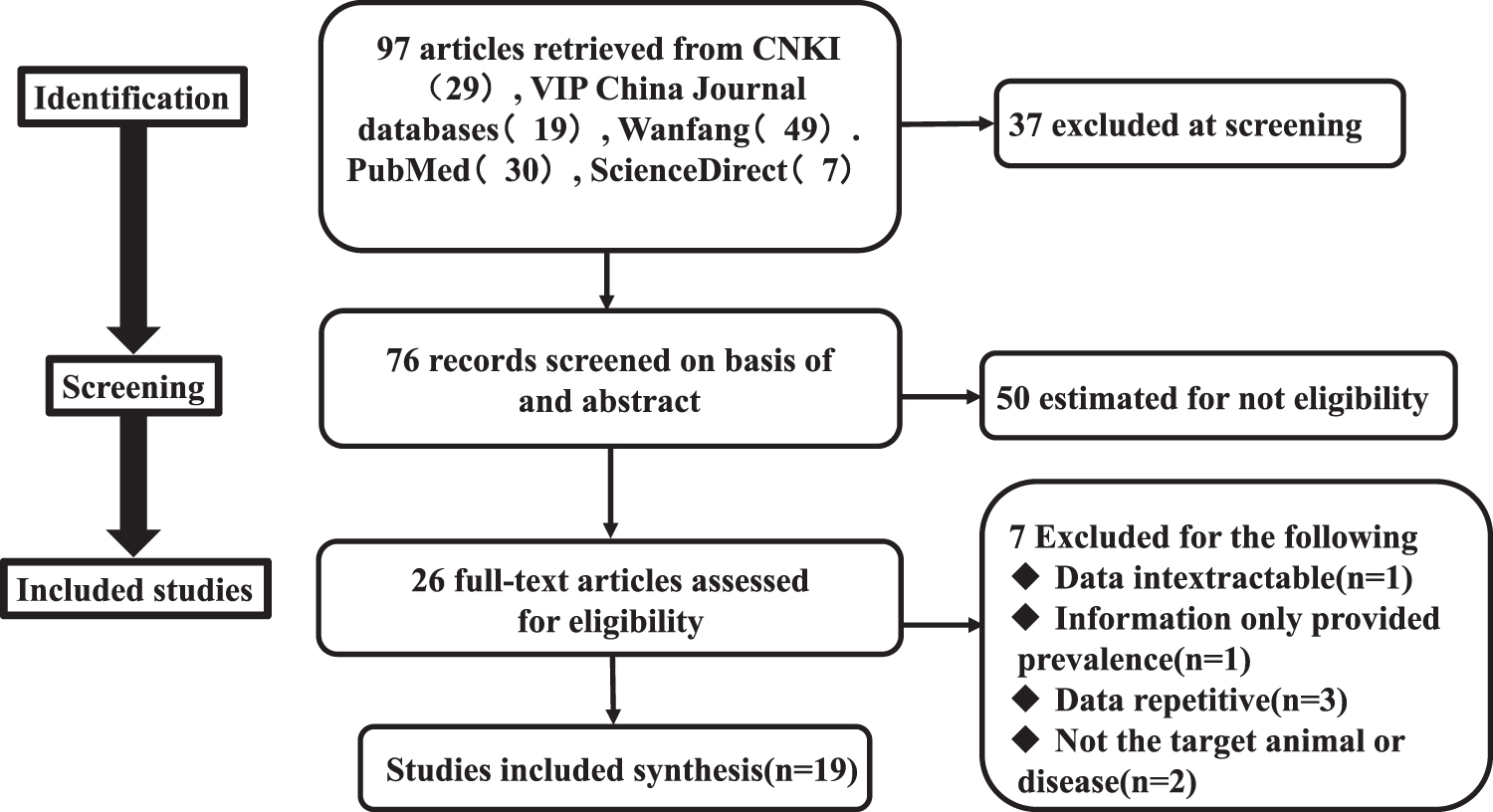
Schematic representation of the selection of eligible studies of bTB prevalence in yak of China. bTB, bovine tuberculosis.
Included Studies of Bovine Tuberculosis Infection in Yak in Mainland China
Association of Different Province and Region in the Prevalence of Bovine Tuberculosis in Yak in China
CI, confidence interval.
Meta-analysis
Some studies have data with a prevalence of zero, so the data are arcsine processed to meet the normal distribution of the pooled data. We constructed a funnel chart of the prevalence of arcsine transform (PAS) based on the standard error to evaluate and illustrate the degree of publication bias (Fig. 2). Funnel plot results show that publication bias favors larger studies and higher prevalence because of its lack of symmetry. Begg's rank correlation test (p value = 0.1716 > 0.05), while Egger's test (p < 0.001) shows bias (Supplementary Fig. S1; Supplementary Table S1). This evidence of publication bias suggests that the random-effects (REs) model will be more appropriate for these data. The combined prevalence of bTB in Chinese yak is estimated by converting the prevalence PAS based on an RE model. The prevalence of bTB in Chinese yak is 1.0% (95% confidence interval [CI]: 0.0–1.0). We assessed the heterogeneity by calculating the Cochran (Q) value (Q = 492.71, df = 18, and p < 0.0001) and the Higgins statistic (I 2 = 96%). We used forest plots to summarize the comparison between meta-analysis and REs models (Fig. 3).

Funnel plot of PAS prevalence estimate of bTB in yak.

REs meta-analysis of bTB infection in yak. RE, random effect.
Difference analysis
The data from the trim and fill analysis showed that four related studies need to be added, but there is no obvious difference between the heterogeneity before supplementation (I 2 = 96.3%, p-value <0.001) and the heterogeneity after supplementation (I 2 = 97.4%, p-value <0.001), meaning there may be no significant publication bias (Supplementary Fig. S2; Supplementary Table S1). We delete one study at a time to perform sensitive analysis on other studies to test whether the results are stable. Sensitive analysis showed that after a single review, the results of the reorganization analysis did not change significantly, so we believe that the meta-analysis results were stable and reliable (Supplementary Table S2). We further study the sources of heterogeneity by using univariate regression analysis. The factors considered in the analysis include study area, study method, gender, age, feeding method, season, sampling year, and sample type (Table 3). The univariate regression results show that the heterogeneity of age (R 2) is the largest, while for the sample type, the minimum value of R 2 is observed (R 2 = 0.06%).
Association of Different Categorical Variables in the Prevalence of Bovine Tuberculosis in Yak in China
Included studies used common diagnostic techniques for bTB testing, including the SIT, SICT, ELISA, ZN staining, and eye detection.
bTB, bovine tuberculosis; SIT, single intradermal test; SICT, single intradermal comparative tuberculin test; ELISA, enzyme-linked immunosorbent assay; ZN, Ziehl–Neelsen.
Geographical distribution of included studies in china
Study reports from included publications encompassed five provinces and two regions in China, including Gansu, Qinghai, Shanxi, Tibet, and Xinjiang, and Northwest China and Southwest China. It can be observed from the map that the prevalence of bTB varied highly between states (Fig. 4; Table 2).

Geographical distribution and pooled prevalence estimates (RE model) of bTB in yak in the different provinces of China. Color images are available online.
Effect of moderators on prevalence of bTB in yak
Based on the RE mode, the pooled prevalence of bTB in yaks in China was 1.0% (95% CI 0.0–1.0, 390/122,729). Prevalence performance of each subgroup: Southwest China, 2.59% (95% CI 1.94–3.34, 51/1966) was higher than Northwest China 0.39% (95% CI 0.2–0.64, 339/120,763). In a single province level, the bTB-positive rate was highest in Tibet, ∼2.59% (95% CI 1.94–3.34, 51/1966), and the bTB positive rate was lowest in Shanxi, ∼0.00% (95% CI 0.00–0.98, 0/98). The prevalence of calves (0.52%, 95% CI 0.06–1.44) is lower compared with adult cattle (2.04%, 95% CI 0.23–5.58). Cows have the lowest prevalence (0.73%, 95% CI 0.16–1.70). Castration cattle have the highest prevalence (9.43%, 95% CI 3.21–18.67).
According to feeding methods, the prevalence of slaughterhouses and breeding farms is zero (0.00%, 95% CI 0.00–0.98), (0.00%, 95% CI 0.00–0.01). Free-range households (1.11%, 95% CI 0.00–4.27) have a higher prevalence than pasture (0.62%, 95% CI 0.34–0.97). The prevalence rate is zero in autumn (0.00%, 95% CI 0.00–0.80), higher in summer (1.07, 95% CI 0.58–1.72) than in spring (0.65%, 95% CI 0.25–1.25). Serum (2.17%, 95% CI 1.63–2.78) detection rate is higher than whole blood (2.06%, 95% CI 0.94–3.61) (Tables 3 and 4).
Univariable Meta-Regression
RE, random effect.
As indicated in Table 3, the prevalence rate before 2009 (0.99%, 95% CI 0.00–5.64) is higher than that in 2009 (0.26%, 95% CI 0.16–0.40) and after 2009 (0.11%, 95% CI 0.02–0.26). In the detection method, the method with SICT has the highest prevalence, 5.23% (95% CI 0.00–21.31); the method with eye detection and ZN prevalence was zero.
Discussion
M. bovis is the main causative agent of zoonotic tuberculosis in humans. bTB results in severe economic losses for livestock producers worldwide, respecting no borders (Ayele et al. 2004, de la Rua-Domenech 2006, Davidson et al. 2017). According to incomplete statistics, bTB causes direct losses to the global economy of more than $3 billion annually (Peng et al. 2018). Yak infection with bTB can lead to weight loss, loss of appetite, reduced milk production, reduced fertility, and serious public health problems (Collins 2006, Zangzhuoma 2019). Although there have been some investigations into yak tuberculosis (Table 1), it is the first meta-analysis of the prevalence of yak tuberculosis in China. Therefore, in this systematic review and meta-analysis, the data from 122,729 yaks from 19 articles were evaluated. We validated that bTB infection in yak was widely distributed throughout the western China plateau and the pooled prevalence was 1.0% (95% CI 0.0–1.0) between 1982 and 2020 (Table 2). In the results of the study, the infection rate in the Southwest region was 2.59%, which was higher than that in the Northwest region. This may be due to the high prevalence of bacteria in the southwest. Geographically, it was found that the Northwest is lower than the Southwest. Studies have found that the prevalence of severe tuberculosis occurs in areas with higher altitudes (Li et al. 2014). This result is similar to the result of China's fifth national tuberculosis epidemiological survey. It is speculated that the prevalence of bTB in yak may be positively correlated with altitude (Disease Control Bureau of the Ministry of Health and Chinese Center for Disease Control and Prevention 2011, Wang et al. 2012). At the same time, there are more documents in the Northwest than in the Southwest. This may due to unstable results. It is recommended that provinces and cities in Southwest China strengthen bTB in yak monitoring to clearly show the regional diversity of bTB in yak in China.
In subgroup of years, before 2009, the prevalence of bTB in Chinese yaks was 0.99%; however, we found that after 2009, the bTB infection rate in yak has dropped significantly. This may be because the local government has strengthened the prevention and control of yak disease in accordance with the National Long-term Animal Disease Control Plan (Anonymous 2012). At the same time, in 2016, the Ministry of Agriculture and the Ministry of Finance of China jointly issued the “Notice on Adjusting and Improving Animal Disease Prevention and Control Policies” (Order of the Veterinary Administration of the Ministry of Agriculture [2016] No. 35) (Anonymous 2017), which improved the animal disease prevention policy. Large-scale intensive breeding is also beneficial to the prevention and control of bovine tuberculosis, which greatly reduce the prevalence of bTB in yak.
There are many detection methods for tuberculosis. The most used method in various studies is SIT 0.28% (n = 12, 299/118,893), but the highest combined prevalence rate is indeed SICT 5.23% (n = 3, 28/371). Although most tests are based on tuberculin, there are many potential causes of heterogeneity yet to be explored. Therefore, combined with the current nonstandardization of diagnostic tests and the existing limitations of various performance characteristics, we emphasize the need to use a single, standardized skin test performed by an independent and trained operator approved by OIE for the national monitoring plan. Research is continuing on new, more accurate and sensitive detection methods, less reliant on the measurement of the immune response in vitro (bovine interferon-γ release assay or antibody ELISA) or in vivo (skin tests), which are less subject to the vagaries of individual operative performance and subjective interpretation (Churbanov et al.
The transmission of tuberculosis is closely related to the density of humans and livestock, and whether the traffic is developed (Torgerson and Torgerson 2010, Broughan et al. 2016). The yak camps in pastoral areas are mostly free grazing, and they are generally far from the main roads and urban settlements (Lei et al. 2016). Therefore, the natural infection rate of tuberculosis is lower compared with high-yielding dairy cows and dairy cows in agricultural areas. However, in recent years, with the development of China's society and economy, the density of people and animals in Tibet and other regions has increased. Transport and trade based on railways and roads have become increasingly active, and people and animals have frequented exchanges. Some yaks are grazing on both sides of railways and highways. Therefore, the infection rate of bTB is also significantly increased. The lack of oxygen on the Qinghai-Tibet Plateau and the generally dry climate are conducive to the survival and reproduction of M. tuberculosis Complex (Zhan et al. 2019), and the low-pressure and low-oxygen environment have reduced the defense function of the respiratory mucosa of cattle, which is susceptible to respiratory diseases (Han et al. 2012). At the same time, the detected positive cattle cannot be eliminated in time. Some of the detected positive cattle were resold and continued to be raised, which further increased the risk of yak infection. It has promoted the spread of tuberculosis and brought many challenges to the prevention and treatment of the disease.
System reviews and meta-analysis also have some limitations. First, we obtain articles from five databases, which may cause some qualified articles published in other databases to be excluded. Second, although our search method includes all articles as much as possible, there may still be some incomplete data. Third, the sample size of the yak detection in some studies is small, which may not reflect the actual prevalence in some areas; fourth, we have restricted the language of articles to only articles in English and Chinese, which may cause some other Qualified studies of language to be missed. Finally, because it is impossible to accurately identify bTB caused by M. tuberculosis or M. bovis, the study did not analyze the distribution characteristics of the disease.
Conclusion
Overall, the results of our systematic review and meta-analysis of 19 publications indicate that the prevalence of bTB in Chinese yak is 1.0% (95% CI: 0.0–1.0). It is necessary to conduct further research to obtain more detailed state prevalence estimates, and to explore other risk adjustment factors that may affect the development and implementation of reasonable and effective bTB controls, while increasing the investigation of yak prevalence. A comprehensive testing plan can be adapted according to the economic condition and breeding scale of different regions. Our current research results show the priority of establishing a sound monitoring system for the epidemic control of yak tuberculosis, the necessity of optimizing detection methods, and the importance of scientific farming.
Footnotes
Author's Contributions
R.D. and F.-L.Z. contributed to the conception and design of this analysis. Y.Z., B.Z., D.Z., and J.-Y.S. independently extracted and recorded the data from each selected study. D.L. conducted the statistical analysis. Y.-H.S. prepared the article. J.-M.L., K.S. revised the article. All of the authors reviewed and approved the final article.
Author Disclosure Statement
No conflicting financial interests exist.
Funding Information
This work was supported by funding from the National Key R&D Program of China (2018YFD0500900, 2018YFC1706601-04). This work was supported by funding from Science and Technology Support Program of Jilin Provincial Department of science and technology (20180201010YY).
Supplementary Material
Supplementary Table S1
Supplementary Table S2
Supplementary Table S3
Supplementary Figure S1
Supplementary Figure S2
References
Supplementary Material
Please find the following supplemental material available below.
For Open Access articles published under a Creative Commons License, all supplemental material carries the same license as the article it is associated with.
For non-Open Access articles published, all supplemental material carries a non-exclusive license, and permission requests for re-use of supplemental material or any part of supplemental material shall be sent directly to the copyright owner as specified in the copyright notice associated with the article.
