




Abstract
Shelters in Jordan accommodate a huge number of dogs, which are rescued as stray dogs from different cities of the country, but their health receives almost no attention. The aim of this study was to examine tick infestation as well as tick-borne protozoa and bacteria of 80 randomly sampled dogs in two Jordanian shelters.
Ticks identified as Rhipicephalus sanguineus sensu lato were found on 14 out of 27 animals in a shelter. No ticks were found on dogs in the other shelter. A total of 42 (52.5% [95% confidence interval: 41.7–63.1]) dogs were infected with one or two pathogens. The DNA of three protozoal (Hepatozoon canis, Babesia vogeli, and Babesia negevi) and two bacterial (Anaplasma platys and Candidatus Bartonella merieuxii) species were detected in the blood samples. To the best of the authors' knowledge, except for H. canis, these species are reported for the first time from Jordan.
Introduction
The most common ectoparasites of dogs are ticks, fleas, mosquitoes, and sand flies that can cause direct damage, and many of them are known as vectors (Shaw and Day 2005, Otranto and Wall 2008, Otranto et al. 2009). Canine vector-borne infections are an emerging problem globally, particularly in countries where prolonged periods of warm weather favor the development of multiple generations of arthropods and allow them to be active all year round (Irwin and Jefferies 2004, Gray et al. 2009, Ogden and Lindsay 2016). Among the hematophagous ectoparasites, ticks transmit the majority of pathogens that can cause mild to severe diseases in dogs. Moreover, infected dogs can act as a reservoir of bacteria, protozoa, and other agents, representing a serious hazard to other dogs and humans through the bite of ticks (Otranto and Wall 2008, Otranto et al. 2009, Dantas-Torres et al. 2012). Therefore, the detection of tick-borne pathogens (TBPs) is especially crucial in shelter and stray dogs, which are at a particularly high risk of infection due to their frequent exposure to these arthropods for lack of protection against ectoparasites (Otranto et al. 2009).
The dog population in Jordan can be divided into three major categories: farm, stray, and police dogs. The large number of stray dogs, including those that arrive across the border from Syria, is a serious problem in the country. The previously adopted “Capture, neuter and return” program is insufficient at national level (Obaidat and Alshehabat 2018). The free-roaming stray dogs are present everywhere, in the streets, in the desert and on the outskirts of communities where they can pose a public health risk because they do not receive basic health care such as antiparasitic treatments and vaccination against pathogens in Jordan. In addition, there are no policies to encourage or enforce responsible dog ownership and adoption.
Although some data have been reported about the tick fauna of Jordan (Sherkove et al. 1976, El-Rabie et al. 1990, Saliba et al. 1990, Qablan et al. 2012), the information regarding the TBPs of local dogs is very scarce. There have been only two reported studies using molecular (Qablan et al. 2012) or serological (Obaidat and Alshehabat 2018) methods. Therefore, the aim of this study was to investigate the tick infestation of dogs in two shelters of the country and specific TBPs using molecular methods.
Materials and Methods
Shelters
The “Al Rahmeh for Animals Shelter” is in the city of Madaba, located 30 kilometers southwest from the capital Amman. The other shelter, “Aqaba Shelter for Homeless Animals,” can be found in the city of Aqaba, in the southernmost part of Jordan (Fig. 1). Both shelters are privately owned and have no veterinarian working for them. At the time of the study, there were 34 and 350 dogs in Al Rahmeh and Aqaba, respectively. All these dogs were local mixed breeds, rescued as stray dogs from different cities of the country. Besides vaccination against rabies, none of them received any other treatments (e.g., vaccinations and antiparasitic drugs).
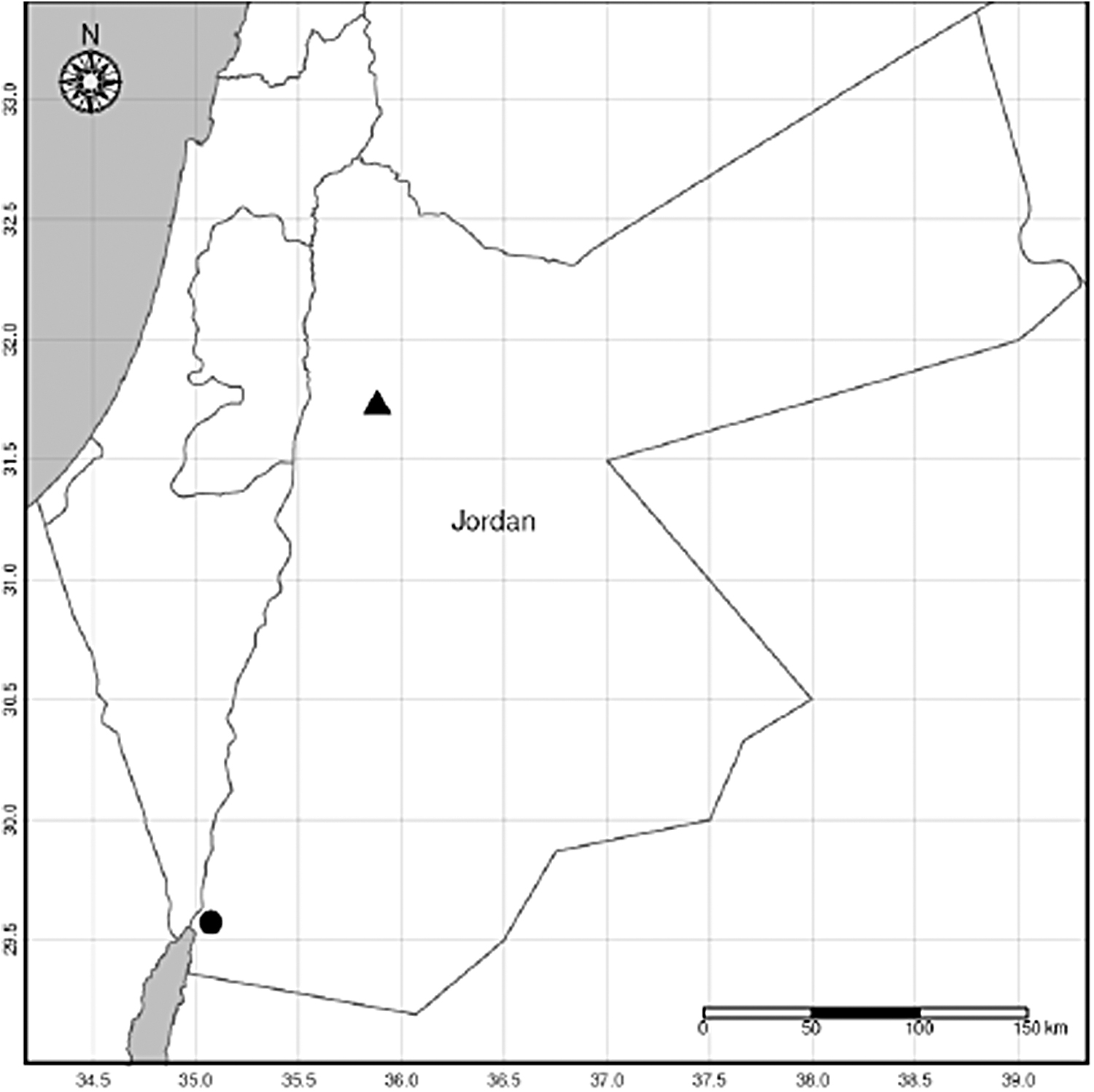
Location of the two shelters in Jordan (•) Aqaba, (▲) Al Rahmeh.
Sampling and data collection
The owners of both shelters were informed about the aim of the study, emphasizing that the sampling was for research purposes. It was also stressed that their decision was completely voluntary as to whether or not they allowed to take samples from the animals. It was also mentioned that their decision would not affect the veterinary care needed by their animals. In July 2019, altogether 80 dogs were sampled randomly in the two shelters, 27 and 53 in Al Rahmeh and Aqaba, respectively. All dogs were apparently healthy and had no disease history or clinical signs. The body surface of each animal was examined thoroughly, and the ticks found were collected in tubes containing 70% ethanol. Blood samples were obtained by venipuncture from each dog into a tube containing ethylene-diamine-tetraacetic acid (EDTA) and shipped to Amman in a cool bag where they were frozen at −18°C before being shipped for laboratory tests. In both shelters a self-administered questionnaire was filled out for each dog, which documented their breed, sex, and age calculated by the examination of their teeth.
Molecular detection of pathogens
The identification of ticks (Estrada-Peña et al. 2004) and the molecular studies were carried out in the department of parasitology and zoology, University of Veterinary Medicine, Budapest, Hungary. DNA was isolated from 200 μL of each EDTA blood sample using the QIAamp DNA Mini Kit (Qiagen, Hilden, Germany) by following the instructions provided by the manufacturing company. Molecular screening for pathogens was carried out in reaction mixtures of 25 μL total volume, by using published protocols and primers (Table 1). PCRs contained 1.0 U HotStar Taq Plus DNA Polymerase (5 U/μL), 0.5 μL dNTP Mix (10 mM), 0.5 μL of each primer (50 μM), 2.5 μL of 10 × Coral Load PCR buffer (including 15 mM MgCl2), and 5 μL template DNA, except for the Hepatozoon PCR, where 2.5 μL template DNA was added to 22.5 μL reagent mixture containing extra 1 μL MgCl2 (25 mM).
Pathogens, Target gene, Product Size, Annealing Temperature, Primers, and References for the PCRs Used in This Study
The thermal protocol steps were the same with the exception of annealing temperatures: an initial denaturation step at 95°CC for 5 min was followed by 35–40 cycles of denaturation at 95°C for 40 s, annealing at 51–65°C
The PCR products of each reaction were electrophoresed in 1.5% agarose gel at 100 V for 60 min, stained with ethidium bromide and visualized under ultraviolet light. Selected positive PCR products were purified and sequenced at the Biological Research Center, Szeged, Hungary. The obtained sequences were edited, aligned, and compared with reference GenBank sequences by the nucleotide BLAST program (BLAST: Basic Local Alignment Search Tool 2020). Representative sequences were submitted to GenBank. Written consent was received for dogs sampled from the owners of both shelters.
Statistical analysis
All statistical analyses were performed in R statistical software (R Core Team 2021).
Results
Tick infestation of dogs
Infested dogs were found only at the Al Rahmeh shelter, where 22 specimens, 12 male and 10 partly engorged female ticks were removed mostly from the head and the neck regions of 14 (51.9% [95% confidence interval; CI: 34.0–69.3]) out of 27 animals. More female (10; 37.0% [95% CI: 21.53–55.77]) than male (4; 14.8% [95% CI: 5.9–32.5]) dogs harbored ticks (p = 0.002). All of the ticks were identified as Rhipicephalus sanguineus sensu lato. Except for one animal, the infested dogs were <2 years old.
Pathogens
In total, 42 (52.5% [95% CI: 41.7–63.1]) dogs were infected with one or two pathogens. The prevalence was higher (p = 0.24) at the Al Rahmeh (63.0% [95% CI: 44.2–78.5]) than at the Aqaba shelter (47.2% [95% CI: 34.4–60.3]). Coinfection caused by two pathogens was found in nine (21.4% [95% CI: 11.7–35.9]) dogs. The DNA of three protozoal and two bacterial species was detected in the blood samples collected at the two shelters (Table 2). Neither Ehrlichia canis nor Rickettsia spp. were found.
Number of Dogs Infested with Ticks and Infected with Pathogens
Eight dogs were infested with ticks of which one animal was coinfected with Babesia negevi.
Eight dogs were coinfected with Candidatus Bartonella merieuxii.
Thirty-four animals (42.5% [95% CI: 32.3–53.4]) were infected with Hepatozoon canis, the prevalence of which was not significantly different at the two shelters (p = 0.1479). In Al Rahmeh the DNA of H. canis was detected in 15 out of 27 (55.6% [95% CI: 37.3–72.4]) dogs, seven of which were infested with ticks. One of these dogs was also infected with Babesia negevi. Babesia vogeli and Anaplasma platys each were present in two tick-infested dogs. Pathogens, mainly H. canis, were detected in 9 out of 14 tick-infested dogs. The DNA of H. canis and Candidatus Bartonella merieuxii was found in the blood samples of 19 (35.9% [95% CI: 24.3–49.3]) and 14 (26.4% [95% CI: 16.4–39.6]) dogs, respectively. Both pathogens occurred in 8 (15.1% [95% CI: 7.9–27.1]) samples.
Sex and age of the infected dogs
Almost the same percentages (p = 1.00) of female (42.3% [95% CI: 29.9–55.8]) and male (42.9% [95% CI: 26.5–60.9]) dogs were infected with H. canis. The DNA of Candidatus B. merieuxii was found in more (p = 0.07) males (28.6% [95% CI: 15.3–47.1]) than females (11.5% [95% CI: 5.4–23.0]). Regarding the sex ratio of the coinfected dogs, there were five female and four male animals. The majority of infected dogs (88.1% [95% CI: 76.6–94.5]) were <2 years old.
Discussion
Stray and shelter dogs are reservoirs of several pathogens of animal and human health importance, many of which are transmitted by ticks (Dantas-Torres et al. 2012, Otranto et al. 2017). In this study, only 14 dogs kept at the Al Rahmeh shelter were infested with ticks that were identified as R. sanguineus s. l., known as the brown dog tick or the kennel dog tick (Dantas-Torres 2010). This is not surprising because this species is widely distributed in tropical and subtropical regions and it is extremely common in kennels and shelters (Latrofa et al. 2014, Solano-Gallego et al. 2015). In studies carried out in Northern Jordan (Qablan et al. 2012) and Palestine (Azmi et al. 2016, 2017), the most abundant tick species collected from dogs was R. sanguineus s. l. Although no data are available about its distribution in Jordan, we suppose that this tick species occurs throughout the country, where its specimens infest large numbers of local stray dogs.
Among tick-infested dogs and wild canids, R. sanguineus is the most important vector of many pathogens of veterinary and human health concern (Dantas-Torres 2008, Latrofa et al. 2014). We assumed that any dogs examined in this study might be infected with TBPs transmitted by this tick species. The results obtained confirmed our hypothesis, the DNA of protozoa and/or bacteria was present in the blood samples of 42 dogs, nine of which had coinfection.
Three protozoal and two bacterial species were detected in the two shelters. H. canis was the most prevalent in dogs kept in Al Rahmeh (55.6%, n = 15) and Aqaba (35.9%, n = 19). The presence of H. canis in dogs of Jordan was first reported by Qablan et al. (2012), who found its high prevalence (28.9%) in 38 stray dogs by PCR. Our result confirms the presence of this protozoal species in Jordan, which is one of the most widespread pathogens infecting domestic dogs and wild canids in tropical, subtropical, and temperate climate areas, including countries of the region where its vector R. sanguineus is present (Baneth 2011, Azmi et al. 2017, Barati and Razmi 2018). It is known that this hemoparasite is also transmitted vertically in dogs (Murata et al. 1993).
The DNA of two protozoal species, which have never been reported from Jordan, was detected in two blood samples collected at Al Rahmeh. The presence of piroplasms in Jordanian dogs was found in three dogs by PCR a few years ago, but the sequencing of the amplicons revealed the highest similarity to the equine piroplasmids Babesia caballi and Theileria equi (Qablan et al. 2012). B. vogeli transmitted by R. sanguineus s. l. in tropical and subtropical regions around the world (Birkenheuer et al. 2020) was found in a dog. This species may cause severe illness especially in young puppies, as well as in immunosuppressed dogs or those coinfected with other pathogens (Solano-Gallego and Baneth 2011). It might be possible that this TBP has been present in Jordan for a long time or it has been introduced into the country with infected stray dog(s) from the neighboring country where it was found in Palestinian dogs (Azmi et al. 2017) and in its tick vector (Azmi et al. 2016). A recently reported (Baneth et al. 2020) new Babesia sp., B. negevi, was identified in the other sample. This recently discovered protozoan was found in five dogs in the neighboring Israel. One of these animals had typical signs of acute babesiosis with fever, severe regenerative hemolytic anemia, and thrombocytopenia, and died within a short time. The DNA of this pathogen was detected in the soft tick Ornithodoros tholozani; however, the vector of B. negevi is currently unknown (Baneth et al. 2020). The infected Jordanian dog might have arrived from the neighboring country. However, it cannot be excluded that it became infected in Jordan before arriving at the Al Rahmeh shelter because the suspected soft tick vector was found in many caves in West Jordan (Babudieri 1957).
Besides the three hemoparasite species, A. platys was also detected in a dog of the Al Rahmeh shelter. This is the first time when the agent of infectious cyclic thrombocytopenia had been in Jordan. As far as we know, before this study only Anaplasma phagocytophilum, the agent of the zoonotic granulocytic anaplasmosis was detected in local dogs (Qablan et al. 2012, Obaidat and Alshehabat 2018).
The finding of A. platys is not surprising, considering its worldwide distribution associated to that of R. sanguineus s. l. with which this zoonotic species (Arraga-Alvarado et al. 2014) is presumed to be transmitted. We assume that A. platys may have been present in Jordan for a long time or arrived recently with stray dogs or wild canids from Israel (Harrus et al. 2011) and/or another neighboring country. To the best of our knowledge, we detected Candidatus B. merieuxii for the first time in Jordan. It was found in 14 dogs kept at the Aqaba shelter, 8 of which were coinfected with H. canis. Several Bartonella spp. have been isolated from dogs, which serve as reservoirs of some of them (Pérez et al. 2011, Álvarez-Fernández et al. 2018). Stray dogs are more susceptible to infection with Bartonella spp. due to the nature of their habitat that makes them prone to being infected with ticks and fleas. Chomel et al. (2012) proposed the name Candidatus B. merieuxii for the new strain that had been described earlier from dogs in Greece and Italy (Diniz et al. 2009). According to the authors who detected this candidate species in jackals and red foxes, domestic dogs may represent its major reservoir, and R. sanguineus may be the possible vector of this new Bartonella sp. (Chomel et al. 2012). A few years later, this bacterium was found in three golden jackals in the neighboring Israel (Marciano et al. 2016). Therefore, it might be possible that this pathogen arrived in Jordan with infected wild canids from which brown dog ticks transmitted it to the local stray dogs.
No E. canis was detected in the present and earlier studies, which is quite surprising because it is highly prevalent in domestic dogs and wild canids harboring R. sanguineus ticks. The absence of this pathogen from dogs examined in the two Jordanian shelters might be due to the small sample size tested.
Conclusions
To the best of the authors' knowledge, except for H. canis, the other TBPs are being reported for the first time from Jordan. These findings indicate that stray and shelter dogs and their ticks are reservoirs of pathogens in the country, which can pose animal and public health risks due to the lack of basic health care for dogs. Further monitoring studies should be conducted among the local stray and domestic dogs as well as in wild canids to help the local authorities to standardize and improve the sanitary protocols aimed at protecting the health of dogs. The results presented in this study are of great importance for the local veterinarians who seemed to be largely unaware of canine vector-borne pathogens. In the future, public health authorities should also pay more attention to arthropod-borne pathogens, including the TBPs of dogs than they did before.
Footnotes
Acknowledgments
We thank the shelter owners for giving us the opportunity and time to take samples from the dogs in their shelters.
Ethical Statement
All dogs sampled in the study were used with the consent of the Animal Care and Use Committee from Jordan.
Author Disclosure Statement
No competing financial interests exist.
Funding Information
No funding was received for this study.