




Abstract
Background:
Intestinal parasites not only lead to poor goat health and productivity but can also affect human health. We investigated the distribution of zoonotic intestinal parasites among goats in southern Thailand to assess the human health risks.
Materials and Methods:
Overall, 561 fecal samples were collected randomly from goats in farms (55) in Songkhla, Satun, Pattalung, Pattani, Yala, and Narathiwat provinces between January 2020 to January 2022. Parasite eggs were detected via the standard protocol formalin ether concentration technique (FECT).
Results:
Samples containing one or more intestinal parasites accounted for 97.33% (543/561) of the total samples, and the percentage of zoonotic parasite was 80.04% (449/561). Among the positive samples, two types of zoonotic helminths were identified, Strongylid egg type (79.32%) and Fasciola spp. (2.14%). Strongylid egg type was highly abundant in samples from Satun (84.62%), Songkhla (82.74%), Pattalung (79.31%), and Yala (77.27%). Fasciola spp. was mostly found in samples form Pattalung (13.79%) and Songkhla (1.12%). Eimeria spp. was the mostly identified protozoa 25.67%. It was mostly identified in samples from Narathiwat (75%), Pattani (41.9%), and Songkhla (31.41%). Mixed infections accounted for 40.82% of the total with 33 patterns. It was found that Strongylid egg types occurred in 28 patterns (84.85%). Strongylid egg types—Eimeria spp.—pattern was the most commonly found.
Conclusion:
Based on the results, zoonotic helminth infection was found together with widespread and high diversity of intestinal parasites infection in meat goats, which affect animal health and may pose a risk to human health. Mass deworming programs with a proper anthelmintic drugs and good agricultural practices need to be encouraged by the government so that people who contact with goats should practice good hygiene behavior. Farm management should be applied by intensive goat raising with pasture circulating to reduce parasite egg contamination. Moreover, fresh fertilizers from goat faces should be avoided.
Introduction
In Thailand, intestinal parasites are common in goats, with considerable economic losses. When present in large numbers, the parasites can induce diseases, especially when the host is weakened by another disease or by poor nutrition. Parasites currently are the main cause of poor goat health and productivity (Kusiluka et al., 1998). The most common clinical signs are diarrhea, poor body condition, poor growth rate or retardation, low milk yield, and poor hair coat (Metre, 2013). Intestinal parasites can reduce appetite in goats, leading to weight loss. Some parasites, such as hookworms, attach to the lining of the gastrointestinal tract and ingest blood from the host, which results in anemia (Villarroel, 2013). The infected goats have a high risk of morbidity and mortality, leading to economic losses (Ghimire and Bhatpara, 2019).
Several parasites in goat from the groups of nematodes, trematodes, cestodes, and protozoa pose a zoonotic risk to humans. Examples of nematodes are a group of Trichostrongylidae such as Bunostomum sp., Strongyloides sp., Haemmonchus sp., Trichostrongylus sp., Toxocara sp., and Trichuris sp. (Fauziah et al., 2021; Pestechian et al., 2014). In the group of trematodes, Fasciola hepatica and Fasciola gigantica are of importance (Nyindo and Lukambag, 2015). In the cestodes, Taenia spp. are highlighted (Faruk et al., 2017). Zoonotic protozoa are Gardia spp., Cryptosporidium spp., and Eimeria spp. (Ikpe et al., 2022).
Previous studies in Thailand reported overall occurrence of gastrointestinal parasitic infections in goats of the central, northern, and western regions was 86.54%, 87.2%, and 88%, respectively; whereas helminthic prevalence among goats in the southern region ranged from 57.82% to 76.4% (Jittapalapong et al., 2012; Worasing et al., 2011). The zoonotic parasites were found such as Strongyloides spp. (78.7%), Trichuris spp. (7.4–32.89%), Eimeria spp. (1.75–58.0%), Entamoeba spp. (37.8%), Giardia spp. (5.2%), and Capillaria spp. (0.5%) (Income et al., 2021; Jittapalapong et al., 2012; Junsiri et al., 2021; Wongsawang et al., 2020; Wuthijaree et al., 2022). Moreover, Bunostomum trigonocephalum (hookworm) is most commonly found in sheep and goat. In Madhya Pradesh, India, the overall prevalence in goat was 30.76% (Khare et al., 2018). The hookworm usually infected the small intestine of sheep or goats and may cause diarrhea, anemia, and sore feet from infection at the site of larval entry (Wormboss, 2022).
Those parasites are still a public health threat in rural areas of Thailand, with infection rates of 17.03%, 11.90%, 10.60%, 8.90%, 7.74%, and 4.92% in northeaster, northern, western, eastern, southern, and central regions, respectively (Nuchprayoon et al., 2002). The prevalence of intestinal parasitic infections in schoolchildren of Satun province during the period December 2014 to January 2015 was 18.42%, including Blastocystis hominis (29%), Giardia lamblia (13.3%), Trichuris trichiura (13.3%), and hookworm (13.3%) infections; the author found a significant association with anemia (Sarasombath, 2017). Association with the report of overall helminthic prevalence among the goats in Satun province was 76.4%, which included zoonotic parasite such as Trichuris spp., Strongyloides spp., Entamoeba spp., and Eimeria spp. (Jittapalapong et al., 2012). It was found that when parasites colonize the gut, the balance between the host and the gut microbiota can be disturbed, potentially leading to inflammatory bowel disease in humans (Naveed and Abdullah, 2021).
In this context, this study aims to determine the prevalence of zoonotic intestinal parasites in meat goat in southern Thailand, providing a basis for the assessment of zoonotic risks to human health.
Material and Methods
Ethical statement
The animal experiments performed in this study were approved by the Institutional Animal Care and Use Committee, Prince of Songkla University, under permission number MHESI 61084/384.
Study design and fecal sample collection
We collected fecal samples from meat goat in six provinces in southern Thailand. Sample size calculation was performed online for a prevalence survey, using a finite population (
Laboratory methods
The standard protocol for the formalin ether concentration technique (FECT) to detect parasite eggs was applied to confirm parasite infection. Briefly, 5 g of feces was dissolved in 15–20 mL of water, filtered through a mesh sieve into a tube and centrifuged at 2,500 rpm for 5 min. The supernatant was discarded, and we added 7 mL of 10% formalin; the mixture was shaken vigorously until the sediment was dissolved and was set aside for 5 min. Subsequently, 3 mL of diethyl ether solution was added, followed by shaking for 1 min and centrifugation at 2,500 rpm for 5 min. After discarding the supernatant, 1–2 mL of 10% formalin was added to the pellet. Of the suspended pellet, one drop was placed on a slide, covered with a cover slip, and observed under an oil immersion microscope at high magnification (10 × ocular lens, 40 × objective). Evaluation of helminth species is based on measurement size and microscopic observation of external and internal morphology according to morphological identification keys of Willium (1997).
Statistical analysis
Data were analyzed as percentages using Microsoft Excel (Microsoft Corp.). Confidence interval for a proportion at 95% was done in online website of Clinical and Translational Science Institute (
Results
The overall prevalence of intestinal parasite infections among goats was 97.33% (543/561), while the prevalence of zoonotic gastrointestinal parasite was 72.55% (407/561). Four types of nematode parasites were identified, Strongylid egg type (79.32%) Strongyloides papillosus (17.20%), Trichuris ovis (9.45%), and Toxocara vitulorum (1.96%). One type of cestode was identified, Moniezia spp. (9.63%). Treaded parasites were Paramphistome spp. (rumen fluke) (9.63%) and Fasciola spp. (2.14%). Only one genus of protozoa was found, Eimeria spp. 26.67% (Table 1 and Fig. 1).
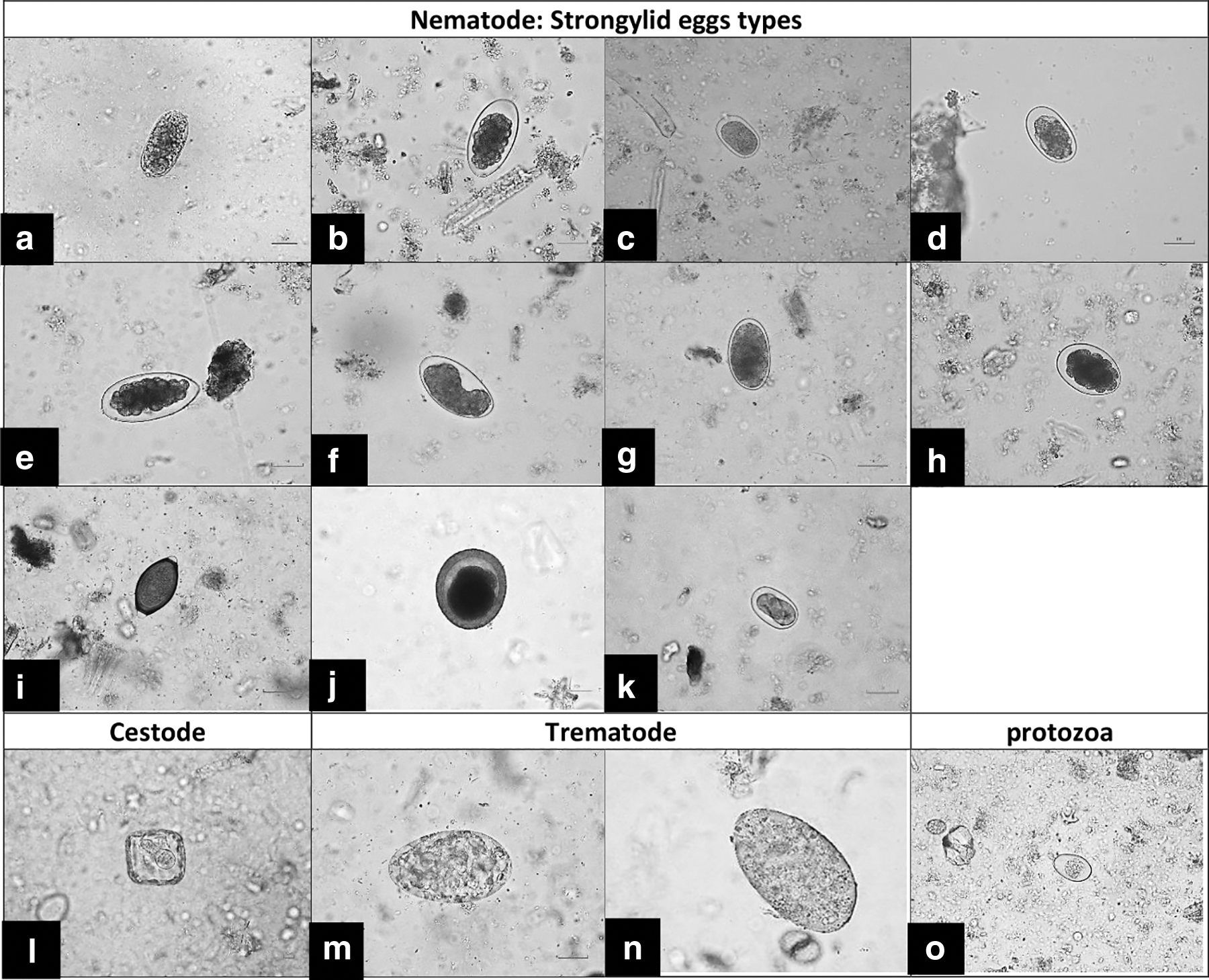
Gastrointestinal parasites presented in meat goat.
The Prevalence of Intestinal Parasites in Meat Goats (N = 561)
CI, confidence interval.
In samples from Songkhla, the most common helminth eggs were Strongylid egg type (82.74%) followed by S. papillosus (24.38%), Moniezia spp. (13.97%), Paramphistome spp. (12.05%), T. ovis (9.32%), T. vitulorum (2.74%), and Fasciola spp. (1.12%), respectively. In samples from Satun, the highest prevalence was found for Strongylid egg type 84.62% followed by T. ovis (20.00%), Paramphistome spp. (13.85%), and S. papillosus (12.31%). In samples from Pattalung, Strongylid egg type (79.31%), S. papillosus (22.41%), Fasciola spp. (13.79%), T. ovis (10.34%), T. vitulorum (1.72%), Paramphistome spp. (1.72%), and Moniezia spp. (1.72%) were identified. In samples from Pattani, three types of helminth were identified Strongylid egg type (45.2%), S. papillosus (6.45%), and Moniezia spp. (3.23%), whereas in samples from Yala and Narathiwat only Strongylid egg types were indentified at 77.27% and 40.00%, respectively (Table 2). Eimeria spp. was mostly identified as protozoa in samples from Narathiwat (75%), Pattani (41.9%), Songkhla (31.41%), Satun (18.46%), Yala (13.64%), and Pattalung (3.45%), respectively (Table 2).
The Prevalence of Intestinal Parasites in Goats Across the Six Studied Provinces
GI, gastrointestinal; NW, Narathiwat province; PL, Pattalung province; PT, Pattani province; SK, Songkhla province; ST, Satun province; YL, Yala province.
Two hundred twenty-nine out of 561 samples were mixed infection with more than 2 species (40.82%) with 33 patterns. It was found that Strongylid egg types occurred in 28 patterns about 84.85% (28/33). Strongylid egg types—Eimeria spp. pattern was the most commonly found, followed by family Strongylid egg types—T. ovis, Strongylid egg types—S. papillosus, and Strongylid egg types—Paramphistome spp. patterns, 15.55%, 6.95%, 4.46%, and 3.39%, respectively (Table 3).
The Patterns of Mixed Parasitic of All Samples (N = 561) in Six Study Areas
EM, Eimeria spp.; FA, Fasciola spp.; MO, Moniezia spp.; PS, Paramphistome spp.; SP, Strongyloides papillosus; STL, Strongylid egg type; TO, T. ovis; TV, Toxocara vitulorum.
Discussion
In this study, the percentage of intestinal parasite infections in meat goats was high (97.33%). Similarly, with a previous study in Satun province, intestinal parasite infection in meat goats was 94.3% (Jittapalapong et al., 2012). The results from this study and previous studies determined the prevalence in the southern area higher than other areas of Thailand, such as the central area (Rachaburi: 86.54%), the western area (Kanjanaburi: 88%), and the northern area (Phitsanulok: 87.2%) (Income et al., 2021; Junsiri et al., 2021; Wuthijaree et al., 2022). These might be because southern area of Thailand is more humid and has a higher level of rainfall than other regions. Besides that goat farms are small and mainly raised in grazing areas rather than in the stable, increasing the chance of parasite contact.
The results determined a high percentage (61.32%) of zoonotic parasites with two groups of helminths. The dominant zoonotic helminth in this study was Strongylid egg type followed by Fasciola spp. Strongylid egg types were mostly identified in samples from Satun (84.62%) followed by Songkhla (82.64%), Pattalung (79.31%), Yala (77.27%), Pattani (45.2%), and Narathiwat (40.00%). Contrasting with the previous findings in Rachaburi, the dominant species were Strongyloides spp. 57.77%) (Junsiri et al., 2021). Such discrepancies may be the result of differences in environmental and climatic conditions. Southern Thailand has a warm, humid climate with a long rainy season, facilitating parasite development. Jittapalapong et al. (2012) reported that gastrointestinal parasitism in ruminants occurs throughout the year in areas with a tropical climate, with higher infection intensities during the rainy season.
Strongylid egg types such as Haemonchus spp., Trichostrongylus spp., and Oesophagostomum spp. can cause diseases in humans. Haemonchus spp. and Trichostrongylus spp. cause trichostrongylosis, which shows abdominal complications and hypereosinophilia in humans (Bhat et al., 2023). Haemonchus is the most commonly found genus and the most important internal parasite of sheep and goats. It is a highly pathogenic hookworm that sucks blood from the mucosa of the abomasum, leading to severe anemia and death in goats (Urquhart et al., 1996) infected via ingestion or skin penetration in moist environments of tropics (Craig, 2009). It is resistant to a variety of anthelminthic drugs such as benzimidazoles, imidazothiazoles, macrocyclic lactones, closantel, and monepantel (Arsenopoulos et al., 2021). Human infection was very rare, and it was reported in Iran (Ghadirian and Arfaa, 1974). Trichostrongylus infection is sporadic as reported in warm countries. Trichostrongylus colubriformis was the main zoonotic species causing hookworm infections (49.4%) in the villages, and the worm showed the same characteristics as the ones obtained from a goats in the village of Laos (Sato et al., 2011). However, the need is to characterize more on the genotypes of Trichostrongylidae in the goats of this study. Oesophagostomum spp. infection occasionally occurred in humans (Ziem et al., 2006). These parasites are common in cattle, sheep, goat, pig, and nonhuman primate, and eggs were shed into the environment and matured to be infective to human (Parasitipedia, 2022). The incidence in human was reported in the northern regions of Togo and Ghana (Blotkamp et al., 1993; Bogers et al., 2001).
In Thailand, the prevalence of Fasciola spp. was high in cattle ranging from 14.14 to 20.30% (Thanasuwan et al., 2021; Yuwajita et al., 2014). This study identified Fasciola spp. in 2.14% of total samples, and they were mostly found in samples from Pattalung 13.79% (8/58) and Songkhla 1.12% (4/365). Similar to the previous study on cattle and buffalo nearby Songkhla Lake that showed as 7.8% and 30.1% positive through fecal examination by formalin-ethyl acetate sedimentation method and 29.3% and 78.9% by enzyme-linked immunosorbent assay (ELISA), respectively (Boonaue et al., 2013).
Songkhla Lake is a wetland area in the Malay Peninsula in the southern part of Thailand, including Songkhla and Phatthalung provinces. Fasciola spp. was a zoonotic liver fluke, and its infection caused fascioliasis, which is an emerging public health threat in a number of regions worldwide, including Southeast Asia (Hoang Quang et al., 2022). They are a waterborne and foodborne zoonotic parasite caused by two parasites F. hepatica and F. gigantica (Mas-Coma et al., 2009). The common symptoms of fascioliasis are epigastric pain, upper abdominal pain, and malaise (Saba et al., 2004). Human cases of hepatic fascioliasis were reported from northern, northeastern, and upper central regions of Thailand (Aroonroch et al., 2006). Even, it was found that this parasite existed in undercooked food, but there were only a few human case reports because undercooked food was not preferred in this area.
Eimeria spp. was the only protozoa detected in the samples and some species were considered as zoonotic protozoa. However, as Eimeria has sheep and goats as specific hosts, there is no threat to public health (Anthony, 2022). In adult goats, the infections are generally asymptomatic, although a few species have been linked to diarrhea and impeded the growth of the goat kids (Anthony, 2022; Chartier and Paraud, 2012).
This study suggests that the likelihood of zoonotic parasite transmission from goats to humans is high. Various zoonotic parasites were found in samples from Pattalung, Satun, and Songkhla; most likely because of the high density of goats and other animals that are bred in these provinces. In contrast, in the southernmost region (Yala, Pattani, and Naratiwat), no zoonotic helminths were identified; therefore, mass treatment should be considering in these areas as well as species identification.
As mixed infections with Strongylid egg type and with other parasites occurred frequently, with varying patterns, different control strategies are needed. However, control is impeded by the resistance of this genus to various anthelmintics, such as benzimidazoles, imidazothiazoles, macrocyclic lactones, closantel, and monepantel (Arsenopoulos et al., 2021). Mixed infections with more than two species weaken the immune system of goats, promoting infections with other parasites. Eimeria spp. that always coinfected with helminths would lead to severe clinical signs and might lead to death. Instead of deworming programme application, management factors associated with high level of Eimeria infection should be done. It should include reduce overcrowding, make a clean condition, and don't use the same pens for young goats and older goats.
According to these findings, zoonotic helminths are contagious to humans. Even though they are not directly transmitted to humans, but at their infective stage in the environment may contaminate the food. Normally, those parasites are waterborne or foodborne transmission. Suggestion for the humans who are in close contact with the goat rearing is that they should wear personal protective equipment and do hand cleaning after contact with animals.
Conclusion
The wide distribution of intestinal parasites as well as zoonotic parasites in southern Thailand, the centre of halal goat meat production, has considerable impacts on goat production and human health. Therefore, intestinal parasites in goat farms need to be monitored, and seasonal and mass deworming programs should be applied. Farm management should be applied by intensive goat rearing. However, semi-intensive farming should be circulating in the pasture field. The “One Health” approach can be applied to prevent the contamination of the environment with parasite eggs. Farmers or workers have to follow strict personal hygiene protocols, with yearly deworming. Moreover, don't use fresh feces of goats as fertilizers, and the consumer should properly clean the vegetables.
Footnotes
Acknowledgments
The authors thank the goat farmers in the provinces of Sonkhla, Satun, Pattalung Pattani, Yala, and Nathiwat for permitting sampling on their farms.
Authors' Contributions
D.K.: conceptualization, methodology. S.K.: data curation. R.W.: investigation. O.P.: supervision. S.P.: software, validation. R.N.: visualization, writing—reviewing and editing manuscript.
Author Disclosure Statement
There is no conflict of interest.
Funding Information
There is no funding applicable.