




Abstract

According to the World Health Organization, >1 billion people are infected with vector-borne diseases every year. These ancient scourges transmitted by bloodsucking nuisances have devastated lives and decimated populations, even contributing to collapse of entire societies. Although mosquitoes take most of that blame, diseases spread by the subject of this book, the bloodsucking ticks, are on the rise. Climate change, habitat loss, and shifts in land use have contributed to the dramatic range expansion of these ticks, and by extension, an increased incidence of tick-borne illnesses.
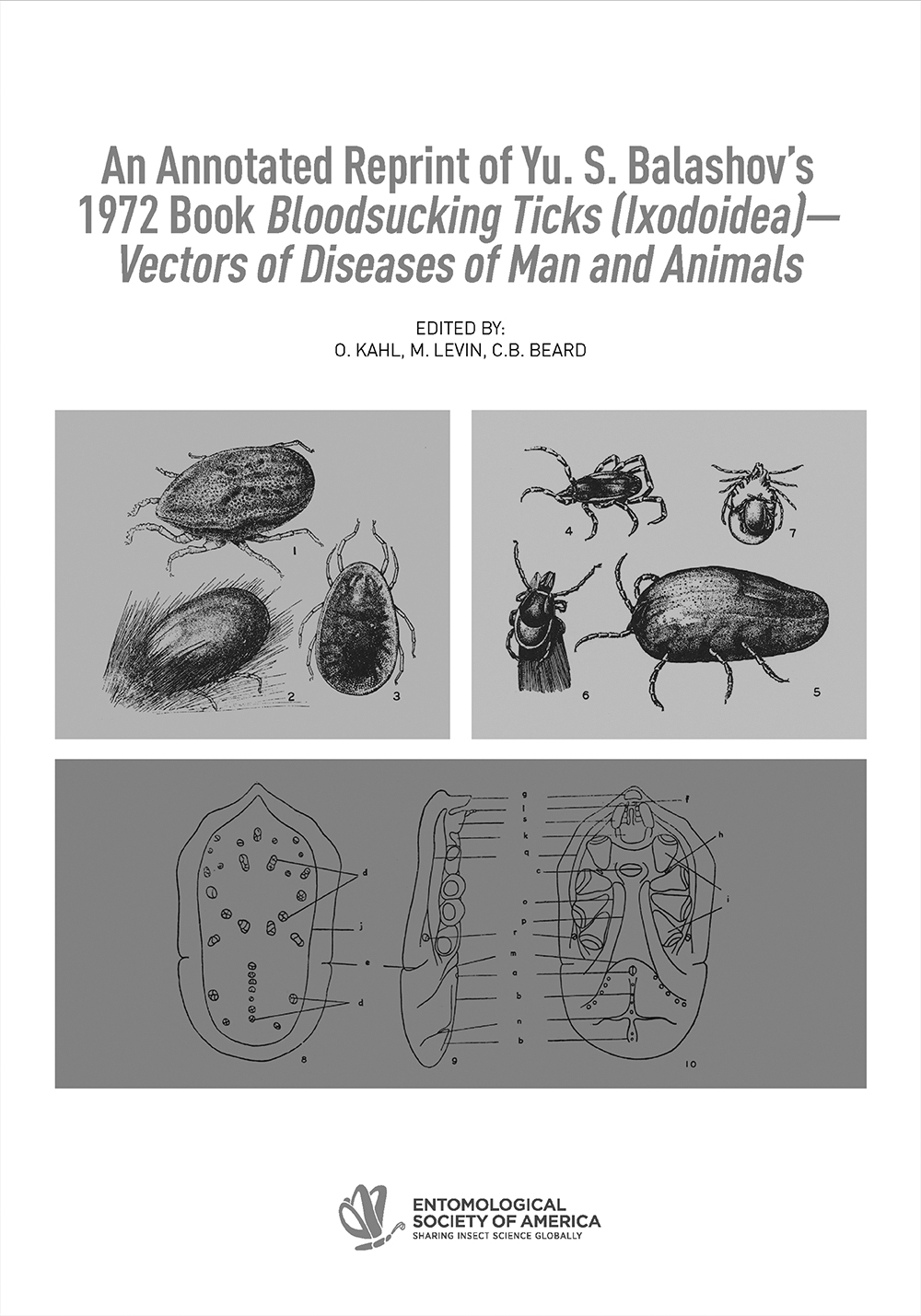
The 1967 classic, translated from Russian in 1972, is an in-depth compendium of the basic biology of ticks, with an emphasis on Eurasian species. The book is divided into the following sections: morphological, life cycle, feeding, feeding mechanism, digestion, excretion, molting, reproduction, ticks, and agents of transmissible vertebrate infections. Detailed line drawings and photomicrographs provide exquisite detail of the anatomy of the tick and histological features.
The intent of the annotated reprint was severalfold. Although the original was an important resource of basic knowledge, the book was difficult to find and not always accessible in electronic databases. This version updates scientific names to reflect the evolving taxonomy. The editors also strove to correct lapses in the previous English translation and provide new references for modern readers while preserving the original text. Importantly, our knowledge of tick-borne pathogens and the tick microbiome has expanded considerably in the past 50 years, making the section on transmissible vertebrate infections out of date. The editors have provided detailed technical references and comments to steer readers to new knowledge and research, again without sacrificing the original text. Of note, one of the editors, Olaf Kahl, did sacrifice his personal original copy for the digitization process!
The annotated reprint provides an easy to follow key of editorial notes, corrections, and taxonomic changes. To readers, please note that page number in the tables on technical comments and taxonomic usage updates refers to the page number in the original text. The PDF version of the book allows for keyword searches, enhancing the utility of the new annotation. Bloodsucking Ticks is densely packed with information, and unfortunately the font in the original is quite small. For those readers with a paper copy, an indicator alerting the reader to a major editorial comment or taxonomic change on the page would have been a nice addition, as I found myself flipping back and forth to the tables.
These are minor quibbles. The annotated reprint makes this classic accessible to a whole new generation of acarologists, and the meticulous research and compilation of knowledge by Professor Balashov stands the test of time. This is an invaluable resource, and the annotated reprint is quite timely. For example, the Eurasian focus mainly provides understanding of tick survival and diapause regulation under extreme conditions such as temperature and aridity. In turn, these insights can inform future research on tick adaptation and range expansion in the face of climate threats.
This book is for students, specialists, all people interested in acarology, and all people interested in the history of science. I was fortunate to be gifted a copy of this wonderful resource, but I would have gladly paid full price.
—Reviewed by:
Catherine A. Brissette
Department of Biomedical Sciences
University of North Dakota
Grand Forks, ND 58202-9061
USA
E-mail: