




Abstract
Background:
The Trypanosoma cruzi parasite is the causal agent of Chagas disease, recognized by the World Health Organization as a neglected tropical disease. Currently there are seven discrete typing units (DTUs) of T. cruzi distributed in America, but there are still gaps about its distribution in some endemic regions.
Materials and Methods:
Seventeen units isolated from Chiapas and Oaxaca in Mexico were identified by amplification of the C-5 sterol desaturase gene.
Results:
Three DTUs of T. cruzi, TcI (6), TcII (10), and TcIV (1) were detected by comparing polymorphic sites in specific regions.
Conclusions:
New DTUs are reported for both states, where TcII was the most common DTU. The genetic characterization of the isolates can help to understand the epidemiology of Chagas disease.
Introduction
The Chagas disease is an anthropozoonosis caused by the parasite Trypanosoma cruzi that affects 6 million people, mainly from rural areas where the presence of vector insects (Hemiptera, Reduviidae, and Triatominae) is common. Historically, T. cruzi has shown high genetic variability and is currently classified into six discrete typing units (DTUs; TcI–TcVI) and the additional genotype, TcBat. The underlying mechanisms of this variation are not completely clear, since its reproduction mechanism is predominantly clonal with infrequent genetic recombination (Messenger et al., 2015; Tibayrenc et al., 1986; Zingales, 2018).
Any genetic group of T. cruzi can infect humans, but some groups seem to be more associated with the different cycles of transmission (domestic, peridomestic, or wild), although so far no real relationship has been established. In addition to this, the ecological and epidemiological implications of the genetic variation of T. cruzi are not entirely clear, but the general consensus is that it may play an important role in the pathogenesis of Chagas disease. In recent years and thanks to the use of different molecular markers, it has been observed that DTUs have a variety of geographical distributions, but some, such as TcI, have a broader and more preponderant distribution in Central and North America (Bosseno et al., 2002). Furthermore, TcI is the most frequently detected DTU in humans and leads to acute and chronic cardiomyopathy (Freitas et al., 2023). Meanwhile, the rest of the DTUs shows a greater distribution in South America. However, in some endemic regions of the disease, this is still little known due to lack of studies (Velásquez-Ortiz et al., 2022).
The objective of this study is to identify the DTU of T. cruzi isolates from southeastern Mexico with the purpose of generating information to understand the transmission dynamics of T. cruzi.
Methods
We identified DTU from a set of T. cruzi isolated from domiciliated triatomines in Chiapas and Oaxaca (Table 1). To fulfill this purpose, DNA from insect feces was extracted using a salt gradient method following a modified protocol (Alijanabi and Martinez, 1997). Subsequently, we used TcSC5DF (5′ GGACGTGGCGTTTGATTTAT) and TcSC5DR (5′ TCCCATCTTCTTCGTTGACT) primers to amplify an 832 bp fragment of the C-5 sterol desaturase gene, which discriminates the seven DTUs by patterns in restriction sites following the amplification protocols reported by Cosentino and Agüero (2012).
Locality and Domiciliated Triatomine Species Where Trypanosoma cruzi Isolates Were Collected
Final amplification reaction volumes of 25 μL were prepared of 16.8 μL Nuclease Free Water (Promega), 5 μL MyTaq reaction buffer 5 × (Bioline), 1 μL of each primer (10 μM), 0.2 U MyTaq DNA polymerase (Bioline), and 1 μL DNA template. The amplicons were purified and sequenced by the biotechnological company “Macrogen, Inc.” The sequences were edited in SeqTrace (Stucky, 2012) and aligned using the Muscle algorithm in MEGA X (Kumar et al. 2018). For identification of DTUs, variable sites were located and compared with sequences previously reported by Consentino et al. (2012). Finally, a phylogenetic tree was made using the maximum likelihood algorithm in Mega X, using sequences reported by Camacho-Sierra (2016) and a bootstrap of 1500.
Results and Discussion
Our results show that T. cruzi strains belong to the TcI, TcII, and TcIV DTUs for both states (Fig. 1). For the state of Chiapas, Mexico, four isolated strains pertain to TcI and four isolated strains to TcII (Fig. 2). The identification of TcII represents the first report of this DTU for the state of Chiapas. This DTU has been associated with chronic disease, both in the cardiac and cardiodigestive forms. Curiously, the state of Chiapas occupies the first places in chronic cases of the disease, even in children alterations associated with chagasic cardiomyopathy have been confirmed (Vidal-López et al., 2021).
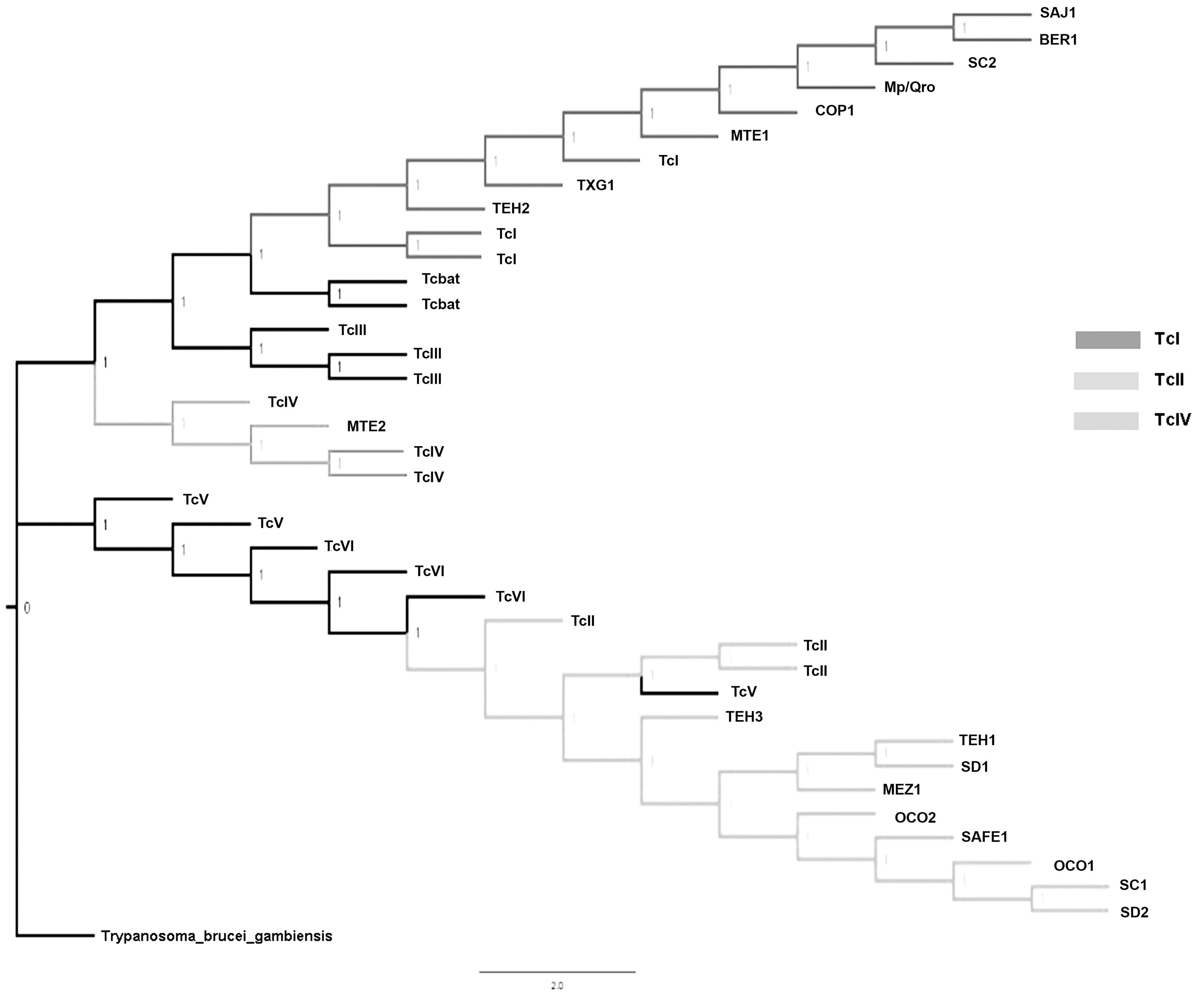
Phylogenetic tree based on the maximum likelihood method where the clustering of Trypanosoma cruzi isolated from Chiapas and Oaxaca, Mexico, is appreciated.

DTUs distribution of Trypanosoma cruzi isolated from Chiapas and Oaxaca, Mexico. DTU, discrete typing unit.
The fact that we found 50% of the isolated strains belonging to TcII is interesting, because other studies in Mexico show a higher prevalence of TcI and the infrequent identification of TcII. In Chiapas, as in much of Central America, Triatoma dimidiata is the main vector, and a predominant infection by DTU TcI has been observed. However, this vector shows great genetic diversity, and different haplotypes of this species have been identified, which could allow it to maintain associations with more than one DTU. In addition to TcVI reported by Pech-May et al. (2019), to date three DTUs have been registered in Chiapas (e.g., Dorn et al., 2017).
For T. cruzi strains isolated from Oaxaca, Mexico, most of them appertain to TcII (six isolated), followed by TcI (two isolated) and TcIV (one isolated) (Fig. 2). The identification of TcIV represents the first report of this DTU in Oaxaca and has been found in humans and dogs in the western Amazon, although it has been shown to have a wide range of hosts such as marsupials, primates, coatis, bats, among others. In Mexico, this DTU has been isolated from T. dimidiata in Quintana Roo, the same vector as us. It is important to mention that the DTUs TcI and TcIV were found in very close locations, which reinforces the idea that there are no differences between the DTUs niches as has been proposed (e.g., Izeta-Alberdi et al., 2016). In fact, in Brazil, the death of a patient who presented mixed infection by four DTUs of the parasite (TcI, TcII, TcIII and TcIV) was recorded, something that had only been observed in insects and wild mammals (Dario et al., 2016). However, the impact and consequences of a mixed infection in humans are still poorly understood.
Likewise, the overlapping patterns of the DTUs would indicate the ability of the parasites to colonize the same environmental niches through their genetic repertoire. As in Chiapas, the higher proportion of infection found by TcII is interesting, although here the most common vector was Triatoma phyllosoma. The state of Oaxaca is one of the regions with the highest number of triatomine species, but ecological or genetic studies are scarce (Dario et al., 2016; Dorn et al., 2017; Izeta-Alberdi et al., 2016; Messenger et al., 2015; Salazar-Schettino et al., 2010; Vasconcelos et al., 2021).
Conclusions
This is the first study to identify the DTU of various T. cruzi isolates in Chiapas and Oaxaca, states located in southeastern Mexico, where there is a high prevalence of Chagas disease. Most of the isolates were obtained from T. dimidiata, a widely distributed vector with a great capacity to adapt to human habitation. In general, we registered three DTUs and thus, five of the seven DTUs of T. cruzi have been registered to date, and only TcV and TcBat remain unreported. However, due to the biodiversity in this region, it is expected that the circulation of all DTUs of the parasite will soon be updated. The identification of DTUs in this region can contribute to the understanding of the transmission dynamics of T. cruzi and generate control strategies for Chagas disease.
Footnotes
Author Disclosure Statement
No conflicting financial interests exist.
Funding Information
No funding was received for this article.