




Abstract
Background:
Researchers paid more attention to nosocomial Acinetobacter baumannii in veterinary hospitals worldwide; however, the research scope toward community-acquired A. baumannii infections among animals is largely ignored. Therefore, the current study aimed to investigate the role of diseased dogs and cats suffering from respiratory illness in transmission of community-acquired A. baumannii infection and its public health threat.
Materials and methods:
Oral swabs were collected from 154 pet animals with respiratory signs, including 80 cats and 74 dogs (outpatient visits). The obtained swabs were cultured on CHROMagar™ MH Orientation media for isolation of A. baumannii, and identification of suspected isolates was conducted via Gram staining, conventional biochemical tests, and molecular detection of the bla OXA-51-like gene. Antimicrobial susceptibility testing of A. baumannii isolates was carried out using the disc diffusion method.
Results:
Overall, 10 (6.5%) out of 154 diseased pet animals were positive for A. baumannii, where 6 (8.1%) and 4 (5%) dogs and cats were positive, respectively. Multidrug-resistant (MDR) A. baumannii was found in 3.9% of the examined animals. The phylogenetic tree analysis revealed that the obtained sequences from dogs and cats were closely related to human and animal sequences.
Conclusion:
The occurrence of MDR A. baumannii among dogs and cats suffering from respiratory illness highlights the potential role of pet animals in the dissemination of MDR A. baumannii in the community.
Introduction
Acinetobacter spp. are aerobic, rod-shaped, Gram-negative bacteria belonging to the Moraxellaceae family of the class Gammaproteobacteria (van der Kolk et al., 2019). Among them, Acinetobacter baumannii is a ubiquitous microorganism that has emerged as an opportunistic nosocomial pathogen in critically ill and immunocompromised patients (Lee et al., 2007). This bacterium has been responsible for numerous life-threatening illnesses such as pneumonia, meningitis, necrotizing fasciitis, sepsis, urinary tract and skin infections, as well as endocarditis (Peleg et al., 2008). Recently, it has been thrust into the public eye as a superbug pathogen due to the increasing incidence of multidrug-resistant (MDR) strains, which cause high morbidity and mortality in humans (Richards et al., 2015). A. baumannii has been identified as a One Health issue since isolates from plants and animals have important antimicrobial resistance genes (Hernández-González and Castillo-Ramírez, 2020). A. baumannii is a member of the ESKAPE group of organisms (Enterococcus faecium, Staphylococcus aureus, Klebsiella pneumoniae, Acinetobacter baumannii, Pseudomonas aeruginosa, and Enterobacter species) that pose a high rate of antimicrobial resistance and virulence factors (Lee et al., 2017). The acquisition of resistance against several classes of antimicrobials via horizontal gene transfer is frequent, dramatically making the available treatment options limited (Lysitsas et al., 2023). The cornerstone of treatment for A. baumannii infection is the use of carbapenems. Since the 1980s, there has been a rise in the number of A. baumannii isolates that are resistant to carbapenem. This evolution may be due to the overuse and abuse of carbapenems in the treatment of Acinetobacter infections (Poirel and Nordmann, 2006). Class D β-lactamases have been commonly reported since the discovery of an OXA-type carbapenemase in an A. baumannii isolate in 1985 and their contribution to high-level carbapenem resistance within A. baumannii strains has been documented (Donald et al., 2000). In 2004, the class D β-lactamase OXA-51 was initially identified in A. baumannii (Brown et al., 2005), and it has been proposed that bla OXA-51-like genes are ubiquitous in A. baumannii (Merkier and Centrón, 2006).
Although the spread of A. baumannii in nosocomial setting is well known, data regarding its circulation outside the hospitals are still scarce (Eveillard et al., 2013; Meumann et al., 2019). A. baumannii is increasingly recognized as an uncommon but important cause of community-acquired pneumonia, bacteremia, cellulitis, and meningitis (Joly-Guillou, 2005; Ong et al., 2009). The extrahospital niches could include domestic and farm animals, as well as a wide variety of foods including fruit, vegetables, cheese, meat, and milk (Ababneh et al., 2022; Askari et al., 2019; Endimiani et al., 2011; Mohamed et al., 2022). Each of these is a potential vessel for dissemination of A. baumannii in the community (Meumann et al., 2019). In veterinary medicine, data about A. baumannii among animals are very limited, even if some cases have been reported (Nocera et al., 2021). The presence of A. baumannii in pet animals has been recently documented (Lysitsas et al., 2023; Nocera et al., 2020) in which A. baumannii isolates from dogs and cats that belonged to human clonal lineages were responsible for human cases (Endimiani et al., 2011; Zordan et al., 2011). These studies have been performed on hospitalized animals and have explored the involvement of A. baumannii in nosocomial infection (Endimiani et al., 2011; Zordan et al., 2011). Yet, few reports exist concerning the role of pet animals as a potential reservoir of community-acquired A. baumannii infections (Belmonte et al., 2014; Pailhoriès et al., 2015). Therefore, the current study was conducted to investigate the occurrence of A. baumannii in oral mucosa, including the saliva of pet dogs and cats suffering from respiratory illness, as saliva contaminates households and comes into contact with humans, to underscore the burden of A. baumannii outside the health care facilities and its threat to human health.
Materials and Methods
Collection of samples
Oral swabs (oral mucosa including saliva) were collected from 154 diseased pet animals (80 cats and 74 dogs) admitted to veterinary clinics suffering from respiratory illness (coughing, sneezing, and nasal discharges) without hospitalization. The collected swabs were inserted into Cary–Blair transport medium tubes and transported in an icebox to the laboratory for immediate bacteriological examination.
Isolation and identification of Acinetobacter spp
Oral swabs were directly plated on CHROMagar™ MH Orientation media (CHROMagar, France) and incubated in an aerobic condition at 37°C for 48 h (Jochum et al., 2021). Afterwards, identification of isolates was based on characteristic colony morphology (creamy in color), followed by Gram staining as well as biochemical identification (Almaghrabi et al., 2018).
Molecular identification of Acinetobacter baumannii
DNA extraction
Genomic DNA was extracted from presumptive Acinetobacter isolates via boiling method. The procedures were carried out according to protocol described by Asadian et al. (2019).
PCR detection of the blaOXA-51-like gene
The bla OXA-51-like gene is intrinsic to A. baumannii due to its highly conserved nature and species specificity (Falah et al., 2019). Polymerase chain reaction (PCR) was carried out using the following primers: OXA-51-likeF 5′-TAATGCTTTGATCGGCCTTG-3′ and OXA-51-likeR 5′-TGGATTGCACTTC ATCTTGG-3′ (Turton et al., 2006). Briefly, a 25 μL reaction mixture was created for each isolate by adding 12.5 μL of COSMO PCR RED Master Mix, 1.25 μL (10 pmols) of each primer, 4 μL of bacterial DNA, and 6 μL of PCR-grade water. The PCR conditions were as follows: 94°C for 3 min and then 35 cycles of denaturation at 94°C for 45 s, annealing at 60°C for 45 s, and extension at 72°C for 1 min, followed by a final extension at 72°C for 5 min. PCR amplicons were identified after an electrophoresis in 0.5 Tris-borate-ethylenediaminetetraacetic acid (EDTA) using 1.5% agarose gel stained with ethidium bromide solution, where specific bands were detected at 353 bp (Fig. 1).
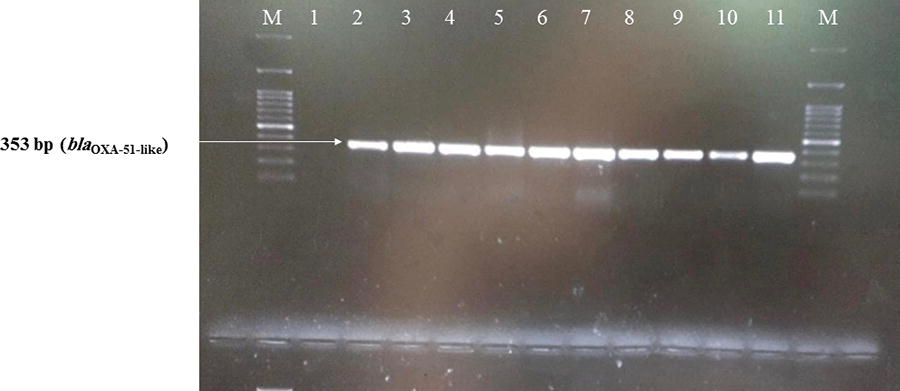
PCR amplification of bla OXA-51-like gene of Acinetobacter baumannii among diseased dogs and cats with respiratory illness. Lane M: DNA ladder (100 bp); lane 1: negative control; lanes 2–11: positive strains showed specific bands at 353 bp. PCR, polymerase chain reaction.
Sequencing and phylogenetic analysis
PCR products of the bla OXA-51-like gene of four A. baumannii isolates retrieved from two dogs and two cats were purified using the QIAquick purification kit (Qiagen, Germany), and direct cycle sequencing was carried out in an ABI 3500 Genetic Analyser (Applied Biosystems, USA). The resulting sequences were blasted in the GenBank database to identify the most similar ones of human cases and animals as well as strains retrieved from the environment to clarify the zoonotic impact of our sequences. Multiple alignments were conducted using the ClustalW program of BioEdit software version (7.0.9), whereas a phylogenetic tree was built up through the neighbor-joining approach using Mega7 software version 7.0.26, and a bootstrap consensus tree was obtained with 500 replicates (Fig. 2).
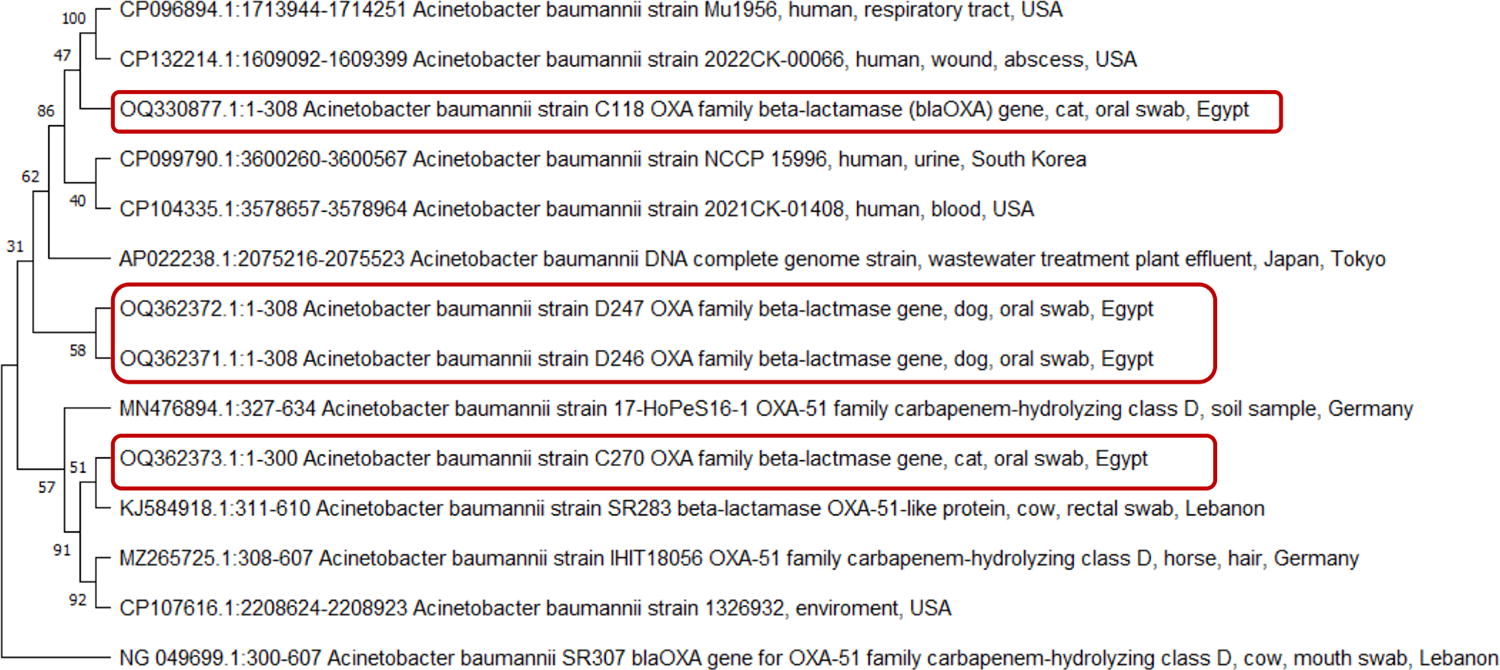
Phylogenetic bootstrap consensus tree was inferred via neighbor-joining approach using MEGA 7 software to show the evolutionary history and genetic relatedness between Acinetobacter baumannii bla OXA-51-like gene partial sequences obtained in this study and those retrieved from GenBank records.
Nucleotide sequence accession numbers
The four partial sequences of A. baumannii bla OXA-51-like gene obtained in the present study were deposited in the GenBank under the following accession numbers: OQ330877 and OQ362373 for cat sequences and OQ362371 and OQ362372 for dog sequences.
Antimicrobial susceptibility testing of A. baumannii isolates
The identification of resistance profiles of 10 A. baumannii isolates was performed through the disc diffusion method following the instructions and guidelines of the Clinical and Laboratory Standards Institute (Clinical and Laboratory Standards Institute [CLSI], 2021). Antimicrobials were selected from the respective table of agents that should be considered for testing against Acinetobacter spp. including piperacillin (PI), ampicillin-sulbactam (A/S), piperacillin-tazobactam (PIT), ceftazidime (CAZ), cefepime (CPM), cefotaxime (CTX), ceftriaxone (CTR), doripenem (DOR), imipenem (IPM), meropenem (MRP), gentamicin (GEN), tobramycin (TOB), amikacin (AK), doxycycline (DO), minocycline (MI), tetracycline (TE), ciprofloxacin (CIP), levofloxacin (LE), gatifloxacin (GAT), and trimethoprim-sulfamethoxazole (COT-SD). The results of zone diameter were documented according to Clinical and Laboratory Standards Institute (CLSI) 2021, and isolates were considered MDR when they displayed resistance to at least one antimicrobial agent in three or more antimicrobial categories (Magiorakos et al., 2012).
Results
Prevalence of A. baumannii among diseased dogs and cats
Overall, 10 (6.5%) out of 154 pet animals with respiratory illness were positive for A. baumannii. From 74 dogs and 80 cats, 6 (8.1%) and 4 (5%) animals were positive, respectively, as shown in Table 1. MDR A. baumannii was found in 6 (3.9%) out of 154 animals, whereas 2.6% (4/154) of the examined animals had antimicrobial susceptible A. baumannii (Table 1).
Prevalence of Acinetobacter baumannii Among Dogs and Cats with Respiratory Illness
MDR, multidrug-resistant.
Antimicrobial resistance pattern of multidrug-resistant A. baumannii isolates
The antimicrobial resistance pattern of 6 MDR A. baumannii isolates is detailed in Table 2. Six isolates were resistant to piperacillin, ceftriaxone, and tetracycline, followed by five strains that showed resistance to ceftazidime. In addition, cefotaxime resistance was found in four isolates, and two isolates exhibited resistance to tobramycin and trimethoprim-sulfamethoxazole. On the other hand, all strains were susceptible to ampicillin-sulbactam, piperacillin-tazobactam, carbapenems (DOR, IPM, and MRP), amikacin, minocycline, and fluoroquinolones (CIP, LE, and GAT).
Antimicrobial Susceptibility Pattern of MDR A. baumannii Isolates
MDR, multidrug-resistant.
Phylogenetic analysis
To determine the genetic relatedness of A. baumannii strains retrieved in this study, we performed a bootstrap consensus neighbor-joining phylogenetic tree, which comprises A. baumannii strains obtained from humans, animals, and the environment. The phylogenetic tree showed that A. baumannii sequences from dogs and cats in this study were closely clustered with human A. baumannii strains, revealing the public health significance of such sequences (Fig. 2).
Discussion
Currently, the majority of documented cases of A. baumannii infection in dogs and cats have been identified as hospital-acquired (Sebola et al., 2023a), but little is known about A. baumannii infection outside the health care settings (Nocera et al., 2021). In the present study, A. baumannii was isolated with a prevalence rate of 6.5% from oral swabs of diseased pet animals with respiratory manifestations admitted to pet clinics without hospitalization, in which 6 (8.1%) dogs and 4 (5%) cats were positive. Other studies reported A. baumannii in nonhospitalized pet animals, as documented by Pailhoriès et al. (2015), who detected A. baumannii in oral swabs of five dogs and two cats admitted to veterinary clinics (outpatient visits) in Reunion Island with an overall prevalence of 4.96% (7/141), and Razali et al. (2020) who isolated A. baumannii from oral cavities of 6 (1.6%) apparently healthy stray dogs and cats, in which one dog (0.57%) and five (2.5%) cats were positive. Also, Hérivaux et al. (2016) reported A. baumannii carriage in pets from the community in France. The oral cavity can act as an extrahospital reservoir for A. baumannii infection (Richards et al., 2015), and aerosolization of these bacteria into the lower respiratory tract can cause pneumonia (Scannapieco et al., 2003). Thus, such results indicate that the saliva of diseased pet animals with respiratory illness can act as a potential source for A. baumannii infection in the community, as saliva contaminates households and comes into contact with humans, particularly children, and thereby the pathogen can be transmitted to humans. Moreover, pet animals have isolates that are more closely related to human strains, implying that humans may be infecting their pets during frequent and intimate contact (Wareth et al., 2019); hence, A. baumannii should be considered when diagnosing respiratory infections in pets.
Carbapenem resistance in A. baumannii serves as a global sentinel event for the emergence of antimicrobial resistance (Richet et al., 2001). There is mounting evidence that A. baumannii has a naturally occurring carbapenemase gene inherent to this species (Héritier et al., 2005). Because bla OXA-51-like is consistently found and ubiquitous to this species, its detection could provide a simple and convenient method of identifying A. baumannii (Turton et al., 2006). Multidrug resistance is one of the greatest threats to public health (Al-Tawfiq et al., 2024). Because of expanding and empirical use of antimicrobials, MDR bacteria have emerged and spread, posing a threat to both veterinary and human health (Essa et al., 2022; Samir et al., 2022; Shaker et al., 2024). MDR A. baumannii was found in 3.9% of the examined pet animals in this study, in which 6 out of 10 isolates exhibited MDR pattern. Likewise, multidrug resistance was detected in high percentage in A. baumannii isolates retrieved from dogs presented at a veterinary academic hospital in South Africa (Sebola et al., 2023b), and A. baumanii strains isolated from dogs and cats in a veterinary teaching hospital in Switzerland (Boerlin et al., 2001). The emergence of MDR A. baumannii in veterinary clinics has been observed worldwide and has become a matter of public health concern (van der Kolk et al., 2019). Noteworthy, a high prevalence of resistance towards penicillins, cephalosporins, and tetracycline was exhibited. This is concerning since these antimicrobials are commonly used to treat skin, eye, and respiratory infections as well as reproductive diseases in pet animals (Valiakos et al., 2020). However, all isolates were susceptible to carbapenems, which was comparable with the findings of Belmonte et al. (2014) in Reunion Island, who found susceptibility to carbapenems in all A. baumannii strains obtained from the examined dogs and cats. In fact, MDR A. baumannii is able to produce large quantities of biofilm (Lee et al., 2008) on biotic and abiotic surfaces facilitating its dissemination in hospital environments, especially on healthcare devices such as urinary catheters and endotracheal tubes (Harding et al., 2018). Furthermore, the close proximity between pet animals and humans gives an opportunity for zoonotic transmission of MDR A. baumannii to pet owners. For instance, MDR A. baumannii isolates retrieved from hospitalized dogs and cats in Germany were genetically related to A. baumannii strains associated with epidemics in human clinics (Zordan et al., 2011).
Interestingly, in this study, partial sequencing of the bla OXA-51-like gene of four A. baumannii sequences from dogs and cats (2 for each species) was carried out, and a phylogenetic tree was constructed to include A. baumannii strains from humans, animals, and the environment. It was shown that the cat sequence (OQ330877) obtained in the present study was in the same clade with A. baumannii strains retrieved from the respiratory tract (CP096894) and abscess (CP132214) of human patients in the United States, whereas another cat sequence (OQ362373) was grouped in the same clade with A. baumannii isolate obtained from cow rectal swab (KJ584918) in Lebanon. In addition, two A. baumannii strains (OQ362371 and OQ362372) isolated from dogs were encompassed in the same cluster with various human strains recovered from urine, blood, respiratory tract, and abscess, as well as environmental A. baumannii sequence obtained from wastewater treatment plant effluent in Japan (AP022238). An important public health point regarding the obtained A. baumannii isolates from diseased pet animals outside the context of nosocomial acquisition is that they have a potential zoonotic risk, highlighting the role of pet animals with respiratory illness in the dissemination of A. baumannii in the community outside the health care facilities (Nocera et al., 2021). Another significant public health concern is the multidrug resistance that exists within these A. baumannii strains. The rapid development of antimicrobial resistance is likely to arise from the ability of A. baumannii to respond effectively to challenges issued by antimicrobials, along with the extensive use of antimicrobials in the hospital settings (Fournier and Richet 2006). Accordingly, the management of A. baumannii infection has become a public health threat in many countries (Landman et al., 2002).
Conclusion
The current study highlights the beginning of a new understanding regarding the potential role of diseased dogs and cats with respiratory illness in transmission of community-acquired MDR A. baumannii infection. Consequently, a concept of the One Health approach is inevitable because human health is dependent on animal and ecosystem health to limit the risk of zoonotic transmission of MDR A. baumannii infection. The limitation of this study was that it only included pet animals outside hospital settings. Further genomic characterization of A. baumannii from animals will be necessary in order to better understand the genetic variation of isolates and provide more data regarding community-acquired A. baumannii.
Footnotes
Authors’ Contributions
A.S., K.A.A.-M., and H.M.Z.: Study design and supervising the work. A.A.S.: Sample collection and practical work. All authors have been included in writing article.
Ethics Approval
A sampling of animals in this study was approved by the ethical committee of the Faculty of Veterinary Medicine, Cairo University, Egypt (Vet CU12/10/2021/377). All methods were performed in accordance with the relevant guidelines and regulations. An informed consent was obtained from the owner of the animals for samples to be taken.
Author Disclosure Statement
No competing financial interests exist.
Funding Information
No funding was received for this study.