




Abstract
Outbreaks of highly pathogenic H5N1 influenza viruses have been reported in many countries worldwide. The possibility of pandemics caused by H5N1 influenza viruses is high since human infections by H5N1 viruses continually occur. In this study we determined the immune response and efficacy of inactivated H5N1 vaccine developed by reverse genetics in ferrets. Ferrets intramuscularly inoculated with two doses of H5N1 vaccine survived the lethal challenge with homologous or heterologous H5N1 influenza viruses, while 75% and 25% of ferrets immunized with one dose of H5N1 vaccine survived the lethal challenge with homologous and heterologous H5N1 influenza viruses, respectively. When we determined antibody subtypes specific for H5N1 influenza viruses in tissues and sera of vaccinated ferrets, IgG antibodies were detected mainly in the trachea, nostril, lung, heart, liver, kidney, intestine, spleen, and serum. Our results suggest that IgG antibodies may play a major role in protecting ferrets immunized with the inactivated H5N1 vaccine from lethal challenge with H5N1 influenza viruses.
Introduction
The highly pathogenic (HP) H5N1 influenza virus first emerged in Hong Kong in 1997 (1,6,28). This virus was directly transmitted from poultry in live bird markets to humans and killed 6 out of 18 infected humans. The massive slaughter of about 1.4 million poultry in Hong Kong stopped further outbreaks of this virus. In February 2003, this virus re-emerged in a family of 4 persons in Hong Kong who had visited relatives who reared chickens in the Fujian Province in China (20). One person died from the HP H5N1 influenza virus infection. Since December 2003, HP H5N1 influenza viruses have spread from poultry in Asia to birds in Europe, the Middle East, and Africa (5,16,26). HP H5N1 influenza viruses (clade 1) were predominantly isolated in Vietnam, Laos, Cambodia, Thailand, and China until 2005. In 2005, the outbreaks of HP H5N1 influenza viruses (clade 2.2) in wild migratory birds at Qinghai Lake in western China prompted these viruses to spread to over 30 countries in Europe, the Middle East, and Africa. After the spread of HP H5N1 influenza viruses (clade 2.2), HP H5N1 influenza viruses (clade 2.3.4.) emerged in southern China and started to spread in that region (4,22,26,27). In Vietnam HP H5N1 influenza viruses (clade 2.3.4) replaced them (clade 1) in northern Vietnam in 2007 (15,31).
To date, most human infections by HP H5N1 influenza viruses have occurred through direct contact with infected poultry, although limited person-to-person transmission has also been reported (2,3,20). The efficient transmission of avian influenza viruses in humans requires preferential binding to sialic acid (SA) receptors containing an α2,6-galactose linkage that are predominant on the epithelial cells in the respiratory tracts of humans (21). The HP H5N1 influenza viruses preferentially bind to SA receptors containing an α2,3-galactose linkage (17). As HP H5N1 influenza viruses continuously evolve and infect humans, they may eventually be able to bind to SA receptors containing a α2,6-galactose linkage, resulting in pandemic influenza viruses. As of September 24, 2009, 262 out of 442 people infected with HP H5N1 influenza viruses had died, and the mortality rate in humans with H5N1 influenza viruses is over 59% (14).
The HP H5N1 influenza viruses may infect cells of tissues other than the respiratory tract in humans (12). A study of one man and one pregnant woman showed that viral antigens were detectable in type II epithelial cells of the lungs, T lymphocytes of the lymph nodes, brain neurons, and Hofbauer cells and cytotrophoblasts of the placenta (12). Patients infected with H5N1 influenza viruses showed clinical signs such as high fever (>38.5°C), severe lymphopenia, diarrhea, seizures, acute encephalitis, and coma (7).
Ferrets have been used to study pathogenicity and vaccine efficacy of influenza virus since they show clinical signs similar to those of humans infected with influenza virus (11,25,29). In this study, we investigated whether ferrets immunized with the inactivated H5N1 influenza vaccine were protected from a lethal challenge with H5N1 influenza virus, and which antibody subtypes were involved in protecting the vaccinated ferrets.
Materials and Methods
Viruses
The H5N1 influenza viruses, A/Vietnam/1203/04 (H5N1) (clade 1) and A/Vietnam/HN31244/2007 (H5N1) (clade 2.3.4) were obtained from the World Health Organization (WHO) Collaborating Center for Influenza, Centers for Disease Control and Prevention. H5N1 influenza viruses were propagated in 10-day-old fertilized eggs in an incubator (37°C). Experiments using H5N1 influenza viruses were performed in a biosafety level 3 (BSL-3) facility approved by the Korean government.
Generation of H5N1 vaccine virus
The reassorted H5N1 vaccine virus (CNUK-H5N1-08-01) was generated using the backbone of A/PR/8/34 (H1N1) as previously described (10,32). Plasmids of PB2, PB1, PA, NP, M, and NS of A/PR/8/34 (H1N1) were kindly provided by Dr. Robert G. Webster at St. Jude Children's Research Hospital, Memphis, Tennessee. Plasmids of HA and NA genes of A/Vietnam/1203/04 (H5N1) were constructed as follows. cDNA was generated from RNA extracted from allantoic fluids containing A/Vietnam/1203/04 (H5N1) using the RNeasy kit (Qiagen Inc., Valencia, CA), the uni12 primer (5′-AGCAAAAGCAGG-3′), and the ImProm-II TM Reverse Transcription System (Promega Corp., Madison, WI). The HA-connecting peptide (RRRKK) was removed by PCR using the Expand High Fidelity PCR System (Roche Diagnostics GmbH, Mannheim, Germany), and overlapping primers: (A) Bm-HA-1 (5′-TATTCGTCTCAGGGAGCAAAAGCAGGGG-3′) and 1089ΔR (3′-CATTCCCTGCCATCCTCCCTCTATAAAACCTGCTATAGCTCCAAATAATCCTCTCTCTCTTTGAGGGCTATTTC-5′); and (B) 1028ΔF (5′-AGAGGATTATTTGGAGCTAT-3′) and Bm-NS-890R (3′-ATATCGTCTCGTATTAGTAGAAACAAGGGTGTTTT-5′). The NA gene was amplified using primers: Ba-NA-1 (5′-TATTGGTCTCAGGGAGCAAAAGCAGGAGT-3′) and Ba-NA-1413R (5′-ATATGGTCTCGTATTAGTAGAAACAAGGAGTTTTTT-3′). The amplified PCR products were cloned into the vector pHW2000 as previously described (13).
To rescue the reassorted H5N1 vaccine virus, Vero cells were transfected with 1 μg of each plasmid with 18 μL of TransIT LT-1 transfection reagent (PanVera, Madison, WI). The transfected cells were incubated for 48 h, and 300 μL of supernatant treated with L-(tosylamido-2-phenyl) ethyl chloromethyl ketone (TPCK)-treated trypsin (1 μg/mL) were inoculated into the allantoic cavity of 10-day-old pathogen-free hen eggs (Charles River SPAFAS, North Franklin, CT). The rescued virus in the allantoic fluids of the inoculated eggs was identified by genetic analysis and hemagglutination-inhibition (HI) assay using H5N1-specific antibodies.
Preparation of inactivated H5N1 vaccine
The H5N1 vaccine viruses were propagated in the allantoic cavities in 10-day-old hen eggs at 35°C for 60 h and the collected allantoic fluid was concentrated using the Amicon concentrator apparatus. The concentrated viruses were purified by 20–75% sucrose continuous gradient (26,000 rpm at 4°C) for 2 h. Bands containing vaccine antigens were collected and treated with formalin (0.02% per volume) at 4°C overnight to inactivate viruses. The pellets treated with formalin were spun down by centrifugation at 26,000 rpm (4°) for 2 h. The concentration of HA protein in the purified H5N1 vaccine was determined by standard single radial immunodiffusion technique using H5N1 standard sera and antigens obtained from the National Institute for Biological Standards and Control (Hertfordshire, U.K.) as previously described (34). We measured only HA concentrations of vaccine antigens since the HA proteins are a major determinant of the immune response to influenza vaccine.
Vaccination of ferrets
Ferrets (7–8 wk old) obtained from Marshall Farms (North Rose, NY) were serologically negative for the human influenza viruses H1N1, H3N2, and human B according to HI assays. The Ferrets were intramuscularly (IM) inoculated with 15 μg of H5N1 vaccine antigens (clade 1) in the hind leg; 3 wk later a second dose was administered at the same location. The vaccinated ferrets were intranasally (IN) challenged with 10 ferret lethal dose 50 (10 FLD50) (103 EID/50) of A/Vietnam/1203/04 (H5N1) (clade 1) or A/Vietnam/HN31244/2007 (H5N1) (clade 2.3.4). The ferrets were observed for changes in body weight and mortality for 14 d after infection. The animal experiments were approved by the Animal Experimental Ethics Committee at the Chungnam National University.
Determination of viral titers in tissues
The tissues of the trachea, nostril, lung, heart, liver, kidney, duodenum, rectum, spleen, and brain (0.05 g) of ferrets infected with A/Vietnam/1203/04 (H5N1) (clade 1) or A/Vietnam/HN31244/2007 (H5N1) (clade 2.3.4) were homogenized in 0.5 mL of PBS (pH 7.4) supplemented with 2 × antibiotic-antimycotic solution (Sigma-Aldrich, St. Louis, MO). The supernatants of the homogenized tissues were serially 10-fold diluted in PBS (pH 7.4) supplemented with 2 × antibiotic-antimycotic solution and were inoculated into four 10-day-old hen eggs. The presence of viruses in the inoculated eggs was identified by hemagglutination assay using 0.5% turkey red blood cells. Viral titers were determined by log10 egg infectious dose 50/mL (log10EID50/mL) as previously described (18). The detection limit of the viruses was 1 log10EID50/mL.
Hemagglutination-inhibition assay
Sera were collected from the vaccinated ferrets and treated with receptor-destroying enzyme (RDE) (Denka Seiken Co., Tokyo, Japan). RDE-treated sera serially twofold diluted in PBS (pH 7.4) in V-bottom 96-well plates were reacted with an equal amount of 8 HA units (25 μL) of A/Vietnam/1203/04 (H5N1) (clade 1) or A/Vietnam/HN31244/2007 (H5N1) (clade 2.3.4) viruses. The plates were incubated for 15 min at room temperature, and then 50 μL of 0.5% turkey red blood cells were added to each well of the 96-well plates. The samples were evaluated after 40 min of incubation at room temperature. The HI titers were expressed as reciprocal dilutions that completely inhibited hemagglutination.
Detection of antibody subtypes in the immunized ferrets
The immunized ferrets were euthanized with high doses of Zoletil® (Virbac Laboratories, Carros, France), and 0.05 g of trachea, nostril, lung, heart, liver, kidney, duodenum, rectum, spleen, and brain were collected and homogenized in 0.5 mL of PBS (pH 7.4) supplemented with 2 × antibiotic-antimycotic solution. Sera from the immunized ferrets were treated with RDE. The subtypes of antibodies in the tissues or sera of the immunized ferrets were determined by enzyme-linked immunosorbent assay (ELISA). The wells of 96-well ELISA plates (Greiner Bio-One, Kremsmünster, Czech Republic) were coated with 100 μL (0.05 g) of the purified inactivated A/Vietnam/1203/04 (H5N1) (clade 1) vaccine diluted in 1 mL of carbonate-bicarbonate buffer (pH 9.6). To each well, 100 μL of supernatant from the homogenized tissues in PBS (pH 7.4) containing 5% horse serum and 0.05% Tween 20 (PBS-Tween 20) were added. The Plates were incubated at room temperature for 1 h and then washed three times with PBS-Tween 20. To each well were added 100 μL (1:1000 dilution in PBS-Tween 20) of horseradish peroxidase (HRP)-conjugated goat anti-ferret IgA (Acris Antibodies, Herford, Germany), IgM (Acris Antibodies), or IgG (Novus Biologicals, Littleton, CO). The plates were incubated at room temperature for 1 h and then washed three times with PBS-Tween 20. To each well, 100 μL of ABTS peroxidase substrate (KPL Inc., Gaithersburg, MD) was added. The plates were incubated at room temperature for 30 min and ABTS peroxidase stop solution (KPL) was added to stop the reaction. Optical density (OD) was read at 405 nm using an ELISA microplate reader (Tecan Systems, San Jose, CA).
Statistical analysis
The statistical significance was determined by a two-tailed, paired Student's t-test. Statistical significance was set at p < 0.05.
Results
Antibody responses in ferrets immunized with inactivated H5N1 vaccine
Ferrets were IM immunized with H5N1 vaccine (clade 1) and boosted 37hairsp;wk after the first immunization. HI titers were determined with clade 1 or clade 2.3.4 H5N1 influenza viruses up to 10 wk post-vaccination (p.v.) (Fig. 1). The mean HI titer against clade 1 peaked at 66.6 at 4 wk p.v. and then gradually declined until 10 wk p.v. In contrast, the mean HI titers against clade 2.3.4 were less than 20 until 10 wk p.v. The mean HI titer against clade 1 in the ferrets immunized with one dose of vaccine (clade 1) was less than 20 (3 wk after immunization).

Hemagglutination inhibition titers in immunized ferret sera. Ferrets (n = 10) were IM immunized with two doses of 15 μg of H5N1 vaccine (clade 1). The second inoculation was administered 3 wk after the first. Sera were collected up to 10 wk after immunization. Hemagglutination inhibition (HI) titers were performed with A/Vietnam/1203/04 (H5N1) (clade 1) or A/Vietnam/HN31244/2007 (H5N1) (clade 2.3.4) viruses and 0.5% turkey red blood cells.
Change in body weight, mortality, and viral titers of ferrets immunized with inactivated H5N1 vaccine
Ferrets immunized with H5N1 vaccine (clade 1) were challenged with a lethal dose of H5N1 influenza virus (clade 1 or clade 2.3.4) and observed for changes in body weight and mortality (Fig. 2A). When we measured the body weights of ferrets at 14 d post challenge (p.c.), the surviving ferrets immunized with one dose of H5N1 vaccine and challenged with homologous and heterologous H5N1 influenza viruses lost 4% and 10% of their body weights prior to the challenge, respectively. The surviving ferrets immunized with two doses of H5N1 vaccine and challenged with homologous and heterologous H5N1 influenza viruses at 4 weeks p.v. gained 3% and lost 3.2% of their body weights prior to the challenge, respectively. The surviving ferrets immunized with two doses of H5N1 vaccine and challenged with homologous and heterologous H5N1 influenza viruses at 10 weeks p.v. gained 5.3% and 3.2% of their body weights prior to the challenge, respectively.
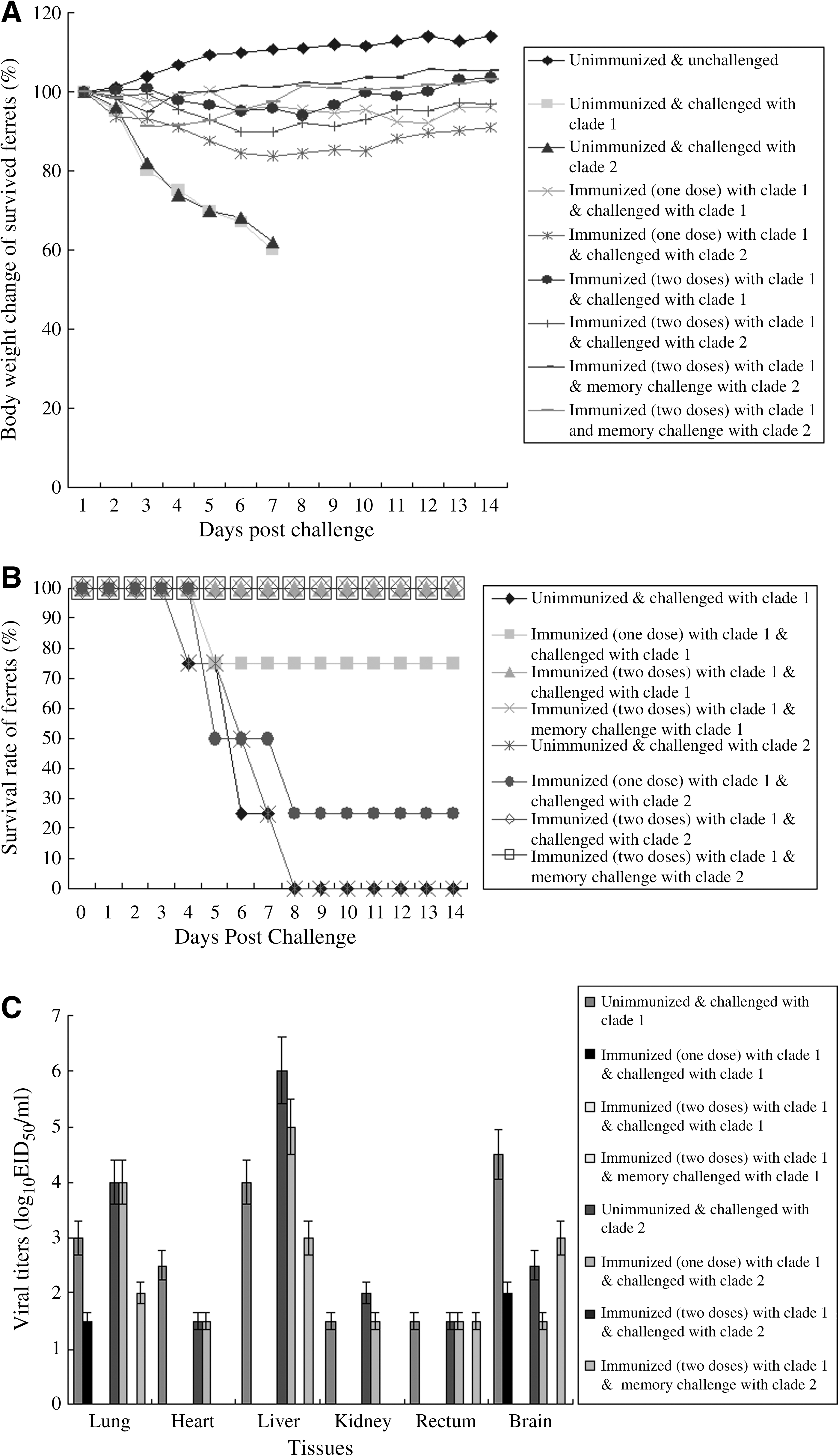
The change in body weight, mortality, and viral titers in tissues of immunized ferrets. Ferrets (n = 15) immunized with two doses of H5N1 vaccine (clade 1) were IN challenged with 10 FLD50 of A/Vietnam/1203/04 (H5N1) (clade 1) or A/Vietnam/HN31244/2007 (H5N1) (clade 2.3.4), and were observed for changes in body weight (
We also determined the mortality of immunized ferrets (Fig. 2B). All tested ferrets immunized with two doses of H5N1 vaccine and challenged 4 wk after immunization survived the lethal challenge with homologous or heterologous H5N1 influenza viruses. The survival rates of ferrets immunized with one dose of H5N1 vaccine were 75% with homologous challenge and 25% with heterologous challenge, respectively. To determine how long the protective immunity would last, ferrets were immunized with two doses of H5N1 vaccine and challenged with lethal doses of H5N1 influenza viruses 10 wk after immunization. All ferrets survived the lethal challenge of homologous and heterologous H5N1 influenza viruses. All non-immunized ferrets challenged with homologous or heterologous H5N1 influenza viruses died by 8 days p.c.
Viral titers in the tissues of the immunized ferrets were determined at 4 d p.c. by log10EID50/mL (Fig. 2C). The mean viral titers in ferrets immunized with one dose of vaccine and challenged with homologous H5N1 influenza viruses were 1.5 log10EID50/mL in lung tissue and 2.0 log10EID50/mL in brain tissue. No virus was detected in the tissues of ferrets immunized with two doses of H5N1 vaccine and challenged with homologous H5N1 influenza viruses at 4 wk and 10 wk p.v. Viruses were detected in lung, heart, liver, kidney, rectum, and brain tissues of ferrets immunized with one dose of H5N1 vaccine and challenged with heterologous H5N1 influenza viruses. The mean viral titers in lung, heart, liver, kidney, rectum, and brain were 4.0, 1.5, 5.0, 1.5, 1.5, and 1.5 log10EID50/mL, respectively. No virus was detected in tissues of ferrets immunized with two doses of H5N1 vaccine and challenged with heterologous H5N1 influenza viruses at 4 weeks p.v., while viruses were detected in lung, liver, rectum, and kidney tissues of ferrets immunized with two doses of H5N1 vaccine and challenged with heterologous H5N1 influenza viruses at 10 wk p.v. The mean titers in lung, liver, rectum, and kidney were 2.0, 3.0, 1.5, and 3.0 log10EID50/mL, respectively. Viruses were detected in lung, heart, liver, kidney, rectum, and brain in non-immunized ferrets challenged with homologous or heterologous H5N1 influenza viruses. The mean viral titers in lung, heart, liver, kidney, rectum, and brain tissues of non-immunized ferrets challenged with homologous H5N1 influenza viruses were 3, 2.5, 4.0, 1.5, 1.5, and 4.5 log10EID50/mL, respectively, and those in lung, heart, liver, kidney, rectum, and brain of non-immunized ferrets and challenged with heterologous H5N1 influenza viruses were 4.0, 1.5, 6.0, 2.0, 1.5, and 2.5 log10EID50/mL, respectively.
Antibody subtypes in tissues and sera of immunized ferrets
To determine what subtypes of antibodies were involved in protecting ferrets from lethal challenge of H5N1 influenza viruses, we evaluated IgG, IgM, or IgA antibodies in trachea, nostril, lung, heart, liver, kidney, duodenum, rectum, spleen, brain, and serum using H5N1-coated plates (Tables 1, 2, and 3). To minimize the introduction of antibodies from serum in the tissues, we fully exsanguinated the ferrets before collecting the tissues. The IgG antibody was predominantly detected in tissues and sera, and higher OD values were detected in tissues of ferrets immunized with two doses of H5N1 vaccine than in those immunized with one dose of H5N1 vaccine (Table 1). The mean OD values of IgM or IgA antibodies in the tissues of immunized ferrets were similar to those of non-immunized ferrets (Tables 2 and 3). The mean OD values of IgM antibodies in sera of immunized ferrets were higher than those of non-immunized ferrets (Table 2).
The subtypes of antibodies in tissues and sera were determined by ELISA using HPR-labeled anti-ferret IgG and plates coated with H5N1 antigens. Data are the mean of 5 ferrets.
The subtypes of antibodies in tissues and sera were determined by ELISA using HPR-labeled anti-ferret IgM and plates coated with H5N1 antigens. Data are the mean of 5 ferrets.
The subtypes of antibodies in tissues and sera were determined by ELISA using HPR-labeled anti-ferret IgA and plates coated with H5N1 antigens. Data are the mean of 5 ferrets.
Discussion
Highly pathogenic H5N1 influenza viruses continually infect humans. If H5N1 influenza viruses gain the ability to transmit from human to human, thousands of people may be affected due to the high virulence of H5N1 influenza viruses. Our study showed that ferrets immunized with two doses of inactivated H5N1 vaccine could be fully protected from both homologous and heterologous infections of H5N1 influenza viruses, and the protective immunity was mainly mediated by IgG antibodies.
Our study showed that immunization with two doses of inactivated H5N1 vaccine without adjuvant provided homologous and heterologous protection to ferrets infected with H5N1 influenza viruses. We used only H5N1 vaccine derived from A/Vietnam/1203/04 (H5N1, clade 1) and did not compare the immunogenicity of H5N1 vaccines derived from different clades. The cross-clade protection seemed to require two doses of H5N1 vaccine without adjuvant, since the survival rate of ferrets immunized with one dose of H5N1 influenza virus and challenged with heterologous H5N1 influenza virus was only 25%. Interestingly, HI antibody titers against heterologous H5N1 influenza viruses were less than 20 in ferrets immunized with two doses of H5N1 vaccine. The reason that two doses of H5N1 vaccine without adjuvant are required to elicit cross-clade protection may be due to the stronger antibody responses elicited by two does of vaccine versus one dose of vaccine. Our study showed that two doses, not one dose, of vaccine without adjuvant induced HI titers over 40.
Cross-clade protection afforded by H5N1 vaccine without adjuvant is very important to protect humans from potential pandemic H5N1 influenza viruses, since H5N1 influenza viruses continuously evolve. Given that pandemic vaccine may need to be administered to many people in a short time period, vaccine without adjuvant may be safer than vaccine with adjuvant. Most seasonal influenza vaccines are presently administered to humans without adjuvants. However, in the event of a pandemic, a shortage of vaccine could occur. To stretch the available doses of pandemic vaccines, vaccine with adjuvant must be considered, and its safety and immunogenicity carefully studied. Previous studies have shown that cross-clade immunity can be induced in mice or ferrets immunized with H5N1 vaccine. Forrest et al. (8) studied cross-clade immunity and protection by H5N1 vaccine with or without MF59 adjuvant. Two doses of vaccine induced higher titers of antibodies, and H5N1 vaccine with MF59 adjuvant induced higher cross-clade antibody titers to H5N1 influenza viruses. The vaccine for A/Hong Kong/213/03 (H5N1) induced the highest antibody titers to homologous and heterologous H5N1 viruses. The inactivated H5N1 vaccine with aluminum hydroxide (alum) adjuvant also provided homologous and heterologous protection against lethal infections of H5N1 influenza viruses (19). The same study showed that immunization of mice with vaccine for A/Hong Kong/213/2003 (H5N1) induced cross-clade antibodies to heterologous H5N1 influenza viruses, and that the vaccinated mice were protected from lethal challenge by homologous or heterologous H5N1 influenza viruses. Murakami et al. (18) evaluated cross-clade immunity in mice using four inactivated H5N1 vaccines prepared from H5N1 influenza viruses (clades 1, 2.1, 2.2, and 2.3.4). Three H5N1 vaccines (1, 2.1, and 2.3.4) provided partial or full cross-clade protective immunity. Among the tested vaccines, the clade 2.1-based H5N1 vaccine provided the broadest cross-reactive immunity.
Our study showed that IgG antibodies were predominantly detected in tissues and sera of immunized ferrets. This suggests that the protective immunity in ferrets immunized IM with inactivated H5N1 vaccine may be mediated by IgG antibodies, not IgA antibodies, and that IgG alone may be sufficient to protect humans or animals from lethal challenge by H5N1 influenza viruses. Indeed, in immunized ferrets, IgG antibodies were detected in both the upper respiratory tract, such as trachea and nostrils, and the lower respiratory tract, such as the lungs, where the initial influenza viral infections occur. Further study is needed to determine whether immunization with inactivated H5N1 vaccine induces IgG antibodies in the tissues and sera of humans, and thus may protect against lethal infection by H5N1 influenza viruses.
Footnotes
Acknowledgments
This study was supported by a grant from the Korea Healthcare Technology R&D Project, Ministry for Health, Welfare & Family Affairs, Republic of Korea. A staff member of HARRISCO, an English editing company, edited this manuscript.
Author Disclosure Statement
No competing financial interests exist.