




Abstract
This study investigated the induction of humoral and cellular immune response by a DNA vaccine based on the bovine herpesvirus-1 (BoHV-1) glycoprotein D with commercial adjuvants (SEPPIC), in the murine model and in a preliminary assay in cattle, in order to select vaccines candidates that can improve cellular response. A DNA vaccine with most of the adjuvants used in this study was able to elicit a gD and viral-specific humoral immune response in vaccinated mice. Nevertheless, only a DNA vaccine with Montanide GEL 01 PR and Montanide Essai 903110 induced viral-specific proliferation and the highest levels of IFN-γ secretion. Since a cellular response is important to deal with BoHV-1 infection, both adjuvants were tested in a small trial using bovines to corroborate improvement of a cellular response in the natural host. It was observed that a DNA vaccine with Montanide Essai 903110 induced the highest BoHV-1 specific IFN-γ production in cattle. So, this adjuvant is proposed as a suitable candidate to be tested in a BoHV-1 DNA vaccine for protection against viral challenge in bovines.
Introduction
B
It is reported that antibodies could contribute to prevention of viral spread to susceptible cells by antibody-dependant cytotoxicity (1). Nevertheless, BoHV-1 spreads intracellularly. Therefore, it can exist in presence of virus-specific antibodies (4,11). For this reason, cytotoxic T lymphocytes (CTL) are critical for elimination of the virus (17).
Inactivated vaccines do not provide complete protection, since they generally are poor inducers of cellular immunity. Regarding live-attenuated vaccines, they are thought to induce higher levels of protective immunity, but they are not entirely safe (20). In this context, DNA vaccines have emerged as an attractive approach.
gD is one of the BoHV-1 envelope glycoproteins. It has been highlighted as the best antigen for a DNA vaccine against BoHV-1 (18). A construct encoding the secreted form of the protein was able to induce a higher immune response than the complete gD sequence (9,10).
However, the potency of naked DNA vaccines is known to be limited (14). The report at hand was designed to test a plasmid encoding the BoHV-1 secreted gD with different commercial adjuvants (Seppic), in its ability to enhance viral-specific humoral and cellular immune response in mice and in a preliminary assay in cattle, in order to select adjuvant candidates for a challenge trial in bovines. Mice have been used regularly as an experimental model for the study of immune responses toward different types of viruses (8,16), reducing the costs and time involved in the use of large animals and as a first step to select the appropriate conditions for larger experiments involving host species. Since the difficulty of performing assays for measuring cytotoxicity mediated for T lymphocytes (CTL) in outbred animals, mice have been widely used as a model for assaying cellular immune responses and CTL epitopes have been identified for BoHV-1 in mice (2,3,6,8,12,13,21,23).
Vaccines were formulated using 15 μg/dose of a secreted gD coding plasmid (pCIgD) according to previous dose–response results (8) and different adjuvants following the manufacturer's indications (Seppic): Montanide Essai IMS 1312 VG (1312), Montanide Essai 903107 (107), Montanide Essai 903108 (108), Montanide Essai 903109 (109), Montanide Essai 903110 (110), Montanide Essai ISA 206 VG (ISA 206), Montanide ISA 201 VG (ISA 201), Montanide GEL 01 PR (GEL 01), Montanide ISA 71 VG (ISA 71), or Montanide ISA 25 VG (ISA 25). The resulting vaccines were named according to the adjuvant included in each formulation.
Montanide adjuvants are considered as safe by the Committee for Veterinary Medical Products (CVMP) for use in immunological products and are included in Annex of European Council Regulation no. 470/2009 (previously no. 2377/90/EC). Adjuvants classified as IMS are dispersions of liquid particles, varying in size between 50 and 500 nm, in an aqueous phase containing an immunostimulating compound. Adjuvants classified as ISA are used to formulate different type of emulsions: water in oil, oil in water, or water in oil in water, and they are based on mineral oil, non-mineral oil, or a mixture of both, with a surfactant based on mannitol oleate. All adjuvants used in this work were selected according to data provided by the manufacturer (Seppic) indicating that these adjuvants were designed to improve cellular immune responses and some of them to improve DNA binding and transfection.
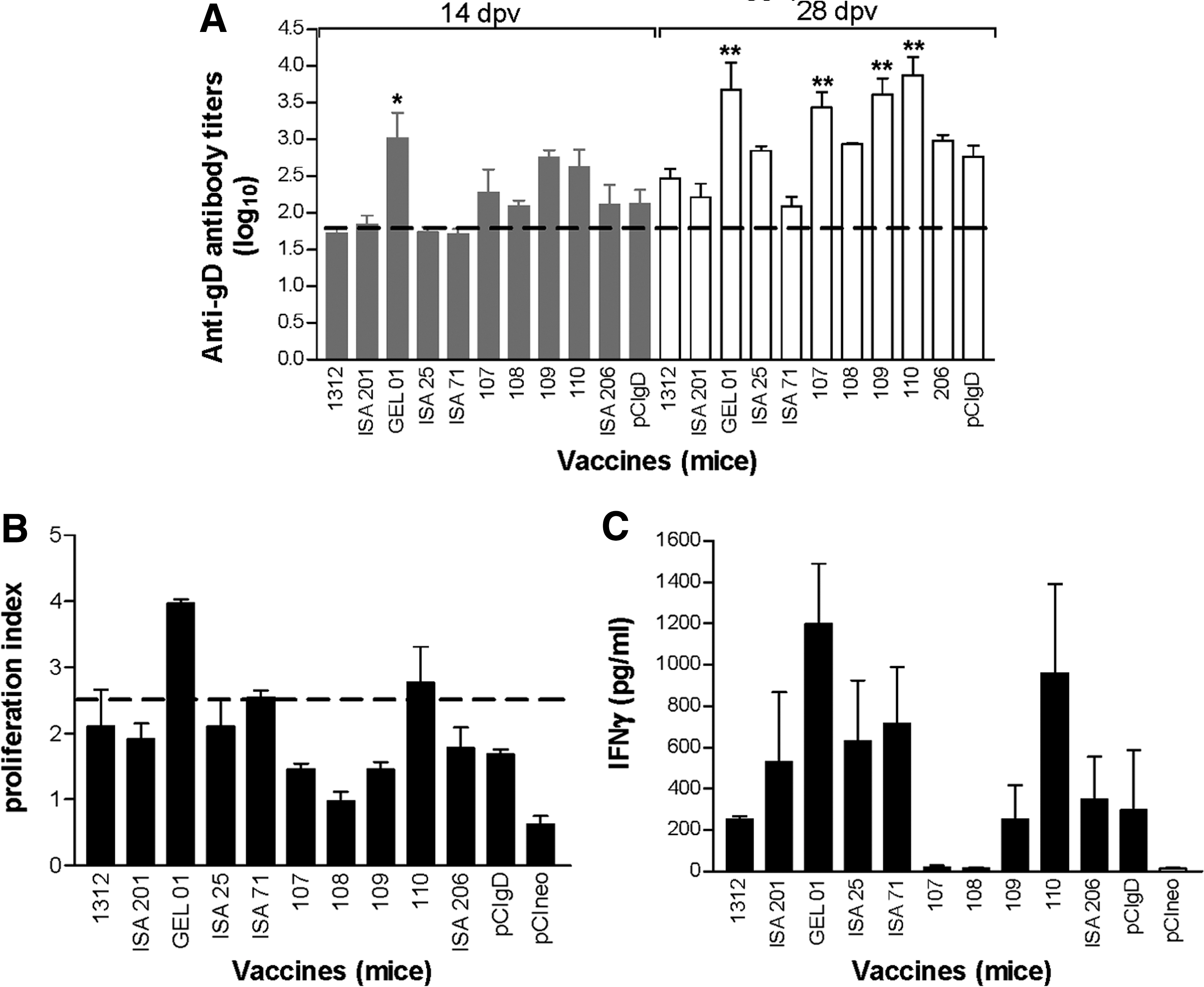
Groups of five BALB/c mice were intradermally (i.d.) inoculated with 0.2 mL of the pCIgD plus mentioned adjuvants, pCIgD alone, or empty pCIneo plasmid (Promega; negative control). Fourteen days after the first vaccination, the mice received a booster vaccination. Analysis of sera by anti-gD enzyme-linked immunosorbent assay (ELISA; Fig. 1A) showed that vaccines GEL 01, 107, 108, 109, 110, and ISA 206 at 14 days post-vaccination (d.p.v.) and all vaccines and pCIgD at 28 d.p.v. were able to induce anti-gD antibody titers (Abs) >2. However, only vaccine GEL01 at 14 and 28 d.p.v. and vaccines 107, 109, and 110 at 28 d.p.v. induced significantly higher anti-gD Abs levels than pCIgD.
(
To study the cell-mediated immune responses induced by the vaccines, spleen cells from immunized mice were removed at 30 d.p.v., stimulated in vitro with gD protein or inactivated BoHV-1 and evaluated for antigen-specific proliferation and IFN-γ secretion. As shown in Figure 1B, vaccines GEL 01 and 110 induced qualitatively higher proliferation indexes than other groups. IFN-γ secretion was evaluated in spleen cell culture supernatants after stimulation with inactivated BoHV-1 by a commercial ELISA kit (e-bioscience). As shown in Figure 1C, vaccines GEL 01 and 110 seemed to induce the highest IFN-γ secretion values, indicating that the respective adjuvants are able to enhance the cellular immune response. When IL4 secretion was assayed, no differences were found between groups (data not shown).
Taking together, these results indicate that pCIgD vaccine formulated with adjuvants GEL 01 and 110 could induce a higher humoral and cellular response against BoHV-1 in mice. Therefore, these adjuvants were further tested in a preliminary trial in bovines, natural host species.
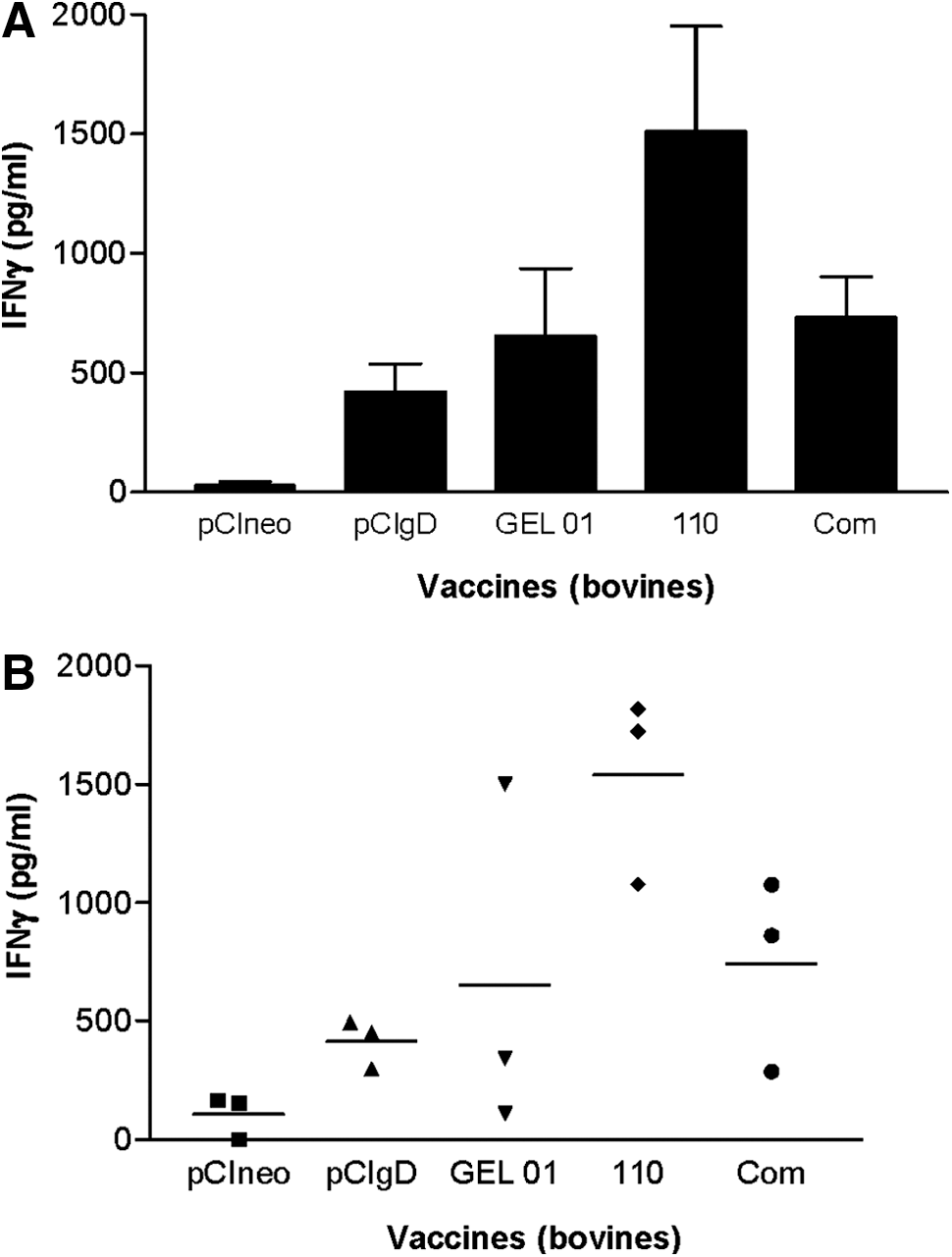
A dose of 500 μg pCIgD was chosen based on a dose–response curve (data not shown). Bovines (1–2 years old, Angus×Hereford breed) were vaccinated i.d. with 1.5 mL of pCIgD alone (n=3), pCIgD formulated with GEL 01 (n=3) or 110 (n=3), pCIneo as negative control (n=3), or an inactivated commercial vaccine (n=3). Fifteen days after the first vaccination, bovines received a booster vaccination. The highest antibody titers against BoHV-1 were recorded at 21 d.p.v. in the commercial group. Bovines in groups pCIgD, GEL01, and 110 had similar antibody levels (Fig. 2A). No differences between groups were found when neutralizing antibodies were measured (data not shown). Nevertheless, when IFN-γ secretion was evaluated at 21 d.p.v. in peripheral blood mononuclear cells (PBMCs) after in vitro stimulation with inactivated BoHV-1, group 110 showed the highest IFN-γ secretion levels (Fig. 2B). This result indicates that adjuvant 110 is capable of improving cellular immune response elicited by pCIgD in bovines, which could improve the protection against BoHV-1 infection. Therefore, adjuvant Montanide Essai 903110 plus gD vaccine was selected for another trial with larger number of bovines and to perform a viral challenge experiment. It was previously reported that adjuvants can selectively induce T helper subtypes and trigger cellular uptake and processing mechanisms that facilitate MHC class I pathway loading of antigen and priming CD8+ cytolytic T cell responses. Examples of this kind of adjuvants are saponins and immune-stimulating complexes (15) such as the ones present in 110 formulation.
(
Montanide Gel 01 is composed of cross-linked polymers that form highly stable micron size aggregates of sodium polycrylate in water (19). Montanide ESSAI 903110 consists of non-cross-linked charged polymers (10–500 nm) dispersed in water containing an immunostimulating compound. It is designed to improve DNA binding capacities and transfection potency (Dupuis L., pers. comm.). On the other hand, it is reported that the immunostimulating compounds contained in both adjuvants recruit cells to the site of injection through inflammatory processes (19). Although the immune mechanisms exerted by these adjuvants remain unclear, an increase of antigen presenting cells at the inoculation site, together with an improved transfection capacity of DNA vaccine, could explain the higher immunity elicited by the combination of pCIgD and these adjuvants.
Footnotes
Acknowledgments
The authors thank Fátima Torales and Valeria Olivera for technical assistance and Seppic for kindly providing the adjuvants. This work was supported by INTA. Seppic agreement VIR-ID-SEPPIC No. 545.
Author Disclosure Statement
No competing financial interests exist.