




Abstract
Dendritic cell-specific intracellular adhesion molecule 3 grabbing nonintegrin related molecule (DC-SIGNR) is a C-type lectin, calcium-dependent carbohydrate-binding protein, which can act as a cell-adhesion and pathogen recognition receptor. DC-SIGNR is known to be highly expressed on liver sinusoidal cells and in the lymph nodes. However, its expression in peripheral blood mononuclear cells (PBMCs) in HIV-1 infection has not been addressed. Therefore, this study determined the expression of DC-SIGNR in PBMCs of HIV-1-infected patients and healthy seronegative individuals by real-time polymerase chain reaction and assessed its correlation with CD4+ T cell counts and DC-SIGNR genotypes. A significantly higher expression of DC-SIGNR was observed in the PBMCs of HIV-1-infected patients compared with healthy seronegative individuals. Further, there was a negative correlation between DC-SIGNR expression and CD4+ T cell counts and positive with viral load, with higher DC-SIGNR expression in the PBMCs of HIV-1-infected patients with a CD4+ T cell count <200 cells/μL than those with >200 cells/μL. This is the first study to report the expression of DC-SIGNR in PBMCs of HIV-1-infected patients. A salient finding of this study is that the DC-SIGNR expression was higher in HIV-1-infected patients, and its positive correlation with viral load and negative with CD4+ T cells counts suggesting a potential role of DC-SIGNR in HIV-1 infection.
Introduction
A
In this cross-sectional study, 30 healthy seronegative individuals and 30 patients infected with HIV-1 were recruited from the blood bank, Cardiothoracic and Neurosciences Center, All India Institute of Medical Sciences and Regional STD Teaching Training and Research Centre, VMMC, and Safdarjung Hospital, New Delhi, India respectively. Blood (5 mL) was collected from each subject (Table 1). Written informed consent was obtained from all the study subjects, and the study was approved by the institute's ethics committee.
Materials and Methods
PBMCs were separated from whole blood by Ficoll gradient centrifugation. Total RNA was isolated from PBMCs using TRI Reagent (Sigma Aldrich). RNA (1,000 ng) was converted to cDNA using random hexamers and Moloney murine leukemia virus reverse transcriptase (MBI Fermentas). The expression of DC-SIGNR was normalized with β-actin as internal control using an ABI 7500 Real-Time PCR System (Applied Bio-Systems). The sequences of primers used were forward primer 5′-GGC GGG CTT GGT ATG TTG TA-3′ and reverse primer 5′-CGG GGT GTA GCT GGA AGT TG-3′ for DC-SIGNR, and forward primer 5′-AGA AAA TCT GGC ACC ACA CC-3′ and reverse primer 5′-TAG CAC AGC CTG GAT AGC AA-3′ for β-actin. Gene expression was determined using the ΔCt method. The real-time PCR products were sequenced. The DC-SIGNR genotyping was done as described in Chaudhary et al. (2). The plasma viral load was determined commercially (Lifeline Laboratory) and represented as RNA copies/mL of plasma. For a cross-sectional comparison of DC-SIGNR genotypes with DC-SIGNR expression, the nonparametric Mann–Whitney U-test (two-tailed) was used. Correlation between DC-SIGNR expression and CD4+ T cells was analyzed by applying the Spearman rank correlation coefficient. In all cases, p-values of <0.05 were considered statistically significant.
Results
Thirty healthy HIV-1 seronegative tested individuals and 30 antiretroviral (ART) naïve HIV-1-infected patients with a mean age of 33.4 ± 8.4 and 32 ± 7.8 years, respectively, were included in this study from North India. The median range of CD4+ T was 287.0 (29–860) cells/μL.
The expression of DC-SIGNR in PBMCs was significantly higher in HIV-1-infected patients compared with healthy seronegative individuals (0.186 ± 0.12 vs. 0.0146 ± 0.01, p < 0.0001; Fig. 1A). The sequencing result of real-time PCR product showed identity with human DC-SIGNR transcript. The expression of DC-SIGNR in HIV-1-infected patients with DC-SIGNR 7/5 genotypes was significantly lower compared with those with 7/7 genotypes (0.2397 ± 0.02 vs. 0.3944 ± 0.13, p = 0.0005; Fig. 1B) as determined by real-time PCR. No such association was observed in HIV-1 seronegative individuals (data not shown).
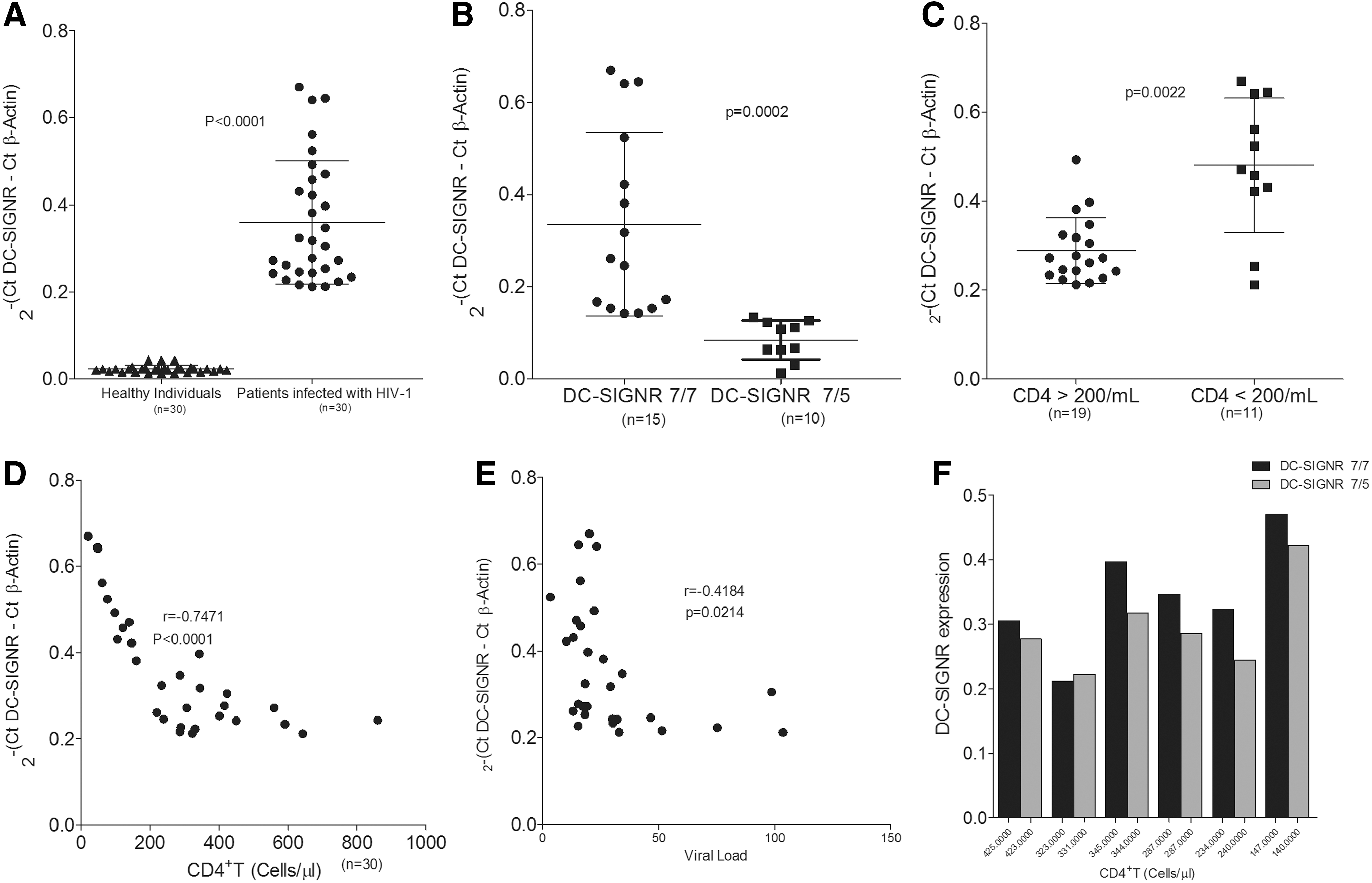
Dendritic cell-specific intracellular adhesion molecule 3 grabbing nonintegrin related molecule (DC-SIGNR) expression (
Real-time PCR analysis revealed a significantly higher expression of DC-SIGNR in HIV-1-infected patients having a CD4 count <200 than those with >200 cells/μL (0.278 ± 0.13 vs. 0.129 ± 0.07, p = 0.0051; Fig. 1C). A negative correlation was observed between the expression of DC-SIGNR and CD4+ T cell counts (r = 0.7471, p < 0.0001; Fig. 1D), whereas a positive correlation was observed for viral load (r = –0.4184, p = 0.0214; Fig. 1E) in HIV-1-infected patients.
Discussion
DC-SIGNR, a C-type lectin receptor, is also recognized to participate and play an important role in the transmission of HIV-1 (5,6,9). In a previously conducted study, Pohlmann et al. reported the expression of DC-SIGNR on sinusoidal endothelial cells in the liver and on endothelial cells in lymph node sinuses and placental villi (10). Cole et al. showed that DC-SIGNR was present on most hepatic sinusoidal endothelial cells in normal liver and in stage 3 hepatitis C virus (HCV) infected liver, while there is a patchy loss in stage 5 disease, suggesting that DC-SIGNR may play a role in potentiating hepatocyte infection with HCV (4).
Soilleux et al. demonstrated in vitro the expression of DC-SIGNR in monocyte-derived dendritic cells in healthy individuals; the DC-SIGNR expression was found to be low in these cells. However, these observations were based on RT-PCR analysis (11). Nair et al. reported that cocaine upregulates the expression of DC-SIGNR on normal immature and monocyte-derived dendritic cells (8).
The present study demonstrates for the first time the expression of DC-SIGNR in PBMCs of HIV-1-infected patients, with a higher expression observed in patients compared with healthy seronegative individuals. With DC-SIGNR expression, a negative correlation with CD4+ T cell counts and positive correlation with viral load in HIV-1 infected patients may be indicative of its role in HIV-1 infection. A plausible reason could be that high expression of DC-SIGNR in the PBMCs could promote increased susceptibility of these cells to HIV-1 infection. A detailed analysis of the expression of this receptor needs to be conducted on individual cell types in the peripheral blood, in order to assess the role of this receptor in the immunopathogenesis of HIV-1 infection.
The percentage of dendritic cells and their subsets were significantly higher in HIV-1-infected patients with the heterozygous DC-SIGNR 7/5 genotypes compared with homozygous 7/7 genotype in a study recently conducted by the authors (7). Further, the DC-SIGNR 7/5 genotypes in patients infected with HIV-1 were associated with high CD4+ T cell count and low viral load compared with DC-SIGNR 7/7 genotypes (2). An interesting finding of the present study is that a significantly lower level of DC-SIGNR expression was associated with DC-SIGNR 7/5 genotype and high CD4+ T cell counts compared with DC-SIGNR 7/7 genotype, suggesting the protective role of DC-SIGNR 7/5 genotype in HIV-1 infection. Additional functional studies on DC-SIGNR are necessary to understand the precise role of DC-SIGNR in HIV-1 infection and disease progression.
Footnotes
Acknowledgments
We thank the study participants. This work was supported by a grant from the Indian Council of Medical Research (ICMR), New Delhi. We also thank ICMR for providing senior research fellowship.
Author Disclosure Statement
No competing financial interests exist.