




Abstract
Foot-and-mouth disease virus (FMDV) O/CHN/Mya98/33-P strain was isolated from the esophageal-pharyngeal fluid sample of cattle, and was shown to cause persistent infection. Its leader protein contains 200 amino acids with one amino acid deletion, which is upstream and next to the second initiation codon compared with the majority of FMDV Mya98 strains. The FMDV genome includes two initiation codons that can produce two different leader proteins, Lab (from the first AUG) and Lb (from the second AUG). For convenience, the inter-AUG region was named as La. Previously, it was found that a recombinant virus with Lab of FMDV O/CHN/Mya98/33-P strain had higher proliferation efficiency, and better ability to inhibit the host innate immune response. Three full-length infectious cDNA clones—rHN33-Lb, rHN33-La, and rHNGSLX-Lb—containing the FMDV O/CHN/Mya98/33-P strain leader proteins Lb, La, or the FMDV O/GSLX/2010 strain leader protein Lb, respectively, were constructed based on an established infectious clone r-HN rescued from FMDV O/HN/CHN/93 strain. After infecting pig kidney primary cells, rHN33-La showed higher replication efficiency than r-HN, and rHN33-Lb displayed better ability to resist host innate immunity than rHNGSLX-Lb. These results demonstrated that the inter-AUG region of FMDV strain O/CHN/Mya98/33-P leader protein must be involved in increasing viral replication efficiency. Additionally, the Lb of FMDV O/CHN/Mya98/33-P must be involve in increasing its ability to inhibit host innate immune response, and the distinctive amino acids G56 and/or R118 of FMDV leader protein may play essential roles in it.
Introduction
F
The length of leader protease (Lpro) is 199–202 amino acids (aa) depending on the viral serotype, and the generic length of FMDV serotype O is 201 aa (10,41). FMDV leader protein exists in two forms—Lab and Lb—due to two forms of initiation of protein synthesis at either of the two initiation codons, usually 84nt apart (37). Generally, Lb is encoded in excess with respect to Lab (12). The region between these two initiation codons is named here as La. The length and secondary structure of La are conserved, while the nucleotides are highly variable (10). Furthermore, previous studies have demonstrated that La is involved in viral replication (7,30).
Lpro is a papain-like protease (20,32,38), and its two forms exhibit similar proteolytic activities (27,39). Lpro cleaves itself from the viral polyprotein precursor, and also cleaves the host eukaryotic translation initiation factor 4 gamma (eIF4G), thereby shutting off cap-dependent mRNA translation (16,19,27,40). In contrast, translation of FMDV mRNA is not affected, since it has an internal ribosome entry site (IRES), which can initiate viral translation by a cap-independent mechanism (6,21). Additionally, poly (A) binding protein (PABP), polypyrimidine tract-binding protein (PTB), and eIF3 (eIF3a and eIF3b) can be cleaved by Lpro (33).
Lpro plays an important role in viral virulence by inhibiting the host innate immune response. Lpro can inhibit the translation of cellular factors and major histocompatibility complex (MHC) by cleaving eIF4G. Additionally, nuclear factor kappa-light-chain-enhancer of activated B cells (NF-κB) (14) and interferon regulatory factors 3/7 (IRF3/7) (45) are degraded by Lpro during FMDV infection, which can interfere with the transcription of cellular factors, such as type I interferon (IFN) IFN-β (13), type III interferon IFN-λ1 (43), and chemokine RANTES (42). Furthermore, Lb, the shorter form of Lpro, has deubiquitinating enzymatic activity (44). Lb negatively regulates the type I interferon pathway by inhibiting the ubiquitination of several key signaling molecules in activation of type I IFN response such as retinoic acid-inducible gene I (RIG-I), TANK-binding kinase I (TBK1), TNF receptor-associated factor 6 (TRAF6) and TRAF3.
FMDV O/CHN/Mya98/33-P strain was isolated from esophageal-pharyngeal fluid sample of cattle. It has previously been shown that it causes persistent infection (3), and its Lpro contains 200 aa with one aa deletion that is upstream and next to the second initiation codon compared with the majority of FMDV Mya98 strains. Moreover, it has been found that a recombinant virus with Lab of FMDV O/CHN/Mya98/33-P strain has higher proliferation efficiency, and better ability to inhibit the host innate immune response (46). The present study describes in detail the proliferative and inhibitory characteristics of FMDV O/CHN/Mya98/33-P strain Lpro. The inter-AUG region of FMDV O/CHN/Mya98/33-P strain seems to be involved in increasing viral replication efficiency. Additionally, the distinctive amino acids G56 and/or R118 of FMDV O/CHN/Mya98/33-P strain Lpro may be involved in enhancing the ability of Lpro to inhibit the host innate immune response.
Materials and Methods
Cells and viruses
Baby hamster kidney cells (BHK-21) and pig kidney primary cells (PK) were maintained in Dulbecco's modified Eagle's medium (DMEM) containing 10% fetal calf serum (FCS), supplemented with 1% antibiotics and 1% glutamine. BSR/T7 cells were kindly provided by Dr. Karl-Klaus Conzelmann (Max von Pettenkofer Institute and Gene Center, Germany), and were grown in Glasgow minimal essential medium (GMEM) containing 10% FCS, supplemented with 4% tryptose phosphate broth, 2% 50× MEM amino acids solution, and 1 mg/mL G418 (22). All cells were grown at 37°C in 5% CO2.
Genetically engineered FMDV r-HN used in this study was generated from BSR/T7 cells transfected with NotI linearized plasmid pOFS (23), which was the full-length cDNA infectious clone of FMDV O/HN/CHN/93 strain. The properties of FMDV O/HN/CHN/93 strain have been previously described (23). O/CHN/Mya98/33-P (GenBank no. JQ973889.1) and O/GSLX/2010 (GenBank no. JQ900581.1) strains were provided by the National FMD Reference Laboratory at Lanzhou Veterinary Research Institute of Chinese Academy of Agricultural Sciences. These viruses belong to the Mya98 topotype. The properties of FMDV O/CHN/Mya98/33-P and O/HN/CHN/93 strains have been previously described (3). All the viruses were titrated in BHK-21 cells.
Construction and rescue of the chimeric FMDV
Chimeric full-length cDNA clones (pO33-La, pO33-Lb, and pOGSLX-Lb) were generated by the exchange-cassette strategy to replace the respective La and Lb genes of an existing pOFS plasmid with the selected FMDV O/CHN/Mya98/33-P and O/GSLX/2010 strains, respectively (Fig. 1). All chimeric plasmids were confirmed by automated sequencing to ensure that no mutations had occurred during the exchange-cassette process.
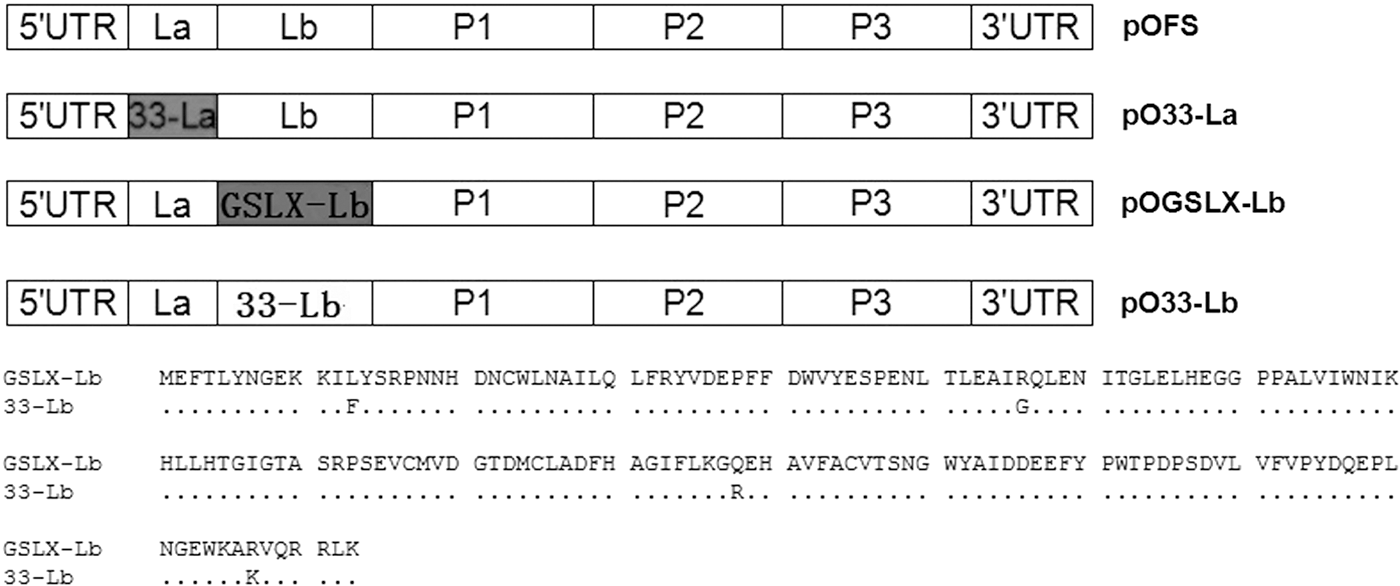
Schematic representation of the chimeric foot-and-mouth disease virus (FMDV). All plasmids containing chimeric cDNA clones were generated by the exchange-cassette strategy using pOFS as the existing plasmid. pO33-La stands for chimeric cDNA plasmid containing FMDV O/CHN/Mya98/33-P strain La, pO33-Lb stands for chimeric cDNA plasmid containing FMDV O/CHN/Mya98/33-P strain Lb, and pOGSLX-Lb stands for chimeric cDNA plasmid containing FMDV O/GSLX/2010 strain. The difference between pO33-La and pOFS-La is indicated, and the sequences of GSLX-Lb and 33-Lb are shown. Leucine and phenylalanine (at position 13) are both nonpolar amino acids; arginine and lysine (at position 167) are both positively charged amino acids. Remarkably, the R56G and Q118R are distinctive mutations for amino acid properties and vary considerably.
Plasmids pO33-La, pO33-Lb, and pOGSLX-Lb were linearized by digestion with Not I, and then purified using QIAquick PCR Purification Kit (Qiagen) according to the manufacturer's instructions. The linearized plasmids were then transfected into a sub-confluent (60–90% confluence) monolayer of BSR/T7 cells using the Lipofectamine 2000® reagent (Invitrogen) according to the manufacturer's instructions. After 6 h incubation at 37°C, the medium was supplemented with 1.5 mL GMEM containing 4% tryptose phosphate broth, 10% FCS, and 2% 50× MEM amino acids solution for further incubation at 37°C. When the cytopathic effect (CPE) of BSR/T7 cells appeared at 2 days post-transfection, the supernatants containing recombinant virus were collected. The virus-containing supernatants were serially passaged in BHK-21 cells for further experiments. In order to avoid any interference due to transfected DNAs, the tenth passage viruses were selected for quantitative real-time reverse transcription polymerase chain reaction (RT-PCR) analysis to ensure that the rescued viruses were obtained from the chimeric cDNA plasmids. The rescued recombinant viruses obtained from the full-length chimeric plasmids pO33-La, pO33-Lb, pOGSLX-Lb, and pOFS were named as rHN33-La, rHN33-Lb, rHNGSLX-Lb, and r-HN, respectively.
Analysis of recombinant viral RNA
In order to avoid the interference of viral quasi-species, the third passage recombinant virus was selected for this assay. A RT-PCR assay was used to evaluate the viral genomic RNA levels in PK cells using a QuantiTect Probe RT-PCR Kit (Qiagen) according to the instructions in the handbook. PK cells were infected with the recombinant virus at a multiplicity of infection (MOI) of 0.1 at 37°C. The virus-infected cells and supernatants were collected at 0, 4, 6, 8, 10, and 12 h post-infection (hpi). RNA was extracted from the infected cells and supernatants using an RNeasy Mini Kit (Qiagen). Primers and FAM (6-carboxyfluorescein)-labeled nucleic acid probes were designed and purchased from TaKaRa. The FMDV RNAs at 0 hpi were used as internal controls to normalize the values for each sample. The sequences of the nucleic acid probes and primers are listed in Table 1. Reactions were performed in a Mx3005P fluorescence ratio PCR system.
Primer and probe sequences were obtained from De Los Santos et al. (13).
F, forward primer; R, reverse primer; T, TaqMan 6-carboxyfluorescein-MGB probe; Number: the location in the genome.
Analysis of IFN-β and OAS mRNAs in PK cells
To avoid the interference of viral quasi-species, the third passage recombinant virus was selected for this assay. A RT-PCR assay was used to evaluate the mRNA levels of porcine IFN-β and OAS genes using a QuantiTect Probe RT-PCR Kit (Qiagen). PK cells were infected with the recombinant virus at a MOI of 10 at 37°C. Virus-infected cells and supernatants were collected at 4, 6, 8, and 10 hpi. RNA was extracted from the infected cells using an RNeasy Mini Kit (Qiagen). The primers and FAM (6-carboxyfluorescein)-labeled nucleic acid probes were obtained from Applied Biosystems based on the study by De Los Santos et al. (13). Porcine glyceraldehyde-3-phosphate dehydrogenase (GAPDH) was used as an internal control to normalize the values for each sample. The sequences of the nucleic acid probes and primers are listed in Table 1. Reactions were performed in a Mx3005P fluorescence ratio PCR system.
Statistical analysis
The Student's t-test was used in statistical analyses with GraphPad Prism v6.0 software.
Results
Generation of the chimeric FMDV
FMDV full-length infectious cDNA clone, pOFS, corresponding to the O/HN/CHN/93 vaccine strain of FMDV was constructed using the M-pSK vector. Three chimeric full-length cDNA clones—pO33-La, pO33-Lb, and pOGSLX-Lb—were generated by the exchange-cassette strategy based on the established plasmid pOFS. As shown in Figure 1, the La of plasmid pO33-La was obtained from FMDV O/CHN/Mya98/33-P strain; the Lb protein encoded by plasmids pO33-Lb and pOGSLX-Lb was obtained from FMDV O/CHN/Mya98/33-P and O/GSLX/2010 strains, respectively. Linearized pO33-La, pO33-Lb, and pOGSLX-Lb plasmids were transfected into BSR/T7 cells, and the rescued viruses were named as rHN33-La, rHN33-Lb, and rHNGSLX-Lb, respectively.
Viral RNA replication of rHN33-La and rHN in PK cells
Previous studies have demonstrated that the FMDV La gene affects viral replication (7,30). In order to investigate the effect of the FMDV O/CHN/Mya98/33-P La gene on viral proliferation in the present study, PK cells were infected with the recombinant viruses rHN and rHN33-La. The infected cells and supernatants were collected at 0, 4, 6, 8, 10, and 12 hpi. The cells and supernatants collected at 0 hpi were used as internal controls. Results are expressed as the increase in viral RNA proliferation relative to the original viral RNA collected at 0 hpi. As shown in Figure 2, the multiplication rate of recombinant virus rHN33-La is higher than r-HN, which demonstrated that FMDV O/CHN/Mya98/33-P La can promote viral replication.

Viral RNA growth curves of the chimeric viruses rHN33-La and r-HN. Viral RNA proliferation was measured by real-time reverse transcription polymerase chain reaction (RT-PCR) in pig kidney primary cells (PK) infected with recombinant virus at a multiplicity of infection (MOI) of 0.1. The cells and supernatants collected at 0 h post-infection (hpi) were used as internal controls. Results are expressed as the increase in viral RNA proliferation relative to the original viral RNA collected at 0 hpi. Error bars represent the standard deviation for each mean data point (n=3).
Transcription of porcine IFN-β and OAS induced by recombinant virus rHN33-Lb and rHNGSLX-Lb in PK cells
Teresa de los Santos et al. showed that the FMDV leader protein Lb can inhibit the induction of IFN-β, and block the host innate immune response (13). The host IFN-β and OAS mRNA transcription was tested here in PK cells infected with two Lb-chimeric viruses. The results indicate that the ability of recombinant rHN33-Lb to inhibit host IFN-β and OAS mRNA transcription is stronger than rHNGSLX-Lb (Fig. 3). Sequence alignments indicate that the leader protein Lb of FMDV O/CHN/Mya98/33-P strain has two distinctive aa—G56 and R118—compared with FMDV O/GSLX/2010. These results indicate that the Lb of FMDV O/CHN/Mya98/33-P must be involved in increasing its ability to inhibit the host innate immune response, and the distinctive amino acids G56 and/or R118 of FMDV O/CHN/Mya98/33-P strain Lpro may play essential roles in it.
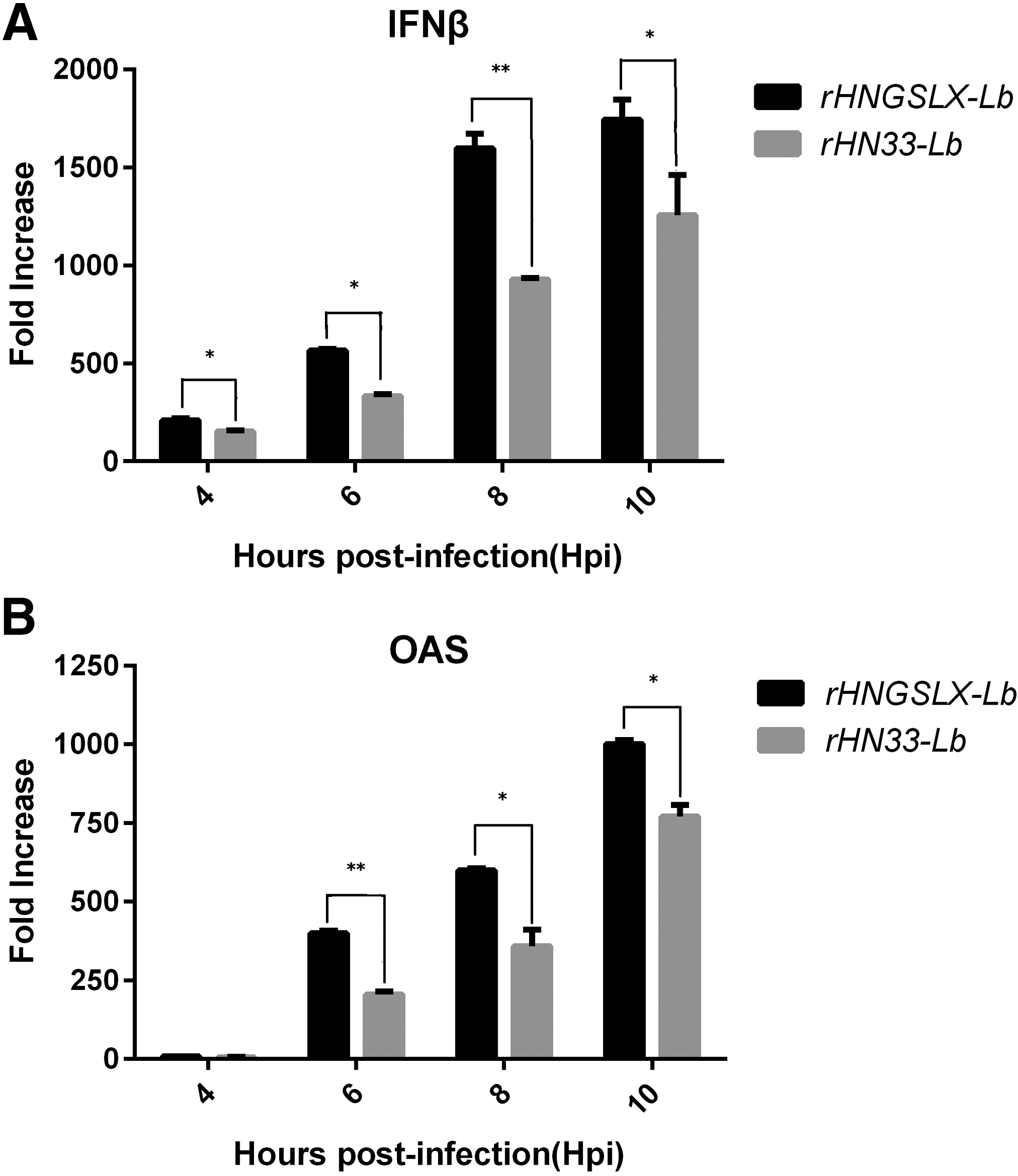
Changes in IFN-β and OAS mRNAs in PK primary cells after infection with chimeric virus. IFN-β (
Discussion
FMDV O/CHN/Mya98/33-P strain was isolated from esophageal-pharyngeal fluid sample of cattle, and has infectivity and pathogenicity to cattle and pigs (3). The present study shows that the La gene of FMDVO/CHN/Mya98/33-P strain can enhance viral replication, and Lb protein can enhance the ability of the virus to inhibit the host innate immune response. Lpro was considered an important virulence factor (11,30) that can inhibit the host innate immune response (13) and affect viral replication (7,30). Other viral factors can also influence virulence. Viral receptors are known to play an important role in disease pathogenesis. The tissue culture adapted virus, which utilizes heparin sulfate (HS) receptor, was shown to be relatively avirulent in cattle compared with wild-type virus that utilizes integrin receptors (28,36). It was also found that the plaques produced by the HS-binding virus on BHK-21 cells are smaller than the integrin-binding virus (2). The role of 3A protein in viral virulence has also been demonstrated. FMDV O/Taw/97 strain can infect pigs but not cattle, and contains a 10-codon deletion in the C-terminal region of the 3A protein. The role of this deletion in the bovine-attenuated phenotype was demonstrated using reverse genetic analysis (4). Besides, the IRES elements also influence viral virulence. Martinez-Salas et al. rescued a virus from persistently infected BHK-21 cells, which had two mutations within the IRES, and hypothesized that these mutations resulted in increased virulence in tissue culture (25). A previous study by the authors showed that a recombinant virus with Lab of FMDV O/CHN/Mya98/33-P strain had a higher rate of proliferation and stronger ability to inhibit the host innate immune response (46).
Sequence alignment has shown that the variations between different FMDV strains are mainly located in La. Generally, the length of La is 84nt, which is conserved, and the predicted secondary structure in these regions is relatively conserved (10,37). However, the length of FMDV O/CHN/Mya98/33-P strain La is distinctive, 81nt, with three-nucleotides deletion upstream and next to the second initiation codon. In this study, the differences in La between recombinant virus rHN33-La and r-HN could be the reason why these two viruses exhibited different replication rates. Piccone reported that mutant viruses containing a 57-nucleotide transposon or tag epitopes insertion in the inter-AUG region produce smaller plaques than wild-type virus (31). Initiation of translation can occur at two AUG codons in FMDV, and can produce two forms of leader protein: Lab and Lb (12,37). However, the amount of Lb is much more than Lab. Selection of the correct AUG codon is critical for virus replication, and selection of the two AUG codons varies between viruses (37). Initiation of translation was proposed to occur at the second AUG codon by a mechanism similar to the ribosome scanning model of Kozak (8), and the utilization of these two AUG codons is independent (1,24). Besides, the presence of the second AUG codon was reported to be essential for virus replication (9). It is tempting to speculate that the presence of three-nucleotides deletion upstream of the second AUG enhances the selection ability of ribosome for that codon, leading to a higher replication rate of rHN33-La compared with r-HN.
FMDV Lpro is an important virulence factor, which can decrease NF-κB (14) and IRF3/7 (45) in the infected cells, and also possesses deubiquitinase activity that leads to inhibition of the type I IFN response (44). The present study has shown that recombinant virus rHN33-Lb has stronger ability to inhibit the host innate immune response compared with rHNGSLX-Lb, and the replication rate of rHN33-Lb is higher than rHNGSLX-Lb. G56 and R118 are two distinctive aa in rHN33-Lb that are different from rHNGSLX-Lb. The leader protein enters the nucleus (17) after FMDV infection and causes NF-κB degradation within the nucleus, which can further inhibit the type I IFN response. Lpro was reported to possess a conserved SAP (for SAF-A/B, Ainus, and PIAS) region that is located between the 47th and 83rd aa (based on the numbering from the Lb form of Lpro) (15). In some cases, this region is responsible for the rate of Lpro entry into the nucleus.
Teresa de los Santos et al. reported that double mutant virus (I55A and L58A) displayed an attenuated phenotype in cell culture, and its Lpro subcellular distribution was altered, which can block the expression of IFN (15). FMDV O/CHN/Mya98/33-P Lb has a distinctive aa G56 near aa I55 and L58. Structural analysis showed that the 56th aa in Lb is located in an α-helical secondary structure of Lb (data not shown). However, there is little possibility of glycine exiting in an α-helix. So, it is speculated that FMDV O/CHN/Mya98/33-P Lb aa G56 would influence the secondary structure of Lb, thereby influencing its efficiency of entry into the nucleus. Besides, FMDV O/CHN/Mya98/33-P strain has another distinctive aa R118 near the enzyme active center H120 (20). This could affect the activity of Lpro, and the host cell translation. It is tempting to speculate that FMDV O/CHN/Mya98/33-P Lb aa G56 and/or R118 affects the transcription of IFN-β and OAS mRNAs. Further mutational analysis is required to determine which aa (L13, R56, Q118, or R167) plays an important role in the inhibition of host innate immune response and determine whether the inhibition play an dispensable role in the enhancement of virus replication.
Footnotes
Acknowledgments
We thank Karl-Klaus Conzelmann (Max von Pettenkofer Institute and Gene Center of Germany) for kindly providing BSR/T7 cells used in this study. This research was supported by grants from the fundamental research funds for incremental project budget of Chinese Academy of Agricultural Sciences “2013ZL036” and major projects of science and technology plan projects in Gansu province (1102NKDA032).
Author Disclosure Statement
No competing financial interests exist.