




Abstract
A massive vaccination in Argentina was implemented recently. The antigenic dominants of VP7 in G9 and G1 rotavirus strains, circulating in La Rioja, Argentina with strain vaccines were compared. From 2000 to 2010 in several attention centers of La Rioja, at northwestern Argentina, 418 stool samples from children younger than 5 years old were collected. Ninety were positive by immunochromatography and 51 were genotyped by reverse transcriptase–polymerase chain reaction followed by nested-multiplex polymerase chain reaction (PCR) with type-specific primers. Six G9 strains and four G1 strains were sequenced by MACROGEN Korea. The phylogenetic analysis was conducted in MEGA 6.0. The 940 bp were aligned using CLUSTALW and the tree was inferred using the UPGMA method. The antigenic dominants of VP7, 7-1a, 7-1b, and 7-2 were studied using BioEdit, 7.2.5. In the comparison between G9-lineage III d rotavirus (RV) strains circulating in La Rioja with ROTAVAC vaccine strain, three differences were detected corresponding to 100, 211, and 145 positions. In the comparison between G1-Lineage 1 strains and G1 Rotarix and G1 RotaTeq, three differences were observed in 94, 123, and 217 positions. All these positions were important for the escape to neutralization for study with monoclonal antibody. In conclusion, the differences between the G1 strains in La Rioja, Argentina and the G1 components of the RotaTeq and Rotarix vaccine strains are few, but important for the escape immunologic, and need to be monitored for appropriate evaluation of long-term impact of vaccine used in Argentina. Nevertheless, the VP7 antigenic regions of G9 RV strains circulating in La Rioja and ROTAVAC vaccine strains are different to other zones of Argentina and could play an important role in the failure of vaccine response in these regions and Argentina.
Introduction
G
A total of 418 stool samples from children younger than 5 years old, hospitalized and outpatient, for viral diagnostic were collected from January 2000 through December 2010 in Hospital Dr. Vera Barros and in primary attention centers of La Rioja. The studied hospitalized children had less than 5 days of evolution from the beginning of the clinical manifestations and the samples were obtained during the first 48 h of hospitalization. The studied ambulatory children have less than 5 days of evolution from the beginning of clinical manifestations. The project and consent were evaluated and approved by Ethics Committee of Foundation Barceló HA (Resolution HCS N°: 4312/11). Ninety (21, 53%) were positive by immunochromatography (Vikia® Rota-Adeno, bioMerieux). The RNA extraction from positive samples was done by alcohol precipitation (14). For visualization of the products amplified, reverse transcriptase–polymerase chain reaction (RT-PCR) was run in polyacrylamide gel with subsequent silver nitrate staining. Six genotype G rotavirus strains (G1, G2, G3, G4, G8, and G9) using primers specific for each were determined. From total positive, only 51 stool samples were genotyped by RT-PCR followed by nested-multiplex PCR with type-specific primers previously described (9). The low amount of genotypes obtained could be due to low amount of virus in samples or the presence of genotypes not studied. Several genotypes in some stool were identified and a total of 86 genotypes (date not shown) were detected because infection multiples were produced. The G1 and G9 RV strains were selected because these have a greater quantity in La Rioja and a major circulation worldwide during period studied, respectively. Both genotypes were amplified and submitted to MACROGEN Korea for the sequencing. The sequences were aligned using CLUSTALW input MEGA 6.0 software (Molecular Evolutionary Genetics Analysis). The accession numbers of G9 strains in GenBank are LR A1 (GenBank: ID: KT948645); LR B5 (GenBank: ID: KT948646); LR C6 (GenBank: ID: KT948647); LR D3 (GenBank: ID: KT948648); LR E7 (GenBank: ID: KT948649); and LR F9 (GenBank: ID: KT948650). The accession numbers of GenBank of G1 strains are LR G9 (GenBank: ID: KT948651); LR H9 (GenBank: ID: KT948652); LR I9 (GenBank: ID: KT948653); and LR J9 (GenBank: ID: KT948653). The evolutionary history was inferred using the UPGMA method. The optimal tree with the sum of branch length = 35.41016264 is shown. The evolutionary distances were computed using the Maximum Composite Likelihood method and are in the units of the number of base substitutions per site. There were 827 positions in the final dataset. Phylogenetic analyses were conducted in MEGA 6.0. The lineage designations G9 and G1 RVs were based on reported studies and the strains are described as follows, the strains/lineage (GenBank: accession). For lineage designations G9, the following strains were used: ITA-MARI 2005/Lineage III d (GenBank:EF150338); CIT254RV/Lineage III c (GenBank:AF281044); MC 345/Lineage III a (GenBank:D38055); 608VN/Lineage III b (GenBank:AB091777); 97S237/Lineage IV (GenBank:AF260959); OM 67/Lineage V (GenBank:AJ491179); 116E/Lineage II (GenBank:14072); and AU32/Lineage I (GenBank:AB045372). For the lineage designations G1 RV, the following strains Thai-804/Lineage 1(GenBank: DQ512979), Cos-70/Lineage 2 (GenBank:U26370), WA/Lineage 3 (GenBank:K02033), Kor-64/Lineage 4 (GenBank: U26378), PA5/90/Lineage 5 (GenBank DQ377573), AU19/Lineage 6(GenBank AB018697), Ban-59/Lineage 7 (GenBank:U2366), Egypt-7/Lineage 8 (GenBank:U26373), PA32/90/Lineage 9 (GenBank: DQ377574), SW20/21/Lineage 10 (GenBank: AF426162), and C60/Lineage 11 (GenBank: L24164) were used. The dominants antigenic of VP7, 7-1a, 7-1b, and 7-2 of G9 and G1 RVs circulating in La Rioja and vaccine strains were studied using the amino acid sequence obtained by BioEdit, 7.2.5. The comparison of dominants was carried out using strains available in GenBank. The strains were denominated with strain name (GenBank: number accession). The strains are Rotarix A41CB052A/G1P(8) strains (GenBank:JN849114); RotaTeq W179-9/G1P(8) strains (GenBank:GU565057); and ROTAVAC IN116E strains (GenBank:FJ361209).
The results showed that fourteen G9 RV strains were detected and correspond to 1 outpatient child during 2003 and 13 hospitalized children during 2008/2009 who were detected (dates not shown). Six samples from children hospitalized in 2008/2009 were sequenced. A total of 24 G1 RVs were detected. Fourteen G1 RVs from hospitalized children and 10 G1 RVs from outpatient children in 2008/2009 (dates not shown) were detected. Only four samples of children hospitalized in 2008/2009 were sequenced. From 1063 sequenced that were amplified, 940 bp were aligned. The Figure 1 shows the phylogenetic tree of the G9 and G1 strains of rotavirus circulating in La Rioja, Argentina. All G9 strains were lineage III d and all G1 strains show the lineage 1. Phylogenetic analyses have revealed that a single sublineage of G9 RV strains was responsible for this worldwide spread. The genotype G9P (8) was most frequently detected in 2008 (54.1%), and their VP7 gene as G9 lineages III was grouped by the phylogenetic analysis (5,17). In Argentina, G9 RV during the 1980–1988 and 1997–2003 period shows relatively low rates in the center (Cordoba) (3) and upto 40% in the south (Ushuaia) (5) was detected. Globally, G1P (8), G2P (4), G3P (8), G4P (8), and G9P (8) genotype combinations of rotavirus strains are the most common cause of human infections (2). Of these, G1P (8) strains are most predominant (37.7%) (11). In Argentina, the intragenotype diversity and the circulation of G1 lineage IV and V strains of G1 RV in Córdoba, Argentina, over a 27-year period (1980–2006), were detected. The cocirculation of lineage I and II strains in the 1990s and 2000–2006 was observed (4). In La Rioja, 16.28% of the stools of children are G9 RV strains, including lineage III d, suggesting their importance in Argentina. Moreover, the lineage 1 in all G1 strain rotavirus circulating in La Rioja, Argentina without cocirculation was detected, suggesting that the epidemiological surveillance of these strains in small cities could be important along with the vaccine implementation. The Figure 2 shows the alignments of amino acid corresponding to antigenic dominants of VP7. The Rotarix and RotaTeq vaccine strains, G9 and G1 RVs of strains circulating in La Rioja, Argentina, were compared. In G9 RV, two intragroup differences (100 and 211 positions) were observed. In position 100, D and N amino acids were detected, a common change to other strains of the world (11,18). In position 211, K was not observed in other strains of Argentina or available strains in GenBank (4,5). In the comparison between G9 RV strains circulating in La Rioja, Argentina with ROTOVAC vaccine strain, three differences were detected corresponding to 100, 211, and 145 positions. All these positions could be important for the escape to neutralization for monoclonal antibody (13,18). In G1 RV, intragroup differences were not observed and only three differences with vaccine strains, in 94, 123, and 217 positions, were detected, similar to strain circulation in Belgium during 2008–2009 (15,16). Two amino acid changes, 94 and 217 positions, have been shown to escape neutralization with monoclonal antibodies (13,18).
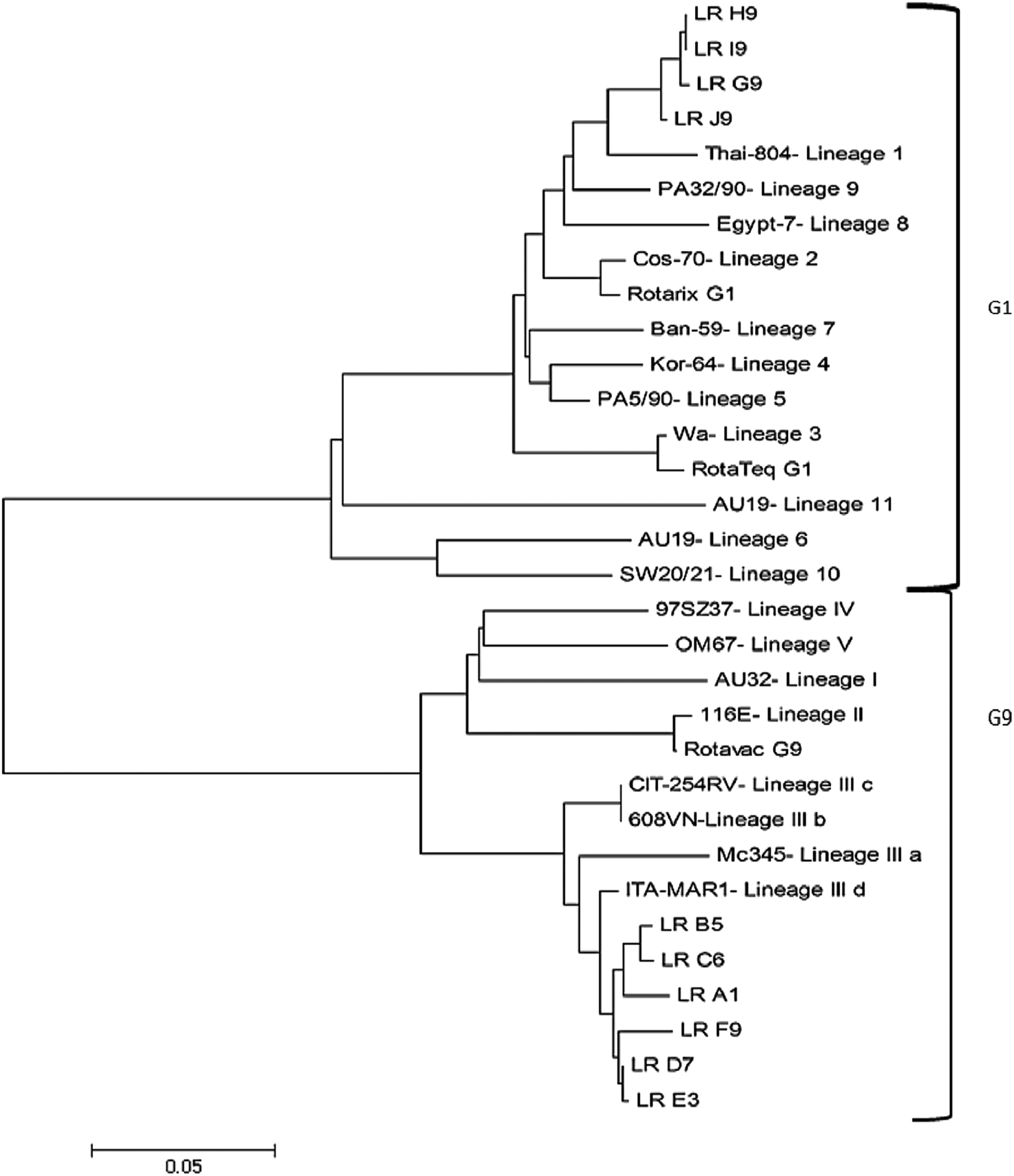
The tree phylogenetic of the nucleotide sequences of G1 and G9 rotavirus strains circulating in La Rioja, Argentina and strains with defined lineage. The evolutionary history was inferred using the UPGMA method. The optimal tree with the sum of branch length = 35.41016264 is shown. The evolutionary distances were computed using the Maximum Composite Likelihood method and are in the units of the number of base substitutions per site. There were 827 positions in the final dataset. Phylogenetic analyses were conducted in MEGA 6.0.
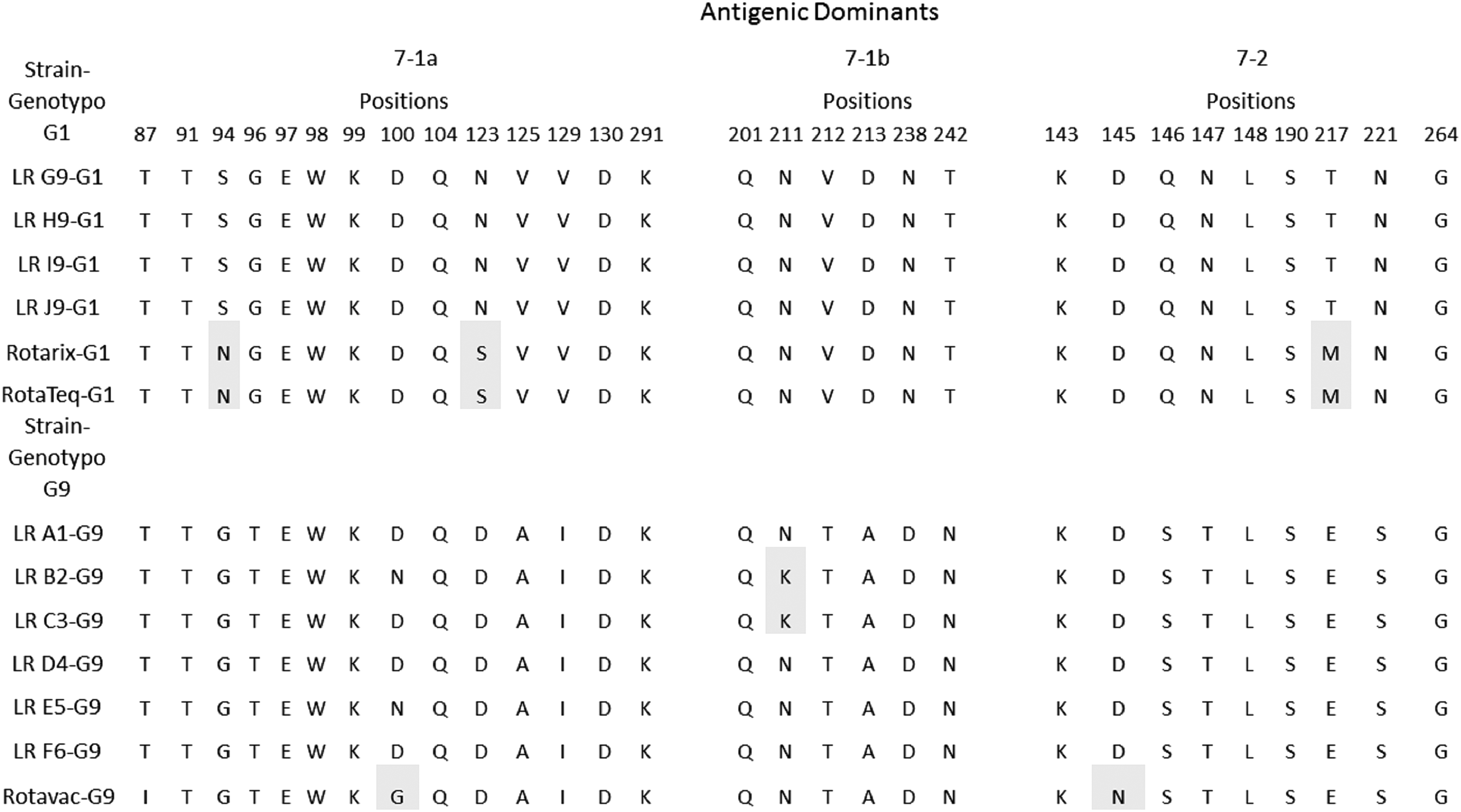
The alignments of 29 amino acids corresponding to dominants antigenic of VP7, 7-1a, 7-1b and 7-2 of G9 and G1 RVs circulating in La Rioja and vaccine strains were studied using the amino acid sequence obtained by BioEdit, 7.2.5. Amino acids that differ between studied are indicated in the shaded boxes. RV, rotavirus.
Conclusions
In conclusion, the differences between the G1 strains in La Rioja, Argentina and the G1 components of the RotaTeq and Rotarix vaccine strains are few, but important for the escape immunologic and need to be monitored for appropriate evaluation of long-term impact of vaccine use in Argentina. Nevertheless, the VP7 antigenic regions of G9 RV strains circulating in La Rioja and ROTAVAC vaccine strains are different to other zones of Argentina and could play an important role in the failure of vaccine response in these regions and Argentina. More studies of other viral proteins are needed to know the importance of these differences in the selection of strain G9 RV for the pressure immunological of vaccine strains and their molecular evolution in Argentina. Continuous rotavirus surveillance is necessary to understand rotavirus evolution and to measure how genetic and antigenic changes might affect the effectiveness of vaccines in the future.
Footnotes
Acknowledgments
The authors are thankful to Dra. Silvia Nates for contributing to the standardization of methodologies in our laboratory and to Dra. Viviana Re for assisting in computer basic methodology for analysis of sequences. Foundation Barceló H.A. funds this work under the Project Resolution HCSN°: 4312/11 and supported the doctoral fellowship of Valeria Cuffia (ref.: 4312/11/LR/BD).
Author Disclosure Statement
The authors declare no conflicts of interest.