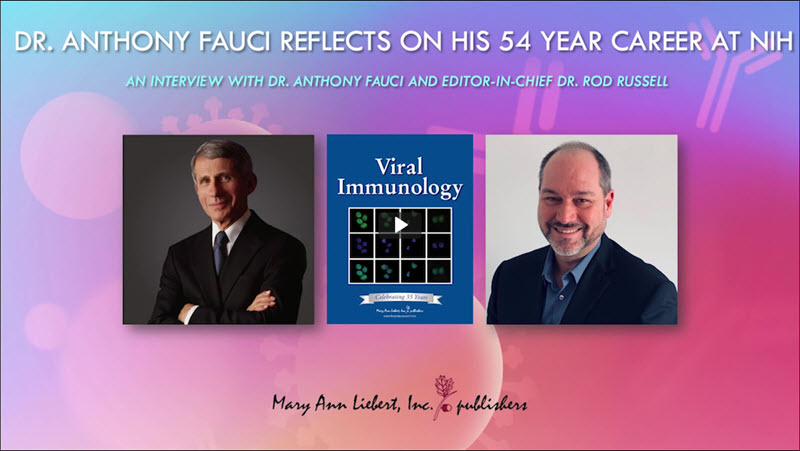
Anthony S. Fauci, MD, is director of the National Institute of Allergy and Infectious Diseases (NIAID) at the U.S. National Institutes of Health, where he oversees an extensive research portfolio devoted to preventing, diagnosing, and treating infectious and immune-mediated diseases. Dr. Fauci has been a key advisor to seven Presidents and their administrations on global HIV/AIDS issues, and on initiatives to bolster medical and public health preparedness against emerging infectious disease threats such as pandemic influenza and COVID-19. Currently, he is the Chief Medical Advisor to President Joe Biden. As an HIV/AIDS researcher he has been involved in the scientific effort since AIDS was recognized in 1981, conducting pivotal studies that underpin the current understanding of the disease and efforts to develop therapies and tools of prevention. Dr. Fauci was one of the principal architects of the President's Emergency Plan for AIDS Relief (PEPFAR), which has helped save millions of lives throughout the developing world and for which he has received the Presidential Medal of Freedom (the highest honor given to a civilian by the President of the United States). Other awards include the National Medal of Science and the Mary Woodard Lasker Award for Public Service.
Viral Immunology: Good morning. I am Dr. Rod Russell from Memorial University of Newfoundland and Labrador, and I am the editor-in-chief of the journal Viral Immunology from Mary Ann Liebert, Inc. Today I have the distinct pleasure to speak with the director of the National Institute of Allergy and Infectious Diseases (NIAID) at the NIH, Dr. Anthony Fauci. Good morning, Dr. Fauci, and thank you so much for taking time to speak with us.
Dr. Anthony Fauci: Good morning. My pleasure. Good to be with you.
Viral Immunology: We know you are a very busy man, so let us get right into the discussion. I wanted to talk today about three themes. We can talk a little about the pandemic and your thoughts on that, as well as some reflection on HIV/AIDS and the work you have done over your career, and some general career points that you might want to share. Let's jump right in. How do you feel the pandemic has affected vaccine literacy in North America and globally?
Dr. Fauci: It's interesting because it depends on what people mean by vaccine literacy. If you mean the awareness of the importance of vaccines, I think it is heightened in some respects greatly; the appreciation by people of the life-saving aspects of vaccines has increased. If anyone seriously looks at the data of the degree and level of hospitalizations, serious disease, often leading to death in the unvaccinated versus the vaccinated, the data are as striking as you could imagine. The overwhelming majority of people, regardless of their underlying status that go on to severe disease leading to hospitalizations and death, are either among the unvaccinated or those who have been vaccinated but not kept up-to-date on their boosting.
In contrast, we are in an era, unfortunately, of antiscience, which is part of antivax, which is a very frustrating situation whereby you have a historic pandemic, which in the United States alone has led to the loss of over 1 million lives and incontrovertible proof that vaccines save millions of lives. And yet, there are so many people in the United States and throughout the world who refuse to get vaccinated because of a fundamental core antivax attitude that is related in many respects to anything from pure disinformation to political ideology, which is really quite frustrating when you are dealing with a public health challenge.
Viral Immunology: Yes, I agree, for sure. What would you say was the most unexpected aspect of the pandemic, in your opinion? I guess I would mean with respect to the virus itself and the curve balls that it threw us, as well as in regard to the public's response to the pandemic.
Dr. Fauci: Why don't we take one of those at a time? The most unexpected aspect of the pandemic from both the virus itself and the epidemiology is the unprecedented nature of the emergence of new variants in a manner that leads to a drifting or changing of the virus approximately every 4 or so months, not only in the United States, but also in Canada and throughout the world. If you look at the evolution of this outbreak, we have never really seen anything even approaching what we are now experiencing. We have drifting of influenza virus from year to year, but we do not have the extent of variant emergence that we have seen with SARS-CoV-2.
The other unexpected element of this was the very short durability of protection from prior infection or prior vaccination. When you get infected with or vaccinated against viruses such as polio, measles, and smallpox, the durability of protection is measured in decades at worst and over a lifetime at best. And yet, with SARS-CoV-2, the durability of protection is really strikingly short.
The public response to the pandemic is what I mentioned just a bit ago, which is the extraordinary phenomenon of the availability of life-savings vaccines, and the fact that, for example, in the United States, only 68% of the population is vaccinated and only about one half of those have been boosted, which seems almost inexplicable that that is happening, but it is.
Viral Immunology: If we can stay there for a moment, with the short duration of protection with the vaccines, and after natural infection, what do you think we are going to need going forward? Are we going to need a better vaccine? Do you think that will give us longer protection or is this just what happens with coronaviruses and we are never going to see a longer duration of protection?
Dr. Fauci: Well, I think there are two or three aspects of what is going to be needed regarding the relationship between vaccines and durability and depth and breadth of protection. We have great vaccines. I mean, some of the great scientific breakthroughs of the last few years have been the mRNA vaccine and immunogen design based on structure-based vaccine design. But even with that advance, we do need better vaccine platforms and immunogens to lead to greater durability and breadth of protection. That could be nanoparticles, or that could be vector-based expression of immunogens.
Also, we are going to need better protection against infection and transmission for a number of reasons, because we now know that the vaccines that we have, although they still do a very good job of protecting you against severe disease, when we look at protection against infection, how many people do we all know, myself included, that were vaccinated, doubly boosted, and still got infected. The protection against severity of disease is pretty good, but if you really want to suppress the virus by suppressing acquisition as well as transmission, we have got to have better vaccines.
Viral Immunology: So, Dr. Fauci, that's an interesting perspective for sure. Let us switch gears now and talk a little about HIV/AIDS, which has been the focus of much of your career. The late Mark Wainberg, who I know you knew well, told me once that you said you hoped to see one person cured of HIV in your lifetime, and now we have seen that. What do you hope we might see in the next 50 years in the world of HIV/AIDS?
Dr. Fauci: Well, we have got to be careful when discussing the person, or few persons, who have been cured of HIV in the sense of not requiring daily medication and yet having the virus be completely absent from their body, essentially having the virus eradicated from their bodies. That has only happened in very unusual circumstances of stem cell transplantation, with the very aggressive conditioning that's associated with that, in people who have an underlying condition such as a lymphoma or a leukemia that required a stem cell transplantation to begin with.
Although that is a proof of concept, it is not a practical approach to the idea of curing people. However, what we have done extremely successfully is develop an array of drugs in combination, sometimes contained in one pill, that can chronically and durably suppress the virus to below detectable level. This not only saves the life of individuals who are being treated and essentially allows them to have an essentially normal lifespan, but it also makes it virtually impossible for them to transmit the virus to someone else.
The terminology of undetectable equals untransmittable [U = U]. That is a major advance. What we have done now over the last few years is to make the therapeutic approach much easier and user friendly, such as with long-acting injectable drugs, which can be given every couple of months. I believe as we get better at it over the coming months and years, it may be that you can give an injectable drug maybe twice a year and continue to suppress the virus below detectable level. That is not a classical cure in the sense of eradication, which we will continue to try to do, but the advances that have been made in therapy now are really quite breathtaking in their success.
Viral Immunology: Great. Developing an effective vaccine for HIV has proven extremely challenging. You just mentioned the wonderful RNA vaccines that we are seeing now. Do you think that we will ever have an effective vaccine for HIV, or is the variability of the virus just going to be too challenging?
Dr. Fauci: I do not know whether we are going to have an effective vaccine. We may not, and it has to do with more than just the variability of the virus. It has to do with the particular capability of a virus once a person gets infected; the virus integrates itself into the genome of one's cells forming a reservoir of virus, which up to this point we have not been able to eradicate. One of the frustrating and very challenging aspects of developing a vaccine for HIV is that in classic vaccinology, you try to have the vaccine mimic natural infection because natural infection with most infections provides a degree of immunity after you recover that protects you from subsequent infection with the same virus.
Since the response to natural infection with HIV never actually gives an adequate immune response to eradicate the virus, what we have to do with a vaccine is to do even better than what natural infection does, and that is a very very difficult challenge. I am not saying that it is impossible, but it is going to be very difficult to get the body to mount an immune response to the vaccine that is even more powerful than the body's immune response to natural infection. That is going to be the challenge of the future efforts to develop a vaccine.
Viral Immunology: Along the same lines, we have seen in the last few years, or the last decade, some great antiviral agents developed in the field of hepatitis C. Do you think that someday we will have a small molecule inhibitor for HIV, or a combination of them, that will get the same kind of cure success as we have seen with hepatitis C?
Dr. Fauci: Well, I mean, that is certainly an aspiration; however, as I mentioned a moment ago, there is a big difference that HIV has from other infectious diseases that do not integrate themselves into the genome of your cells. As HIV integrates itself into genomes, it becomes very difficult to essentially eradicate the virus. However, the same approach of developing small molecules that are aimed at the vulnerable components of the viral replication cycle that has led to the durable suppression of HIV without eradicating the virus actually was the stepping stone for why we were able to develop such truly curative drugs for hepatitis C. It was the approach of targeting the replication cycle that not only gave us good drugs for HIV, but actually led to the development of excellent drugs to cure hepatitis C.
Viral Immunology: Interesting perspective. Let us switch gears again now. You have mentioned that you will step down from your position as director of NIAID at the end of the year. I am curious to get your thoughts on your career. What would you say was the most impactful finding that has come out of your own research over the years?
Dr. Fauci: I've had the privilege of wearing multiple hats over the last 54 years that I have been here at NIH, and over the last 38 years that I have been the director of NIAID. If you look at the individual hats, they are really quite different. For example, as an individual research scientist in the early part of my career, I was working with the development of therapies for autoinflammatory diseases such as the systemic vasculitides, which had a very high mortality rate, close to 100%.
I refer to diseases such as granulomatosis with polyangiitis and polyarteritis nodosa, among others. I was fortunate enough to develop therapeutic protocols that put those diseases into a very high rate of remission, well over 90% when they were almost 100% fatal if untreated. That work took place during the first 10 years of my postfellowship career. Then when HIV came along, I devoted literally the next 41 years, including to this day, in delineating the pathogenic mechanisms of HIV.
That led to insights into the development of effective therapies and some of the advances we have realized, some that I feel quite good about and quite proud of. But the other aspects of my career, I believe, are equally, if not more, important, and that is when I took over as the director of NIAID. I developed and nurtured the institute from a small institute of a budget of approximately $350 million to an infectious diseases global powerhouse of $6.3 billion.
In addition, as director, I developed the AIDS program at the institute, which actually is responsible in part for the development of the life-saving drugs that have been responsible, essentially, for transforming the lives of persons with HIV throughout the world. Then, there is the other hat as a public health official and a policy person. I was very fortunate to have been asked by President George W. Bush to be the principal architect of the President's Emergency Plan for AIDS Relief, or PEPFAR, which now is responsible for saving between 18 and 20 million lives throughout the world. I feel very privileged to have been put into the position of being able to make those kinds of contributions.
Viral Immunology: You cannot see me right now, but I have a big smile on my face because that is such an impressive body of work. I remember when I was a master's student, your first articles came out on identifying the reservoir, and at that time, that was around 1997, some thought we might be able to cure HIV with the protease inhibitors. I remember the reservoir was already, based on your work and others, looking to be the problem. And it is still what you mention now as the major challenge for vaccines and treatment today. So clearly, that was my favorite part of your work. Still on the same theme then, what do you think has been the greatest scientific advance in viral immunology, in general research, that you have witnessed in your career?
Dr. Fauci: As you know, as our discussion has proven, for better or worse, that I have had a very long career; however, when you talk about viral immunology, the thing that comes to my mind is the extraordinary success of vaccines. Let us just take our current most recent 3-year experience with COVID-19 where you have a virus that was completely unknown in December of 2019, was identified as a novel coronavirus in January of 2020, namely SARS-CoV-2, and proved itself to be deadly to the tune of killing millions and millions of people throughout the world.
And yet, in less than 1 year, from January of 2020 to the beginning of December of 2020, multiple vaccines were developed, put into clinical trial, proven to be safe and highly effective, and began to be distributed to people in a life-saving way. To me, that is an entirely unprecedented accomplishment in the field of viral immunology and I believe in the entire history of medicine. We are fortunate that we have been witness to a truly historical accomplishment.
Viral Immunology: I couldn't agree more, and I have always found it interesting that despite the fact that many COVID-19 vaccines were developed using traditional platforms, the new platform of vaccines [mRNA], which people might have been most afraid of, turned out to be the one that we are now relying on the most.
Dr. Fauci: Indeed.
Viral Immunology: The last question I have to ask is, at this point in your career, what advice would you give to current trainees in the field of virology or immunology if they are planning their own future in research?
Dr. Fauci: I have the same advice I have been giving for years now because it applied to me and the things that have driven the direction of my own career. It is to go with what your passion is, what really turns you on. There are so many exciting things in the field of medicine and in research associated with medicine, and sometimes young people tend to go with what they think people want them to do or what is the most fashionable thing. But if you listen to your gut and you get involved in something that you really are excited about, that creates in you a level of energy and drive that will really serve you very well, both in your accomplishments and in your feeling of self-fulfillment. To put it in a very colloquial way, just go with your gut and you cannot go wrong.
Viral Immunology: That is beautiful advice—you have to love what you are doing. Okay, those are all the questions I had in mind to ask you. Was there anything you wanted to add or throw in there at the end?
Dr. Fauci: No, I think that was a very good interview. It covered a lot.