




Abstract
Viral infections are ubiquitous, and their prevention and treatment have become a great challenge. Steroids have different biological activities, including antiviral activity, which is related to steroid structural diversity. With the intensive study of steroids, it has been found that steroids can interfere with almost any step of the viral life cycle to exert antiviral activity. In this article, we review the antiviral activity and mechanism of action of steroids and their derivatives against a range of human viruses and conclude that natural steroids and their derivatives are very promising antiviral drug candidates that deserve further study to elucidate their pharmacological potential.
Introduction
Viruses containing RNA or DNA, some of which may be encapsulated by lipid-containing envelopes, are highly infectious pathogens that pose a serious risk to human health (Kausar et al., 2021). Antiviral drugs can be divided into six major categories: nucleoside reverse transcriptase inhibitors, non-nucleoside reverse antivirals, protease inhibitors, fusion inhibitors, CC chemokine receptor 5 antagonists, and integrase inhibitors (De Benedetto et al., 2020). With the reemergence of new viral strains and infections, new antiviral compounds have to be discovered (Lou et al., 2014).
Natural products have many advantages, such as structural diversity and the ability to act on various enzymes, proteins, and receptors, and are an important source of new drugs (Cole et al., 2019). Steroid compounds are a category of natural products with very special structures, whose mother nucleus all contain cyclopentane parallel polyhydrophenanthrene carbon skeletons, as shown in Table 3 (Dembitsky, 2020), Steroid compounds have the characteristics of small molecular weight and large lipid solubility; these characteristics make it easy to enter the cell and produce a series of physiological changes, so steroids have the natural advantage of becoming drugs (Mustafa et al., 2022). Steroid compounds have a variety of pharmacological effects, such as anti-inflammatory, antitumor, antibacterial, antiviral, immunomodulation, and regulation of physiological status (Castilla et al., 2010).
Steroids have been found to be used as a targeted therapy for a variety of human diseases and human viruses, including SARS-CoV-2, influenza virus (IV), adenovirus (ADV), hepatitis virus, herpes simplex virus (HSV), human rhinovirus (HRV), human immunodeficiency virus (HIV), human papilloma virus (HPV), Junin virus, flavivirus, ZIKA virus, leukoplakia virus, measles virus (MV), human rotavirus (HRV), Lassa virus, Seneca Valley virus, cerebral myocarditis virus, rabies virus, norovirus (NV), respiratory syncytial virus (RSV), human cytomegalovirus (HCMV), and dengue fever virus (DENV). Steroid structures act on important viral molecular targets, participate in different stages of the viral growth cycle, affect membrane fusion and viral entry, inhibit viral replication, and interfere with viral protein assembly and release.
In this article, we review the antiviral activity of naturally occurring steroids and steroid derivatives and highlight the mechanisms of action. The mechanism of antiviral action of steroid compounds is summarized in Figure 1.
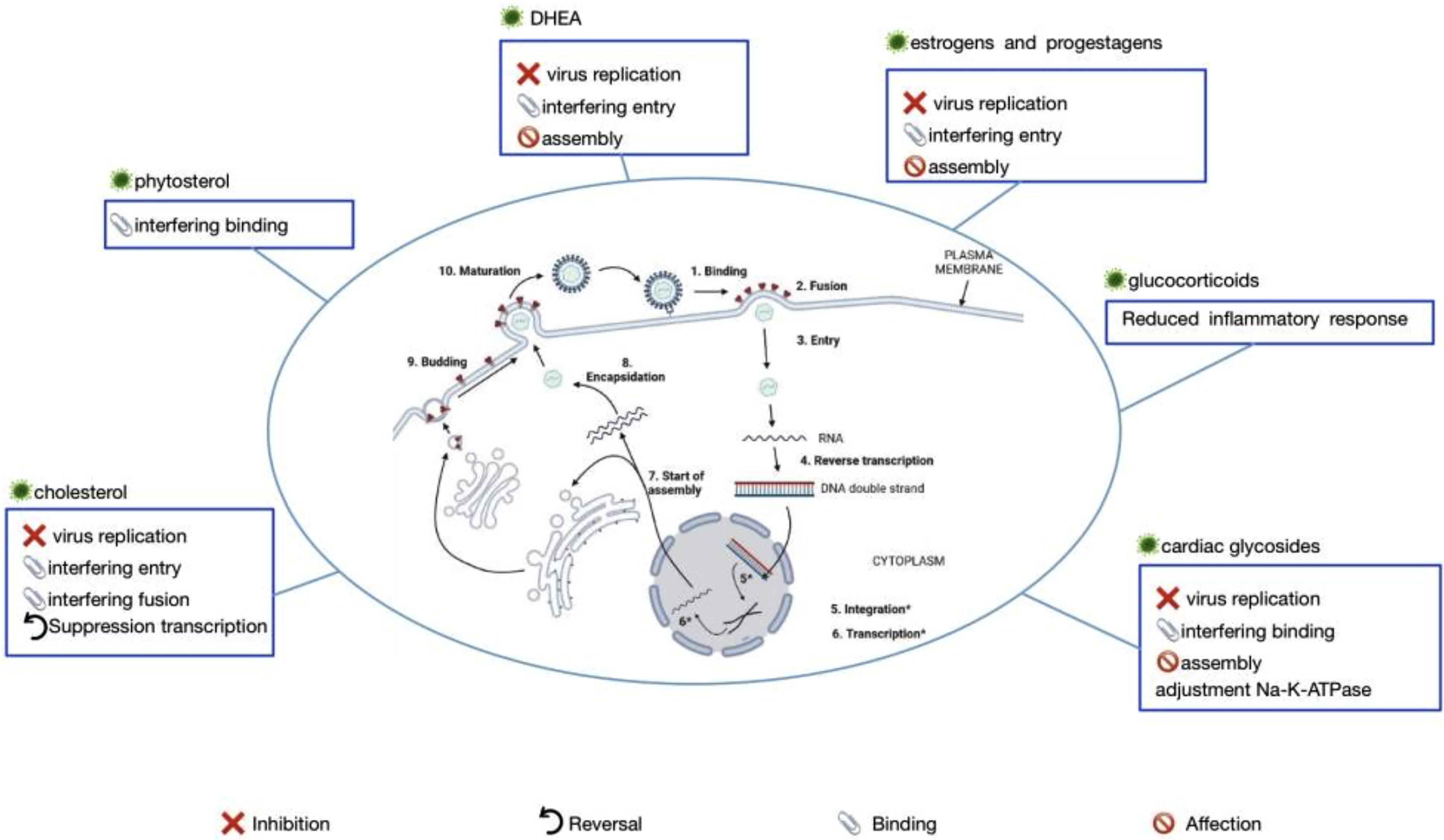
Major steps in the generalized viral life cycle; steroid antiviral main mechanism. Effect of natural steroid compounds on viruses.
Steroidal Hormones
Glucocorticoids
Steroid hormones are an important category of active substances capable of a variety of physiological activities, such as anti-inflammatory effects, life support, and immunomodulation, including glucocorticoids, salt corticoids, androgens, progestins, and vitamin D. In humans, steroids are mostly synthesized by the gonads and adrenal glands (Isidori et al., 2020). In recent years, the application of steroid hormone drugs has been shown to be effective in the treatment of a wide range of viral infections (Yang et al., 2010). As shown in Table 1, glucocorticoids are excellent immunosuppressive agents with sufficiently potent immune properties, as well as being an important nuclear transcription factor that acts mainly by binding to the glucocorticoid receptor, thereby regulating the expression of a wide range of genes (Li et al., 2013). Small doses of glucocorticoids reduced immune cell damage and accelerated SARS-CoV-2 and ADV virus clearance (Fu et al., 2020; Liang et al., 2020). The application of glucocorticoids increased the expression of OMP and decreased the expression of tumor necrosis factor-α (TNF-a) and interleukin 6 (IL-6) in the olfactory mucosa of IV-infected mice, which may be the mechanism of glucocorticoid treatment for olfactory disorders. HRV was found to reduce glucocorticoid-induced activation of the glucocorticoid response element (GRE) reporter system in a time- and concentration-dependent manner (Wan, 2010). The addition of a long-acting β2-adrenoceptor agonist to glucocorticoids functionally restored this response and indicates that the combination of glucocorticoids with a long-acting β2-adrenoceptor agonist may be beneficial during virus-induced asthma exacerbations (Rider et al., 2013). Glucocorticoids combined with antiviral drugs were effective in reducing the acute inflammatory response in HSV-1 patients in the short term and improving the immune cell damage (Li, 2020). HBV-associated early chronic plus acute liver failure treated with glucocorticoids in combination with antiviral therapy shortens the time to symptomatic remission by modulating T-lymphocyte subsets without increasing the risk of adverse effects (He et al., 2020).
Antiviral Mechanisms of Steroid Hormones
ADV, adenovirus; DENV, dengue fever virus; gp120, glycoprotein 120; GPR30, G protein coupled receptor 30; GRE, glucocorticoid response element; H1N1, influenza A (H1N1) virus; HBV, hepatitis B virus; HCMV, human cytomegalo virus; HCV, hepatitis C virus; HIV, human immunodeficiency virus; HPV, human papilloma virus; HSV, VZV, CMV, herpesvirus; HSV-1, herpes simplex virus; IFN, interferon; IL-6, interleukin 6; IVA, influenza A; JEV, Japanese encephalitis virus; JUNV, Junin virus; MMP-9, matrix metalloproteinase 9; OMP, olfactory marker protein; RHV, human rotavirus; RSV, respiratory syncytial virus; SARS-CoV-2, severe acute respiratory syndrome coronavirus 2; TLR-7, toll-like receptor 7; TNF-a, tumor necrosis factor-α; VSV, vesicular stomatitis virus.
Estrogens
Natural estrogens are estrone (E1), 17β-estradiol (E2), and estriol (E3), of which E2 is the main hormone in women of reproductive age. Estrogens modulate immune cell responses and promote anti-inflammatory and neuroprotective effects (Pinna, 2021; Wang et al., 2022).
As shown in Table 1, studies have demonstrated that E2-induced reduction in HIV susceptibility in CD4+ T cells and macrophages also inhibits HIV replication through an anti-inflammatory response (Devadas et al., 2018; Rodriguez-Garcia et al., 2013). Estrogen readily crosses cell membranes and binds to estrogen receptors, which mediate its physiological effects. It was found that E2 inhibits HCV infection granule production in an estrogen receptor alpha-dependent manner and promotes matrix metalloproteinase 9 (MMP-9) blocker protein cleavage to downregulate HCV entry and transmission via the G Protein Coupled Receptor 30 (GPR30) pathway (Hayashida et al., 2010; Ulitzky et al., 2016). It also reduced influenza A virus (IAV) virus replication via the estrogen receptor beta signaling pathway (Peretz et al., 2016); SARS-CoV-2 triggers symptom severity and mortality more commonly in men than women, and there is evidence that estrogen prevented viral replication and invasion of alveolar cells (Wang et al., 2022). Estrogen also inhibited HPV viral transcriptional long control region downregulation of early gene expression, including E6/E7, and E6 and E7 self-expression sensitized cells to estrogen (Bristol et al., 2020).
Progesterone
Progesterone has the ability to remodel immune cells and induce effective anti-inflammatory effects (Solano and Arck, 2020; Wang et al., 2022;). As shown in Table 1, studies have shown that progesterone reduced inflammation and promoted lung repair after IAV virus clearance by modulating cytokine levels (Goldfarb et al., 2015). CXCL9, CXCL10, and CXCL11 chemokines and interleukin-1β (IL-1β) and IL-6 cytokines were downregulated in HIV-1-infected cells pretreated with high concentrations of progesterone compared to untreated HIV-1-infected cells or HIV-1-infected cells treated with low concentrations of progesterone. Therefore, there was a strong correlation between progesterone pretreatment-mediated antiviral and pro-inflammatory responses and reduced HIV-1 replication (Devadas et al., 2018). Progesterone binds progesterone receptors in immune cells, including natural killer cells, T cells, macrophages, and dendritic cells, but also binds nonimmune cells, where it alters cell signaling activity. Progesterone interfered with viral recognition by inhibiting the interferon signaling pathway to induce recombinant toll-like receptor 7, a key receptor for early HCV viral recognition (Tayel et al., 2013); It also activated and induced antiviral genes to exert anti-SARS-CoV-2 effects (Su et al., 2022). Reproductive steroids behave differently in COVID-19, and clinical symptoms between men and women will be an important consideration in future pharmaceutical studies.
Dehydroepiandrosterone
Dehydroepiandrosterone (DHEA) is the most abundant serum steroid hormone in the body and a precursor of sex hormones, and its positive effects in the treatment of viral infections have been demonstrated (Sahu et al., 2020). As shown in Table 1, DHEA inhibited Japanese encephalitis virus (JEV) replication, and reduced JEV-induced cytotoxicity was accompanied by the inactivation of extracellular signal-regulated protein kinase (ERK). In addition, the effective concentration of DHEA was higher than that required for the action of hormones (Chang et al., 2005); it reduced the release of ADV, HSV-1, and vesicular stomatitis viruses and affected their protein synthesis (Romanutti et al., 2009, 2010; Torres et al., 2012). DHEA has had some antiviral effects on JUNV and IAV, but the exact mechanism of action has not been clarified (Acosta et al., 2008; Yang et al., 2016). Compared with DHEA, epiandrosterone (EA) is only a weak androgen, and the mechanism of EA on both ADV and JUNV viruses has not been clarified (Romanutti et al., 2009, 2010).
Steroidal saponins
Steroidal saponins are composed of steroidal glycosides and sugar chain linkages and are widely distributed in plants. As shown in Table 1, recent studies have revealed that cardiac glycosides have a wide range of pharmacological activities, such as antiviral infection and modulation of immune-inflammatory responses. The main mechanism of antiviral activity of cardiac glycosides is to disrupt the early and late activities of the viral cycle, thus blocking viral survival by disrupting ion homeostasis, triggering host cell autophagy, or various signaling cascades (Reddy et al., 2020; Škubník et al., 2021). Inhibition of HIV-1 gene expression by cardiac glycosides through interaction with Na+/K+-ATPase and inhibition of Rev-mediated translation of RNA into the corresponding viral structural protein, and reduction of glycoprotein 120 (gp120) expression in the viral envelope reduced the ability of HIV-1 virus to infect target cells (Wong et al., 2013, 2018); Inhibition of replication of IAV, JEV, DENV, SARS-CoV-2, ADV, and herpes viruses (Amarelle et al., 2019; Cheung et al., 2014; Grosso et al., 2017; Guo et al., 2020; Plante et al., 2020; Singh et al., 2013); cardiac glycosides may exert antiviral effects against SARS-CoV-2 (Souza e Souza et al., 2021), RSV by regulating virus-related signaling pathways through Na+/K+-ATPase interactions (Hartley et al., 2006; Norris, 2017); CG may inhibit HCMV by regulating human cellular targets associated with hERG (Kapoor et al., 2012). Overall, cardiac glycoside may have broad-spectrum antiviral activity, this also suggests that there will be greater potential for clinical antiviral development as a new drug.
Sterols
Sterols affect the virus life cycle, including virus penetration into host cells, virus replication, and promotion of interleukin secretion, as shown in Table 2 (Lembo et al., 2016; Otaegui-Arrazola et al., 2010). Sterols are steroidal compounds with hydroxyl groups attached to the 3-position carbon atom, which are widely distributed in nature and can be mainly classified as phytosterols and animal sterols. Phytosterols are found in most plants and found commonly in vegetables, fruits, nuts, and seeds. The most common types of phytosterols include β-sitosterol, soy sterol, rapeseed sterol, and canola sterol, which are found in the roots, stems, leaves, fruits, and seeds of plants (Valitova et al., 2016). Animal sterols are mainly from animal tissues and animal cells, represented by cholesterol, which have important physiological roles in the human body (Radenkovic et al., 2020). Twenty-five-hydroxycholesterol (25HC) and 27-hydroxycholesterol (27HC) previously had been shown to play a key role in blocking cellular viral fusion caused by a viral infection, and cholesterol-25-hydroxylase, an interferon-stimulated gene, exerted broad-spectrum antiviral effects through its enzymatic activity product 25HC.
Antiviral Mechanisms of Sterols
EMCV, cerebral myocarditis virus; H1N1, influenza A(H1N1) virus; HBV, hepatitis B virus; HCV, hepatitis C virus; HHV-8, herpesvirus; HIV, human immunodeficiency virus; HPV-16, HROV, HRHV, human papilloma virus; HRV, human rhinovirus; HSV-1, herpes simplex virus; KSHV, EBV, herpesvirus; LASV; Lassa virus; MNV, murine norovirus; OSBP, oxysterol-binding protein; PTBP1, polypyrimidine tract binding protein 1; RABV, rabies virus; SARS-CoV-2, severe acute respiratory syndrome coronavirus 2; SIRT1, silent mating type information regulation 2 homolog-1; SVV, Seneca Valley virus; VAPA, vesicle-associated membrane protein-associated protein A; ZIKV, ZIKV virus.
Effects of steroidal derivatives on viruses
Steroid structure is a representative category of mother nucleus, antiviral activity was studied by modifying the active site, as shown in Table 3. The modification of steroid structure is still mainly focused on C3, C16, and C17, the acetylation of C3 and C16 of DHEA (Acosta et al., 2012; Romanutti et al., 2009; Torres et al., 2008). The introduction of oxygen-containing five-membered ring in C16 antiviral not increased, and then the accompanying increase in cytotoxicity is also obvious (Romanutti et al., 2010; Torres et al., 2008), but the introduction of N heterocyclic or N-N structures in C-16 and C-17 antiflavivirus-B encephalitis virus JEV (Chang et al., 2005; Zhang et al., 2021), IAV virus (Yang et al., 2016), ZIKA virus activity was better. Structural modifications in natural oleuropein steroids, we know that the 5-hydroxyl group was replaced by 5α-fluorine group and B ring was replaced by heptacyclic lactone, although the derivatives had higher cytotoxicity, their SI values were higher than those using ribavirin, and the antiviral activity against MV was better than that of ribavirin, which was the derivative with better antiviral activity against MV (Wachsman et al., 2002). And the introduction of heterocycle at the 17 position of hydroxycholesterol reduced the replication of SARS-CoV-2 (Ohashi et al., 2021). Novel steroid derivatives containing peroxide bridges were synthesized, and the compounds performed well in anti-HBV activity tests (Jia et al., 2016).
Antiviral Activity of Steroidal Derivatives
MV, measles virus; ZIKA, ZIKA virus.
At present, the steroid parent nucleus plays an active role in steroids, and the structural design of steroid derivatives will become more and more complex. Structural modification using steroids as the lead compound of the parent nucleus, analysis of conformational relationship, and further targeted structural modification with in vivo activity test will be the future direction of antiviral research.
Future direction
It is well-known that the major complications and fatalities arising from viral infections are due to the overexpression of pro-inflammatory cytokines. Therefore, for viral infections, anti-inflammatory, and immunomodulatory therapy may improve the condition. In-depth discussion on the corticosteroids in combination with antiviral drugs. Reproductive steroids behave differently in COVID-19, and clinical symptoms between men and women will be an important consideration in future pharmaceutical studies. Steroids will gradually become a hot spot in antiviral research, and in the future research and development, there will be more, better efficacy of natural steroid and its derivatives developed into antiviral drugs to make a contribution to human health.
Conclusion
At present, there has been tremendous progress in understanding the steroids and molecular mechanisms of diseases. In vivo assays and clinical trials reveal that steroid actions involve the regulation of distinct cell processes that would finally lead either to an inhibitory or a stimulatory effect on virus replication.
Footnotes
Authors’ Contributions
L.Z. and L.C.: Study concept and design and critical revision of the article for important intellectual content; G.S. and J.L.: Acquisition of data, analysis, and interpretation of data; Y.Z. and Y.Y.: Drafting of the article; and B.Y.: Administrative and material support and study supervision. All authors have made a significant contribution to this study and have approved the final article.
Author Disclosure Statement
No competing financial interests exist.
Funding Information
This study was supported financially by the Postdoctoral Project of Heilongjiang Province (LBH-Z21066).