




Abstract
While technological innovations are sometimes published in methods papers, they often are part of a research paper and thus not apparent to people outside of the specific research area. To enhance the dissemination of generally useful technological advances and transgenic lines, Zebrafish is introducing TechnoFish, which will highlight these innovations for the general zebrafish community. The advantage for the community is that it will highlight technological advances in papers that many people might otherwise miss, and the advantage for authors is that it will draw broad attention to their paper.
Authors who feel that this is appropriate for their work will submit a short (150 word or less) description, written in the third person, which highlights why their method or transgenic line is of general interest. A figure should be included to draw interest, which is attractive in both black and white (for the printed version) and in color (for the online version). The submission will be rapidly reviewed to ensure that the technology is of general interest and is clearly described. By submitting this, authors are also agreeing that all relevant plasmids, transgenic lines, etc., will be made available to all who request it. We are accepting submissions or inquiries for your TechnoFish — please address to David Kimelman (
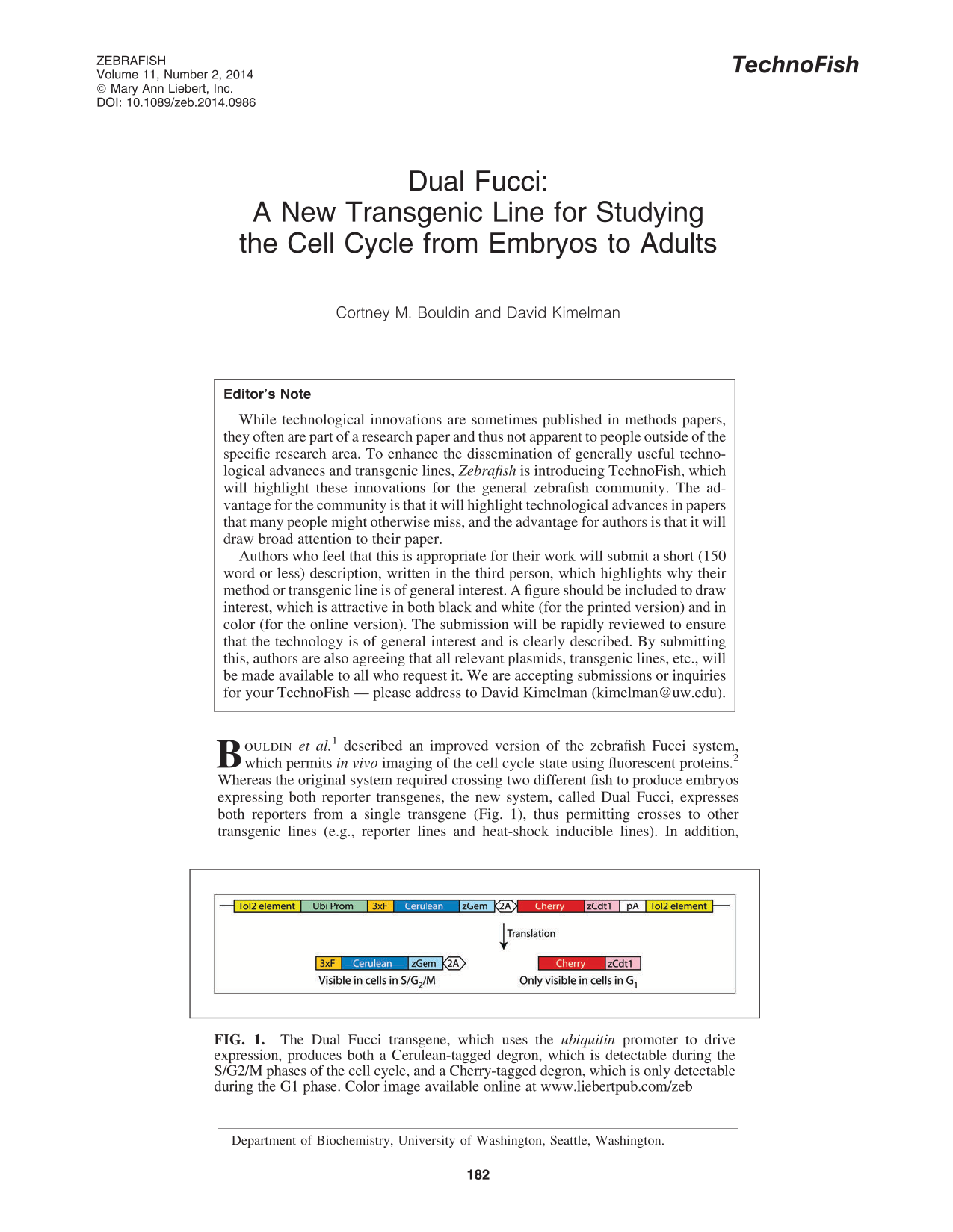
B

The Dual Fucci transgene, which uses the ubiquitin promoter to drive expression, produces both a Cerulean-tagged degron, which is detectable during the S/G2/M phases of the cell cycle, and a Cherry-tagged degron, which is only detectable during the G1 phase. Color image available online at www.liebertpub.com/zeb