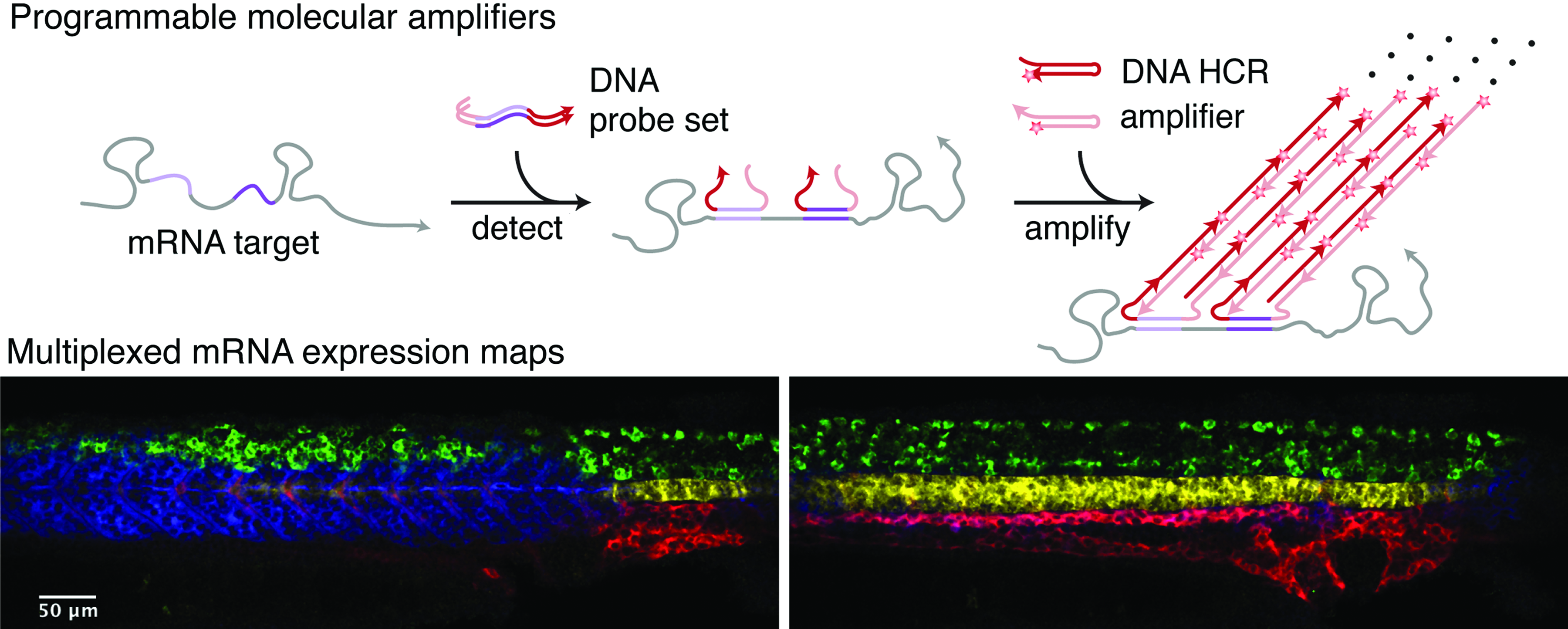
Choi et al.1describe programmable in situ amplifiers based on the mechanism of hybridization chain reaction (HCR) that enable simultaneous mapping of multiple target mRNAs within whole-mount zebrafish embryos. In contrast to traditional in situ hybridization approaches, HCR in situ amplification is performed for all target mRNAs simultaneously, so the experimental timeline is independent of the number of target mRNAs. Using HCR, probes complementary to mRNA targets trigger chain reactions in which metastable fluorophore-labeled hairpins self-assemble into tethered fluorescent amplification polymers in situ (Fig. 1), enabling straightforward multiplexing for up to five target mRNAs at a time, deep sample penetration, high signal-to-background, and subcellular signal localization. The new DNA HCR technology1 improves on the original RNA HCR technology2 to dramatically increase signal gain, reduce reagent cost, and increase reagent durability. DNA HCR kits containing probe sets, amplifiers, and buffers can be purchased from the nonprofit academic resource (www.molecularinstruments.org). Advice and technical support can be obtained by emailing support@molecularinstruments.org
Multiplexed mapping of mRNA expression within intact zebrafish embryos using next-generation DNA hybridization chain reaction (HCR). [Image from Choi et al. (2014); http://pubs.acs.org/doi/abs/10.1021/nn405717p; used with permission from the American Chemical Society.] Color image is available online at www.liebertpub.com/zeb
References
1.
ChoiHMT, BeckVA, PierceNA. Next-generation in situ hybridization chain reaction: higher gain, lower cost, greater durability. ACS Nano, 2014; 8:4284–4294.
2.
ChoiHMT, ChangJ, TrinhLA, PadillaJ, FraserSE, PierceNA. Programmable in situ amplification for multiplexed imaging of mRNA expression. Nat Biotechnol, 2010; 28:1208–1212.