




Abstract
Abstract
Triclosan (TCS) is an ionizable synthetic antimicrobial that has been found to be a persistent environmental contaminant with potential for bioaccumulation. Standard laboratory assays have shown that TCS is toxic to aquatic organisms; however, varied environmental conditions could impact this risk. For example, we would predict that sorption to dissolved organic carbon (DOC) in natural surface waters would reduce the bioavailability and, therefore, toxicity of TCS. To better understand the potential risk that TCS poses to wild fish, we evaluated the toxicity of TCS to zebrafish in the presence of DOC. Zebrafish were exposed to TCS (0–900 μg TCS/L), DOC (0–25 mg/L), or TCS (0–900 μg TCS/L) together with either 10 or 25 mg DOC/L from 8 to 120 h postfertilization through static waterborne exposure. We compared impacts of TCS alone or in conjunction with DOC on mortality, development, and hatching success. Exposure to TCS in the presence of DOC improves survival and hatching success, and reduces the incidence of developmental toxicity. However, since the presence of DOC did not completely prevent sublethal toxicity, our data suggest that given its bioaccumulation potential, developmental toxicity of TCS under environmental conditions still warrants concern.
Introduction
E
The risk quotient (ratio of maximum environmental concentration to predicted no-effect concentration) for TCS has been reported to range from greater than 1 to as high as 10, suggesting that TCS poses a risk to aquatic organisms.16–19 Algae are most sensitive to TCS, and it is thought that toxicity results from the compound's antibacterial nature (disruption of lipid synthesis) (see reviews by 6 and 7). TCS is also toxic to fish, particularly during early developmental stages, with negative impacts documented using standard laboratory assays for a variety of fish, including zebrafish, Japanese medaka, fathead minnow, and rainbow trout. 6 For a range of life stages (embryo to adult), the LC50 (48 or 96 h) for TCS lies between 260 and 602 μg/L, which classifies TCS as a Category 1 toxicant (acute toxicity ≤1.00 mg/L) within the United Nations Globally Harmonized System of Classification and Labeling of Chemicals (GHS).6,20 Chronic studies in fish have shown that TCS is a developmental toxicant and can influence behavior in adults. In rainbow trout larvae, TCS elicited loss of equilibrium and erratic swimming as well as skeletal malformations. 21 In zebrafish, delayed hatching of embryos, spine malformations, edema, and reduced overall size have been observed effects. 22 In adult Japanese medaka, exposure to TCS reduced swimming speeds, 23 and altered nest behavior of fathead minnows. 24
While these laboratory studies are useful for establishing potential toxic endpoints, the extent to which results may be extrapolated to natural aquatic systems is uncertain. For example, dissolved organic carbon (DOC) in natural waters has been shown to sorb and reduce the bioavailability of neutral, hydrophobic organic compounds in a manner that is predictable based on the fraction of compound bound to DOC.25–28 However, TCS differs from the majority of well-studied neutral hydrophobic organic contaminants because it is a weak acid with neutral and anionic species that coexist at relatively high proportions under environmental pH conditions. Therefore, empirical studies are needed to test the prediction that the presence of DOC would reduce the toxicity of TCS.
To more accurately assess the potential for TCS to impact fish species in natural aquatic environments with DOC, we evaluated whether exposure to TCS in the presence of DOC prepared with Leonardite humic acid reduced developmental toxicity in zebrafish (Danio rerio) larvae in a predictable manner. Previous work in our laboratory quantified moderate DOC-water sorption coefficients (log KDOC, L kg−1 DOC) ranging from 3.80 to 4.14 for neutral TCS and 3.42 to 3.51 for the anionic TCS species standard humic acid materials (N. Carmosini, unpublished data). Leonardite humic acid was selected as a model sorbent for this study because it was found to have the greatest ability to sorb TCS and thereby potentially reduce or prevent TCS bioavailability and toxicity. Results from this study can be extrapolated to other DOC materials with known chemical properties. The effects of DOC and TCS on survival and morphological alterations were examined both individually and in combination using multiple concentrations of each.
Materials and Methods
Chemicals and test species
TCS (≥97.0%) was obtained from Sigma-Aldrich Co. (St. Louis, MO). Acetone, potassium hydroxide (KOH), and hydrochloric acid (HCl) were purchased from Fisher Scientific (Pittsburgh, PA) and were analytical reagent grade or higher.
Leonardite standard humic acid (Leo-HA) was purchased from the International Humic Substances Society (IHHS, St Paul, MN) and used as received. This humic acid possesses a high aromatic content (58%), lower aliphatic content (14%), and is relatively nonpolar ((O+N)/C = 0.509) (IHSS 2014). A stock Leo-HA solution was prepared by dissolving a known quantity of powder in buffered zebrafish water (60 mg/L; Instant Ocean, Blacksburg, VA; 50 mg/L sodium bicarbonate), adjusting the pH to 11 with KOH and stirring the solution overnight. After the equilibration period, the solution was readjusted to pH 7.5 with HCl, filtered through a Whatman 0.45 μm nylon membrane filter, and stored at 4°C. Nonpurgeable DOC was quantified with a Shimadzu TOC-VCSH analyzer (Columbia, MD). Experimental DOC solutions of 0, 10, and 25 mg DOC/L were prepared by diluting the stock DOC solution with additional zebrafish water adjusted to pH 7.5. These concentrations are in the mid to upper range of natural DOC concentrations. 29
A stock TCS solution (1 g/L) was prepared by dissolving a measured quantity of TCS in acetone. Exposure concentrations were based upon preliminary experiments in our laboratory that established the LC50 of 400 μg TCS/L (nominal concentration) as well as a previously reported LC50 for zebrafish. 22 Dosing solutions with nominal concentrations of 100, 300, 500, 700, and 900 μg TCS/L were prepared by diluting an appropriate quantity of stock solution in buffered zebrafish water with a selected DOC concentration. The pH of the dosing solutions was verified to be 7.5 at the outset of the experiments and was assumed to remain unchanged due to the buffered nature of the rearing solution. All TCS-dosing solutions and control treatments were prepared such that they contained <0.01% acetone.
An established line of AB strain of zebrafish was used for all experiments, and fish were raised according to standard protocols. 30 All animal husbandry and experimental conditions were approved by the University of Wisconsin–La Crosse Animal Care and Use Committee. Breeder fish were kept in sex-differentiated tanks with zebrafish water at 25–26°C, 14-h light–10-h dark cycle. Zebrafish were fed twice daily with TetraMin® Tropical Flakes, 3-pigment Adult Zebrafish Complete Diet (Zeigler, Gardners, PA), and live brine shrimp nauplii. Eggs were collected and distributed into 24-well plates (one embryo per well) for exposure within 4 h from onset of spawning as described below.
Zebrafish exposures
Triplicate experiments were performed in 24-well plates (one fish per well, n = 24) for each exposure (TCS, DOC, and TCS+DOC; total n = 72 per treatment). Zebrafish embryos were individually placed into 2 mL of dosing solution with the following nominal concentrations: acetone vehicle control (<0.01%), 100, 300, 500, 700, and 900 μg TCS/L; 10 or 25 mg DOC/L; or 100, 300, 500, 700, and 900 μg TCS/L with either 10 or 25 mg DOC/L. For TCS+DOC treatments, solutions were equilibrated for 24 h before exposure to allow sorption of TCS to the DOC; preliminary studies found this length of time to be sufficient (N. Carmosini, unpublished data). Static waterborne exposures began at 4–6 h postfertilization (hpf) through 120 hpf without renewal of dosing solution. Based on the reported 8-day half-life for TCS in freshwater, we would expect that experimental concentrations of TCS after 96 h of exposure would be ∼75% of initial concentrations. 10 Embryos were maintained at 28°C with a 14-h light–10-h dark cycle.
Evaluation of toxicity
Embryos/larvae were screened daily and scored for survival, alterations in morphology, and endpoints of toxicity as described previously. 31 Briefly, fish were scored on a scale of 0–4: 0 = healthy (normal), 1 = mild toxicity (one endpoint), 2 = moderate toxicity (two endpoints), 3 = severe toxicity (three or more endpoints), 4 = dead. The endpoints observed here included yolk sac edema, pericardial edema, and yolk, pericardial, craniofacial, and tail malformation. We also noted whether fish displayed toxicity that would be characterized as blue sac syndrome (toxicity presents as a combination of pericardial and yolk sac edema, craniofacial malformations, and uninflated swim bladders). At 120 hpf, eight representative larvae per experimental treatment (N = 24) were immobilized in 3% methylcellulose and photographed laterally using an Optronics MicroFire camera mounted on a Leica MZ16 stereomicroscope. Photomicrographs of larvae were used to quantify incidence of specific endpoints of toxicity, and ImageJ was used to measure standard length, snout length (length from tip of jaw to caudal edge of the eye, normalized to standard length), and area of pericardial and yolk sac edema.
Data analyses
Mortality data were used to calculate the median lethal concentration (LC50 and 95% confidence interval [CI]) at 96 hpf using Probit method analysis (JMP11). LC50s were compared using the LC50 ratio test. 32 Statistical analyses of developmental toxicity data were performed using JMP11. All data were evaluated for homoscedasticity (Leven Median test) and are presented as mean ± standard error. One-way ANOVA with Tukey's post hoc was used to assess toxicity incidence, standard length, snout length, and pericardial and yolk sac edema within experimental exposures, and two-way ANOVA with Tukey's post hoc was used to assess impacts on mortality and mean toxicity score. For all statistical tests, p-values of <0.05 were considered significant.
Results
Acute toxicity of DOC, TCS, and TCS in the presence of DOC
For all experiments, the embryos/larvae within the control group developed normally, and had mortality less than 10% as required for test validity. Exposure to DOC did not induce mortality at any concentration, nor did it induce overt signs of developmental toxicity (Supplementary Fig. S1; Supplementary Data are available online at www-liebertpub-com.web.bisu.edu.cn/zeb). Developmental exposure to ≥500 μg TCS/L nominal concentrations caused developmental toxicity that eventually lead to mortality; the 96-h LC50 for TCS is 406 μg/L (95% CI 365–452) (Table 1); those exposed to ≥700 μg TCS/L died before hatching (Supplementary Fig. S2). Hatching success was also reduced following exposure to ≥500 μg TCS/L (Fig. 1). Exposure to TCS in the presence of DOC significantly increased the LC50 of TCS (Table 1). While the presence of DOC delayed mortality following exposure to 700 μg TCS/L (Supplementary Fig. S3), mortality was still 100% by 96 hpf. Presence of DOC improved hatching success in a dose-dependent manner (Fig. 1).

Hatching success at 72 hpf following waterborne exposure to 500 μg TCS/L (nominal concentration) with varying concentrations of DOC. Letters denote significant differences between treatment groups (p < 0.05). DOC, dissolved organic carbon; TCS, Triclosan.
Schwarzenbach et al. (2003). 31a
DOC, dissolved organic carbon; TCS, Triclosan.
Sublethal toxicity of TCS and TCS in the presence of DOC
Sublethal toxicity scores were significantly increased in 120 hpf fish exposed to 500 μg TCS/L (Fig. 2). Developmental endpoints of toxicity included: severe craniofacial malformations, pericardial and yolk sac edema, yolk sac malformations, uninflated swim bladders, and reduced growth (Figs. 3 and 4). Nearly 100% of larvae exposed to ≥500 μg TCS/L developed blue sac syndrome (Figs. 2A and 3). Fish were 25% smaller (Fig. 4A), and their snouts were 29% shorter (Fig. 4B).
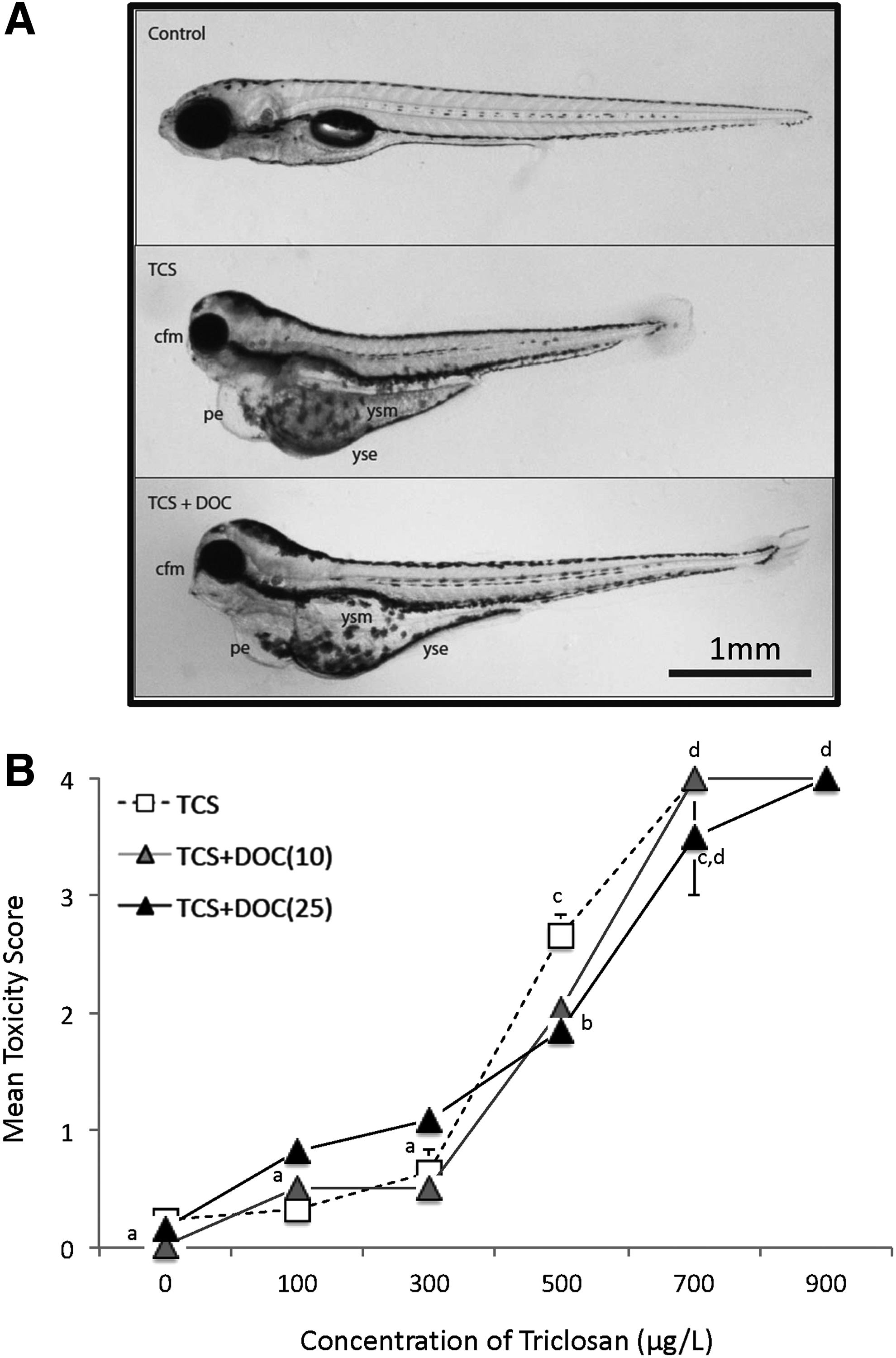
Sublethal toxicity following waterborne exposure to TCS in the presence of DOC.
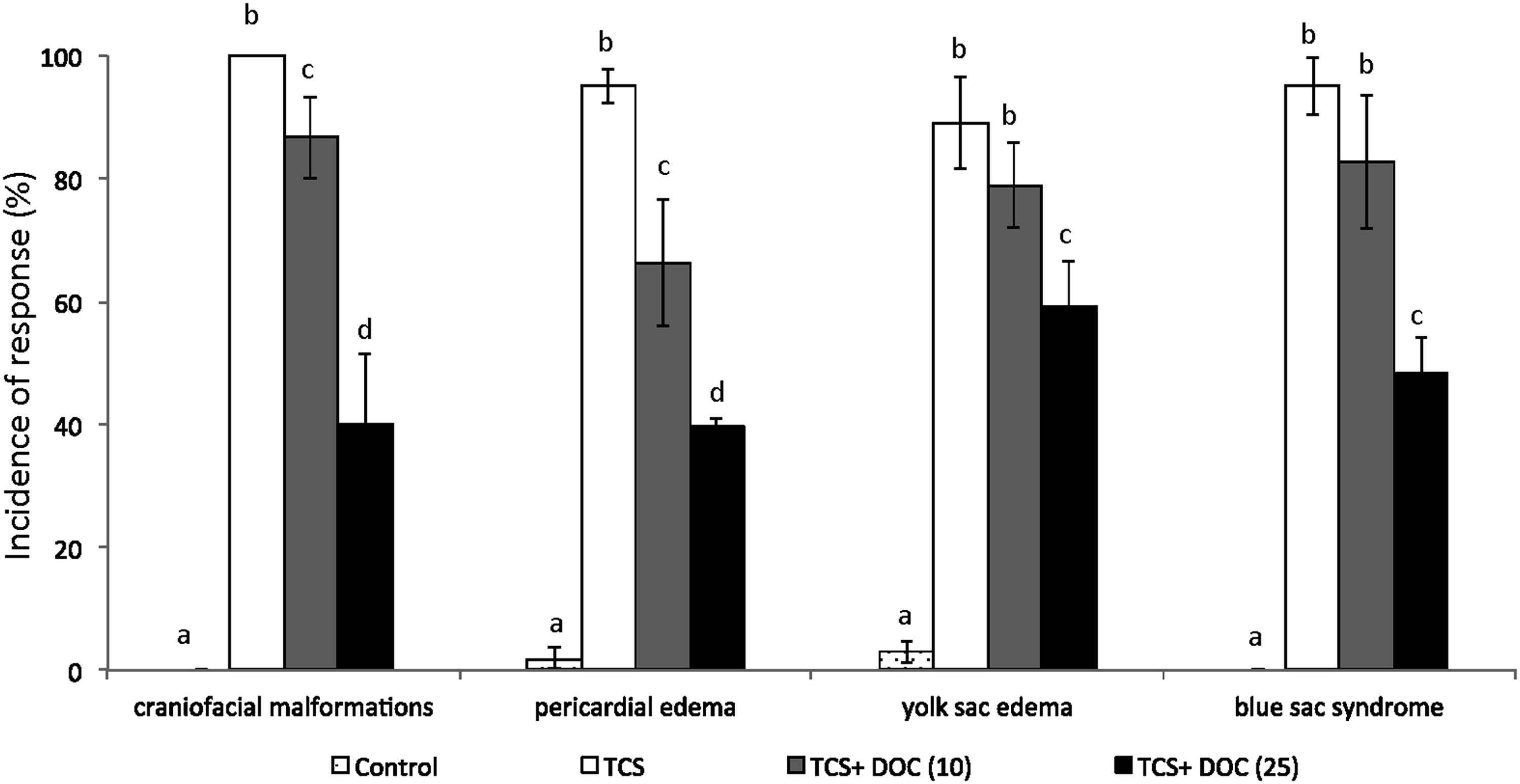
Incidence of selected endpoints of toxicity following exposure to 500 μg/L TCS in combination with varying concentrations of DOC (10 or 25 mg/L). Endpoints of toxicity were evaluated at 120 h. Letters denote significant difference within endpoint (p < 0.05).

Severity of developmental toxicity of TCS in the presence of DOC. Impacts on growth
The presence of DOC reduced the incidence and severity of observed blue sac syndrome and associated endpoints of sublethal toxicity (Figs. 2 and 3). However, since exposure to ≥700 μg TCS/L in the presence of DOC still resulted in nearly 100% mortality at 120 hpf, refined quantification and comparison of the endpoints was restricted to exposures of 500 μg TCS/L in combination with 10 and 25 mg DOC/L. Incidence of craniofacial malformations was reduced by 10% in the presence of 10 mg DOC/L, and 60% in the presence of 25 mg DOC/L (Fig. 3). Impacts on growth and snout length were also improved in the presence of DOC (Fig. 4A, B). The same beneficial effect was observed for the incidence of pericardial edema, which was reduced by 30% and 55% in the presence of DOC at 10 and 25 mg/L, respectively (Fig. 3). Furthermore, the severity of edema was also reduced (Fig. 4C). While 25 mg DOC/L was required to reduce the incidence of yolk sac edema and blue sac syndrome (Fig. 3), the severity of yolk sac edema was significantly reduced in the presence of both 10 and 25 mg DOC/L (Fig. 4D).
Discussion
Natural aquatic environments contain a variety of dissolved and colloidal organic molecules that can bind neutral hydrophobic organic contaminants and reduce their bioaccumulation in aquatic organisms.25–27 TCS and many other emerging contaminants originating from personal care products and pharmaceuticals are ionizable with anionic forms having a weaker affinity for DOC and bioaccumulation. In this study, the effects of TCS and DOC on survival and morphological alterations of zebrafish embryos were examined both individually and in combination using multiple concentrations of each. A well-characterized model DOC material with a strong binding affinity for TCS was used to quantify a relatively high potential for DOC to modulate TCS toxicity and allow comparisons to be made with other characterized DOC materials. Information from this study contributes to a better understanding of the toxic potential and improved risk assessments for TCS. Moreover, this work illustrates the ease at which zebrafish embryo tests can be adapted to better reflect environmental conditions.
According to standard evaluation procedures of the US EPA for freshwater fish, 33 the LC50 reported for different fish species suggests that TCS is toxic to fish. The 96-h LC50 quantified for TCS in zebrafish in our study (Table 1; 5-day exposure without daily renewal of dosing solutions) is within the same range as the 96-h LC50 for zebrafish with a 5-day exposure with daily renewal of dosing solutions (420 μg TCS/L; 95% CI overlap; Oliveira et al. 2009), and is similar to the LC50s reported for other species, which range from 0.4 to 1.47 mg/L nominal concentration.21,22,34,35 The LC50 values and the exposure concentrations used in our study are higher than TCS levels measured in the environment, which range from ng/L to low μg/L.18,36 However, TCS can bioaccumulate at much higher concentrations than found in water and sediment,21,37 with a bioaccumulation factor ranging from 3700 to 8400.38,39 For example, muscle concentrations of TCS in male breams from rivers in Germany ranged from 0.25 to 3.4 μg/kg, 40 and plasma concentrations in fish from the Detroit River (United States) ranged from 0.75 to 10 μg/kg, 41 whereas concentrations in the water were much lower. Since TCS can readily bioaccumulate and bioconcentrate within aquatic biota, and is readily replenished within the environment as the result of its widespread use (see 6 and 7 for review), fish are likely to be at risk from sublethal toxicity following long-term exposure to environmentally relevant concentrations of TCS.
Sublethal toxicity of TCS resembled blue sac syndrome in zebrafish, along with reduced hatching success, and subtle impacts on craniofacial structures and the cardiovascular system (pericardial edema). Blue sac syndrome (or blue sac disease) comprises several toxic responses, including pericardial and yolk sac edema, hemorrhaging, reduced growth, and craniofacial abnormalities that eventually lead to death following exposure to varied environmental contaminants.42–44 While the other reports referenced above do not classify the acute toxic response as blue sac syndrome, the toxicity they describe is similar. In zebrafish, toxicity caused by exposure to ≥700 μg TCS/L resulted in death by 72 hpf, and the severity of blue sac syndrome observed in larvae exposed to 500 μg TCS/L suggests that the larvae would not survive to adulthood. Thus, we cannot ignore the potential risks that chronic exposure to TCS poses to wild fish populations.
The mechanisms by which TCS induces toxicity in vertebrates are not clear. A variety of in vitro studies suggest that TCS is neither genotoxic nor mutagenic at levels usually found in personal care products. 6 Teratogenic response of TCS in zebrafish includes alterations in the expression of biomarkers (gst, enzyme assay [ChE], and ldh), 22 that suggest toxicity may result from oxidative stress or neurotoxicity. TCS is classified as a halogenated aromatic hydrocarbon and some of its metabolites (i.e., 2,3,7-TCDD, 1,2,3,8-TCDD, and 1,2,8-TCDD) are aryl hydrocarbon receptor (AhR) agonists (see Dhillon et al. 45 for review). In vitro studies suggest that TCS can act both as an AhR agonist and antagonist, has weak antagonistic activity for the estrogen receptor, and is an androgen receptor antagonist.34,46,47 Limited animal studies are available to confirm its mode of action. Blue sac syndrome is typically associated with the overexpression of CYP1a detoxifying enzymes leading to edema from damage to lipid membranes from reactive oxygen species. 42 Our findings lend support that the mechanisms that underlie the toxicity of TCS may be similar, and warrant further evaluation.
This study shows that in the presence of DOC, survival increases and sublethal toxicity is significantly reduced following exposure to concentrations near the LC50 for TCS. Hatching success, a common endpoint in early life stage tests in fish, was significantly increased in the presence of 10 mg DOC/L and completely rescued in the presence of 25 mg DOC/L. The severity of observed sublethal toxicity was minimized such that larvae survived, with mortality and growth similar to control fish. However, a significant proportion of larvae still showed signs of edema and blue sac syndrome indicating that TCS is still bioavailable to some extent. Thus, we would predict that long-term survival of these larvae would be reduced in typical aquatic environments containing DOC. Since minor reductions in growth or survival can have compounding impacts on annual recruitment,48,49 our data suggest that exposure to sublethal concentrations of TCS, even in the presence of DOC, presents a risk to wild fish populations. To better understand environmental risks of TCS, we need to evaluate the uptake and biotransformation of TCS in the presence of DOC.
Since the toxicity seen following exposure to TCS in the presence of DOC is similar, but reduced in incidence and severity, this suggests that the DOC is not modifying the mode of action for TCS, but rather reducing its bioavailability. It also suggests that dioxin and other TCS phototransformation products that are more toxic than TCS are not being produced in important quantities under our test conditions, although we did not monitor any degradation products. Others have shown that DOC at 2 mg/L in an aqueous solution at pH 9.0 reduced TCS phototransformation by natural sunlight by 20%, and attributed this decrease to light absorption by DOC. 50 Degradation of TCS would likely be further reduced in our experimental conditions that used higher DOC concentrations.
In our experiment, the use of fish water with a pH of 7.5 would result in TCS speciation being about 76% neutral and 24% anionic. Based on measured log KDOC values of 4.14 and 3.51 for these species (N. Carmosini, unpublished data), respectively, the nominal free aqueous concentration of TCS (neutral and anionic), which is considered to be the bioavailable fraction, would be estimated to be ∼450, 629 and 809 μg TCS/L for the 500, 700, and 900 μg TCS/L treatments combined with 10 mg DOC/L, respectively. Similarly, the nominal bioavailable concentrations would be ∼391, 547, and 703 μg TCS/L when combined with 25 mg DOC/L, respectively. Thus, for the highest two dosing treatments, the bioavailable fraction of TCS remains substantially higher than the measured LC50 of the TCS alone (366–428 μg/L; Table 1), which concurs with the observed rates of mortality and sublethal toxicity we observed in this study.
Conclusions
While environmental fate models predict that naturally occurring DOC likely reduces the bioavailability and associated toxicity of hydrophobic organic contaminants, empirical toxicity studies demonstrating this are lacking, particularly for relatively new emerging ionizable contaminants like TCS. Our work supports models that predict the presence of a highly sorptive type of DOC has the potential to reduce contaminant bioavailability and, therefore, acute toxicity of TCS; however, we also show that the long-term health of the population may still be impaired. We observed that coexposure of TCS with DOC only delayed eventual mortality of larvae, which would have been missed if we had not included observations posthatch. Hence, this study also supports the idea that when using zebrafish assays to determine toxicity and predict risk, endpoints should extend beyond 48–72 hpf to include a minimal period of exposure and observation time after larvae hatch from their chorion. 51 This work demonstrates a simple way in which standard toxicity assays with zebrafish can be amended with DOC to better reflect environmental exposures to wild fish. It also suggests that the zebrafish is a useful laboratory model to help us better predict and understand the risk that TCS presents to wild animal populations since zebrafish had the same sublethal toxicity and similar LC50 for TCS as other fish species. Finally, our work indicates that a better understanding is needed of how DOC potentially modulates the risks that TCS and other ionizable organic compounds pose to aquatic organisms. Future work to improve our understanding of DOC–contaminant interactions and their influence on toxic endpoints should incorporate additional types of naturally occurring DOC with varying abilities to bind contaminants, a range of pH conditions that could influence DOC–contaminant interactions, as well as multiple toxicants that could compete for DOC sorption sites as could be expected to occur in the environment.
Footnotes
Acknowledgments
The authors thank Jenna Weigand and Sasha Chihak for their assistance with preliminary experiments that preceded this work. This work was funded by UWL Faculty Research Grants, UWL Undergraduate Research Grant to Sarah Grandstrand, and the UWL River Studies Center.
Compliance with Ethical Standards
All animal husbandry and experimental conditions were approved by the University of Wisconsin–La Crosse Animal Care and Use Committee. Documentation is available upon request.
Disclosure Statement
No competing financial interests exist.
References
Supplementary Material
Please find the following supplemental material available below.
For Open Access articles published under a Creative Commons License, all supplemental material carries the same license as the article it is associated with.
For non-Open Access articles published, all supplemental material carries a non-exclusive license, and permission requests for re-use of supplemental material or any part of supplemental material shall be sent directly to the copyright owner as specified in the copyright notice associated with the article.
