




Abstract
Abstract
Currently there is a lack in fundamental understanding of disease progression of most neurodegenerative diseases, and, therefore, treatments and preventative measures are limited. Consequently, there is a great need for adaptable, yet robust model systems to both investigate elementary disease mechanisms and discover effective therapeutics. We have generated a Tol2 Gateway-compatible toolbox to study neurodegenerative disorders in zebrafish, which includes promoters for astrocytes, microglia and motor neurons, multiple fluorophores, and compatibility for the introduction of genes of interest or disease-linked genes. This toolbox will advance the rapid and flexible generation of zebrafish models to discover the biology of the nervous system and the disease processes that lead to neurodegeneration.
Z
To streamline the production of zebrafish models for the study of the nervous system and neurodegenerative disease, we designed a Tol2 Gateway-compatible toolbox based on the original Tol2kit generated by the Chi-Bin Chien Lab. 5 We made use of the Tol2kit's flexibility to quickly assemble promoters, genes, and tags to generate a toolbox for the study of the nervous system and neurodegenerative disease. By utilizing the Tol2kit's standard format, the easy distribution and reuse of existing kit components are possible.
The neurodegenerative disease toolbox includes four promoters, six fluorophores (N- and C-terminal tags), and empty vectors with MultiSite Gateway (Invitrogen)-compatible cloning sites or multiple cloning sites for the easy insertion of genes of interest (Supplementary Tables S1–S5; Supplementary Data are available online at www.liebertpub.com/zeb). We have collated and adapted promoters for many key cell types of the nervous system that are implicated in neurodegenerative diseases, including promoters for motor neurons (-3mnx1/Hb9), pan neuronal (elavl3/HuC), microglial/macrophage (mpeg1.1), and astrocytic (gfap) expression. In addition, we have collated and adapted several fluorophores of nonoverlapping emission spectrums, such as mTagBFP (blue), TagRFPt (red), and EGFP (green) or mVenus (yellow), mCerulean3 (cyan), and mKOFP2 (orange). This will allow for the easy expression of a gene or fluorophore of interest in any of the key cell types of the nervous system.
Figure 1 shows an example of how our constructs can be used to create transgenic zebrafish lines expressing fluorescent reporters and diseased-linked genes. In this example, motor neurons are labeled in blue, a ubiquitously expressed neurodegenerative disease-linked protein (TDP-43) is labeled green and a ubiquitously secreted cell death reporter (ANNEXINV) is labeled in red (Fig. 1A, D–F). We first generated the Tg(-3mnx1:TagBFP) by selecting the p5E plasmid containing the motor neuron-specific promoter (p5E--3mnx1)11,12 and combined it with the pME plasmid containing the mTagBFP fluorophore to create a fish line with blue motor neurons (Fig. 1B, C, E, G and Supplementary Data). To generate a zebrafish expressing a neurodegenerative disease-linked candidate gene, we choose to use the p5E plasmid containing the existing ubiquitous promoter (p5E-ubb) 13 and combined this with our pME-EGFP-NS and p3E-Hsa.TDP-43 plasmids to create a zebrafish expressing green TDP-43 in every cell [Tg(ubb:EGFP-NS-Hsa.TDP-43)] (Fig. 1B–D, H and Supplementary Data).
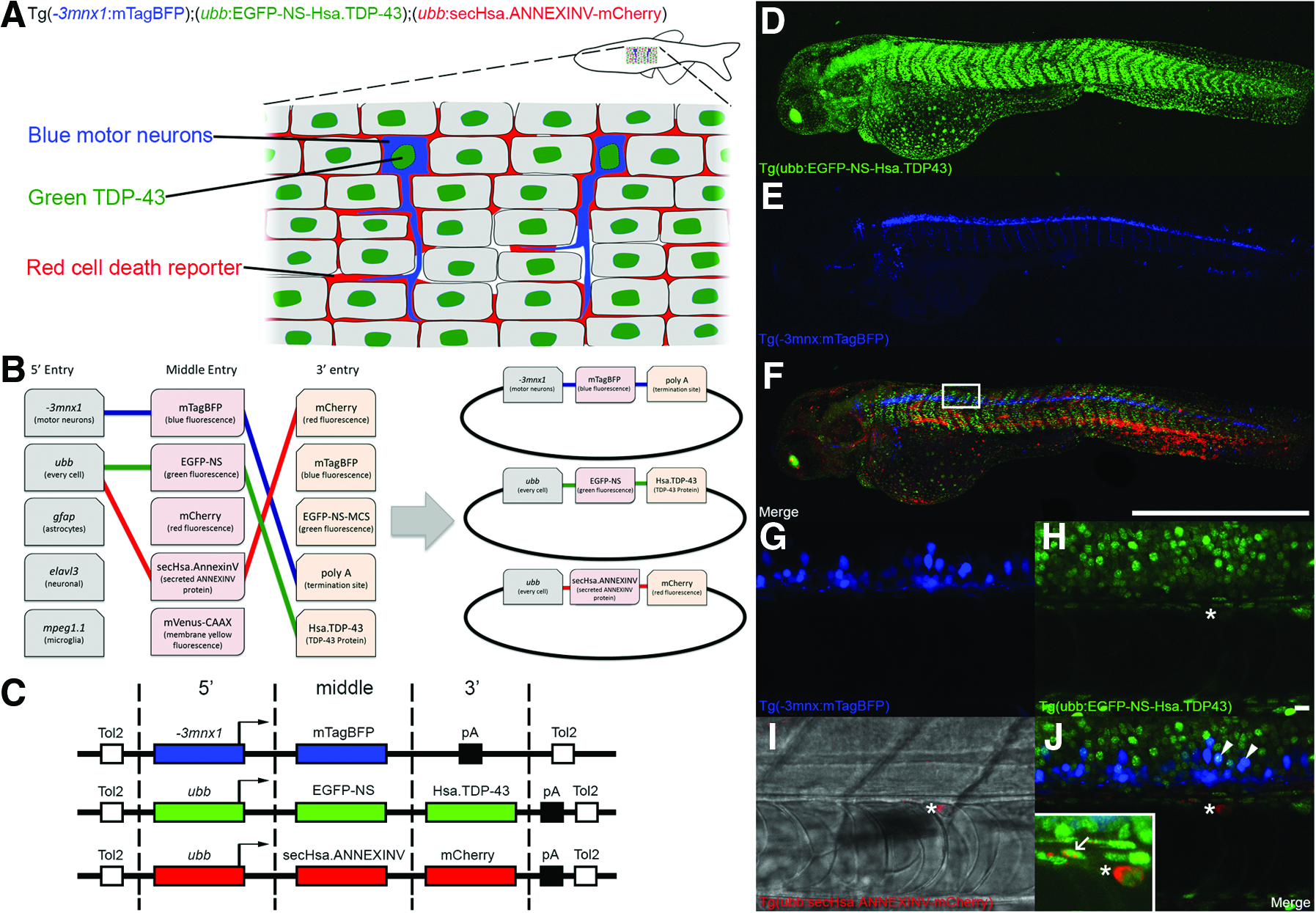
An example of an ALS zebrafish model created with our toolbox to study the relationship between TDP-43 (an ALS-associated protein) and motor neuron degeneration. This zebrafish has blue motor neurons, green TDP-43, and a red cell death reporter
To examine the effects of the neurodegenerative disease-linked protein, TDP-43, on the viability of motor neurons, we created a ubiquitously expressed cell death reporter by combining p5E-ubb with our pME plasmid containing secreted ANNEXINV with the existing C-terminal mCherry fluorophore 5 to generate a pTol2pA2—ubb:secHsa.ANNEXINV-mCherry construct (Fig. 1B, C, I, J and Supplementary Data). This construct, tagging a red protein to cells undergoing cell death, was injected into the compound transgenic Tg(-3mnx1:mTagBFP); Tg(ubb:EGFP-NS-Hsa.TDP-43) and live-imaging microscopy allowed us to examine whether the overexpression of our gene of interest induced motor neuron death in our animal model of neurodegenerative disease (Fig. 1J inset). In this way, sharing our Tol2 Gateway-compatible toolbox with the community allows for the flexibility and rapid generation of multiple zebrafish lines to study the biology of the nervous system and the processes of neurodegenerative disease.
Footnotes
Acknowledgments
We would like to thank The Snow Foundation, The Rebecca Cooper Medical Research Foundation, the MND Research Institute of Australia (GIA1409 and GIA1638), and  for their funding. Dr. N.J.C. is supported by the National Health and Medical Research Council (NHMRC), project grant [GNT1034816], and Macquarie University. Prof. R.C. and Dr. N.J.C. are supported by ARC grant DP140103233. The authors thank Dasha Syal for zebrafish care. We also thank the Raymond Lab (University of Michigan, USA), the Huttenlocher Lab (University of Wisconsin, USA), the Chien Lab (The University of Utah, USA), and the Key Lab (University of Queensland, Australia) for the sharing plasmids.
Disclosure Statement
No competing financial interests exist.
References
Supplementary Material
Please find the following supplemental material available below.
For Open Access articles published under a Creative Commons License, all supplemental material carries the same license as the article it is associated with.
For non-Open Access articles published, all supplemental material carries a non-exclusive license, and permission requests for re-use of supplemental material or any part of supplemental material shall be sent directly to the copyright owner as specified in the copyright notice associated with the article.
