




Abstract
The use of proper anesthesia in zebrafish research is essential to ensure fish welfare and data reliability. However, anesthesia long-term side effects remain poorly understood. The purpose of this study was to assess anesthesia quality and recovery in adult zebrafish using different anesthetic protocols and to determine possible long-term effects on the fish activity and anxiety-like behaviors after anesthesia. Mixed-sex adult AB zebrafish were randomly assigned to five different groups (Control, 175 mg/L of tricaine methanesulfonate [MS222], 45 mg/L of clove oil, 2 mg/L of etomidate, and 5 mg/L of propofol combined with 150 mg/L of lidocaine) and placed in the respective anesthetic bath. Time to lose the equilibrium, response to touch and to caudal fin pinch stimuli, and recovery after anesthesia administration were evaluated. In addition, after stopping anesthesia, respiratory rate, activity, and anxiety-like behaviors in the novel tank test were studied. Overall, all protocols proved to be adequate for zebrafish anesthesia research as they showed full recovery at 1 h, and only etomidate had minor effects on fish behavior in the novel tank, a validated test for anxiety.
Introduction
Versatility is a key characteristic of zebrafish that makes it a popular model in biomedical research, but the development of refinement measures is not always accompanying that popularity and increase in zebrafish use. This includes the development of anesthetic protocols, which are essential to mitigate stress and/or pain when fish undergo surgical and invasive or stressful procedures.
Tricaine methanesulfonate (MS222), benzocaine, 2-phenoxyethanol, clove oil (CO), etomidate (Eto), and lidocaine have been described to be used to anesthetize adult zebrafish, with MS222 use highlighted. 1 From these anesthetics, clove oil and etomidate were described to cause minimal aversion to zebrafish.2,3
Nevertheless, MS222 is the main sedative and anesthetic used for zebrafish. Its wide use in this species is probably related to its wide use in other fish, as it is the only anesthetic authorized for some aquatic species by the U.S. Food and Drug Administration (FDA). 4 MS222 acts mostly by blocking sodium currents in the nerve membranes, reducing action potentials that lead to muscle relaxation.4–6 It is a local anesthetic that acts systemically by administration in a water bath.
Etomidate is an ultra-short-acting nonbarbiturate hypnotic agent 7 that provides a rapid induction, but a rather long recovery, 8 and it has no analgesic component. 9
Clove oil is a local anesthetic, but, as MS222, it acts systemically when administered by immersion. It is a natural essential oil, the active substance of which is eugenol. 10 Clove oil is highly lipophilic and quickly absorbed through the gills and skin 11 ; thus, it has rapid induction and delivers consistent anesthesia in fish compared with other anesthetics. 12
As these agents are delivered in water bath, there is an increased risk of overdose and subsequent death or other side effects. Balanced anesthesia is based on the use of different anesthetics in combination, in a way that potentiates anesthesia and allows lower concentrations to be used, hence decreasing the risk of overdose. One example is the combination of propofol with lidocaine tested by our group, which showed promising results,12,13 while each anesthetic alone presents some concerns. Lidocaine hydrochloride, a water-soluble local anesthetic agent, 8 provides rapid anesthesia induction and recovery, 9 but exhibits low margin of safety in zebrafish, 14 whereas propofol, a short-acting sedative-hypnotic used for induction and maintenance of general anesthesia, 8 does not provide satisfactory analgesia for painful procedures. 13
In studies reporting anesthesia parameters and recovery quality, side effects are often disregarded, overlooking potential consequences for late mortality and/or interference with research outcomes and fish welfare.
Thus, this study aims not only to assess the efficacy of zebrafish anesthesia but also to study the recovery profile of each anesthetic agent (MS222, clove oil, etomidate, and propofol/lidocaine) and their potential to cause long-term influence on zebrafish activity and anxiety levels, using the novel tank test.
Materials and Methods
Ethics statement
All procedures were carried out under personal and project licenses approved by the National Competent Authority for animal research (Direção-Geral de Alimentação e Veterinária; approval No. 014703) and by the Animal Welfare and Ethics Review Body of the Institute for Research and Innovation in Health for a larger project where this study protocol was included. All experimental procedures were performed in accordance with the European Directive 2010/63/EU on the protection of animals used for scientific purposes, and its transposition to the Portuguese law, “Decreto Lei” 113/2013.
Animals and housing
Seventy-five 13- to 16-month-old mixed-sex AB zebrafish bred in the Animal Facility of the institute were used (1:2.5 ratio of female:male). They were kept in 3.5 L tanks in a recirculating water system connected to a central unit of water purification and controlled temperature (27°C ± 0.2), pH (7 ± 0.2), and conductivity (900 μS) under a 14:10 h light:dark cycle. Fish were fed twice a day with the commercial diet ZEBRAFEED (Sparos, Olhão, Portugal). Food restriction was applied on the day of anesthesia, thus 19 h before the experiment. After anesthesia administration, the animals recovered individually for 24 h in a 1 L tank with water at 27°C ± 0.5°C, and in visual contact with the neighbors.
The anesthesia was performed during the morning (at 10 a.m. or at 12:30 p.m.) and the novel tank in the afternoon (at 3 or 5:30 p.m., the day after anesthesia). During the experiment, the animals were monitored 1, 2, 6, and 24 h after anesthesia or longer if they had not recovered normal behavior.
Anesthesia and recovery
Zebrafish were randomly assigned to five different groups: Control (unanesthetized animals; pH = 6.94; n = 14), MS222 (animals anesthetized with 175 mg/L [6.70 μM] of tricaine methanesulfonate; Sigma–Aldrich; pH = 7.07; n = 15), CO (animals anesthetized with 45 mg/L [2.19 μM] of clove oil containing 85%–90% of eugenol, and 405 mg/L [0.0088 μM] of ethanol, Sigma–Aldrich; pH = 7.15; n = 16), Eto (animals anesthetized with 2 mg/L [8.19 μM] of etomidate from 2% solution, Lipuro; B. Braun Melsungen AG, Germany; pH = 6.97; n = 15), or P/L (animals anesthetized with 5 mg/L [2.8 μM] of propofol from 2% solution, Lipuro; Braun; combined with 150 mg/L [5.54 μM] of lidocaine hydrochloride from 2% solution; Braun, Queluz de Baixo, Barcarena, Portugal; pH = 7.05; n = 15). Pilot studies were first conducted to ensure that these concentrations provide loss of equilibrium and no mortality.
Except for MS222 and clove oil, anesthetic solutions were freshly prepared. For MS222, a stock solution was previously prepared by adding tricaine methanesulfonate powder to system water and buffering it with sodium bicarbonate until the solution reached a pH of7. 13 A stock solution of clove oil 10% was also previously prepared with ethanol. 9
Each anesthetic bath was used for only one fish, making the fish the experimental unit. Anesthetic baths were prepared in a 1 L tank with 200 mL of water from the system and then vigorously stirred. 13 Individually, zebrafish was immediately placed in the prepared water bath, and time to lose the equilibrium and the reflex to a caudal fin pinch were measured. Equilibrium loss was considered when fish stayed more than 5 s in lateral or dorsal recumbency, and the response to a caudal fin pinch was observed by gently pressing the caudal fin with forceps. Stimuli were tested approximately every 30 s. When 7.5 min had elapsed after the loss of equilibrium, the animal was placed in another 1 L tank with clean water, and the time to regain the equilibrium was measured. This recovery was video recorded to assess the opercular movements/respiratory rate (RR) after the animal was placed in the recovery tank. Control animals were left in a 1 L tank with 200 mL of system water without anesthetics for ∼1 min to mimic the time spent by treatment groups until loss of equilibrium and then placed in a similar recovery tank.
One, 2, 6, and 24 h after the anesthesia administration, animals were video recorded during 10 min by a side-view camera for later analysis by a researcher blinded to the treatments. After recording, a plastic pipette was introduced inside the tank in the field of vision of the fish, and then, a light touch with the pipette was applied on the fish side to assess response to visual and mechanical stimuli, respectively. Responses were considered positive when fish moved away from the pipette, increasing activity, freezing, or when other behavioral alteration was observed. Also, food was provided at the end of the first period of recording, and fish acceptance was noted. For the video analysis, distance, average speed (m/s), maximum speed (m/s), angular velocity (absolute turn angle [°]/test duration [s]), time (s), and frequency of immobility and freezing were recorded. Also, distance (m) and time (s) spent swimming at a velocity higher than 0.05–0.07 m/s (to roughly assess erratic movements automatically 15 ) were evaluated.
To analyze all these parameters, the Any-maze™ behavioral tracking software (Stöelting, Dublin, Ireland) was used. In the software analysis, immobility was considered when the animal was immobile for more than 2 s with a sensibility of 70%, while freezing was detected after 1 s of total absence of movements with a threshold of 20. The threshold defined in the software system is related to the noise presented by the image regarding movement (e.g., flickering). The default threshold of the program is 30, but we wanted to be stricter and make sure the animal was not moving, thus we tested several values, and, for our videos, the threshold of 20 was the most adequate.
Novel tank test
The novel tank test has been used to assess anxiety-like behaviors in fish. It is expected that animals spent more time in the bottom (BTM) of the tank than in the upper (UP) zone, near water surface, from where dangers may appear. 16 The apparatus consisted of a trapezoidal tank (3.5 L; Tecniplast) with clean water from the fish system (column of water of 12 cm). Twenty-nine hours after the anesthesia administration, fish were individually placed in the middle of the novel tank and allowed to explore for a period of 6 min. Fish behavior was video recorded by a side-view camera, and the videos were analyzed with the Any-maze software. In this software, the water column in the tank was virtually divided by a horizontal line in an UP and BTM zone of equal height.
Several parameters were assessed in the whole apparatus: distance (m); average speed (m/s); maximum speed (m/s); angular velocity (°·s−1); time (s); frequency of immobility and freezing (s); distance, time spent, and number of movements with fish swimming at a velocity higher than 0.05–0.07 m/s (indicative of erratic movements); immobility and freezing were detected with the same methods described previously. Except for angular velocity and indicators of erratic movements, the parameters were analyzed in each zone. The latency to enter and exit BTM zone, number of entries in UP zone, and the index of distance and time spent in the BTM zone were also evaluated. These indices were calculated by dividing the distance or time spent in the BTM zone by the total distance or time, respectively. An index value near 1 means that the animal swam more (distance) or spent more time in the BTM zone.
The same videos of 6 min were analyzed by dividing that period into two segments of 3 min, evaluating the same parameters. The first 3 min may reveal anxiety-like behaviors that can be diluted in the 6 min analysis. Comparing parameters values between the first 3 and the last 3 min will allow to observe the evolution of behavior and habituation to the novel environment.
Animal numbers
Sample size calculation was performed in G*Power 3.1 (University of Düsseldorf), assuming type II error probability of α = 0.05, a power of 0.90, and an effect size of 0.47. One animal of MS222 and CO were excluded from the recovery analysis because the videos were corrupted. Also, the software could not always detect the fish in one MS222, two Controls, four Eto, and three P/L videos, being the animals excluded. Moreover, two animals from the MS222 and CO groups and one animal from the Eto group were excluded at the RR analysis due to poor video quality to measure these movements. Two MS222 and one CO animals were excluded from the novel tank analysis due to corrupted video files, and one control due to lack of animal detection by the software.
Statistical analysis
Data were checked for normality (Shapiro–Wilk test) and homogeneity of variance (Levene's test). Normally distributed data are expressed as mean ± standard deviation and nonnormally distributed data as median and interquartile range. To assess differences between groups in the anesthesia measures, one-way analysis of variance (ANOVA) followed by the adequate post hoc test (Tukey's or Games-Howell) or Kruskal–Wallis nonparametric test followed by Dunn's multiple comparison test was used. To analyze distance traveled during anesthesia recovery, repeated-measures ANOVA was used with treatment as between-subjects factor and time as within-subjects factor. Likelihood ratio was used to test if there was an association between the number of animals to react to visual and touch stimuli and the treatment groups in the recovery period.
For novel tank data, paired Student's t-test or Wilcoxon signed-rank test was used to assess the differences of parameters between the zones and between time segments for each treatment, and the Bonferroni correction was applied setting the p at 0.01. The one-sample t-test or one-sample Wilcoxon signed-rank test was performed to compare the percentage of time spent in each zone with the chance level percentage of time (50%). The same tests were used to compare the angular velocity of each group with the value of 180°·s−1, as values above 180°·s−1 indicate the presence of erratic/escape turns. 17
Data were analyzed using SPSS 24.0 (IBM SPSS Statistics 25 Software; IBM Corp, Armonk, NY), and graphical representations were created in GraphPad Prism 7 for Windows (GraphPad, Inc., San Diego, CA).
Results
Anesthesia efficacy and recovery
Fish exposed to clove oil lost the equilibrium faster than propofol/lidocaine-treated animals (p = 0.002; Fig. 1A), whereas MS222-treated animals regained the equilibrium faster than all the other groups (p < 0.0001; Fig. 1C).

Anesthetic parameters of adult zebrafish exposed to different anesthetic protocols (175 mg/L of MS222, 2 mg/L of Eto, 5 mg/L of propofol combined with 150 mg/L of lidocaine [P/L], and 45 mg/L of CO).
Loss of the pain reflex within the observed time frame varied widely between treatment groups. None or very few animals in the Eto group (0/15) and the CO group (2/16), about half in the P/L group (7/15), and nearly all in the MS222 group (14/15) lost the pain reflex within 7.5 min after equilibrium loss. Nevertheless, there were no differences in the time to lose this reflex (Fig. 1B) when comparing the animals that lost this reflex in the P/L (n = 7) and MS222 (n = 14) groups.
All animals responded to the visual and touch stimulus at 2, 6, and 24 h after anesthesia. Immediately after being placed in clean water, only five MS222 animals and three P/L, CO, and Eto animals per group reacted to the visual stimulus. There were no differences between groups regarding the reaction or not to visual or touch stimuli during recovery. Also, there was no association between treatments and number of animals that reacted to each stimulus using the likelihood ratio.
Regarding swimming distance, repeated-measures ANOVA (Supplementary Fig. S1) showed a significant time effect (p < 0.001), with animals swimming longer at 2 h compared with the 1 h post-anesthesia and at 24 h compared with 6 h post-anesthesia. At 1 h, P/L animals showed higher immobility than Eto animals (p = 0.037). At 24 h, animals exposed to etomidate presented a higher swimming speed than the MS222 animals (p = 0.045). No differences were detected regarding maximum speed.
Concerning the RR (Fig. 2), P/L (p = 0.008) and Eto (p = 0.002) animals had a reduced number of opercular movements compared with MS222 animals. Also, CO animals showed increased RR compared with those treated with propofol/lidocaine (p = 0.006) and etomidate (p = 0.001).
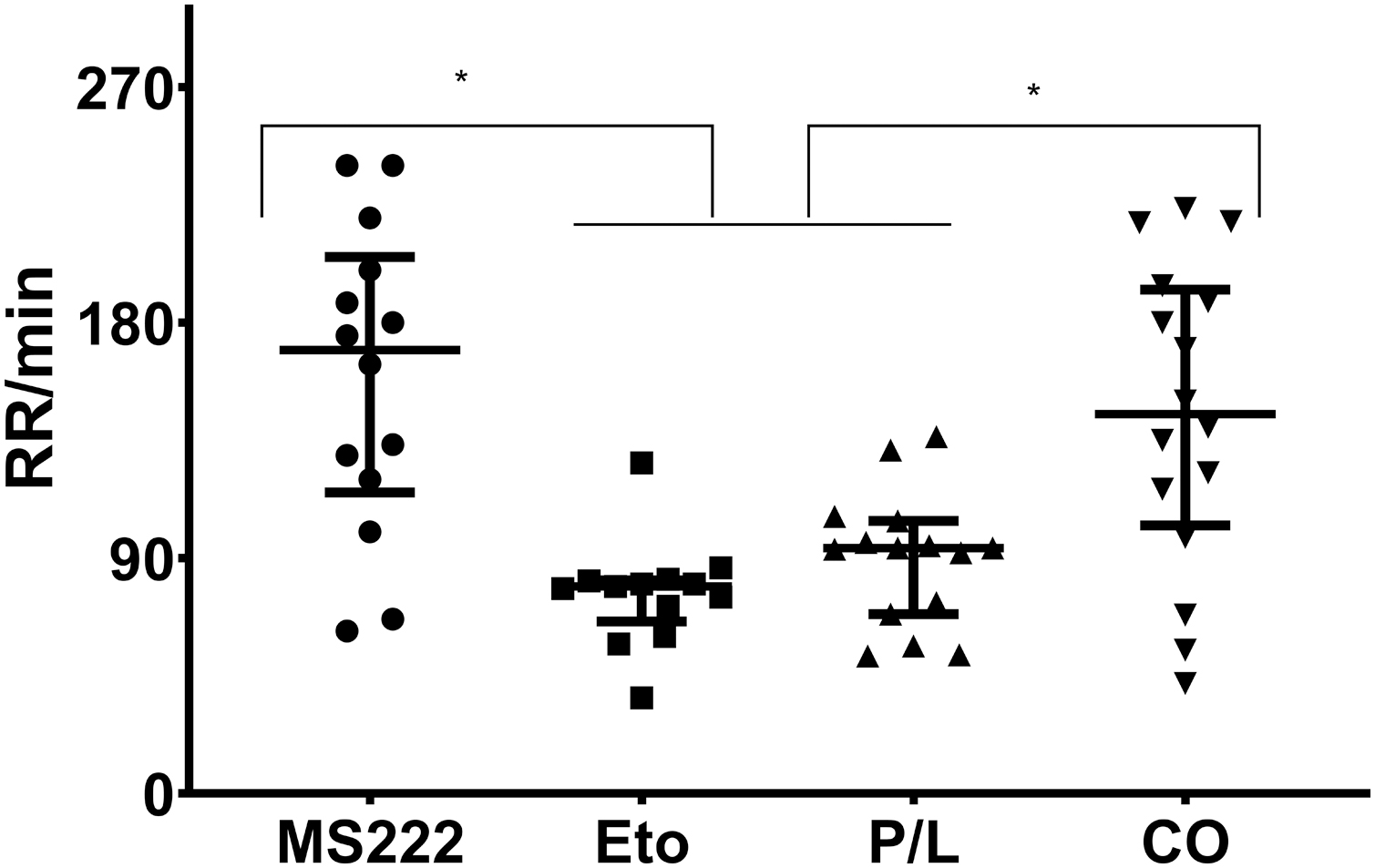
RR per minute of adult zebrafish after being exposed to different anesthetic protocols and placed in clean water (175 mg/L of MS222 [n = 14], 2 mg/L of Eto [n = 13], 5 mg/L of propofol combined with 150 mg/L of lidocaine [P/L; n = 15], and 45 mg/L of CO [n = 16]). Each point represents an animal. Data are expressed as median (interquartile range). *p < 0.05. RR, respiratory rate.
Novel tank
During the 6 min in the novel tank, no significant differences were found between groups regarding the parameters analyzed in the whole apparatus to study long-term recovery of the swimming activity (total distance traveled, average speed, maximum speed). Also, anxiety-like behaviors potentiated by the exploration of a new environment were also similar between groups: angular velocity, number, distance, and duration of erratic movements. This lack of differences between groups was also observed on these parameters analyzed in each zone (UP and BTM tank zone), and on the number of entries in each zone and the indices of time and distance.
Regarding behavioral comparisons between zones, all groups spent significantly less time in the UP zone compared with the time spent in this zone by chance (180 s) (p ≤ 0.001; Fig. 3A). Also, the time spent (p ≤ 0.001; Fig. 3A) and distance traveled (p ≤ 0.001; Fig. 3B) were significantly longer in the BTM zone of the tank than in the UP zone in all groups. Control, P/L, and CO groups had significantly higher maximum speed in the BTM part of the tank than in the UP part of the tank (p ≤ 0.005).
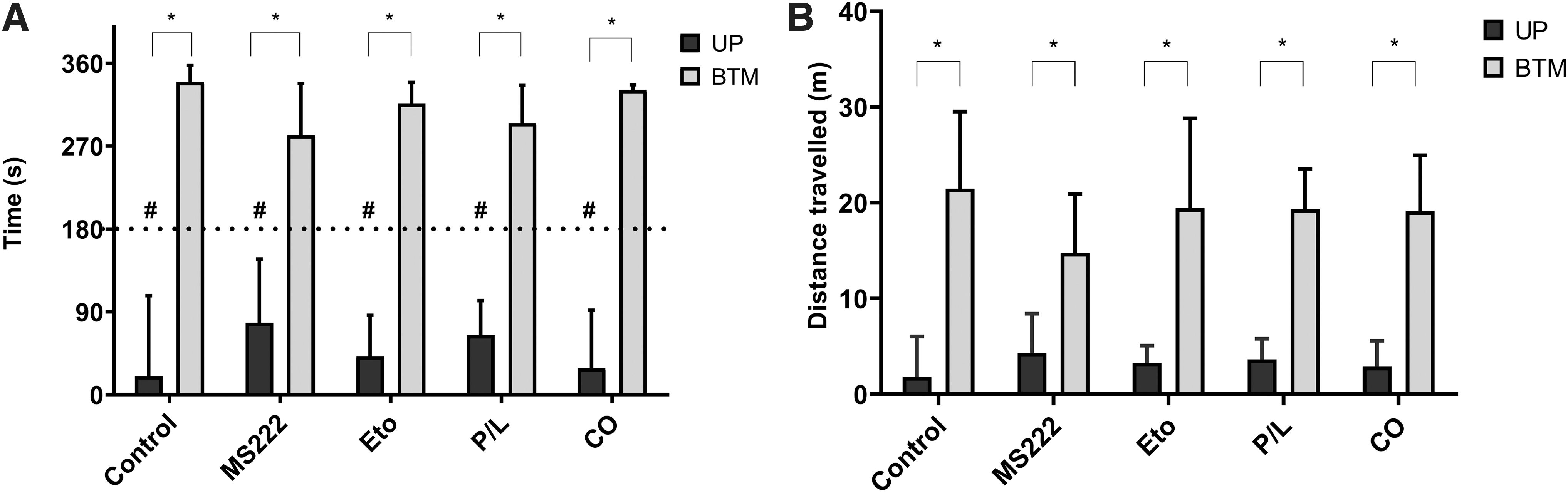
Activity of adult zebrafish in the novel tank for 6 min, 28 h after being exposed to different anesthetic protocols (175 mg/L of MS222 [n = 14], 2 mg/L of Eto [n = 15], 5 mg/L of propofol combined with 150 mg/L of lidocaine [P/L; n = 15], and 45 mg/L of CO [n = 15]).
When the analysis was divided in two segments of 3 min, it was observed that all groups spent significantly more time in the UP zone compared with what would be predicted by chance (90 s) in the first 3 min (p ≤ 0.001, Fig. 4A). Also, all animals spent significantly more time swimming (p ≤ 0.001; Fig. 4A) and swam longer distances (p ≤ 0.001; Supplementary Table S1) in the BTM zone than in the UP zone. Nevertheless, Eto animals increased their time spent (p = 0.011, Fig. 4B) in the UP zone in the last 3 min compared with the first 3 min, being the only group to change this behavioral pattern. Also, etomidate-treated animals increased the angular velocity in the whole tank analysis at the last 3 min compared with the first 3 min (p = 0.003; Supplementary Table S1). Other occasional differences in these time segments analysis are reported in Supplementary Table S1.
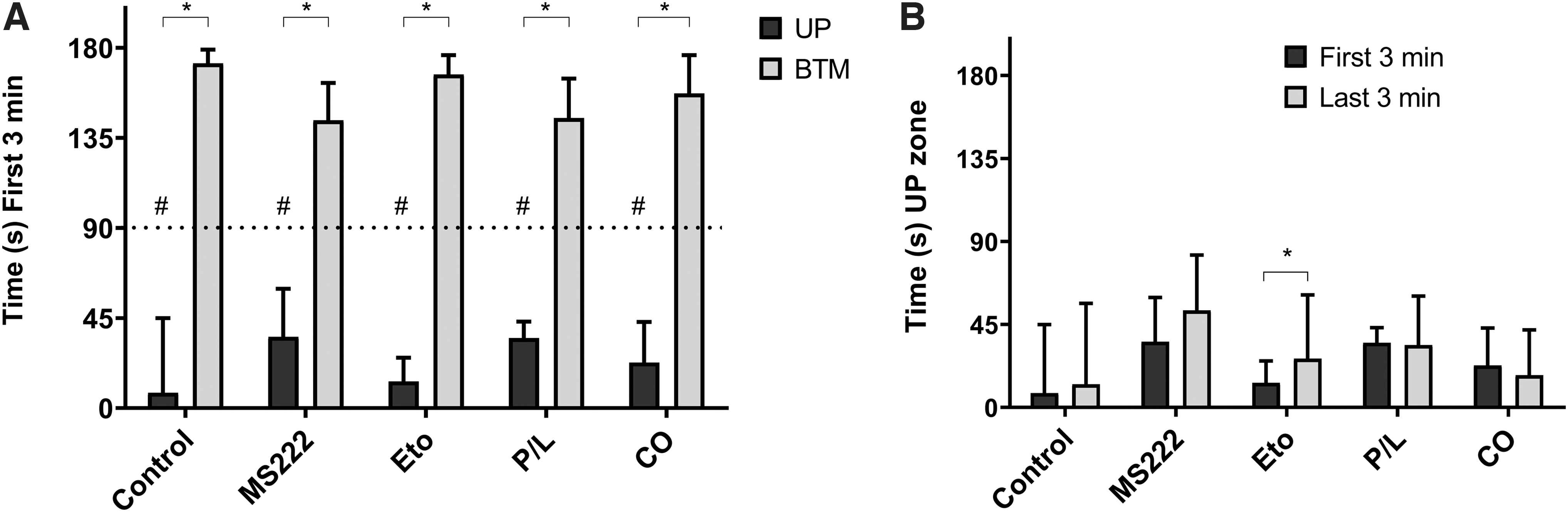
Time spent (s) by adult zebrafish in each zone of the novel tank test 28 h after being exposed to different anesthetic protocols (175 mg/L of MS222 [n = 13], 2 mg/L of Eto [n = 15], 5 mg/L of propofol combined with 150 mg/L of lidocaine [P/L; n = 15], and 45 mg/L of CO [n = 15]). The results are presented by dividing the time in two segments of 3 min.
For both 6- and 3-min analysis, none of the groups had an angular velocity significantly higher than 180°·s−1; only clove oil-treated animals had a significantly lower value (Supplementary Table S1).
Discussion
Anesthesia should avoid distress to the animals while inducing immobility and analgesia as needed, and a full recovery in the end. In this study, we tested several anesthetic protocols for adult zebrafish to determine their efficacy, safety, and recovery quality. In general, independent of anesthesia protocol, all fish were rendered unconscious, indicated by equilibrium loss, and displayed a full recovery from anesthesia with no mortality. Also, using the novel tank test, no side effects on anxiety levels were evident 28 h after anesthesia.
MS222 has frequently been referred to as being aversive or causing distress to zebrafish,2,11,18,19 but our results showed that this anesthetic was not different from any of the others in terms of erratic movements after anesthesia. Rapid opercular movements and some erratic movements were also seen during induction in all animals, including the control group, probably for being introduced into a new environment with a small height of water column.
Typically, the optimal anesthetic should induce a rapid anesthesia (3 min or less) and recovery (5 min or less), leave low tissue residues after a withdrawal period of 1 h or less, have low cost, and not be toxic for fish and users.20,21 All the anesthetic protocols tested induced loss of equilibrium in less than 3 min. Nevertheless, clove oil induced a quicker loss of equilibrium compared with propofol/lidocaine. This result may be caused by differences in the anesthetics solubility and action mechanisms. Ethanol was added to the clove oil to increase its solubility, thus being easily inhaled by the gills and, as it is also highly lipophilic, its entry through the cellular membranes into the blood is facilitated, reaching the brain quickly.22,23 However, propofol, although lipophilic and presented in an oil-in-water emulsion, is not fully soluble in water, and the solution must be vigorously stirred, thus the quantity absorbed per unit of time may be lower, causing a longer induction compared with the clove oil.
Regarding response to painful stimulus, etomidate did not induce loss of this response. This was expected since etomidate is a hypnotic that does not provide analgesia. 9 Moreover, 45 mg/L of clove oil only caused loss of the response to painful stimuli in one animal (0.67%). Similar findings were observed by Bolasina et al. 24 for guppy, where a 50 mg/L eugenol exposure resulted in light sedation. However, for clove oil, the time under exposure may be the key to achieve analgesia as our preliminary studies showed that clove oil at the same concentration induces analgesia in almost all animals, but it takes longer than 7.5 min. 25
Even though eight P/L animals did not lose the response to painful stimuli (53%), our previous work 13 showed that propofol/lidocaine at the same dose induced analgesia. In the present study, there was a time limit of 7.5 min of anesthesia after equilibrium loss; thus, this result does not mean that P/L cannot produce full anesthesia in all animals, only that it may takes longer than the period observed. Also, in the study by Valentim et al., 13 using egg water instead of system water to prepare the anesthetic solutions resulted in a higher pH (8.2) than in the present study (7 ± 0.2 pH). The anesthetic solution pH interferes with its efficacy, as it changes the ratio of ionized and nonionized forms. 9 In the water, the pka of propofol is 11, 26 whereas the one for lidocaine is 7.7. 27 This increase of the water pH to a value nearer the pka leads to a greater proportion of nonionized forms, resulting in higher bioavailability, 28 and consequent increase in drug efficacy. Thus, the higher pH of the water of the anesthetic solution in the study by Valentim et al. 13 resulted in a quicker anesthesia and analgesia compared with the present study. Given this, pilot studies to test the effects of water pH in the anesthetic solutions on animals are recommended, as well as reporting the pH values used, improving data reproducibility and replicability. 29
MS222 has been described to depress the cardiovascular and respiratory system, interfering with ion regulation 30 during exposure, especially in long duration procedures. However, it has also been described to stimulate respiratory activity during anesthesia induction.31,32 In the present study, MS222 induced higher rate of opercular movements compared with etomidate and propofol/lidocaine, after the animal was placed in clean water. Thus, the stimulatory mechanism seems to be activated also immediately after the animal has been removed from a short duration anesthetic bath.
CO animals also had higher opercular rates compared with Eto and P/L animals. This was expected as propofol may cause cardiorespiratory depression. 33 Moreover, some studies12,34,35 found evidence of ventilation reduction following etomidate exposure. In this situation, animals took several minutes to recover the normal opercular rate, 35 which explains the lower opercular rates in the Eto animals even after they had been placed in clean water for recovery. Regarding clove oil, it has been described to inhibit the respiratory centers in the medulla oblongata, 36 which predicts a decrease in the opercular movements that were not observed in the present study. However, the data from literature are related to the period during anesthesia, and this study shows the opercular rate during the start of anesthesia recovery.
In general, the temperature at which zebrafish are kept promotes high metabolic rates; thus, once the fish is in clean water, elimination of the anesthetics is expected to be relatively quick. 22 Indeed, except for one, the animals recovered in less than 10 min. The high opercular rate observed in the MS222-treated animals may have promoted a faster regain of the equilibrium compared with the others, as this allowed the anesthetic to be metabolized and eliminated quickly by the gills. Thus, the induction of MS222 quick recovery is probably due to the local anesthetic action and stimulatory effects on the respiratory and cardiovascular system. 37 Following this idea, as clove oil-treated animals also had high opercular rates, they may be expected to recover faster. However, the fact that this anesthetic is an oil and has been described to coat gill epithelia, may make anesthetic elimination difficult, 38 and thus prolong the anesthesia recovery.
Our results regarding equilibrium recovery of the P/L group support our previous work. 13 However, Martins et al. 12 reported that this combination induced a more rapid recovery than MS222. This discrepancy in results may be explained by the fact that they used a lower dose of propofol/lidocaine than the one in the present study.
Although MS222 animals took less time to recover the equilibrium, at 1 h post-anesthesia, all animals swam in the water column, and all anesthesia groups already exhibited a control level activity. All groups increased distance swum throughout time, showing a normal process of habituation to being placed in a new tank. This is in accordance with previous works,12,13 where MS222 and P/L groups are fully recovered at least at 5- and 24-h post-anesthesia.
To evaluate anxiety-like behaviors, we used the novel tank test, which is based on fish’ natural tendency to react to novelty by initially spending more time at the BTM of the tank and gradually increase their exploration to the UP zone from where threats may appear. 39 We found that fish from all treatments spend more time swimming and swam longer distances in the BTM zone than in the UP zone of the tank, for all periods of the test, with no differences between groups. Thus, all animals behaved similarly to control levels, showing no alterations on the anxiety profile.
Apart from minimal scattered differences, the etomidate group in the last 3 min of analysis showed an increase of time spent in the UP zone compared with the first 3 min. Although this increase is not enough to characterize an anxiolytic-like behavior, this result may indicate a different habituation profile to a new environment that could be related to the properties of etomidate to block cortisol production, 40 reducing stress responses and facing the UP zone of the novel tank with less cautious throughout time quicker than the other groups. Etomidate-treated animals also exhibited an increase in angular velocity from the first to the last 3 min. An increase in angular velocity is often associated with escape turns indicative of stress. However, the angular velocity per group was never above 180°·s−1, which only indicates routine turns. 17
In this study, the effect of ethanol alone was not tested, as we intended to study the practical application and effects of clove oil. As clove oil cannot be diluted in water, it must always be administered together with ethanol, thus, in practice, any influence of ethanol alone would not change the clove oil procedure. In addition, not having one more group, the number of animals in this study was reduced and the aim reached. Nevertheless, the lowest concentration for acute ethanol administration in adult zebrafish reported in the literature was 6 × higher (0.25%) than the one used here (0.04%) with minor alteration in fish (e.g., Gerlai et al. 41 ). Also, a recent study showed that 10 days of exposure to 0.1% of ethanol did not induce alterations in anxiety tested with the novel tank, although social behavior, neurotransmitters, and reactive oxygen species levels were affected 42 ; however our study exposed animals to a 2.5 × lower concentration and only for 7.5 min. Furthermore, other studies showed no influence of 0.07% or 0.05% of ethanol on anesthetic effects 43 or on fish behavior, 44 respectively.
The present study shows that all protocols are effective for anesthetizing adult zebrafish, without mortalities or significant alterations on behavior and with a quick recovery of normal activity (at least within an hour of anesthesia administration). Although the behavioral alterations induced by etomidate in the novel tank were minimal and do not indicate a different anxiety profile, its use must be considered carefully depending on the experimental objective, as its effect on cortisol release may be an unwanted interference with research results. The choice of the best anesthetic protocol will also depend on the procedure invasiveness and duration. If a procedure requires analgesia, MS222 and propofol/lidocaine protocol will be the most adequate, although animals anesthetized with P/L may take longer to achieve analgesia with these concentrations.
Further studies should be performed with animals from other genetic backgrounds and life stages to gather more information regarding the potential impact of different anesthetic protocols in the zebrafish and to refine the concentrations needed for each procedure.
Footnotes
Authors' Contributions
A.M.V. conceived the experimental design. J.M.F. and A.M.V. conducted the experiments. S.J. analyzed the data and wrote the first version of the article. A.M.V. gave important input and close supervision to the article writing. I.A.S.O. provided critical feedback. All authors discussed the results, contributed to the final article, and approved the article for publication.
Acknowledgments
The authors would like to thank to the i3S Zebrafish Facility staff for helping with the maintenance of the tanks and the animals in ideal conditions.
Disclosure Statement
No competing financial interests exist.
Funding Information
This work was funded by FEDER funds through the Operational Competitiveness Programme—COMPETE 2020 and the Operational Competitiveness Programme and Internationalization (POCI-01-0145-FEDER-029542), Portugal 2020, and by National Funds through FCT—Fundação para a Ciência e a Tecnologia under the project PTDC/CVT-CVT/29542/2017.

References
Supplementary Material
Please find the following supplemental material available below.
For Open Access articles published under a Creative Commons License, all supplemental material carries the same license as the article it is associated with.
For non-Open Access articles published, all supplemental material carries a non-exclusive license, and permission requests for re-use of supplemental material or any part of supplemental material shall be sent directly to the copyright owner as specified in the copyright notice associated with the article.
