




Abstract
Currently, in Brazil, all researchers involved in animal experimentation must undergo training in laboratory animal science to stay updated on biology, methodology, ethics, and legal considerations related to the use of animals. The training program presented in this study not only aims to fulfill a legal obligation but also intends to train students and professionals to effectively care for their biomodels. It seeks to help them understand the importance of this care, both for the welfare of the animals and for the results of their projects. In total, 58 participants were present at the event (pre-event and full-time course). These participants consisted students and professionals from 11 institutions and 5 different countries. These numbers demonstrate the successful attainment of the desired capillarity in the scientific community and the posterior dissemination of knowledge. Through this course, it was possible to train the participants and raise their awareness about the importance of applying scientific knowledge in their daily practices to maintain the animals, ensuring the welfare of the models and refining the research. Finally, the program presented in this study, as well as the strategies adopted, can serve as a model for other institutions aiming to achieve similar results.
Introduction
The zebrafish was proposed as a biological model for scientific research in 19341 and gained more popularity once Streisinger et al. published a study in Nature demonstrating that zebrafish could be cloned. 2 This species was first described by Francis Buchanan Hamilton in Kosi River, India, in 1822 as Cyprinus rerio (Cyprinidae). In 1991, after a taxonomic revision, 3 the zebrafish was classified again as Danio rerio. In recent years, evidence from integrative taxonomy has led to reclassification of D. rerio into another family: Danionidae.4,5
Not only has the natural history of zebrafish been continually studied and updated but also its anatomy, physiology, ethology, pathology, and genetics. Zebrafish have been extensively used in research as laboratory animal for a wide range of purposes. 6 Recent data showed that 27.6% of all animals used by science in the European Union in 2020 are fishes. Of these 277,328 are zebrafish, which represent about 13% of the fishes used. 7 Indeed, all knowledge generated about this species through basic research is crucial for applied research. These two serve as the primary domains for utilizing animals, accounting for 40.9% and 31.2%, respectively. 7 For instance, the zebrafish is considered a potential model for testing treatments and conducting immunology studies related to COVID-19.8,9
It is also employed as avatars in personalized medicine10,11 with entirely translational objectives. Furthermore, significant progress has been achieved in the field of genetic engineering, largely credited to the use of zebrafish as a model organism.12,13 So how can we advance in cutting-edge areas of knowledge, such as these, without a firm grasp of the fundamental aspects of zebrafish biology?
Many legislations around the world have been established and adopted based on the seminal publication of the 3Rs principle—replacement, reduction, and refinement, 14 including Brazilian legislation. There are also some recent approaches aimed at complementing the 3Rs principle, such as the 10Rs principle 15 and 12Rs principle. 16 However, the concept of refinement remains a significant cornerstone of good practice and animal welfare during experimentation. 17
Currently, in Brazil, all researchers involved in animal experimentation are required to undergo training about laboratory animal science by the Normative Resolution (NR) number 49 from National Council for Animal Experimentation Control. 18 This training encompasses practical aspects, ethical considerations, and specific legislation. This policy is designed to ensure that researchers stay updated on the biological aspects of animal models, methodological issues related to experimental procedures, and ethical and legal considerations regarding the use of animals. Therefore, these training programs aim to fulfill the principle of refinement in the short term, optimizing the utilization of animals and ultimately contributing to the principles of reduction and replacement in the long term.
Recognizing the significance of this subject, and even before the implementation of NR number 49, the technical staff of the Federal University of Rio Grande (FURG), in collaboration with professionals from the Federal University of Pelotas (UFPEL), proposed the “Course on Breeding, Handling, and Experimental Procedures of Zebrafish (D. rerio).” This training initiative is not solely driven by a legal obligation, since it predates NR number 49. The objective of this course was to educate undergraduate and graduate students, as well as professionals, to proficiently care for their biomodels, comprehending the significance of such care for both the animals and the outcomes of their projects.
Materials and Methods
A practical-oriented program
The course was conducted in March 2020 at the Institute of Biological Sciences of FURG. To accomplish the primary objective, the course was structured with ∼50% theoretical and 50% practical content. This structure was designed to provide participants with the opportunity to apply the concepts covered during the theoretical sessions in the practical classes. In fact, most courses on laboratory animal science available in Brazil primarily concentrate on theoretical content. Beyond the allocation of course hours, the content itself was meticulously planned to align with the demands of daily laboratory zebrafish maintenance routines. As such, crucial facets of zebrafish husbandry—including habitat, behavior, feeding, reproduction, diseases, and applications—were integrated into the program. All the procedures involving animals were approved by the Animal Ethics Commission of FURG (Internal Approval Document Code P008/2020). The Table 1 presents the complete program with the chronogram of proposed activities.
The Program and Chronogram of the Course on Breeding, Handling, and Experimental Procedures of Zebrafish (Danio rerio)
FET, fish embryo toxicity; FURG, Federal University of Rio Grande.
A competent organization team
The entire organization team had prior experience in the utilization of zebrafish for scientific purposes. At the time, the three main course coordinators are part of FURG's professional technical staff and held PhD degrees. In addition, professors from UFPEL, a neighboring university, also participated in the organization. Furthermore, some graduate and postdoctoral researchers were invited to compose the organization team, including four master's students, two doctoral students, and one postdoctoral professional. The course coordinators ensured accurate guidance and instructions for participants by choosing a qualified, experienced, and well-trained organization team.
Communication strategy
The organization team produced promotional materials for the course. In addition to the schedule (Table 1), a poster and a video 1′:30″ of duration with essential information such as dates, location, objectives, target audience, schedule, link for registration, and important correspondence contacts were produced and shared. The video also featured images of the physical structure of FURG's laboratories and zebrafish facilities, allowing participants to get a glimpse of how and where the activities would be conducted. This material was shared on social media platforms such as Facebook®, Instagram®, YouTube®, and LinkedIn®.
The coordinators reached out to numerous universities and graduate programs across Brazil and South American countries through email communication. The primary goal was to establish a broader presence and greater capillarity within the scientific community. These emails were composed in English and maintained a succinct and clear format, encompassing important details about the course. Furthermore, the organization team also engaged with potential supporters, inviting them to contribute lectures and exhibit their companies to the participants. This initiative aimed to forge a stronger connection between the academic and commercial/industrial sectors, fostering business prospects for companies and offering potential employment avenues for participants.
Didactic strategy
An essential strategic choice made was to limit the number of vacancies offered. During the course planning, the coordinators conducted an assessment of the university's infrastructure. This evaluation aimed to determine the maximum number of participants who could engage in a significant number of individual practical activities. Therefore, the limit for vacancies was established at 34. This measure ensured that every participant would have opportunities to actively engage in practical activities and receive personalized guidance from the instructors. By maintaining a manageable group size, the coordinators aimed to provide high-quality learning experience for all participants.
Still, to ensure inclusivity and prevent excessive restrictions, the coordinators devised a pre-event (conducted on the morning of the course's first day, as presented in Table 1) with free registration (without any fee) and no limit on vacancies. This pre-event featured two speakers: a professor from FURG itself and another from the University of Passo Fundo (UPF), situated ∼550 km away from FURG.
Each professor gave a lecture highlighting the application of zebrafish in their respective research field. Following the presentations, there was a period of interactive roundtable discussion with questions from the audience. The purpose of this pre-event was to introduce the zebrafish model and its applications to a less experienced audience and those who could not secure a vacancy in the full course. Although it was free of charge, only registered individuals were accepted for the roundtable discussion pre-event. This approach allowed the organization team to anticipate the number of participants, prepare an auditorium, and organize a coffee break suitable for the expected demand.
Another didactic strategy aimed to enhance the understanding and learning of the participants was scheduling theoretical classes ahead of their corresponding practical sessions. This sequencing allowed course participants to receive an initial introduction to key aspects of zebrafish maintenance activities and, subsequently, to reinforce and apply these concepts through hands-on activities. Instances that could not be directly demonstrated during practical sessions (and not limited to these instances alone)—like various clinical disease cases, for instance—were illustrated using photographs and videos sourced from the internet or drawn from the instructors' personal collection. In all theoretical classes, multimedia content was presented through the utilization of digital projectors.
Finally, during the practical classes, a strategy was adopted to prevent participants from diverting their attention from the proposed activities to take notes. For this, the organization drafted, printed, and distributed a copy of each practical class protocol to every participant (Supplementary Data S1). By providing the protocols, participants could focus more on the execution of activities and also have the opportunity to create a portfolio with several specific and essential protocols for zebrafish maintenance routines. This approach allowed participants to concentrate on the hands-on experience, while also having a valuable reference of protocols to take with them for future use.
Financial support and main expenses
The course received significant financial support of the Regional America Committee of the International Council for Laboratory Animal Science (ICLAS), which has a policy of continuous incentive actions to encourage activities that promote laboratory animal science. This opportunity became possible due to the active work of the Brazilian Society of Science in Laboratory Animals (SBCAL), which holds a position at ICLAS and consistently disseminates opportunities within the Brazilian scientific community. Nevertheless, the course budget was additionally supplemented through support from some companies, as well as by charging a registration fee to participants. With the aim of ensuring that the event remained inclusive and nonrestrictive, the coordinators extended discounts to participants who could demonstrate socioeconomic vulnerability due to low income. This approach ensured that the course remained accessible to a diverse audience, thereby nurturing diversity and inclusivity within the scientific community.
The budget revenue obtained through these actions was used to subsidize the planned activities. No financial compensation was provided to any professional involved in lectures, classes, coordination, or organization of the course. A portion of the budget was used to cover travel and accommodation expenses for the UPF researcher visiting Rio Grande (FURG's location). In addition, the organization team hired a local company specialized in event management to be specifically responsible for the two daily coffee breaks (Table 1). Moreover, a graphic design company was hired to develop the poster and promotional video for the course. Finally, essential supplies for participant's individual activities were purchased, including procedure gloves, 8 cm Vannas scissors, forceps, scalpels (handles and blades), Petri dishes, 96-well plates, beakers, tricaine methanesulfonate (MS-222) salt, nets, and brine shrimp (Artemia sp.) cysts. Other laboratory materials, as well as all associated infrastructure, were provided by FURG.
Results and Discussion
Number of participants
In addition to the full-time course participants, the free pre-event attracted 24 local students. Thus, two groups of biotechnology undergraduate students from UFPEL (located ∼50 km from FURG) attended the lectures and the roundtable discussion on the morning of the first day. Furthermore, the course in its full modality (5 days, morning and afternoon) attracted 34 participants from 11 different institutions. Of these, 10 were undergraduate students; 8 were professional master's students; 10 were professional doctoral students; 5 were professional doctors; and 1 was professional without graduate degree.
The course was able to attract students and professionals from various areas of knowledge (Tables 2 and 3, respectively). This interest of students and professionals in these areas is reflected in the main uses of zebrafish in Brazil and in the world. In Brazil, the areas that most use zebrafish are neurosciences and behavior; pharmacology and toxicology; and environment and ecology. 19 In the global ambit, the top 10 areas that use zebrafish are developmental biology; biochemistry/molecular biology; cell biology; neurosciences/neurology; genetics/heredity; zoology; science and technology; toxicology; life sciences/biomedicine; and anatomy/morphology. 20 All these areas can be developed by the academic profiles that are interested in the course.
Number of Undergraduate Student Subscribers in the Course on Breeding, Handling, and Experimental Procedures of Zebrafish (Danio rerio) in the Full-Time Modality and Their Academic Background
Number of Professional Subscribers in the Course on Breeding, Handling, and Experimental Procedures of Zebrafish (Danio rerio) in the Full-Time Modality and Their Academic Background
Geographical coverage
The filling of the total course vacancies left the organization team very satisfied, as it indicated the confidence of the academic community in FURG's expertise in zebrafish research. However, beyond the number of subscribers, the expectation for academic capillarity was reached due to the geographical coverage achieved by the event. Participants from 7 of the 27 Brazilian states attended the course personally.
From the state of Rio Grande do Sul, where the city of Rio Grande and FURG are located, participants from the cities of Rio Grande, Pelotas, Passo Fundo, and São Gabriel were present. In addition to Rio Grande do Sul, participants from the states of Santa Catarina, São Paulo, Rio de Janeiro, Tocantins, Pará, and Rio Grande do Norte also attended. This extensive coverage across a country with continental dimensions like Brazil was significant for the organization team. Furthermore, several foreign participants also sought the course. Researchers from Mexico, Colombia, Venezuela, and Turkey also looked for the full-time modality of the course (Fig. 1).
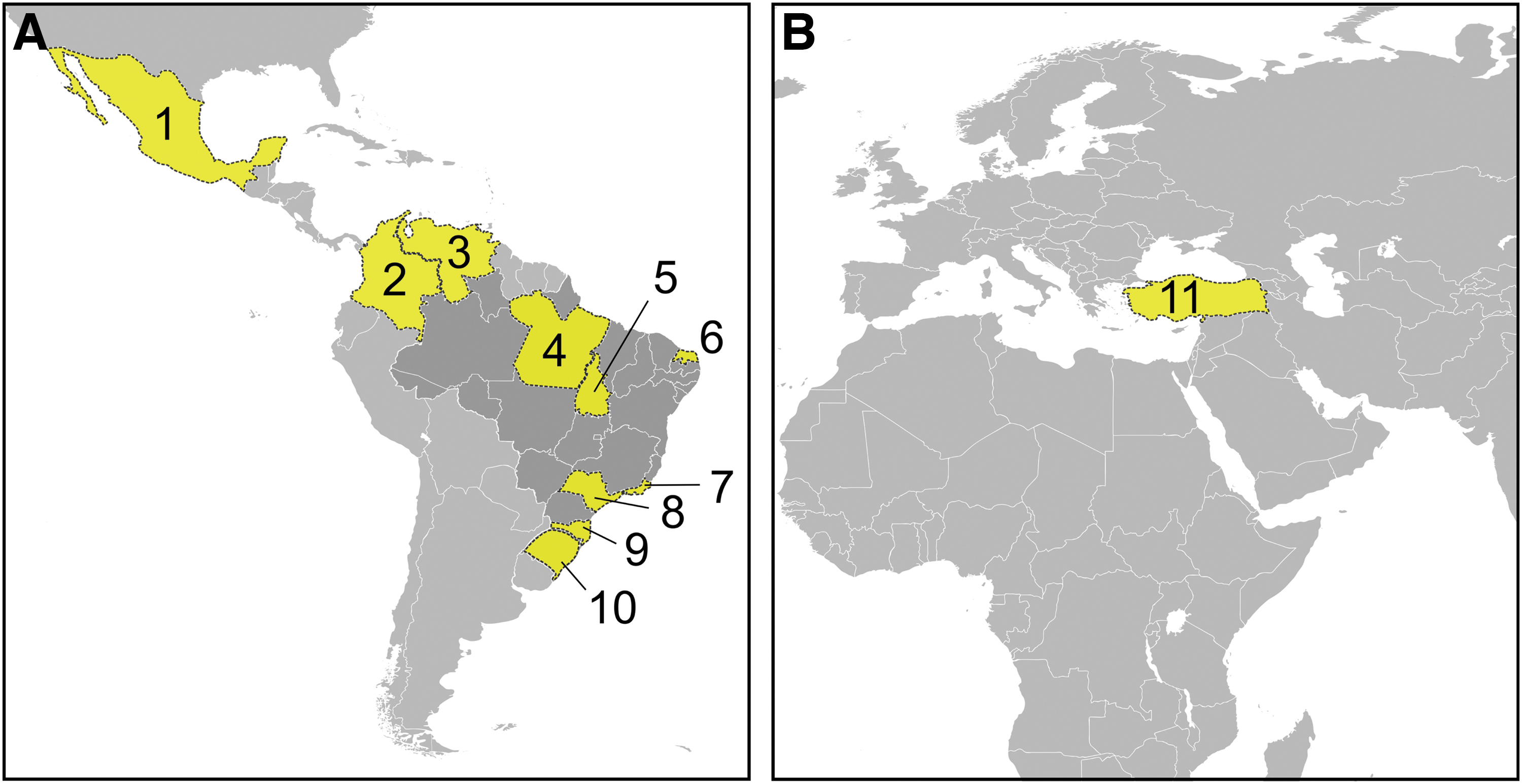
Geographical coverage of the course on breeding, handling, and experimental procedures of zebrafish (Danio rerio).
These foreign researchers were already in Brazil, developing other scientific activities; they did not travel to Brazil exclusively for the course. However, upon return to their respective countries, they will carry the protocols and knowledge acquired at FURG to three different continents. This geographical coverage (regional, national, and international) resulted from intense communication and promotional efforts for the course and is directly related to the permeability within the scientific community and the dissemination of knowledge. Moreover, Brazil is a reference in zebrafish research in South America, attracting researchers from various countries.
The South American country that collaborates the most with Brazil on articles involving zebrafish is Argentina. Nevertheless, Brazil's main scientific collaborators in this context are the United States of America, United Kingdom, and Portugal. 19 The participation of individuals from diverse nationalities in the course, rather than just those who already maintain a strong partnership with Brazilian researchers, is pivotal for solidifying and disseminating FURG's expertise and internationalizing the studies. It also serves as an indicator of the success in achieving the initially proposed high level of outreach.
Technical knowledge and paradigm shift
During the course period, both basic and advanced knowledge were imparted. Despite many participants already having some experience with zebrafish, it was noteworthy that many people were unfamiliar with the normal anatomy and behavior, as well as the clinical signs of stress or common diseases in zebrafish. How can a suffering animal be recognized without knowing its natural appearance and behavior? Indeed, the higher the level of education, the greater the ability of students to perceive animal pain. 21 Likewise, it has been shown that taking specific courses results in more empathetic attitudes on the part of students toward animals.22,23
A curious report occurred during the anatomy and necropsy class: A doctoral participant explained that he had mistakenly collected the spleen of animals in his experiment, believing it to be the liver. Upon noticing the error, he concluded that he had to redo the entire experiment from the beginning. Not using the actual “liver” would not be an option, as his research directly depended on this organ. This is a serious issue, as it implies publishing incorrect data about biological phenomena that other researches may use. Furthermore, it directly impacts the repeatability and reproducibility of future experiments 24 and leads to the wastage of animals, undermining the principle of “reduction.” 25
Similarly, during the anesthesia class, the professor instructed the participants to adjust the pH of the tricaine solution before use. Surprisingly, only a few participants showed awareness of the need for buffering and checking the pH (pH = 2.5) when dissolving the tricaine powder in water during the practical session. Despite being the most widely used anesthetic internationally, some researchers still overlook the fact that the tricaine solution is excessively acidic for indiscriminate use. 26 These instances provided everyone with an opportunity to experience the practical importance of understanding the basic and applied biology of a biomodel, as well as ethical aspects, to enhance experiment refinement and improve the utilization of animals. This aligns with one of the main objectives of ICLAS, the primary supporter of this course. 27
Commercial prospects
The course not only imparted valuable knowledge and training but also facilitated networking, fostering potential collaborations, and creating business opportunities for all involved parties. In this manner, participants gained insight into the commercial significance of the content covered throughout the course. Four companies from the State of São Paulo (Brazil) supported the course, with three of them sending representatives to speak. After each lecture, many participants raised questions regarding employment opportunities in the job market. In addition, a robust consultative network was established, and participants proposed the creation of a WhatsApp® contact group. This enabled ongoing discussions and collaborative problem-solving beyond the duration of the classes. This forum facilitated continuous dialog and collaborative troubleshooting beyond the course's timeframe. Some business opportunities also emerged for the supporting companies, as several participating researchers became customers and purchased supplies for their laboratories/institutions.
The collaboration between universities and industries has been strengthened in recent years. This relationship benefits both parties, with key advantages, including (1) Absorption Capacity, Knowledge, and Competitiveness in University-Industry Relations; (2) Impact of Knowledge Spillovers on University-Industry Relations; (3) Strategic Alliances for Industry Innovation; and (4) University-Industry Cooperation.28,29
Conclusion
While many researchers understand the importance of purchasing and maintaining quality chemical compounds to ensure their proper function, a significant number do not show the same level of concern for their biomodels. It is plausible to suggest that more researchers know the appropriate temperature for storing their chemicals than the optimal temperature for maintaining the animals under their responsibility. The Course on Breeding, Handling, and Experimental Procedures of Zebrafish (D. rerio) represents an effort to rectify this situation. Through the course, it was possible to train the participants and raise their awareness about the importance of applying scientific knowledge in their daily practices to maintain the animals, ensuring the welfare of the models and refining the research. Finally, the program presented in this study, as well as the strategies adopted, can serve as a model for other institutions aiming to achieve similar results.
Footnotes
Acknowledgments
The authors would like to thank the participation of researchers Camila Martins; Carlos Eduardo da Rosa; Fernanda Lopes; Juliano Zanette; Leonardo Barcellos; and Simone Costa, who agreed to participate in the course with lectures and specific classes.
Authors' Contributions
T.S.: Project administration; supervision; conceptualization; methodology; writing—original draft; writing—review and editing; and funding acquisition. M.K.: Project administration; supervision; conceptualization; methodology; and writing—review and editing. B.N.: Project administration; supervision; conceptualization; methodology; and writing—review and editing. M.M.: Conceptualization; and methodology. D.S.: Conceptualization and methodology. A.I.L.: Conceptualization and methodology. A.L.: Conceptualization and methodology. C.C.: Conceptualization and methodology. J.M.: Conceptualization and methodology. L.E.S.: Conceptualization and methodology. P.d.L.: Conceptualization and methodology. L.F.M.: Conceptualization and methodology. M.R.: Supervision; conceptualization; methodology; and writing—review and editing.
Disclosure Statement
No competing financial interests exist.
Funding Information
This project received primary funding from the International Council for Laboratory Animal Science (ICLAS) and additional secondary support from the companies Alesco—Industry and Commerce Ltd., Altamar—Aquatic Systems, Steq—Laboratory Equipments, and Alcon Ltd.—Industry and Commerce of Dehydrated Foods.

References
Supplementary Material
Please find the following supplemental material available below.
For Open Access articles published under a Creative Commons License, all supplemental material carries the same license as the article it is associated with.
For non-Open Access articles published, all supplemental material carries a non-exclusive license, and permission requests for re-use of supplemental material or any part of supplemental material shall be sent directly to the copyright owner as specified in the copyright notice associated with the article.
