




Abstract
The goal of the University of Wisconsin-Milwaukee WInSTEP SEPA program is to provide valuable and relevant research experiences to students and instructors in diverse secondary educational settings. Introducing an online experience allows the expansion of a proven instructional research program to a national scale and removes many common barriers. These can include lack of access to zebrafish embryos, laboratory equipment, and modern classroom facilities, which often deny disadvantaged and underrepresented students from urban and rural school districts valuable inquiry-based learning opportunities. An online repository of zebrafish embryo imagery was developed in the Carvan laboratory to assess the effects of environmental chemicals. The WInSTEP SEPA program expanded its use as an accessible online tool, complementing the existing classroom experience of our zebrafish module. This virtual laboratory environment contains images of zebrafish embryos grown in the presence of environmental toxicants (ethanol, caffeine, and nicotine), allowing students to collect data on 19 anatomical endpoints and generate significant amounts of data related to developmental toxicology and environmental health. This virtual laboratory offers students and instructors the choice of data sets that differ in the independent variables of chemical concentration and duration of postfertilization exposure. This enables students considerable flexibility in establishing their own experimental design to match the curriculum needs of each instructor.
Introduction
To achieve a healthy society, the United States needs both highly trained health professionals and a science-literate public. The development of both begins during K-12 education, the time when interest in science is seeded. 1 The Wisconsin Inquiry-based Scientist Teacher Education Partnership (WInSTEP) Program at the University of Wisconsin-Milwaukee (UWM) provides secondary life science teachers and their students with authentic research experiences that link biological concepts with societally relevant problems by utilizing zebrafish embryos as a biomedical experimental system. Specifically, students explore the effects of various environmental agents on zebrafish embryo development and are introduced to basic toxicology concepts, including “the dose makes the poison.” 2
Program description
The UWM WInSTEP program has been funded by the Science Education Partnership Award Program (SEPA) through the National Institute of General Medical Science (NIGMS), part of the National Institutes of Health. In the WInSTEP program, environmental health science and related research serve as the means to connect basic science and students' lives through active participatory learning, which has been shown repeatedly to yield stronger outcomes than passive, rote transmission of knowledge from teacher to student.3,4
The field of environmental health emphasizes understanding the environmental determinants of disease etiology. In the early years of their lives, students are learning about their surroundings and how the environment contributes to health and disease. We have found that learning and inquiry are highly engaging to high school age students when they explore basic life science processes in relation to real-world chemicals that are significant for teenagers. 5 In this context, exploration of life processes and their perturbation by agents such as alcohol (ethanol), a chemical that many teens experiment with, and nicotine, an addictive substance in cigarettes and in the surging market of e-cigarettes, provide options for study in the WInSTEP program modules.2,6–8
WInSTEP partners with the UWM science teacher certification program to prepare preservice teachers to offer robust scientific and communication opportunities to their high school and middle school students. This program depends on our long-standing collaborative partnership with regional in-service teachers.
Zebrafish research module
The UWM WInSTEP program created the “Zebrafish as Models: Studying the Effects of Environmental Agents on Human Health” experiment module to engage high school students in the investigation of effects of various environmental/lifestyle chemicals on zebrafish embryo development. 2 The rapid development of large numbers of transparent embryos from a single female makes zebrafish embryos the ideal organism for learning about embryogenesis. High school students use developing embryos to examine the effects of lifestyle chemicals, such as caffeine, ethanol, and nicotine, on the morphology and gross physiology of developing embryos. Students generate starting hypotheses about the biological effects of these agents and then proceed to test them.
In their analysis of results, students consider how their findings might relate to humans. Because a female zebrafish produces hundreds of embryos per clutch, students are able to expose numerous, nearly synchronized embryos (30–40) to multiple concentrations of toxicants for different time periods and can generate dose–effect curves, as well as data that can be subjected to statistical analysis. Through this process, the zebrafish embryo serves as a surrogate for humans in the study of the outcomes of exposure to chemicals.
Next generation science standards
The zebrafish module of the UWM WInSTEP program is predicated on the Next Generation Science Standards (NGSS), which aim to provide precollege students with active learning that introduces them to content and process the way scientists do science.9,10 As described below, the program directly addresses and supports many of the key standards that the NGSS set forth as necessary for students to become facile with the methods and content of science (Table 1). Among the standards are content goals and goals that foster doing science, including understanding the nature of science, the relationships between major crosscutting concepts in science, and linkages between science and society.
Next Generation Science Standards Relevant to the WInSTEP Zebrafish Module
The UWM WInSTEP program integrates these standards by providing students with research/guided inquiry experiences (experiment modules) that relate directly to the knowledge goals of high school life science. Moreover, the zebrafish module offers a powerful means to understand the relationship of science and society by focusing inquiry on problems of the physical environment in which teenagers find themselves. The NGSS ask students to develop the formal, disciplined approach to observation and analysis that characterize scientific thinking.
Rationale for the development of the virtual zebrafish laboratory
The primary goal of the WInSTEP Virtual Zebrafish Laboratory is to provide a valuable and relevant research experience to students and instructors in an online setting, allowing an expansion of our proven instructional research program to a national scale, and removing many common barriers—lack of access to zebrafish embryos, laboratory equipment, classroom facilities, and transportation—which often deny disadvantaged and underrepresented students from urban and rural school districts, valuable inquiry-based learning experiences.
Materials and Methods
The WInSTEP Virtual Zebrafish Laboratory is based on a custom-written laboratory information management system (LIMS) developed by authors Carvan and Hansen over a period of several years, to facilitate the analysis of zebrafish embryo images for toxicant-induced developmental defects in Carvan's laboratory. This system allows laboratory technical staff to record and store images as the embryos are developing. The anatomical endpoint data are entered later, either in the laboratory or remotely, by staff specifically trained in zebrafish embryo morphology. The program and repository are hosted on servers at the University of Wisconsin-Milwaukee. It is written in the PHP online scripting language and uses MariaDB as the backend database.
Animal treatments
All the animal protocols described herein were approved by the Institutional Animal Care and Use Committee (IACUC) of the University of Wisconsin-Milwaukee. Wild-type zebrafish (Danio rerio) embryos used in this study were from the EK strain, which was originally obtained from EkkWill Waterlife Resources (Ruskin, FL; maintained in the laboratory for well over 20 generations). All zebrafish embryos were reared in E2 embryo medium (15 mM NaCl, 0.5 mM KCl, 1 mM MgSO4, 150 μM KH2PO4, 50 μM Na2HPO4, 1 mM CaCl2, and 0.7 mM NaHCO3), and were incubated at 28°C on a 14-h light/10-h dark cycle. All chemicals used (nicotine, caffeine, ethanol, and 3,4-dichloroaniline) are water soluble so no vehicle control was needed. High concentrations were diluted to create the range of treatments.
Creation of the virtual zebrafish laboratory
Once the idea of an online instructional image repository was conceived, the existing LIMS in Carvan's laboratory was used to collect images of zebrafish embryos following treatment with multiple concentrations of caffeine (0.0003, 0.001, 0.003, 0.01, 0.03, 0.1, 0.3, and 1.0 mg/mL), nicotine (0.0003, 0.001, 0.003, 0.01, 0.03, 0.1, 0.3, and 1.0 mg/mL), ethanol (0.0003, 0.001, 0.003, 0.01, 0.03, 0.1, 0.3, and 1.0 M), 3,4-dichloroaniline (positive control; 0.03, 0.2, 0.3, 1.0, 3.0, 10, and 30 μM), or embryo media alone (negative control). Embryos were placed in 96-well plates, one embryo per well, and E2 media with the appropriate chemical concentration was added. Embryos were incubated at 28°C and images were captured starting at 24 h postfertilization (hpf) and continuing every 24 h through 120 hpf, as described in Figure 1.
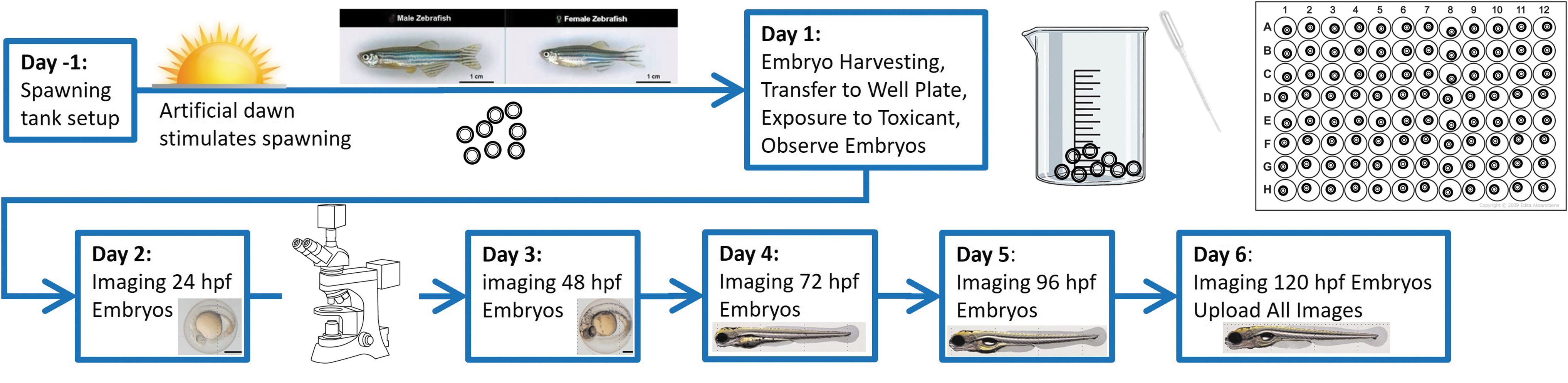
Flow chart of operations used to create images included in the Virtual Zebrafish Laboratory.
The key to organizing the repository and LIMS and transforming it into an educational tool was the decision to integrate it as a module within the Canvas® Learning Management System (Instructure, Salt Lake City, UT). Canvas is a cloud-based, open-source Learning Management System with advanced functionalities and can be easily accessed from any internet-connected device at any time. In addition to providing a complete and already-developed user management and access infrastructure, integrating the virtual laboratory as a Canvas module makes possible the seamless incorporation of other Canvas-based resources that are presented alongside the repository, such as online teacher-student and student-student communication, posting of instructional materials, online quizzes and tests, and so on. Instructors are issued teacher accounts in Canvas and can then easily add their students to their online class by simply logging into the Canvas Zebrafish module and pasting in a list of students' email addresses.
Once the online classroom is established, the instructors can control which sets of images are presented to their students. This allows the instructors flexibility in establishing an experimental design, presenting embryos by combinations of chemical exposure and developmental stage (hpf). This also gives students the potential to setup a variety of experimental designs, providing a more challenging experience. Each zebrafish embryo image presented to the students is accompanied by a list of different anatomical and physiological endpoints. The student can simply click a checkmark (e.g., normal/abnormal) next to each endpoint, based on observation of the embryo image.
Results
The UWM WInSTEP program created the “Zebrafish as Models: Studying the Effects of Environmental Agents on Human Health” learning module 2 to support hands-on live animal experiments in the secondary science classroom. Selected results from the 2022 to 2023 external evaluation and quotes from teachers are shown in Box 1. The activities in the module are illustrated in Figure 2. In the last 10 years, nearly 13,000 students have completed the module using embryos supplied by the UWM WInSTEP program. In addition, some teachers have been able to produce zebrafish embryos in their classroom for hundreds of students.

Flow chart for classroom-based module “Zebrafish as Models: Studying the Effects of Environmental Agents on Human Health” described in Tomasiewicz et al. 2 This figure illustrates the processes used in the zebrafish module. On Day 1, embryos are harvested in the laboratory at UWM or in the classroom if the teacher has a successful breeding group, transferred to a well plate, and exposed to the toxicant. Each day the embryos are observed under the microscope, and the media changed. UWM, University of Wisconsin-Milwaukee.
The WInSTEP Zebrafish Virtual Laboratory was operational in late 2021 and valuable feedback was received from several teachers who navigated the first version of the site. Three teachers beta tested the Zebrafish Virtual Laboratory, while teaching the module during the 2021–2022 and 2022–2023 school year. Two teachers (each with 120 students) used the Zebrafish Virtual Laboratory as a teaching tool to prepare students for the hands-on, classroom-based module experiments and one teacher tested the utility in a completely virtual environment with 80 students.
Students can model all the steps of scientific method with this virtual resource. They can make a hypothesis about the effects of one or more of the chemicals investigated in this module. They can design virtual experiments that examine the impact of chemical concentration and embryo age on both control and experimental embryos. Because the images are high-quality photographs of embryos, students can obtain more detailed data than in live experiments analyzing images captured on a smart phone or through the ocular of a microscope. Students can collect data by viewing images of developing embryos. Then, they can interpret these data to develop explanations, predictions, and models of the effects of specific contaminants on normal development.
The Virtual Zebrafish Laboratory allows students to test the impact of selected lifestyle chemicals (caffeine, nicotine, and ethanol) on 19 anatomical endpoints in the zebrafish, generating significant amounts of data. This offers students and instructors the choice of data sets that differ in the independent variables of chemical concentration and time of postfertilization exposure. In turn, this enables each student flexibility in establishing an experimental design. To supplement the Virtual Zebrafish Laboratory, a detailed Teacher Instruction Guide is provided that describes how to navigate the UWM Canvas site that hosts the virtual experiment, how to register students for the site, options for how students can use the portal, and how students can export data generated using the Virtual Zebrafish Laboratory and analyze their results.
Tour of the WInSTEP virtual zebrafish laboratory
Upon navigating to the UWM Canvas site that hosts the Virtual Zebrafish Laboratory (Fig. 3A), the student starts on the Welcome (Home) page that has a brief introduction to the experimental module, a “Modules” tab, and a “START HERE” button that launches the virtual experiment. Clicking the “Modules” tab reveals an introductory video about zebrafish and their use in research, a second method for accessing the virtual zebrafish experiment, a virtual experiment data sheet, a “Go Fish” poster that shows the developmental stages of zebrafish embryos, and zebrafish embryo diagrams (from von Hellfeld et al. 11 ) that illustrate anatomical structures of interest at the developmental stage at which images were taken.

Experimental setup pages from the Virtual Zebrafish Laboratory.
The first page of the virtual experiment allows access to different sets of embryo images based on treatment and allows the export of saved data in either descriptive or numerical format to a CSV file (Fig. 3B). Clicking on a set navigates to a page that reveals the entire set of embryo images by developmental stage and toxicant concentration (Fig. 3C).
Clicking on one of the circle icons takes the student to a page with a high-resolution image of the specific embryo and the anatomical structures of interest (Fig. 4A, C). Clicking on the information icon,  , next to a structure provides a definition of the anatomical structure taken from ZFIN.
12
There is also a “Diagram” tab that leads to a zebrafish embryo diagram (from von Hellfeld et al.
11
) that illustrates anatomical structures of interest at the developmental stage the image was taken (Fig. 4B). One hundred twenty hpf embryos also have a short video from which the students can measure heart rate (Fig. 4C).
, next to a structure provides a definition of the anatomical structure taken from ZFIN.
12
There is also a “Diagram” tab that leads to a zebrafish embryo diagram (from von Hellfeld et al.
11
) that illustrates anatomical structures of interest at the developmental stage the image was taken (Fig. 4B). One hundred twenty hpf embryos also have a short video from which the students can measure heart rate (Fig. 4C).
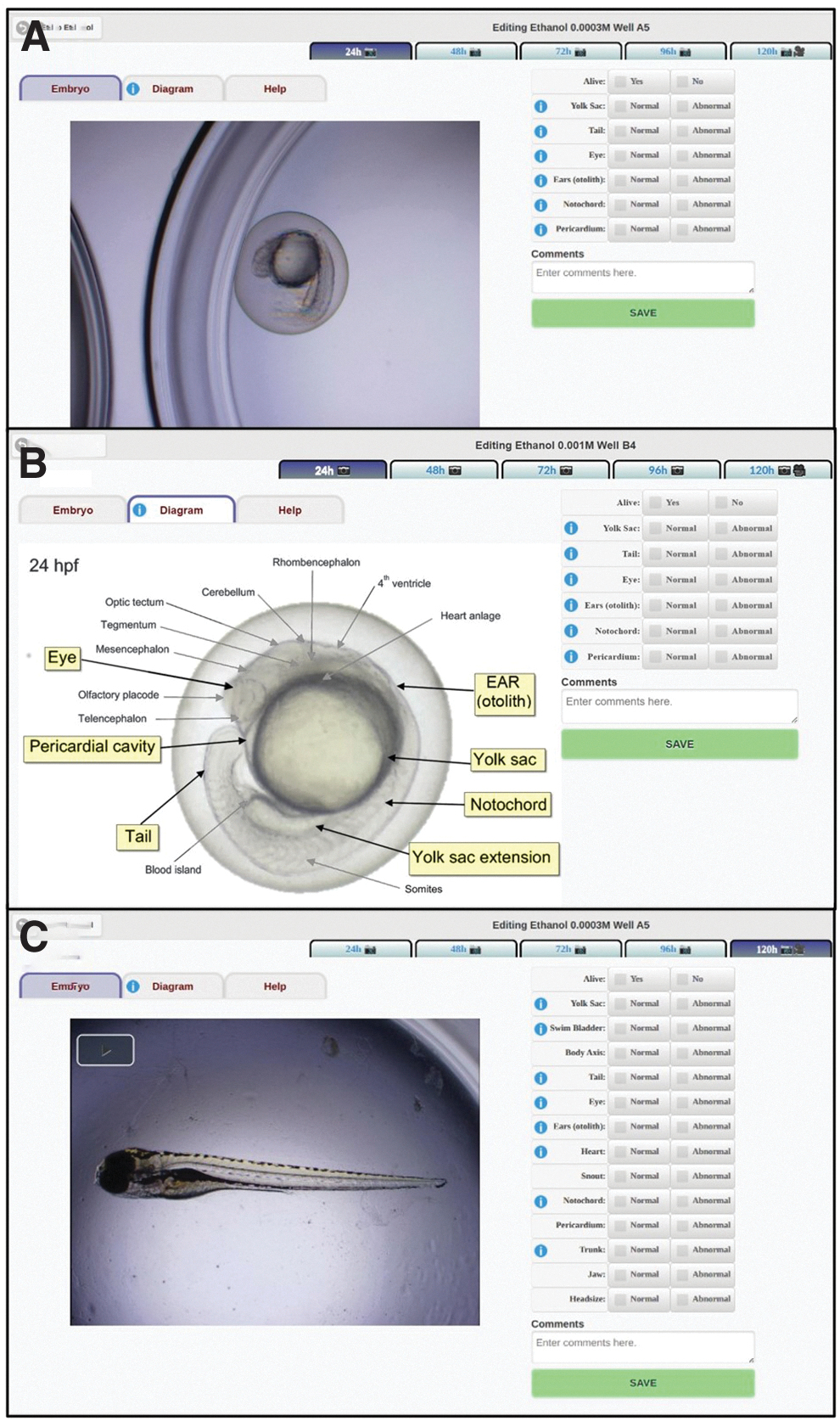
Anatomical analysis pages from the Virtual Zebrafish Laboratory.
Discussion
Zebrafish embryo development occurs rapidly over the course of 3 days. 13 Because embryos are transparent, the details of this process can be observed in great detail. Such features are highly attractive to scientists interested in the fundamentals of early development and concerned with abnormal development caused, for example, by exposure to environmental chemicals. Our learning module “Zebrafish as Models: Studying the Effects of Environmental Agents on Human Health” provides students opportunities for experimentation with zebrafish embryos, which examines the impact of chemicals on embryo development. 2
There were two objectives of the creation of the Virtual Zebrafish Laboratory. First, to provide access to key experiences in doing research to those students without the means to observe live zebrafish embryos in the context of an experiment. Second, to furnish teachers and students with a much larger pool of animals and experimental conditions from which to collect and analyze data. These data can be analyzed alone or in combination with data from others in the same class, at the teacher's discretion, to increase the complexity of the data set, and thus to create the challenge of analyzing “big data.” The Virtual Zebrafish Laboratory allows the analysis of health effects across a concentration range and through time. The student experience will be greatly enhanced by using the Virtual Zebrafish Laboratory as the interface for students to navigate through more than 3500 images and videos.
Virtual experiments certainly have both disadvantages and advantages. In the context of the WInSTEP module “Zebrafish as Models: Studying the Effects of Environmental Agents on Human Health” and the Virtual Zebrafish Laboratory, the disadvantages include the following:
Lack of student interaction with live animals in the classroom, The inability of the student to create custom experimental conditions, and The difficulty of behavioral observations and their inherent variability. The advantages of virtual experiments include the following: Allows inquiry-learning to occur even without live animals, Adds a new learning component in hybrid learning model, Solves the problem of obtaining live animals due to the lack of a local source or classroom rules that specifically exclude live animals, Enables the exploration of health effects caused by chemicals at additional concentrations that are too toxic to be used in a secondary school classroom, and Permits students unable to attend in person to complete the module.
Conclusions
The virtual experiments can be used if students are learning remotely, or if zebrafish embryos or materials are not readily available. In addition, the virtual experiments can be employed to prepare students for corresponding hands-on experiences in class. By applying the results of zebrafish embryo experiments to human embryo development, students can draw conclusions regarding personal health, environmental hazards, and the risks and benefits of personal and social decisions in relation to these hazards.
Footnotes
Acknowledgments
Embryo images: All embryo images are the property of Michael J. Carvan III and the Carvan Laboratory © 2021 Michael J. Carvan III.
Embryo diagrams modified from von Hellfeld et al. 11

Authors' Contributions
M.C.: Conceptualization, writing (all aspects), methodology, and supervision; T.H.: Conceptualization, writing (all aspects), software, and methodology; R.H.: Writing (all aspects) and project administration; A.Z.: Writing (review and editing), investigation, and validation; C.B.: writing (review and editing); and D.H.P.: Writing (review and editing), supervision, and resources.
Disclosure Statement
No competing financial interests exist.
Funding Information
This project was made possible by Grant Number R25GM142031 awarded to the University of Wisconsin-Milwaukee from the Science Education Partnership Award (SEPA) Program, which is supported by the National Institutes of General Medical Sciences of the National Institutes of Health (NIH). The content is solely the responsibility of the author and does not necessarily represent the official views of the National Institutes of Health.