




Abstract
The 4th Italian Zebrafish Meeting took place in Palermo from February 7 to 9, 2024. The primary aim of this meeting was to bring together a diverse group of principal investigators, young researchers, facility managers, commercial vendors, and others to provide an important forum for presentation and discussion of the most innovative and exciting scientific research currently ongoing in Italy using the zebrafish model. Nonetheless, the meeting program has been conceived to allow the dissemination of cutting-edge scientific research across a wide range of topics and to shed light on its future directions, without geographical boundaries. Indeed, people from various parts of the world joined the meeting, and 210 participants presented their latest work in talks and posters. Importantly, the meeting had designated time to foster open scientific exchange and informal networking opportunities among participants of all career stages, thus allowing initiation of new collaborations and strengthening of existing partnerships. The meeting was a tremendous success as testified by the highest participation ever since the first meeting of the series in 2017, coupled with the highly positive satisfaction rating expressed by the attendants. The full program and detailed information about the meeting can be found on the dedicated website at https://itazebrafishmeeting.wixsite.com/izm2024.
Introduction
From February 7 to 9, 2024, the 4th Italian Zebrafish Meeting, henceforth IZM2024, was held in the beautiful frame of Palermo, the capital city of Sicily, the largest island in Italy located in the heart of the Mediterranean Sea. The scientific and organizing committees welcomed a total of 210 attendants, mostly from Italian universities and research institutions (Fig. 1). This participation, the highest ever since the first meeting of the series in 2017 (Fig. 2 and Fig. 3), represents a good way to gauge the steady growth of the Italian zebrafish community in the last years. Moreover, a number of attendants came from various parts of the world, including Spain, France, Germany, Hungary, the Netherlands, Switzerland, Israel, and United States of America. To further highlight the international breadth of this event, IZM2024 was organized under the patronage of the European Zebrafish Society, and sponsored by seven leading multinational companies in the fields of animal equipment, imaging microscopy, and animal behavior tracking software.

Geographical map showing the Italian universities and research institutions represented at the IZM2024. The inset shows the IZM2024 logo.
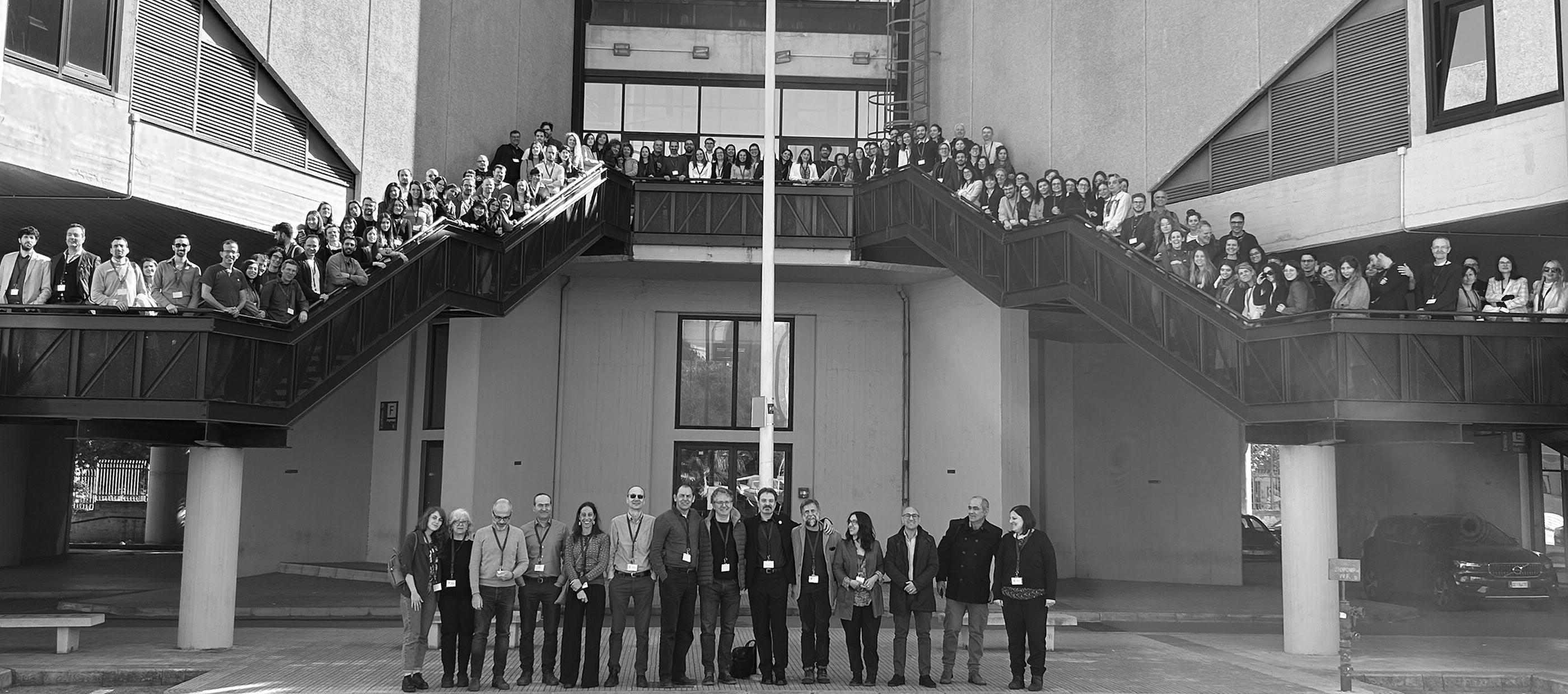
Group photo showing most of the IZM2024 participants. Some members of the scientific and organizing committees are on the foreground (from the left): Gaia Pucci, Marina Mione, Cristiano Bertolucci, Massimiliano Andreazzoli, Anna Pistocchi, Dario Finazzi, Francesco Argenton, Massimo Santoro, Vincenzo Cavalieri, Tiziano Verri, Antonella Lauri, Giuseppe Montalbano, Paolo Sordino, and Chiara Gabellini.

Histograms showing the number of participants, keynote lectures, oral presentations, and posters of the four Italian Zebrafish Meetings organized so far.
Each day was opened by one invited keynote lecture followed by multiple oral sessions including short presentations and an afternoon poster session. The three keynote speakers were outstanding researchers addressing specific topics of relevant interest for the zebrafish community, while participants contributed with 53 short presentations and 73 posters regarding their latest research (Fig. 3). Short presentations were selected from the submitted abstracts and divided into seven oral sessions: (1) development and differentiation, (2) cancer, (3) emerging technologies, (4) drug discovery, toxicology, and stress, (5) disease models, (6) nutrition, and (7) neurobiology and behavior.
Each poster session was anticipated by a poster preview session, whereas a total of 16 selected authors provided a flash presentation of their work, to better stimulate the audience to visit their poster during the dedicated sessions. There, all of the attendants had an excellent opportunity to networking and think about ways to develop new collaborations, because, in fact, this was also at the central core of this meeting.
In addition, three short presentations were given by sponsoring companies. In particular, Tommaso Sala (Tecniplast, Italy) introduced the Tritone XS automated feeding system for zebrafish, Guillaume Lopez (Viewpoint, France) summarized the standard and custom-made behavioral tracking solutions for zebrafish, and Cristina Anghel Mills (Bionomous, Switzerland) introduced the EggSorter, a device to automate zebrafish egg sorting.
The IZM2024 social activities included an outdoor guided tour across the historical city center on Thursday, February 8, evening. With each step over the cobblestone streets of Palermo, participants were transported back to a bygone era, where the echoes of millennium-old stories whisper through the walls of the architectural marvels. The walk touched some of the most iconic sites of the city, including the Arab-Norman itinerary, which is in the list of World Heritage Sites by UNESCO as an exceptional example of syncretism, that is, the peaceful fusion of opposing and irreconcilable cultures (Arab, Norman, and Byzantine) that took place in Sicily in the 12th century during the Norman reign. Other sites were the Royal Palace, seat of the Norman monarchy and the Spanish viceroys, the Cathedral, a fortress church rebuilt by the Norman king of Sicily, William the Good, the Quattro Canti baroque square, which is the geometric center of the city, the Renaissance fountain in Piazza Pretoria, and the Chiaramonte Palace, the ancient court of the Holy Inquisition.
After the guided tour, the social dinner took place at Artale Tumminello Palace, a 17th century building located just on the back of the Cathedral church. On the background of the sumptuous rooms teeming with precious paintings, ceramics, decorations, and elegant tapestries belonging to Palermo’s aristocracy, participants had a lot of time and space for enjoying typical Sicilian dishes and to carry on significant informal interactions.
The IZM2024 Scientific Program
The scientific program started with a short opening address by the main organizer, Vincenzo Cavalieri (University of Palermo), a molecular biologist who established the zebrafish facility at the Advanced Technologies Network Center of the University of Palermo, and pioneered the use of zebrafish for scientific research in Palermo.
The first keynote lecture, entitled “From fish embryos to human patients: lymphangiogenesis in zebrafish and beyond”, was given by Stefan Schulte-Merker (University of Munster, Germany) and chaired by Marina Mione (University of Trento, Italy). Stefan highlighted how studies in zebrafish embryos can inform about organ formation in vertebrates, including humans, using both genetics and in vivo studies to elucidate the behavior of individual cells and the formation of an entire organ system.
The subsequent oral session, entitled “Development and differentiation”, was chaired by Massimiliano Andreazzoli (University of Pisa, Italy) and Filippo del Bene (Sorbonne Universitè, France). In this session, Sepand Rastegar (Karlsruhe Institute of Technology, Germany) reported the role of sox1 genes in defining the neural diversity in the ventral spinal cord of zebrafish. Matteo Di Gregorio (University of Pisa, Italy) summarized the role of setd5 gene into zebrafish brain development. Luigi Balasco (University of Trento, Italy) explored the role of zebrafish impg2a and impg2b genes in retinal development and disease. Marco Spreafico (University of Milan, Italy) highlighted that NRP1 acts as a mediator of SEMA3A chemorepulsive cues to guide vessel sprouting, and Samuele Sartori (University of Trento, Italy) focused on the role of the Wnt inhibitory factor 1 as a paradigm of gene compensation and transcriptional adaptation.
The “Cancer” session was chaired by Anna Pistocchi (University of Milan, Italy) and Massimo Santoro (University of Padua, Italy). In this session, Giacomo Miserocchi (Institute of Romagna for the Study of Tumors, Meldola, Italy) presented an innovative approach to study in vivo tumor dynamics by 3D culture transplantation in zebrafish embryos. Francesca Lorenzini (University of Trento, Italy) reported that LTD4-dependent activation of YAP signaling in uveal melanoma supports tumor progression. Anna Pistocchi, replacing Alex Pezzotta at the last minute (University of Milan, Italy), summarized the dissection of dysregulated biological mechanisms and potential therapeutic cancer treatments related to Hedgehog and HDAC6. Finally, Sebastiano Giallongo (University of Catania, Italy) reported that lactate reshapes myelofibrosis tumor microenvironment.
The second day of the meeting started with the keynote lecture entitled “From development to therapeutic mRNAs: Combining genomics and expansion microscopy to understand the basic mechanisms of transcription and translation”, given by Antonio Giraldez (Yale School of Medicine, United States of America) and chaired by Vincenzo Cavalieri (University of Palermo, Italy). Antonio gave a really inspiring presentation focused on a central question in biology: How do the molecular regulatory circuitries shape gene expression during vertebrate embryonic development, and how to use this knowledge toward developing effective therapeutic strategies?
The successive “Emerging technologies” session was chaired by Simona Casarosa (University of Trento, Italy) and Alessandro Cellerino (Scuola Normale Superiore, Italy). Filippo Del Bene (Sorbonne Universitè, France) introduced a method for fast, efficient, and flexible manipulation of neuronal activity with single-cell precision, while Marta D’Amora (Italian Institute of Technology, Italy) reported a method for high-density electrophysiological recordings in zebrafish larvae across multiple brain regions.
The oral session entitled “Discovery, toxicology and stress” was chaired by Michela Ori (University of Pisa, Italy) and Tiziano Verri (University of Salento, Italy). In this session, Judith Habicher (University of Trento, Italy) presented a high throughput in vivo screening of compounds to find novel factors affecting the zebrafish habenular circuit development and linking it to neuropsychiatric disorders. Vincenzo Cavalieri (University of Palermo, Italy) reported the protective effects of secretome from Wharton’s jelly mesenchymal stem cells in zebrafish. Maria Marchese (Fondazione Stella Maris, Italy) provided insights on the role of lysosomal protein Cln5 in neurodegeneration using zebrafish as a tool. Francesca Greco (University of Verona, Italy) reported the characterization of a zebrafish model for SPG4 hereditary spastic paraplegia. Francesca Maradonna (University of Marche, Italy) reported that dietary probiotic reduces bisphenol-A waterborne toxicity, and Elisa Fonsatti (University of Padua, Italy) evaluated the stress response of adult zebrafish exposed to intermittent fasting.
The “Diseases models” session counted a total of 10 oral presentations divided into 2 sub-sessions chaired by Dario Finazzi (University of Brescia, Italy) and Natascia Tiso (University of Padua, Italy), and Livia D’Angelo (University of Naples, Italy) and Daniele Tibullo (University of Catania, Italy), respectively. Alessia Brix (University of Milan, Italy) reported that ADA2 regulates inflammation and hematopoietic stem cells emergence via the A2bR pathway in zebrafish. Francesca Terrin (University of Padua, Italy) reported that increased levels of beta-glucosyl-sitosterol triggers intestinal dysfunction. Anja Buhler (University Hospital of Ulm, Germany) reported that Hdac1 regulates cardiomyocyte proliferation during development and heart regeneration. Francesco Dalla Barba (University of Padua, Italy) presented the modeling of sarcoglycanopathy in zebrafish. Antonella Lauri (Ospedale Pediatrico Bambino Gesù, Rome, Italy) reported about the early signs preceding disease onset in a zebrafish model of rare tubulinopathy exhibiting untreatable neurodegeneration. Deianira Bellitto (University of Genoa, Italy) reported the use of zebrafish for modeling Alexander disease. Annachiara Tesoriere (University of Padua, Italy) highlighted the role of PS727 Stat3 regulation of vitamin D pathway in the pathogenesis of Job’s syndrome. Michela Ori (University of Pisa, Italy) presented the modeling of Pitt Hopkins syndrome and de novo pathogenetic variants of TCF4 gene. Giulia Fasano (Ospedale Pediatrico Bambino Gesù, Italy) reported the assessment of Teen sensor fish to detect early RASopathy-associated ERK activation and its pharmacological modulation. Finally, Luca Mignani (University of Brescia, Italy) reported a novel model for Krabbe disease in zebrafish.
The third day of the meeting started with the keynote lecture entitled “Sleep facilitates neuronal maintenance across evolution”, given by Lior Appelbaum (Bar-Ilan University, Israel) and chaired by Francesco Argenton (University of Padua, Italy). Lior discussed about the interaction between sleep, neuronal activity, and DNA damage and repair in zebrafish and other animal species, highlighting that sleep enables efficient nuclear maintenance of single neurons.
The “Nutrition” session was chaired by Paolo Sordino (Stazione Zoologica Anton Dohrn, Italy) and Fabio Marino (University of Messina, Italy). Rosario Licitra (Fondazione Stella Maris, Italy) systematically reviewed zebrafish feed intake management in laboratory conditions, while Marzio Cometa (University of Messina, Italy) reported the impact of rosemary and lemon extracts on the intestinal microbiome of zebrafish larvae.
The last oral session, entitled “Neurobiology and behavior”, was chaired by Cristiano Bertolucci (University of Ferrara, Italy) and Chiara Gabellini (University of Pisa, Italy). In this session, Gaia De Russi (University of Ferrara, Italy) reported the impact of light pollution on behavior and cognition of zebrafish. Giulia Messa (Institut du Cerveau, France) presented the serotoninergic regulation of body axis alignment in the postembryonic zebrafish. Elia Gatto (University of Ferrara, Italy) reported how neural plasticity genes expression affects individual differences in cognition. Sara Bagnoli (Scuola Normale Superiore, Italy) presented the study of neurodegeneration and nuclear morphological changes in the fast-aging teleost Nothobranchius furzeri, while Andrea Messina (University of Trento, Italy) concluded the session presenting the neural path for visual discrimination of magnitudes in zebrafish.
Before the IZM2024 closing remarks, two best oral presentation awards and three best poster awards were announced by the scientific committee. In particular, the oral presentation winners were Judith Habicher and Francesca Lorenzini (both from University of Trento, Italy). The three poster awards were won by Raquel Branas Casas (University of Padua, Italy), Alessia Muscò (University of Pisa, Italy), and Silvia Zini (University of Brescia, Italy), and they covered distinct topics, from use of zebrafish mutants for modeling of PolG diseases, comparative study of PRR12 gene expression, and generation of a transgenic zebrafish line for modeling of Parkinson’s disease, respectively.
Conclusion
The IZM2024 provided a valuable and representative snapshot of the current state of the art in zebrafish-based research in Italy. The Conference and Didactic Center of the University of Palermo, located inside the University Campus in Viale delle Scienze, turned out to be an ideal venue for the event, right at the gates of the historical city center and at very close walking distance from the hotels. We were also fortunate that the weather was warm and sunny throughout the event, with an average daytime temperature of around 20°C. Overall, we can safely conclude that the IZM2024 was a resounding success. This is also confirmed by the highly positive satisfaction rating expressed by the attendants using the survey feedback questionnaire. The survey received a response rate of 37%, whereas 97% of the participants gave a positive rating of “Excellent” (26%), “Very good” (47%), and “Good” (24%). In the closing remarks by Vincenzo Cavalieri, the host city for the next meeting was announced, and Matthias Carl (University of Trento, Italy) invited the attendants to Trento in the Winter 2026.
Footnotes
Acknowledgments
The organizers thank Eleonora Lecchini (Fondazione Guido Bernardini, Italy) for the administrative help, which was instrumental in ensuring a successful meeting. The University of Palermo and the Department of Biological, Chemical and Pharmaceutical Sciences and Technologies (STeBiCeF) are acknowledged for their support. Finally, the organizers would like to thank students of the Master’s degree program in Biomolecular and Industrial Biotechnologies of the University of Palermo for their precious help.
Disclosure Statement
No competing financial interests exist.
Funding Information
The organizers gratefully acknowledge the generous financial support from the European Zebrafish Society, Tecniplast, Zeiss, ViewPoint, Nikon, Bionomus, Any-maze, and Noldus.