




Abstract
The zebrafish is no longer a shy “beginner” but a key model species in neuroscience and drug discovery research. Understanding zebrafish behaviors is important for developing valid models of brain disorders and probing their genetic and environmental causes. The rapid development of zebrafish-based tests and screens also necessitates formal and consistent terminology for the observed phenotypes and behavioral phenomena. To address these needs, in 2013 we compiled a comprehensive ‘consensus’ glossary of nearly 190 zebrafish behaviors—the Zebrafish Behavior Catalog (ZBC-1) for both larval and adult fish. However, as novel zebrafish behaviors continue to be recognized, an expansion and revision of ZBC were deemed timely. Here, we present the next additional volume of the catalog (ZBC-2), which describes over 120 novel zebrafish behavioral terms and, like the original project, represents a result of a global teamwork of multiple collaborating zebrafish laboratories. Illustrating the value of community efforts to improve data replicability and reliability, this catalog is expected to help interpret research findings, foster cross-domain and cross-species modeling, and encourage new laboratories to study zebrafish behavioral phenotypes.
Introduction
The zebrafish (Danio rerio) is a powerful model organism in translational neuroscience research,1,2 whose genome is fully characterized, and physiology and neuroanatomy are similar to those in humans.3–5 Zebrafish breed in large numbers, are inexpensive to maintain, have small size, and can be easily manipulated genetically or pharmacologically. 6 Zebrafish behavioral and physiological responses are robust, appear to be evolutionarily conserved, and often parallel those in mammalian experimental species (e.g., rodents). 7 Multiple genetic and pharmacological models have also been developed in zebrafish for multiple central nervous system (CNS) deficits, ranging from neurodevelopmental and neurodegenerative disorders8,9 to depression, schizophrenia, and autism. 10 These fish are also widely used to screen genetic mutants and drugs to develop novel therapies for various CNS disorders. 6
Understanding zebrafish behaviors is crucial for developing valid models of human brain disorders, probing their genetic and environmental causes,10,11 as well as for ensuring animal welfare and research reliability and reproducibility.12,13 The rapid development of zebrafish-based behavioral assays also necessitates a formal and consistent terminology for the observed phenotypes. To address these needs, in 2013, we compiled a comprehensive catalog comprising nearly 190 zebrafish behaviors (Zebrafish Behavior Catalog, ZBC-1) for both larval and adult fish. 14 However, multiple novel concepts and paradigms continue to emerge in zebrafish behavioral research, reflecting just how rapidly developing the field is (Fig. 1). Consider, for example, translational modeling of behavioral ‘despair’ 15 which was previously unrecognized in zebrafish but can now be tested in a recently introduced zebrafish tail immobilization (ZTI) test. 16 Conceptually similar to rodent ‘despair’ tests such as forced swim and tail suspension tests, ZTI involves immobilizing the caudal half of the fish body, leaving the cranial part to move freely in a small beaker with water, to assess active struggling versus despair-like immobility. 16 Zebrafish display operant conditioning behavior, 17 including responses in a high-throughput operant conditioning system for zebrafish larvae that can simultaneously train multiple fish to associate a visual conditioned pattern with electroshocks. 18 Zebrafish also help understand the role of auditory and vibration stimuli in behavioral processes, 19 as, for instance, we now recognize that they emit locomotion-generated vibrations that can be quantified and experimentally manipulated. 20
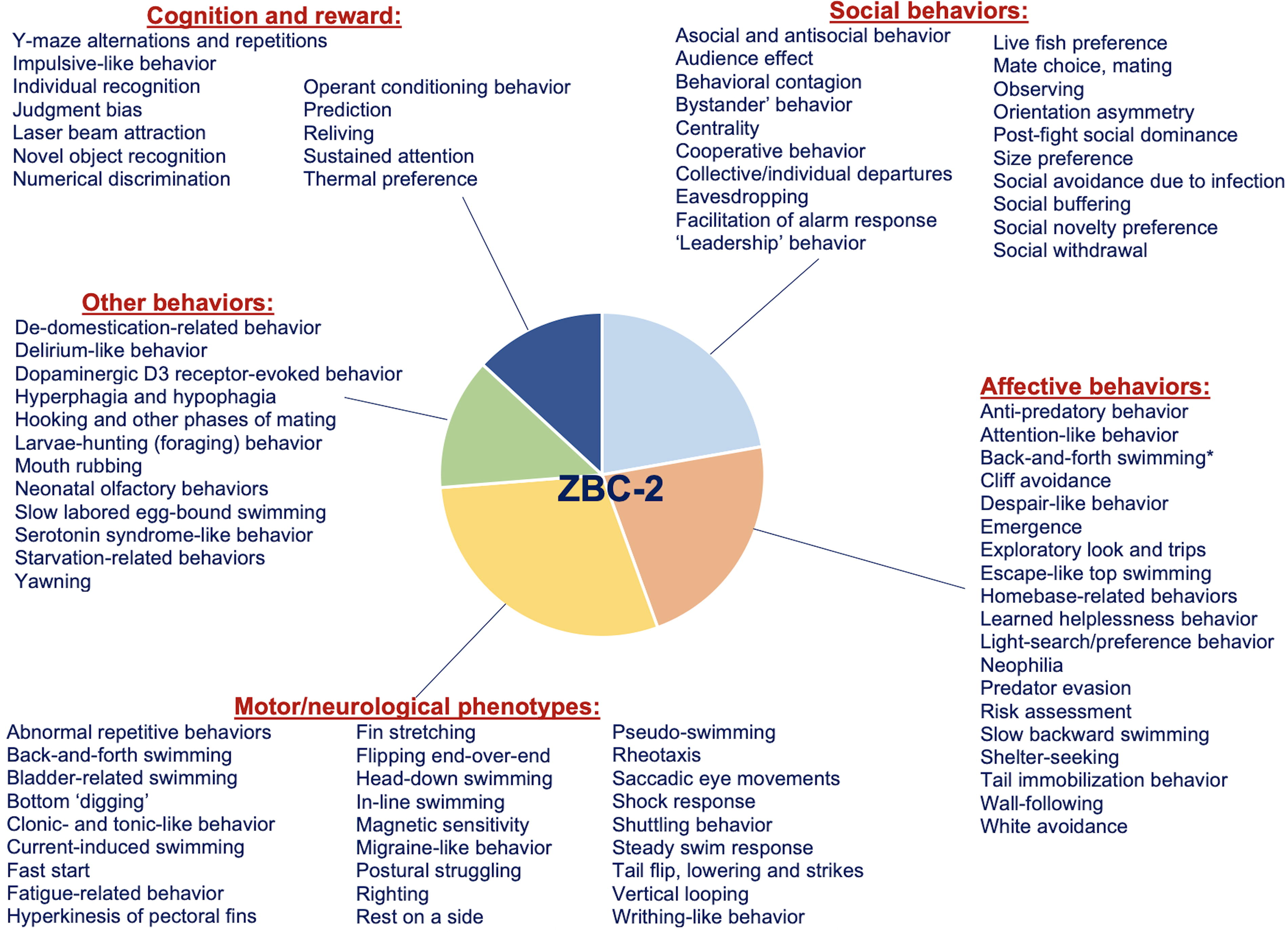
Clustering of major neurobehavioral domains expanded in the present Zebrafish Behavioral Catalog Volume V2 (ZBC-2).
Furthermore, zebrafish are indispensable for improving our understanding of social behavior and its deficits, such as aggression and social withdrawal. 21 For instance, we now recognize that zebrafish employ various types of social learning, including eavesdropping, as they (similar to humans) collect adaptively relevant information from observing others. Likewise, it becomes increasingly clear that zebrafish are remarkably socially aware, for example, paying more attention to interacting (e.g., fighting) than noninteracting pairs of conspecifics. 22 However, only zebrafish dominant “bystanders” who had seen the fight would display more directional focus (a measure of attention) toward the losers, indicating that information about the fighters’ acquired status is collected from watching the interaction (rather than from postinteraction status cues), suggesting individual recognition in zebrafish. 23 With this growing amount of behavioral data, the use of detailed and standardized terminology in zebrafish behavioral research becomes necessary.
Compiling the first edition of ZBC in 2013 14 was a challenging but rewarding task. Spearheaded by the International Zebrafish Neuroscience Research Consortium (ZNRC), it relied on active participation and productive cooperation between multiple zebrafish laboratories globally. Most importantly, this publication was well-received by the research community and rapidly became widely used (with >1200 citations as of August 2025) and presently being the most cited article ever published by “Zebrafish.” Yet we fully recognized that the field of zebrafish neurobehavioral research is relatively young, very dynamic and rapidly growing. To address these developments, here we present the next additional “consensus” volume of the catalog (ZBC-2), which describes over 120 novel zebrafish behavioral terms or phenomena collected as a result of teamwork of multiple collaborating zebrafish laboratories globally. Numbered and arranged in alphabetical order, the terms for volume 2 of this catalog were selected to the best of our knowledge, aiming to be comprehensive but concise, cover all major behavioral categories, and target (in a balanced manner, where possible) both adult and larval zebrafish models. Covering a wide range of phenotypes and contexts (Fig. 1), ZBC-2 describes novel zebrafish behavioral phenotypes that were either previously unrecognized or omitted in the original ZBC-1 glossary. Like the format of the original publication, most of ZBC-2 entries here, with a few important “conceptual” exceptions (e.g., age differences, aggression priming), represent terms that describe specific behaviors or behavioral syndromes. Notably, this glossary shows a major expansion of zebrafish behavioral terms, especially in domains of affective, social, cognitive, and motor behaviors (Fig. 1). Where pertinent or critical, specific contexts and details about zebrafish age or sex were indicated in the glossary, with necessary references to related terms from ZBC-1. 14 Finally, the present ZBC-2 represents not a revision or replacement of, but rather an addition to, the original ZBC-1, hence providing a next volume in the developing depository of zebrafish behavioral phenotypes. We expect that with both ZBC volumes, zebrafish behaviors can now be better understood, standardized, recognized, compared, and formalized in the literature, assisting both experienced and newer laboratories working with these fish.
Zebrafish Behavioral Catalog v. 2 (ZBC-2) Glossary
Abnormally stereotypic motor behavior (e.g., repeated back-and-forth swimming and bottom digging), aberrant goal-oriented behavior (e.g., repeated thigmotaxis), and self-injurious cycled actions. 24 This behavior can be seen in both adult and larval zebrafish of both sexes.
Age differences (in behavior)
Behavioral differences exist across the lifespan of zebrafish. For example, zebrafish activity in both sexes decreases with age, and old zebrafish become less responsive to intermittent exercise than younger fish, 25 display blunted sensitivity to acute and chronic stressors,26,27 and have progressive cognitive deficits. 28 Thus, age differences in zebrafish behaviors are critical for interpreting their behavioral phenotypes.
Aggression priming
Elevation of adult zebrafish aggressive behaviors following their exposure to conspecifics. 29 This behavior may be seen in both sexes.
Antipredatory behavior
A set of zebrafish behaviors related to predator exposure, including predator avoidance (ZBC 1.12), predator attack (ZBC 1.123), predator inspection/approach (ZBC 1.122), as well as predator evasion30,31 and predator-evoked “background” neophobia. 32 Some of these behaviors can be facilitated following the exposure to alarm pheromone or other predation-associated cues. This behavior can be seen in both adult and larval zebrafish of both sexes.
Attention-like behavior
Focused and sustained interaction of zebrafish with a specific stimulus (see sustained attention). This behavior can be assessed, for example, in adult zebrafish in the 5-choice serial reaction time task (5-CSRTT) as the percentage of correct responses (i.e., swimming toward a chamber when a light is on).33–35 Evidence for its relevance to attention comes from zebrafish knockout of the adgrl3.1 gene (related to externalizing disorders with attentional deficits), which shows decreased accuracy in the 5-CSRTT. 33 A measure of zebrafish attention is a directional focus (e.g., turning toward the loser while observing two fighting fish) to collect social information. 23
Asocial behavior
Deficient social behavior manifested as reduced (albeit not fully abolished) preference for adult zebrafish shoals or other social interactions (e.g., social preference, ZBC 1.151-152) with conspecifics; differs from antisocial behavior (preference to stay alone). 36
Antisocial behavior (hermit/loner or “hikikomori” effect: social avoidance)
Aberrant social behavior manifested as strong social aversion and avoiding swimming in adult zebrafish groups (overt preference to stay alone). 36 Resembling behavior of human hermits or “hikikomori” (who live as loners and refuse to socialize), this behavior can emerge in some individuals in early development but differs from asocial behavior (that reflects reduced social preference rather than strong social avoidance).
Audience effect
Altered aggression of fights in the presence of the audience (of observing “bystander” conspecifics) versus fights without an audience, 29 depending on the timing of the audience presentation. For example, preexposure to the audience induces faster aggressive “displays” (ZBC 1.3), longer chasing subordinates (ZBC 1.162), and faster resolution of agonistic interactions in male zebrafish, whereas exposure during fighting increases the number of “displays” and reduces the escalation of aggression for resolved interactions. 29 This behavior can be seen in adult zebrafish of both sexes.
Back-and-forth swimming
Behavioral pattern related to stereotypic abnormal locomotion (e.g., shuttling behavior with 180° turning, 37 bottom “digging”) or exploratory strategies (e.g., back-and-forth exploration in novel environments, for example, as the emergence behavior when the adult fish emerges and retracts from/to the shelter, with or (most typically) without turning the body; see exploratory look). 38
Behavioral contagion (social transmission)
The ability of adult zebrafish to match the emotional or behavioral state of another individual conspecific.39,40 Often this behavior expresses in exploratory contexts, for example, as individuals display fear or distress behaviors (e.g., erratic movements and freezing) in response to observing similar behaviors in others. 41 Likewise, familiar distressed target fish elicit stronger alarm responses in observers 42 (see observing), whereas yawning zebrafish can “catch” yawns from others 43 (see yawning). Potential sex differences in this behavioral phenomenon are poorly understood.
Behavior-generated vibration
Low-frequency vibration generated by locomotion of individual or group-swimming zebrafish. 20 This behavior is sensitive to various experimental manipulations and CNS drugs 19 and may contribute to zebrafish social communication. With further development of technology, assessing this behavior can be applied to studying some neurological disorders (e.g., epilepsy and tremor-like phenotypes). This behavior can be seen in both adult and larval zebrafish of both sexes.
Bladder-related swim (swimming)
Abnormal swimming when fish struggle to control their buoyancy, often leading to difficulty maintaining the position in the water. Severe cases may involve positive (staying near the water surface) or negative buoyancy (remaining at the bottom of the tank). The condition is related to swim bladder alterations and can be caused by poor water quality, swim bladder malformations or infection, or air ingestion (see head-down swimming). Malformations often originate during the critical period when larvae must inflate the swim bladder. Insufficient access to surface air during this phase can result in underinflation of the swim bladder, impairing buoyancy control.44,45
Bottom “digging”
Repetitive stereotypic bottom swimming of adult zebrafish with characteristic “digging” behavior (e.g., seen in the dopamine transporter knockout fish) reminiscent of the sand digging described for other fish species. This behavioral phenotype is a form of ARB, may be relevant to compulsive checking, and can be alleviated by pharmacological (e.g., an antipsychotic clozapine) treatment. 46
“Bystander” behavior
Behaviors produced by adult zebrafish watching other fish’ aggressive confrontations (“bystanders”). 29 For example, during observing the fights, bystanders pay more attention to fighting (vs. nonfighting) interactions, whereas during the postresolution phase, this behavior is driven by biological movement features of the dominant fish chasing the subordinate fish. 22
Centrality
Specific behavioral pattern common for dominant zebrafish as they tend to occupy a central position in the tank while displaying less bottom dwelling and reduced thigmotaxis (staying close to the walls, ZBC 1.173). 47 This behavior can be seen in adult zebrafish of both sexes.
Cliff avoidance
Aversion toward real or perceived change in depth (Kalueff et al., 2009–2025, own systematic observations). This behavior can be seen in adult zebrafish of both sexes (its presence in larval fish is unclear).
Clonic-like behavior
Abnormal behavior characterized by increased velocity combined with corkscrew swimming resembling clonic-like seizures in other species (e.g., rodents). It often occurs following the exposure to chemoconvulsants, as part of a broader seizure-like behavior spectrum that includes tonic-like behaviors (see tonic-like seizures), and is typically reduced in zebrafish by anticonvulsant drugs.48–51 This behavior can also be induced by selected genetic mutations, and is observed in both adult and larval zebrafish of both sexes.
Collective departures
Relocation of adult zebrafish shoals between the resting areas is typically initiated by several alternating “leader” zebrafish 52 (see leading). This behavior differs from individual departures, and its sex differences are poorly understood.
Context appraisal
Behavioral phenotype which, with respect to a single or repeated postintervention (e.g., pharmacological, social or behavioral), depends on exposure to the intervention-paired context, manifesting as either positive (e.g., approach, attraction, following) or negative (e.g., anxiety-like behavior, avoidance, escape) behaviors.53,54 This behavior can be seen in adult zebrafish of both sexes.
Cooperative behavior
A general behavior directed at intra- and inter-species cooperation to achieve a specific survival goal. Some evidence suggests that adult zebrafish may cooperate with other conspecifics during predatory inspection. 55
Current-induced swimming
See Forced-against-the flow swimming.
De-domestication-related behavior
A complex of behavioral adaptations of laboratory-raised zebrafish to living in the wild. For example, de-domesticated adult zebrafish alter swimming patterns, moving faster and at longer distance, becoming bolder, forming smaller schools, or dwelling more time individually, without a group (Kalueff et al., 2024–2025, own unpublished observations).
Delirium-like behavior
A behavioral syndrome characterized in adult zebrafish by hypo- and/or hyperlocomotion, increased arousal, impulsiveness of behavior, frequent shuttling behavior (see) and cognitive deficits. 56 Paralleling clinical delirium, this behavior can be experimentally evoked in zebrafish following treatment with deliriant drugs, such as cholinergic hallucinogens57,58 and some N-benzylphenethylamines. 59
Despair-like behavior
Behavior of adult zebrafish akin to “giving up” resulting in increased immobility observed following exposure to an unavoidable stressor (e.g., tail immobilization) that persists despite avoidance attempts15,16,60,61 (see postural struggling). This phenotype reflects learned helplessness, usually manifests as alternating periods of immobility with bursts of active avoidance movements, and can be assessed using the ZTI test. 16 It differs from acute stress/anxiety-evoked immobility/freezing behavior (ZBC 1.82, 1.68). 14 The prevalence of this behavior in larval zebrafish is unclear (however, some evidence suggests that larval fish can “give up” after their swim attempts repeatedly fail to generate movement, hence becoming passive (futility-induced passivity)) 62 .
Dopaminergic D3 receptor-evoked behavior
Characteristic intense swimming of adult zebrafish with extended episodes of high-frequency tail beats, commonly evoked by dopaminergic D3 receptor agonists.63,64 The presence of this behavior in larval zebrafish, and sex differences, are unclear.
Eavesdropping
Part of social learning, when adult zebrafish “eavesdrop” on (observe) conspecifics during agonistic interactions, 23 collecting information about their status. This behavior can be modulated by the dominance status of the eavesdropping fish. The presence of this behavior in larval zebrafish is unclear.
Emergence
Characteristic exploratory behavior of adult zebrafish as they explore novel environments by slowly moving their entire body (full emergence) out of the protective covered “shelter” area (e.g., in the emergence test). This behavior can reflect reduced stress/anxiety-like behavior and boldness, but in some cases, involves partial emergence (see exploratory look) with retraction and/or back-and-force movements. The presence of this behavior in larval zebrafish is unclear.
Exploratory look
Exploratory behavior as adult zebrafish move coronally, poking a head out from a more protective environment (e.g., shelter in the emergence test, see emergence), observing the environment from it without performing a full exit; can also involve slow back-and-forth movements without turning, controlled mostly by pectoral fins. The presence of this behavior in larval zebrafish is unclear.
Exploratory trips
Exploratory behavior commonly observed in adult zebrafish open field test, characterized by repetitive excursions from the homebase (see homebase-related behavior). Usually, bolder animals or fish with reduced general anxiety levels perform more exploratory trips.65–67 The presence of this behavior in larval zebrafish is unclear.
Escape-like top swimming
Dwelling of adult zebrafish in potentially dangerous top (surface) areas driven not by exploration but by escape-like avoidance of bottom-dwelling predators (e.g., Indian leaf fish, Nandus nandus) following their exposure. 5 (Kalueff et al., 2023–2025, own systematic observations). The presence of this behavior in larval zebrafish is likely but remains to be validated.
Facial recognition
Ability of adult zebrafish to distinguish human facial features (e.g., caregivers). 68
Facilitation of alarm response
A form of social contagion behavior, resulting from using social information in threat detection (e.g., upon alarm pheromone exposure). 69
Fast start
Rapid shape changes of adult or larval fish during motion, involving the fish bending itself and then unfolding to produce a strong acceleration and a change of direction. 70 Synonymous in most cases to fast turn/turning (ZBC 1.55).
Fatigue-related behavior
Behavioral inhibition of adult zebrafish activity as a result of long-term forced locomotion in specific experimental situations (e.g., forced-against-flow swim, extended swimming against the suction source [rheotaxis, ZBC 1.130] or away from the vortexing stress). The presence of this behavior in larval zebrafish is unclear.
Fin flapping
See Hyperkinesis of pectoral fins.
Fin stretch (stretching)
A short-term adult zebrafish behavior involving extending caudal fin commonly occurring during yawning (see), 43 often seen with tail lowering (see). This behavior differs by its short-term nature and association with yawning from more prolonged fin raise (extension/erection of caudal fin, ZBC 1.60), common in zebrafish during aggression and courtship, or droopy tail (ZBC 1.49, a caudal akinesia associated with neurological deficits).
Flipping end-over-end
Characteristic pattern of terrestrial jumping behavior (ZBC 1.171) in adult zebrafish (also see tail flipping). The presence of this behavior in larval zebrafish is unclear.
Forced-against-the-flow swimming (current-induced swimming)
Natural swimming against the flow (in both adult and larval zebrafish)71,72 (e.g., rheotaxis behavior, ZBC 1.130); can be studied to study fatigue-related behavior, stress, physical exercise, and (potentially) learned helplessness. Note that training to swim against the flow may have beneficial effects in larval fish, improving their coping with hypoxia and, hence, stress. 73
Head-down swimming
Behavior when adult zebrafish struggle to maintain position and swim with an inclined and rather rigid “head-down” posture when attempting to descend. This behavior commonly occurs due to air trapped in the gastrointestinal tract or swim bladder (zebrafish possess a pneumatic duct connecting the swim bladder to the esophagus that allows air to enter the former during feeding, and so affect their buoyancy and swimming behavior) 74 (also see bladder-related swimming). This behavior differs from the bottom “digging” phenotype (see) that is unrelated to problems with buoyancy.
Hyperphagia
Overeating behavior (increased food intake) caused in zebrafish by various experimental manipulations (e.g., overexpression of growth hormone). 75 This phenotype can be seen in both adult and larval fish of both sexes.
Hypophagia
Reduced food intake behavior caused in adult or larval zebrafish by various experimental manipulations (e.g., loss-of-function mutation of agouti-related neuropeptide gene). 76 This behavior differs from food neophobia (ZBC 1.101) by long-term character independent of food novelty context per se.
Homebase-related behaviors
Exploratory behaviors of adult zebrafish related to a preferred “safe” area (homebase) in a novel environment65–67 (see homebase formation in ZBC 1.71). These behaviors include exploratory trips leaving the homebase and returns to it, as well as observing the environment from within the homebase and slowly moving out of it (similar to emergence). The presence of this behavior in larval zebrafish, as well as its potential sex differences, remain to be tested.
Hyperkinesis of pectoral fins
Characteristic hyperkinetic behavioral phenotype (e.g., seen in genetic zebrafish models of the “restless leg syndrome”), in larval zebrafish consisting of frequent flapping movements by pectoral fins (fin flapping). 77
Hooking
Part of wrapping around phase of adult zebrafish mating behavior, when (after both sexes contort their trunks) the male adjusts its body position until the trunk compresses the female’s dorsal fin, before sliding away from the female’s dorsal fin while simultaneously sliding his pectoral fin across the female’s gravid belly, stimulating egg release (squeezing). 78
Hypoxia-induced behavior
Characteristic set of adult (and, likely, larval) zebrafish behaviors in hypoxic conditions, involving changes in ventilatory frequency, altered swimming activity, surface respiration, and aberrant vertical surface swimming. 79
Free-movement pattern Y-maze alternations
Repeated sequential alternations of adult zebrafish between different arms of free movement pattern (FMP) Y-maze in successive trials (a maze with no cues, no differential reinforcement, and no differential aversive outcomes). This activity represents the highest frequency behavior in the FMP Y-maze, with ∼40% of choices being sequential alternations. Alternating (vs. random) responses in the FMP Y-maze can be used as a direct measure of working memory, evidenced by the concentration-dependent reduction following administration of memory-blocking drugs.28,80–82 The behavior is sensitive to various pharmacological agents, including agonists and antagonists of the glutamatergic, cholinergic, and dopaminergic systems. 81 The presence of this behavior in larval zebrafish remains poorly understood.
FMP Y-maze repetitions
Zebrafish repetitive behaviors in terms of arm choice of a maze (e.g., consecutive right or left choices in the FMP Y-maze).28,80,82 Repetitive choices in the FMP Y-maze are associated with ARB (see above) and often increase after acute stress. This behavior may be influenced by the dopaminergic system since D1/D5 agonist treatment reduces stress-induced repetitions. 80 The presence of this behavior in larval zebrafish is unclear.
Impulsive-like behavior
Engaging of adult or larval zebrafish in rapid behavioral actions regardless of potential risks or consequences (impulsivity). For example, in the 5-CSRTT, after training, zebrafish delay their choices before entering the correct chamber to receive a food reward,33–35 whereas fish entering a chamber prematurely (i.e., prior to light signal) display impulsive-like response. Sex differences in this behavior are unclear. Relevance to impulsive-like response is supported by its presence in adgrl3.1 knock-out fish (a model for externalizing disorders) and rescue by atomoxetine (commonly used to decrease impulsive behaviors clinically). 33
Individual departures
Social behavior when an individual adult zebrafish initiates brief “breakaways” from their shoals to other areas of the tank, followed by returning to the group. Differs from collective departures, when the entire group (typically led by several alternating “leaders”) moves as a shoal from one location to another (see 52 for details).
Individual recognition
Ability to recognize adult zebrafish individuals, clearly distinguishing them among other conspecifics. 83 Sex differences in this behavior, and its presence in larval zebrafish, are unclear.
(In)flexibility (behavioral)
Phenotype commonly observed in the FMP Y-maze 28 and T-maze as repeated alternations or repetitions (see FMP Y-maze alternations/repetitions). Behavioral flexibility reflects the rate of changing of exploration patterns from random to nonrandom (alternation/repetition), corroborated by increases in speed of change from random to nonrandom in the FMP Y-maze following administration of psychostimulant drugs, 28 or the rate of spontaneous alternations in the T-maze. The presence of this behavior in larval zebrafish merits further studies.
In-line swimming
Characteristic pattern of social swimming, when adult fish share the same orientation and keep distance from each other (due to hydrodynamic repulsion), with one fish leading and another trailing. 84 It is presently unclear if this behavior is seen in dyads or may include larger fish groups.
Inter-species shoaling
Natural behavior of adult fish involving swimming in mixed-species groups in the wild, typically including zebrafish and other fishes (e.g., Indian flying barbs, Esomus danrica and whitespots, Aplocheilus armatus). 85 Like in same-species zebrafish groups, this behavior likely represents an evolutionary strategy to evade predation and increase overall vigilance.
Judgment bias (pessimism and optimism)
Stable behavioral “personality” traits, when some adult zebrafish tend to interpret ambiguous stimuli as positive (optimism) and others as negative (pessimism). 86
Lateralization of behavior
Bias for moving predominantly in one direction. 87 In zebrafish, it reflects choices in the FMP Y-maze and T-maze, where without cues, differential reinforcement, or aversive outcomes, fish may display more (>60%) turns in one direction (left or right), which can be considered a laterality bias.88,89 Strong behavioral lateralization predicts increased fear conditioning responses. 88
Larvae-hunting (foraging) behavior
A specific foraging behavior involving hunting for a larval fish by an adult zebrafish, 90 part of cannibalism (ZBC 1.25) and infanticide behavior (ZBC 1.84).
Laser beam attraction
Attraction of adult zebrafish to a laser beam manifests as following beams of specific colors (e.g., red), likely perceived as food (Kalueff et al., 2021–2025, own unpublished systematic observations). The presence of this behavior in larval zebrafish is unclear.
“Leadership” behavior
Specific behavior in adult zebrafish groups when an individual fish (often alternating between several “leader” fish) guides other members to move to another location (i.e., initiating collective departures). This pattern can be either homogeneously distributed across all members of the group, or have an asymmetrical distribution. 52 It differs from individual departures from the shoal, which is performed by single fish.
Learned helplessness behavior
Behavioral syndrome consisting of reduced struggling behavior and increased immobility (see despair-like behavior) that are evoked in adult zebrafish by exposure to uncontrollable, unavoidable stressors (e.g., restraint or unavoidable electric shock).91,62 The presence of this behavior in larval zebrafish is unclear.
Light-searching behavior
Phenotype triggered in zebrafish by the loss of visual navigation cues, which drives a period of stereotypic leftward or rightward circling to find a source of light. 92 The direction of circling of an individual fish (left- or rightward) remains consistent for at least several days, occurs in equal proportions within the population, and is not heritable.93,94
Light/dark activity
Innate behavioral response in larval and adult zebrafish characterized by hyperlocomotion when exposed to sudden darkness, followed by restoration of activity levels in light conditions.95,96 Reflects anxiety-like behavior96,97 and is commonly used for assessing the effects of neuroactive substances or genetic mutations on behavior. 98
Light preference
An innate preference for higher over lower level of lighting in adult zebrafish. This behavior differs from natural scototaxis (preference for dark/black color of the environment, ZBC 1.137)99–101 , as well as from scotophobia (dark avoidance, ZBC 1.136) in larval fish.
Live fish preference
Ability of adult zebrafish to distinguish and prefer live fish (e.g., shoals) over simulations (e.g., videos). 102 The presence of this behavior in larval zebrafish is unclear.
Magnetic sensitivity
Ability of adult or larval zebrafish to adjust behavioral activity in response to exposure to a magnetic field.103,104 For example, high-frequency and static magnetic fields evoke hypoactivity in zebrafish larvae.105,106 Potential sex- and age differences in this response merit further studies.
Mate choice
Competition between adult males and females to choose the best partner for reproduction, 107 often proceeds to courtship (ZBC 1.38) and mating.
Mating (mating behavior)
Characteristic behavioral cascade leading to spawning (ZBC 1.155) and successful fertilization. 78 An adult male zebrafish engages the female by oscillating his body in high frequency (quivering), as the female pauses swimming and bends the body. The male then contorts the trunk to enfold the female’s trunk (wrapping around), adjusting the body until his trunk compresses the female’s dorsal fin (hooking) and then moving away from it while simultaneously sliding his pectoral fin across the female’s gravid belly, stimulating egg release (squeezing) to ensure reproductive success. 78 Surgical removal of the female dorsal fin inhibits hooking and the transition to squeezing.
Migraine-like behavior
A complex syndrome recapitulating human migraine, involving anxiety-like behavior, abnormal swimming, impaired social behavior (shoaling), and electrophysiological deficits, and can be caused in adult zebrafish experimentally by similar triggering factors as in humans or in rodent models (e.g., nitroglycerin exposure, injection of pro-inflammatory cytokines; Kalueff et al., 2022–2024, own systematic observations). The presence of this behavior in larval zebrafish is likely, but remains unclear.
Mouth rubbing
Aberrant behavior when adult zebrafish rub their mouth/lips against the tank walls or other surfaces (part of rubbing behavior, ZBC 1.134). This phenotype can indicate oral discomfort, irritation, or response to specific substances (e.g., when injecting acetic acid into zebrafish lips as a model for studying nociception and pain, causing increased mouth-rubbing on the sides of the tank as the main behavioral response108–110 ).
Neonatal olfactory behaviors
Part of zebrafish olfactory behavior (ZBC 1.106) that involves lasting behavioral changes in larval (and, possibly, adult) fish in response to specific cues following their exposure as embryos. For example, embryonic exposure to predator cues (e.g., released from predator cichlids) and heterospecific dietary cues (released from cichlids that have ingested medaka, Oryzias latipes) inhibit locomotor behavior of zebrafish larvae at 120 and 144 h past fertilization (hpf). 111
Neophilia
A general attraction to novel objects; this behavior can be assessed by measuring the latency to approach and time exploring these objects. 112 While fish habituate to some objects over time, some of them can evoke sustained attention; opposite of neophobia (ZBC 1.101).
Novel object recognition
Ability of adult (and, possibly, larval) zebrafish to distinguish between different objects, identifying a familiar object and usually spending more time interacting with the novel object (see neophilia).113–115 Pathologically increased such behavior can represent an ARB-like compulsive checking (see further).
Numerical discrimination (quantity approximation)
Quantitative ability of adult and larval zebrafish (similar to other fishes) to estimate both continuous (e.g., objects of varying sizes) and noncontinuous quantities (e.g., shoals with different numbers of fish, such as 2- vs. 3- or 5-fish shoals). 116 Sex- and age differences in this behavior remain unclear.
Observing (observing behavior)
Watching other adult zebrafish behavior without direct engagement, commonly used to learn socially from conspecifics, part of social learning. 22 This behavior differs from behavioral contagion as observing fish may not change their own behavior as a result of such social information-gathering.
Operant conditioning behavior
Phenotype when a specific voluntary behavior becomes more or less likely dependent on the consequence of that action (e.g., swimming into a specific compartment that triggers delivery of a reinforcement or punishment stimulus); 117 this behavior is seen in both larval and adult zebrafish.
“Optimistic” traits
See judgment bias.
Orientation asymmetry
Part of postfight social dominance behavior, when the dominant and subordinate adult zebrafish display different direction (toward and away each other, respectively). 118
Outward swimming
See wall-following in larval zebrafish, and thigmotaxis (ZBC 1.173).
“Pessimistic” traits
See judgment bias.
Postural struggling
Bursts of rigorous escape-like body movements of adult zebrafish to avoid being restrained fully (e.g., in narrow tubes) or partially (e.g., by tail in ZTI or caudally, as in tail striking), that alternate with (and are gradually taken over by) immobility episodes that reflect despair-like behavior (also see learned helplessness). This behavior can also be seen if fish are placed in an uncomfortable position (i.e., upside down in narrow tubes; Kalueff et al., 2023–2025, own systematic observations) and can also be potentially used for assessing neurological symptoms (e.g., righting reflex, as in rodents). This behavior differs from previously described “struggling behavior” (ZBC 1.161) that refers to alternating motor bursts in larval zebrafish behavior to propagate the body. Postural struggling is not yet described in larval zebrafish.
Postfight social dominance
Characteristic dominant adult zebrafish behavior established and maintained after the fight, characterized by orientation asymmetry (direction of dominant fish toward the “loser,” and orienting the “loser” away from the winner fish). 118
Predator evasion
A form of antipredatory behavior when zebrafish can survive encounters with predators by escaping from a looming visual stimulus, seen in both adult and larval zebrafish.90,119,120 Another strategy involves swimming in the proximity of the predator hiding in the “blind spot,” hence avoiding being detected.
Predator-evoked “background” neophobia
A form of antipredatory behavior, when background exposure to predation cues evokes general anxiogenic/neophobic phenotype in adult zebrafish. 32 The presence of this behavior in larval zebrafish necessitates further studies.
Prediction (predicting)
Ability to generate predictions of future states seen as an adaptive strategy in some, but not all, zebrafish (e.g., as seen during the avoidance learning behavior). 121 Likewise, larval zebrafish combine position and velocity perception to construct a future positional estimate of its prey, hence projecting trajectories forward in time. 122
Pseudo-swimming
Swimming-like body movements of head-fixed adult and larval zebrafish following visual stimulation (e.g., in the virtual reality) that imitates free swimming. 123 Coupled with brain imaging, it can help study neural circuits involved and zebrafish locomotor behaviors.
Quivering
Oscillating the adult male zebrafish body when close to the female as part of mating behavior.
Reliving (trauma re-experiencing)
Anxiety-like behavior that is exclusively triggered by a nonanxiogenic cue that was previously paired with a moderate to severe stressor, for example, a specific color, pattern, or other cue (see also context appraisal, anxiety behavior). 54
Righting (righting reflex)
A reflex of larval or adult zebrafish to adjust their body and maintain its stable horizontal body position, dorsal side up; typically is complemented with volitional movements to achieve this goal.124,125
Risk assessment
Complex behavior where the adult zebrafish engages in cautious proximal but targeted investigation (with sustained attention) of a potentially dangerous stimulus. It can involve slow, deliberate movement toward the stimulus with frequent stops, quick retreat and back-and-forth movements. This behavior typically occurs when animals explore a specific area that can be more aversive to the fish (e.g., zone close to a predator).126–129
Rest on a side
Behavior of young larval zebrafish (<96 hpf) as they rest on their sides, gradually beginning to make active swimming movements by days 3 and 4 of life. 124 This behavior differs markedly from stress-related immobility/freezing (ZBC 1.68).
Rheotaxis
Orienting toward a current and swimming to hold the position away from the suction source in both adult and larval zebrafish. This behavior represents an innate and robust multisensory response that involves the lateral line and visual systems. 130
Robot-driven behavior
A set of zebrafish behaviors as they interact with, and alter their behavior in response to, a robot (e.g., con- or heterospecific robotic fish). 131 Adult zebrafish can interact with an inanimate fish robot, which mirrors the locomotory patterns of the other subject, 131 and explore or avoid robotic “heterospecific” predator fish. 132 The presence of this behavior in larval zebrafish is unclear.
Saccadic eye movements
A key oculomotor behavior consisting of rapid voluntary or reflexive eye movements between the two points of fixation; has a binocular nature in larval and adult zebrafish mediated by specific neural circuits. 133 This behavior can be context-specific in zebrafish larvae, including conjugate saccades that perform optokinetic nystagmus, visual scanning in stationary animals, shifting gaze in coordination with body turns, and partially oppose head rotation (to maintain gaze during forward locomotion) and convergent saccades (coordinated with body movements to foveate prey targets during hunting); 134 may be potentially relevant to stress responses and cognitive (e.g., attention) processes.
Slow backward swim (swimming)
Form of backward swimming behavior (ZBC 1.14) representing an extra-safe exploratory strategy during the observation of new environments in larval, juvenile, and adult zebrafish (Kalueff et al., 2021–2025, own systematic observations).
Slow labored egg-bound swimming
Hypolocomotor phenotype commonly seen in gravid adult female zebrafish.
Squeezing
Part of zebrafish mating behavior, when (after hooking by female dorsal fin) the adult male slides away from it while simultaneously sliding his pectoral fin across the female’s gravid belly, stimulating egg release (spawning, ZBC 1.155). 78
Serotonin syndrome-like (toxicity-like, toxidrome-like) behavior
Behavioral syndrome in adult (and, likely, larval) zebrafish evoked by serotonergic drugs (acutely at high doses or given chronically) and other factors that enhance serotonergic signaling, or their combination. It involves characteristic surfacing behavior (ZBC 1.164) with hypolocomotion (ZBC 1.81), relevant to clinical serotonin toxicity syndrome (toxidrome)–a rapidly developing and potentially dangerous condition caused by an excess of serotonin. This behavior can be used to assess toxicity of serotonergic drugs or their combinations with other agents and factors (e.g., genetic mutations). 135 Putative sex- and age differences in this behavior merit further scrutiny.
Sex differences (in behavior)
Overt behavioral variance between male and female zebrafish, as, for example, adult females display higher anxiety-like behavior than males89,136 (who better respond to anxiolytic effects of diazepam 136 ) and show anxiolytic (vs. anxiogenic in males) responses to scopolamine. 137
Shelter-seeking
Protective behavior of adult zebrafish involving the search for shelters while avoiding open (aversive) areas. This behavioral strategy is similar (but not identical) to thigmotaxis (ZBC 1.173).
Size preference
Zebrafish preference for larger over smaller conspecifics, likely due to an instinctive choice of a leader and submission to it. Zebrafish also prefer larger shoals over smaller shoals. 138 This aspect in larval zebrafish remains unclear.
Starvation-related behaviors
Behavioral syndrome developing in adult zebrafish in response to food deprivation and hunger. This ecologically relevant behavior includes aggression (induces a fight/attack of conspecifics) 139 and increased anxiety, depending on the duration of starvation. The presence of this behavior in larval zebrafish is unclear, meriting further studies.
Sexual attraction
Mating and other sexual behaviors induced in adult zebrafish by a water-borne sexual attractant cue. 140
Social avoidance (due to infection)
Characteristic behavior of adult zebrafish infected with pathogens, presented as reduced social preference, likely helping prevent spreading pathogens in the populations (can be relevant to sickness behavior, ZBC 1.144) 141 and social withdrawal; see further.
Social buffering
Reduced fear response of adult zebrafish to an aversive stimulus due to social factors, for example, displaying lower stress-like freezing behavior following aversive alarm substance exposure when both olfactory and visual cues from conspecifics are present.40,142,143 The presence of this behavior in larval zebrafish is unclear.
Social novelty preference
Preference of adult zebrafish for novel (over familiar) conspecifics (e.g., in the social preference tests). 144 This behavior can also be related to the recognition of familiar conspecifics (see also individual recognition).
Shock response
Combination of aversive behaviors displayed by adult (and, likely, larval) zebrafish exposed to a mild electric shock, including increased erratic movement, burst swimming, and occasional backward swimming (unrelated to hallucinogenic-like backward swimming, ZBC 1.14). This behavior can typically be followed by freezing (e.g., in fear conditioning paradigms).145–147
Shuttling behavior
Characteristic stereotypic ARB-like swimming (typically observed near the bottom of the tank, see back-and-forth swimming), often seen in adult zebrafish under the influence of selected psychostimulants, such as quinpirole (selective agonist of dopamine D2/D3 receptors) 63 or hallucinogenic drugs (see delirium-like behavior). This pattern can represent a phenotype associated with genetic mutations. The presence of this behavior in larval zebrafish is unclear.
Social transmission
See behavioral contagion (also see eavesdropping, observing and social buffering).
Social withdrawal
Reduced interaction of adult zebrafish with conspecifics due to stress and drug-related effects; this behavior can aslo be related to social avoidance due to infection (see) and, more broadly, to sickness behavior (ZBC 1.144).
Steady swim response
Larval swimming phenotype with persistent body undulations are used for cruising; 148 can be evoked following administration of specific psychoactive substances. 96
Strain differences (in behavior)
Overt behavioral differences across various inbred and/or outbred zebrafish strains in both adult and larval fish. 149
Sustained attention
Differential, prolonged interest displayed by adult zebrafish toward some novel objects and not toward some other objects. Such differential attention is consistent with information-seeking rather than sensation-seeking or indiscriminate neophilia, 112 and can also be part of observing behavior as part of risk assessment (e.g., directed at potential predators/dangers). The presence of this behavior in larval zebrafish is unclear.
Tail flip (flipping)
Strong powerful tail contraction to push body away from the stimulus or against the surface (as part of terrestrial jumping, ZBC 1.171). Unlike some other fishes, adult zebrafish tend to show flipping end-over-end during the terrestrial jumping. 150 This behavior can also be present when fish are not on the ground but still out of water (e.g., during experimental handling or health monitoring), with some practical implications. For example, tail flipping may indicate that optimal anesthesia may require more time before certain experimental procedures (e.g., fin clipping, intraperitoneal injections, or swabbing) can be performed.
Tail lowering
Characteristic short-term tail descending, commonly (in >50%) occurring in adult zebrafish during yawning, 43 and often accompanied by fin stretching. This behavior differs (by its short-lived nature and close relation to yawning) from more prolonged neurological deficits, such as droopy tail (ZBC 1.149).
Tail strikes (striking)
Multiple energetic escape-like tail movements of head-fixed larval or adult fish (also see struggling), different from “locomotor” tail movements during pseudo-swimming in virtual reality or powerful tail flip during terrestrial jumping.
Thermal preference
Natural preference of adult (and, possibly, larval) zebrafish for specific (i.e., warm) temperatures. 128 Such preference varies during the day, as fish prefer higher temperatures during the active (daylight) phase and lower - during the resting phase (at night). 151 Heat exposure increases zebrafish exploration and boldness. 152 Thermal preference also correlates with zebrafish personality traits, as bolder and more aggressive fish prefer higher temperature. 153
Tonic-like behavior
Sustained muscle contractions leading to rigid, extended body posture, resembling tonic-like seizures in mammals. This behavior is often observed in adult or larval zebrafish after exposure to convulsant drugs as a sudden loss of posture accompanied by immobility or very slow movement patterns.48–51
Vertical loop (looping)
Abnormal “vertical” up-and-down circling behavior seen in some neurological mutant larval zebrafish with vestibular or motor neuron deficits (also see circling/cycling/rotation behavior, ZBC 1.32, 1.40, 1.132).
Wall-following
Natural “thigmotaxic-like” outward swimming behavior of larval zebrafish unrelated to stress or anxiety. 154 Notably, if the large arena includes a circular inner perimeter (e.g., in a donut-shaped arena), larvae do not “hug” the inner convex wall, as would be expected for true thigmotaxis (ZBC 1.173). Wall-following can represent an environmental exploratory strategy, where wall proximity may indicate boldness rather than anxiety. 154 This behavior has not been tested in adult zebrafish.
White avoidance
Behavior characterized by aversion for a white background with longer latency to enter it, 155 as adult fish spend less time in a white background versus darker arenas (see scototaxis, ZBC 1.137). In white environments, adult zebrafish lack camouflage response (ZBC 1.16), making them prone to predation. In contrast, larvae are transparent and prefer white background (displaying scotophobia, ZBC 1.136).156,157 This robust behavior can be used to assess anxiety-like behaviors and drug effects in both larval and adult zebrafish, based on their white avoidance or preference. 155
Wrapping around (wrapping)
Part of adult zebrafish mating behavior, this phenotype is seen after a male enfolds the female with its trunk after quivering and before spawning (ZBC 1.155), 43 and consists of hooking and squeezing behaviors.
Writhing-like behavior
Abnormal constriction of adult zebrafish body after the administration of irritating agents intraperitoneally (e.g., acetic acid), reflecting acute discomfort, stress and pain, and predictably abolished by analgesic drugs (e.g., morphine).109,158,159
Yawning (yawn)
An evolutionarily conserved fixed action behavioral pattern, involving slow mouth opening, maximal jaw stretching, and fast mouth closing. 43 Adult zebrafish differs by its spontaneous and socially contagious nature from other types of mouth opening behaviors (ZBC 1.100, e.g., during aggression) and jaw movements (e.g., following drug treatments, ZBC 1.176). This behavior can be observed with fin stretching and especially commonly - with characteristic tail lowering. 43 It remains unclear whether this behavior exists in larval fish, or can involve yawning contagion by zebrafish from other fish species.
ZTI behavior
Innate behavior relevant to adult zebrafish despair-like behavior, and analogous to several rodent models, such as the tail suspension 160 and forced swimming test. 161 It conceptually relates to the learned helplessness paradigm since it evokes behaviors akin to “giving up.” 15 Antidepressant treatment usually decreases ZTI despair-like behavior, associated with increased serotonergic and dopaminergic signaling.15,16,60,61 ZTI is insensitive to anxiolytic drugs without antidepressant effects.15,16,60,61 Acute stress prior to ZTI increases despair-like behavior in zebrafish,16,60 whereas chronic stress bidirectionally modulates this behavior depending on the length of stress exposure. 61
Limitations, challenges, and future research
In general, modeling human brain disorders using experimental animals is both an important strategy of biomedical research and a big challenge. For example, human behavioral syndromes are usually complex and, therefore, rather difficult to fully and in-depth recapitulate in animals. 162 There are also inherent limitations of animal behavioral models in terms of what they can, and cannot, mimic in clinical phenotypes. Furthermore, those human behaviors that we can potentially translate into animal models need careful validation, as certain phenotypes can be easily misinterpreted, misconceptualized, and incorrectly modeled across species simply because animal behaviors are poorly understood, and we do not yet know their evolutionary origins and biological significance. Another challenge in this field is that even though many behaviors described in ZBC-1 and ZBC2 are evolutionarily conserved, some other key behaviors, albeit present in other fishes (e.g., parental behaviors), are missing in zebrafish. Likewise, mate copying (the ability of individuals to copy other’s mating preferences), albeit reported in various fishes, is not yet found in zebrafish. 163 This notion also applies to empathy - the ability to recognize, understand, and share another individual's emotions, or experiences, which has been extensively studied in humans and mammals, but remains undertested in zebrafish. Thus, not all behaviors, however interesting or potentially evolutionarily conserved, may be present in zebrafish behavior repertoire.
Placing zebrafish behavior in a specific context is also critical, because seemingly the same behavior in various contexts represents two or more distinct behavioral domains (e.g., from “normal” yawning-related behavior 43 to depression-like “droopy tail” to neurological deficit, as in the case of tail descending). Furthermore, many behaviors markedly vary depending on sex and age, and while these both factors are critically important in biomedicine in general,164,165 and in zebrafish studies in particular,166,167 they are not systematically reported in fish behavioral studies, hence complicating data interpretation. Similarly, individual 168 and strain differences 169 in zebrafish behavior are widely recognized, yet poorly understood, and may factor into our interpretations of specific behaviors in question.
Proper quantifying and recognizing some subjective behaviors in zebrafish also presents a challenge, necessitating further translational and multidisciplinary research that will combine conceptual frameworks and methodological approaches from different (and not always readily overlapping) fields, including behavioral neuroscience, physiology, molecular biology, psychopharmacology, biopsychology, and behavioral ecology. However, while the effort to build a comprehensive database of zebrafish behaviors may facilitate our conceptualizing of zebrafish CNS models, it is equally important to avoid anthropomorphizing of zebrafish behaviors in order to obtain more objective and valid findings. Thus, where possible, in ZBC, we opted to focus on describing specific behaviors in their context, rather than assigning them specific meanings. Nevertheless, the risks of anthropomorphizing animal behaviors are a general problem common for all model organisms, including laboratory mice and rats, 170 and do present a challenge for cataloging zebrafish natural or laboratory-bound behaviors.
The latter also presents a problem, since most of our knowledge of zebrafish behavior comes from observing laboratory-raised and/or kept animals, and the impact of such conditions on fish behavior remains unclear. For example, some of behaviors that we consider “natural” for zebrafish may, in fact, represent aberrant phenotypes (e.g., ARB) evoked or promoted by laboratory rearing. In contrast, some key natural fish behaviors may be suppressed or distorted in laboratory conditions, hence remaining undetected or misinterpreted until some additional changes (e.g., rigorous environmental enrichment, more naturalistic habitats, optimized social structure and improved general welfare of fish colonies) are introduced, or when more “naturalistic”, ecologically relevant and fish-specific behavioral assays are developed.
On a positive side, recent developments in the fields of high-quality data visualization and deep learning/artificial intelligence (AI) provide an unprecedented support for increasing our knowledge of zebrafish behaviors. For example, behavioral analyses in zebrafish have been empowered by applying AI-based tools 171 that help detect and analyze fish images for automated testing without human intervention.172,173 Such AI systems have already been used to recognize various drugs from adult zebrafish locomotor tracks, 174 distinguishing them based on known pharmacology with high probability and accuracy. 175 Likewise, using these approaches also helped reveal some other novel, previously unrecognized zebrafish phenotypes, such as specific mating- and yawning-related behaviors (see ZBC-2 for details). Robotic tools have also been applied to zebrafish behavioral assays, 132 enabling controlling the individual or group dynamics in zebrafish by manipulating robotic fish. Due to rapid technological progress, zebrafish also help gain a comprehensive understanding of how visuomotor transformations are implemented in a vertebrate brain, 176 including whole-brain imaging of neural activity in freely behaving fish.177,178
Another notable advance in zebrafish research is the use of three-dimensional (3D) analyses of their individual and, more recently, group behaviors. For instance, 3D analyses and spatiotemporal reconstructions of fish shoaling behavior reveal that anxiogenic substances reduce shoal volume and increase its geotaxis, whereas anxiolytic drugs induce opposite effects. 179 Moreover, compared with 2D behavioral analyses, a 3D approach requires fewer subjects to achieve the same degree of validity, hence benefitting animal welfare by reducing animal use without affecting statistical power. 180 Zebrafish are also well-positioned for high-throughput screening due to powerful video-tracking tools developed for both larval and adult zebrafish,181–183 which have already been applied for various purposes, including finding drug repurposing candidates for neurodegenerative 184 and pediatric epilepsy (e.g., Dravet syndrome) disorder. 185 Finally, multiple advanced genetic tools (e.g., CRISPR-Cas9 or transcription activator-like effector nucleases/TALENS), 186 as well as optogenetics-based187,188 and other neuroimaging methods, 189 have also been successfully applied to this aquatic model, collectively making it a major model system in biomedicine.
In summary, accurate detailed description of zebrafish behavior and standardizing the terminology used for various behavioral phenomena are necessary for several reasons. First, this allows for a better understanding of zebrafish natural behavior and its evolution, and this information can then be used to study laboratory zebrafish behavior patterns. Second, an in-depth cataloging of their behavior can generate valuable data on how different conditions and treatments affect the fish, providing insight into potential treatments for human diseases and disorders. Without such data, these findings may be incomplete and difficult to interpret. Likewise, this also allows for easier comparison and replication of studies, as well as the ability to combine and reuse data from different projects. Moreover, accurately cataloging zebrafish behavior is crucial for animal welfare aiming at minimizing potential harm or distress to experimental zebrafish. 14 For instance, classifying and monitoring their behavior helps better identify signs of stress or discomfort, and adjust experimental procedures accordingly, to ensure fish well-being and further improve the reliability of research and its findings by reducing confounding variables. Importantly, proper cataloging of zebrafish behaviors may reveal novel, previously unrecognized patterns, hence leading to novel models of CNS disorders, as well as to new behavioral assays for studying such new phenotypes. Luckily, this process is presently ongoing, and zebrafish neurobehavioral research is rapidly growing. For example, a recently developed model of laser-induced olfactory bulbectomy in adult zebrafish 190 offers novel insighits into affective mechanisms underlying zebrafish olfactory behaviors (ZBC 1.106), whereas specific mutations (e.g., slitrk5a) that evoke characteristic stereotypic swimming (ZBC 1.158-159) - an aberrant “checking behavior” in the presence of a novel object - suggest the presence of obsessive-compulive disorder (OCD)-like phenotypes in this species. 191 Likewise, exposing zebrafish to environmentally relevant extreme conditions, such as shallow water 192 or removal from water (Kalueff et al., 2024–2025, own systematic observations), provides valuable information on how severe ‘survival’ stressors shape fish affective/emotional responses.
Overall, together with community efforts to improve zebrafish housing and experimental conditions and their reporting, 12 as well as to standardize behavioral testing protocols and assays, 193 the present categorization and future systematization of zebrafish behavioral terms are expected to facilitate the use of this fish as a premier model organism in CNS research, with the growing translational relevance and practical significance. Illustrating the value of community efforts to improve data replicability and reliability, this catalog is expected to help interpret findings, foster cross-domain and cross-species modeling, and encourage new laboratories to study zebrafish behavioral phenotypes. Furthermore, this initiative is consistent with recent calls for improving the robustness, reproducibility, and reporting of zebrafish research and comprehensive data sharing. 12 As such, this effort can also promote further cross-discipline and cross-domain data integration, helping bridge zebrafish behavior with molecular and genetic evidence.
Finally, cataloging zebrafish behaviors is also critical for improving our understanding of their behavioral and neural regulation, including underlying molecular mechanisms, neural circuits, and neurotransmitter and neuroendocrine control. It may also foster innovation of research by identifying novel patterns which can provide valuable new insights into zebrafish behavior. For example, tracking the movements of zebrafish in a social setting can gain a better understanding of their social behavior and hierarchy, which can then be used to study the effects of genetic mutations, drugs, or environmental factors on social behavior, eventually aiding in the development of new treatments for human diseases.
Footnotes
Acknowledgments
This study was initiated, promoted and coordinated by the International Zebrafish Neuroscience Consortium (ZNRC).
Funding Information
This study was supported by Suzhou Municipal Key Lab of Neurobiology and Cell Signaling (XJTLU, Suzhou, China). M.S.A. is supported by the Research Support Foundation of the State of Rio Grande do Sul (FAPERGS) research fellowships 24/2551-0001333-4. D.B.R. was supported by the Conselho Nacional de Desenvolvimento Científico e Tecnológico (CNPq) research productivity grant (307690/2021-0), FAPERGS fellowship grants (23/2551-0001853-5, 24/2551-0001237-0), and the PROEX/CAPES fellowship grant (88881.844988/2023-01, grant 1333/2023). C.D.B. was supported by Coordenação de Aperfeiçoamento de Pessoal de Nível Superior (CAPES; Finance Code 001), CNPq research productivity grant (306115/2023-9) and CNPq research grant (402097/2023-8).