



Abstract
The places in which organizational life occurs can have profound impacts on actors, actions, and outcomes but are largely ignored in organizational research. Drawing on ideas from social geography, we explore the roles that places play in institutional work. The context for our study is the domain of housing for the hard-to-house, within which we conducted two qualitative case studies: the establishment of Canada’s first residential and day-care facility for people living with HIV/AIDS, and the creation of a municipal program to provide temporary overnight accommodation for homeless people in local churches. In examining these cases, we found that places played three key roles: places contained, mediated, and complicated institutional work. Each of these roles was associated with a distinct ontology of place: places as social enclosures, as signifiers, and as practical objects. Our findings have significant implications for how we understand the relationship between location and organizations and allow us to develop a process model of places, institutions, and institutional work.
Keywords
Although the places in which organizational life occurs can have profound consequences for the actors involved, the actions they take, and the outcomes that follow, the concept of place is largely ignored in organizational research. Place is more than geography: it has been defined as the intersection of a geographic location, a set of meanings and values, and a material form (Gieryn, 2000; Cresswell, 2004). Consider a site of religious worship, such as a church, mosque, or temple—perhaps St. Paul’s Cathedral in London, Al-Masjid al-Haram in Mecca, or a local temple in a small town; these sites are defined by their locations, the meanings and values that community members assign to them, and their materiality, including their artifacts, architecture, and furnishings. Research in social geography (Tuan, 1977; Massey, 1995) and environmental psychology (Gustafson, 2001; Lewicka, 2011) has highlighted the emotional, cultural, and political significance of places in the lives of individuals, communities, and societies. More broadly, it suggests that the concept of place provides a distinctive lens on social life: “‘place’ is not so much a quality of things in the world but an aspect of the way we choose to think about it” (Cresswell, 2004: 11). Other scholars have similarly argued that place “need not be thought of as a ‘container’ or ‘backdrop’ . . . but rather as an active ingredient in social and cultural life” (Finnegan, 2008: 369).
To explore places as active ingredients in organizational life, we adopt an institutional perspective, focusing on the roles that places play in institutional work. Central to the concept of an institution is that “there are enduring elements in social life—institutions—that have a profound effect on the thoughts, feelings and behaviour of individual and collective actors” (Lawrence and Suddaby, 2006: 216). The notion of an institution points us to higher-order social arrangements that involve both patterns of activity and symbolic systems that infuse that activity with meaning (Friedland and Alford, 1991). Institutional work thus describes the efforts of actors to influence those higher-order ideas directly or through the institutionalization or deinstitutionalization of local practices and discourse that represent and embody those higher-order ideas (Lawrence and Phillips, 2004; Zilber, 2009). Institutional work is defined by its aims rather than its effects, as all human behavior has institutional effects, if only to reproduce existing institutions (Giddens, 1984). The value of focusing on institutional work as a way of exploring the concept of place stems from the situatedness of actors’ efforts to shape institutions (Lawrence, Suddaby, and Leca, 2009, 2011; Rojas, 2010): institutional work involves action that is triggered, facilitated, and constrained by the environments in which it occurs (Battilana and D’Aunno, 2009; Wright and Zammuto, 2013). Thus exploring the roles that places play in institutional work has the potential to highlight distinctive relationships between actors and environments: places might motivate actors to work to affect institutions, as well as provide the material and symbolic resources used in those efforts.
The context of our study is the creation of novel forms of housing for the hard-to-house in Vancouver, Canada. By hard-to-house, we mean individuals with complex health and social needs who have difficulty in maintaining stable housing and who are or risk becoming homeless (Popkin, Cunningham, and Burt, 2005). We conducted two case studies in this domain: one focusing on a “mat program” that provided individuals with overnight accommodation in church halls, and a second on the Dr. Peter Centre, which is Canada’s first HIV/AIDS day health program and supported-living residence. From each case, we identified two important places and explored the roles they played in the institutional work associated with the cases.
Place, Institutions, and Institutional Work
The Concept of Place
Our understanding of place is rooted in social geography (Tuan, 1977; Massey and Jess, 1995), particularly the experiential view that emphasizes human attachment to particular places (Tuan, 1975, 1977). The basic definition of place in geography is “a meaningful location” (Cresswell, 2004: 7), which has been elaborated to describe the intersection of location, material form, and sets of meanings and values (Cresswell, 2004; see Gieryn, 2000, for a similar definition in sociology). Conceptualizing places as locations with material form and meaning leads to the idea of places as “constructed” (Massey, 1995) or, as Gieryn (2000: 465) argued, “doubly constructed” in the sense they are “built or in some way physically carved out” and “interpreted, narrated, perceived, felt, understood, and imagined.” Places are therefore sites of both constraint and agency. If we think of hospitals, prisons, and schools, for instance, they have “architectures of enclosure, display, segregation, surveillance, and classification [that] give an impersonal and autonomous power over docile subjects” (Gieryn, 2000: 475). At the same time, places are continuously constructed as people do things in and around them, with places providing “raw material for the creative production of identity” and “creative social practice” (Cresswell, 2004: 39).
An important focus of research on place has been the emotional attachment of individuals to particular places. This research involves a range of disciplines, such as geography, environmental psychology, and sociology, using a variety of labels, including sense of place, place attachment, and place identity (Patterson and Williams, 2005). Research on place attachment has tended to focus on particular kinds of places, most often homes, neighborhoods, and cities, but also sacred places, working places, and sporting grounds. This research suggests that people’s attachment to places has remained important despite the technological and social shifts that have led to increased mobility and long-distance commuting (Lewicka, 2011: 209).
A second stream of research has focused on the impacts of specific places and kinds of places, such as those associated with science (Latour and Woolgar, 1986; Gieryn, 2002). Accounts of the development of science museums, for instance, show their influence on disciplinary developments and scientific careers (Finnegan, 2008: 374). In Victorian London, the design of the Natural History Museum and the Museum of Practical Geology created physical structures within which actors negotiated the meaning and boundaries of their scientific disciplines (Finnegan, 2008). An important insight from research on places of science is the “polyvalent” nature of places, with multiple sets of practices and meanings represented in the material and locational features of a place. Eighteenth-century botanical gardens, for example, acted as sites where political and cultural projects sponsored by elite French actors were as important as botanical science (Finnegan, 2008: 376). The Jardin du Roi in France, for instance, acted as a symbol of and mechanism reinforcing royal rule, economic reform, and republican polity at different points in time, shifts that were made possible by the space that the gardens provided for naturalists to act as “bricoleurs generating a wide variety of meanings and practices” (Finnegan, 2008: 376).
The research on place suggests some important issues to consider when studying it. First, places are more than locations—they are combinations of location, material form, and sets of meanings and values (Gieryn, 2000; Cresswell, 2004). Second, places are socially constructed, with people arriving at places already loaded with material form and meaning but also performing those places and thus continuously revising and reconstructing them. Third, places are important to individuals in terms of emotional and practical value, as well as to broader social and cultural processes. Fourth, places are polyvalent, intertwined with and important to multiple sets of human activities, meanings, and values.
Place and space
A key distinction for the study of place is between place and space. Although scholarly writing has described this relationship in a variety of ways, a consistent theme is the association of space with abstraction and indirect experience, and of place with more concrete and direct experience (Tuan, 1977; Casey, 2003). Descriptions of space tend to map and describe it in terms of general, abstract dimensions—visual, practical, acoustic, social, cultural—with an emphasis on understanding how these dimensions shape human interaction. In contrast, descriptions of place tend to address the particulars of a location, providing answers that involve its location, materiality, and meaning for particular sets of people (Cresswell, 2004).
Considering place and space in organization studies shows the dominance of space and the potential value of introducing place as a distinct concept. The idea of organizational spaces has been subject to theoretical reviews (Hernes, 2004; Clegg and Kornberger, 2006; Taylor and Spicer, 2007) and empirical studies (Yanow, 1998; Marrewijk and Yanow, 2010). Organizations have been examined in terms of different kinds of spaces, such as relational spaces (Kellogg, 2009) and moral spaces (Perin, 1991). In contrast, the concept of place is largely absent in organization studies, or at best used as a synonym for space. Examining organizational places rather than spaces would shift the focus toward understanding the meanings—practical, emotional, cultural—of specific places and the roles that places play in organizational life.
Place and scale
The issue of scale is important because places can include “[a]t one extreme a favorite armchair . . . [and] at the other extreme the whole earth” (Tuan, 1977: 149). The dominant approach to scale in geography is a hierarchical one, which describes scale in terms of “nested territorial units stretching from the global [to] the urban, the local, and the body” (Brenner, 2004: 9). To overcome the limitations of traditional, hierarchical approaches to scale, Marston, Jones, and Woodward (2005: 424) proposed an alternative, flat ontology of human geography, the point of which is to retain the idea that places and the relationships between them have ordering effects on human interaction, but to avoid assuming those relationships involve a vertical, scalar hierarchy. In bringing Marston, Jones, and Woodward’s (2005) flat ontology of scale to the study of organizational places, we adopt an inclusive understanding of the places that count as locations of organized activity: rather than presuppose a hierarchy of places, this approach suggests exploring each place on its own terms through a focus on its relationship to organizational processes, systems, and structures.
Places and Institutional Work
Although much institutional research has situated itself in relatively abstract contexts, such as fields, there is also a long tradition of locating institutional research in specific places (Selznick, 1949; Hinings and Greenwood, 1988) and an emerging interest in focusing on the relationships between institutional processes and the locations, particularly communities, in which they occur (Marquis, Glynn, and Davis, 2007; Wry et al., 2010). Research on the relationship between institutions and communities marks an important turn for institutional research but does not deal adequately with locations as places in the sense provided by social geographers. In a review of the research on institutions and communities, for instance, Marquis, Lounsbury, and Greenwood (2011: xi) defined communities as “local relational systems,” which echoes the language of organizational fields and neglects the potential importance of geographical location, material form, and the interaction of both with sets of meanings and values.
To guide our exploration of the roles that places play in institutional work, we focus on three aspects of institutional work. First, institutional work involves effort expended to achieve a result, and thus is motivated, purposive action. Places can significantly affect individuals’ emotions and identities (Tuan, 1975), which are key motivators of human action (Ashforth and Mael, 1989; Elfenbein, 2007). Thus places may play an important motivating role in institutional work. Second, institutional work draws on heterogeneous material and symbolic resources, the availability and quality of which can significantly affect the strategies actors employ (Dacin, Munir, and Tracey, 2010; Zietsma and Lawrence, 2010). Research on place has shown how the combination of location, material form, and meaning can affect action through practical and political mechanisms (Latour and Woolgar, 1986; Finnegan, 2008), suggesting that places may provide material and symbolic resources that shape institutional work. Third, although institutional work is not defined by its outcomes (Lawrence, Suddaby, and Leca, 2009), its relationship to the transformation or maintenance of institutions has remained an enduring interest of institutional scholars (Marti and Mair, 2009; Rojas, 2010; Gawer and Phillips, 2013). Places may be implicated in this issue because the material and symbolic resources that places provide may affect the intended and unintended consequences of institutional work.
Although research on places and on institutions is suggestive of these relationships, none of them have been explicitly examined. Thus whether and how places play these roles is the focus of our study. More formally, the overarching question that guides the rest of this paper is what roles places play in motivating, shaping, and affecting the outcomes of institutional work.
Methods
Research Context and Design
To investigate the role of places in institutional work, we conducted two qualitative case studies in the domain of housing for the hard-to-house in Vancouver, British Columbia. Housing for the hard-to-house represents an appropriate research context because prevailing beliefs, attitudes, and regulations mean that creating housing for this population was likely to have involved significant institutional work. This dynamic is illustrated by the NIABY (Not in Anyone’s Back Yard) website: the product of “hard working, tax paying, concerned citizens” in Metro Vancouver opposed to “addiction and mental health community treatment solutions proposed for residential neighbourhoods.” 1 The context is also appropriate because it is a domain in which the role of place is central: the hard-to-house are defined by their inability to secure a particular type of place, with their placelessness often having devastating impacts on their well-being (Fullilove, 1996; May, 2000).
Our study was exploratory, and so we made trade-offs that favored exploration over confirmation. First, we chose a research context in which place was evidently important. This allowed us to observe social and organizational processes in which places played significant roles, potentially at the cost of some generalizability. Second, we chose to explore two cases in one broad social domain. Relying on in-depth case studies is consistent with previous research that has focused on new questions and novel settings, such as Mair, Marti, and Ventresca’s (2012) study of building markets in rural Bangladesh and Dacin, Munir, and Tracey’s (2010) study of the institutional consequences of formal dining in Cambridge colleges. In both these studies, the close examination of individual institutional contexts provided a foundation for identifying multiple mechanisms and theoretical relationships. In our case, we examined two cases of innovation in the same social domain both to allow a comparability between the cases and to broaden the potential insights generated.
Choosing to include two cases in a single study comes with significant trade-offs, however. Traditionally, case-study research published in organizational journals has tended to focus either on a single case (e.g., Corley and Gioia, 2004; Plowman et al., 2007), which has the advantage of simplicity, or on a relatively large number of cases (e.g., Lawrence, Hardy, and Phillips, 2002; Amis, Slack, and Hinings, 2004), which provides a greater potential for systematic comparison. Although less common as a research strategy, exploring a small number of cases in depth opens up the potential for a broader range of insights than would a single case study but allows the researchers and readers to gain a deeper understanding of each case than is possible with a larger set of cases. Of course, examining two cases makes it important to understand the contributions and limitations of the findings. The findings presented below cannot represent a comprehensive articulation of the roles that places play in institutional work, but rather a set of roles that were important in the cases examined and seemed worth exploring in detail because of their potential applicability in other contexts.
Case 1: The Tri-Cities Mat Program
Known locally as the “Mat Program,” this program provided individuals with overnight accommodation in a church hall. They received an evening meal, a mat to sleep on, breakfast, and a bagged lunch. The program began in December 2007 and continued over the winter months. It was a community response to increasing numbers of individuals identified as homeless and dealing with alcohol and drug addiction. The Mat Program was distinctive among similar programs because it was developed in a suburban area with no history of homelessness and because the mats were moved each month to a different church in a residential area. The idea for the Mat Program was initially met with significant opposition by the local community. There was considerable fear about providing accommodation in churches to homeless people, especially those dealing with addictions. Once implemented, however, the Mat Program was associated with significant change in beliefs about homelessness and the hard-to-house for a number of individuals and organizations. It also made a practical difference: for instance, of the 350 people who used the service in its first two years, 69 individuals were able to access housing, detox, and recovery services.
Case 2: The Dr. Peter Centre
The Dr. Peter Centre opened in 2003 as Canada’s first day health program and supported-living residence for people with HIV/AIDS. Located in a residential area of Vancouver’s West End, its participants would be perceived by many as hard-to-house because 100 percent of the participants had complex health issues, 98 percent had overt mental health symptoms, 54 percent were poly substance users, and 30 percent were homeless or had had extended and/or frequent periods of homelessness. The establishment of the Centre and its subsequent operation has been associated in Vancouver and more widely with transforming attitudes and behaviors toward those perceived as hard-to-house, especially those living with HIV/AIDS.
Data Collection
Interviews
We conducted 72 interviews (58 different individuals) between February 2009 and March 2010, most of which lasted approximately 1.5 hours, and all of which were transcribed. Interviewees were chosen based on media reports, identification by other interviewees, and our previous knowledge of the cases. Interviews included organizational leaders as well as front-line staff and volunteers and those with a public profile as well as those working behind the scenes. Table 1 summarizes the interviews by interviewee type.
Interviews by Interviewee Type

The interviews were an iterative process as we learned more about the cases. Within a day of each interview, we wrote a “contact summary” comprising a two-page list of key events and activities, which informed the interview protocol for subsequent interviews. In the Dr. Peter Centre case, we interviewed the executive director every few weeks to get a deeper sense of the challenges of creating housing for the hard-to-house. We carried out most of the interviews for this case at the Dr. Peter Centre site. For the Mat Program case, we interviewed the chair of the Task Group at the beginning and middle of the field work to gain insight into the activities taking place behind the scenes and explore the significance of particular activities and events. Interviews of Task Group members were conducted in a range of locations, including homes, offices, and coffee shops.
Observations
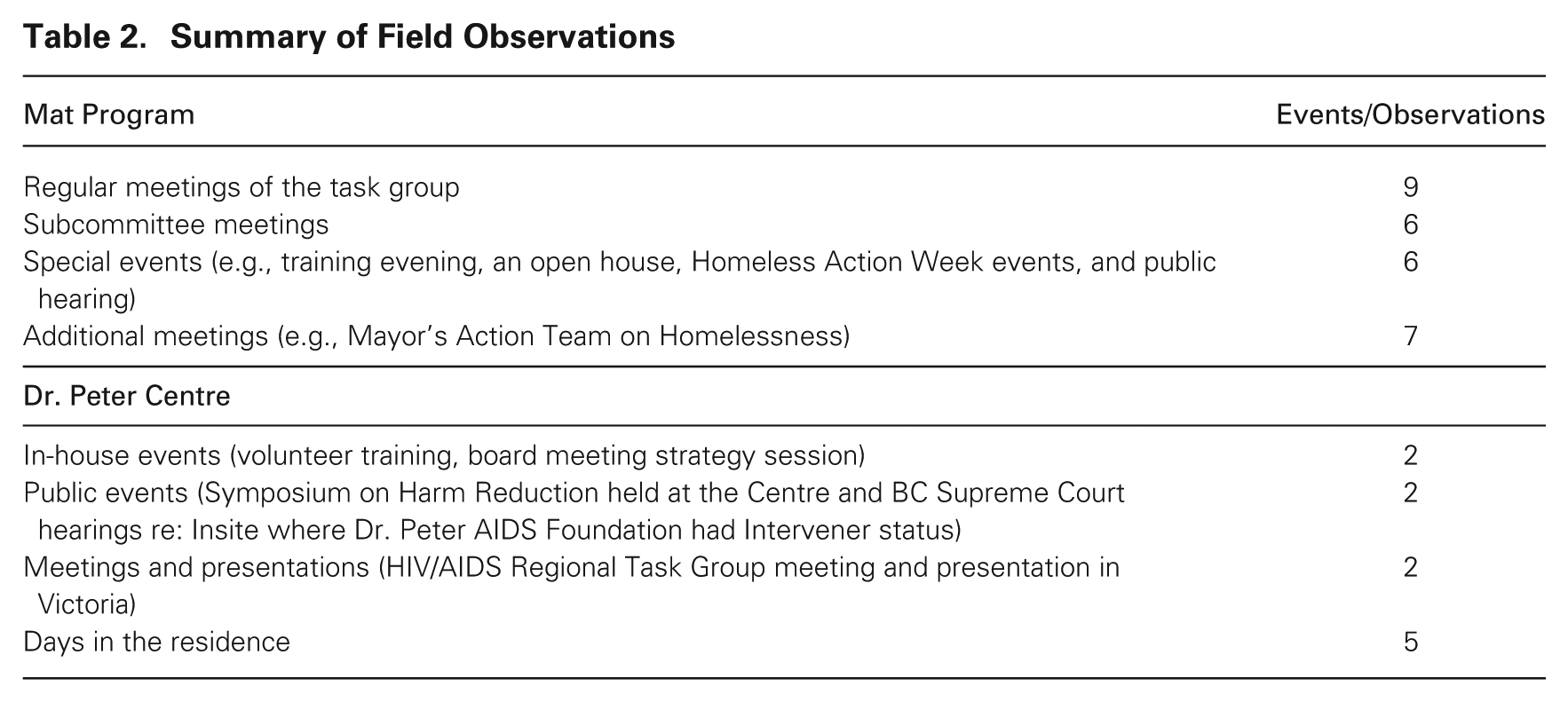
We spent from February 2009 to March 2010 in the field. Table 2 summarizes the events we observed. In the early stages, we observed as many activities as practically possible. Later, our observations became more focused, as when we spent a week in the residence of the Dr. Peter Centre. We observed formal meetings, such as the monthly Task Group meetings and a strategic planning session of the Dr. Peter AIDS Foundation’s board, as well as informal interactions such as often occurred while waiting for interviews in the Dr. Peter Centre. We tried to engage with the cases in a variety of ways, such as walking to the Dr. Peter Centre from different directions to better understand its geographical and social location and visiting the area where some of the homeless camped. The Mat Program was run in churches close to where one author lived, making it easier to understand and visualize its context.
Summary of Field Observations
Documents and other material
Our third main source of data was documents and other media, including internal documents such as minutes of meetings and external documents such as reports on homelessness or HIV/AIDS. Documentary evidence was particularly important in the early stages to sensitize us to the issues. We also accessed websites (e.g., of the Task Group and the Dr. Peter AIDS Foundation) and watched video recordings of the public hearings of the Mat Program in one municipality. We listened to and made notes on audio recordings of public hearings from other municipalities. We also gained access to one individual’s 30-year archive of media articles and other documents relating to HIV/AIDS in Vancouver.
Data Analysis
In analyzing the data, we engaged in a two-phase approach, with several data analysis steps making up each phase. The first phase revolved around generating an initial understanding of the data (Wolcott, 1994), which led us to focus on place as the central orienting concept. The second phase followed contemporary inductive, qualitative methods (Strauss and Corbin, 1998; Maitlis, 2005; Gioia, Corley, and Hamilton, 2013) and focused on analyzing the roles that specific places played in each of the cases. Although the relationship of place and institutional work could have been analyzed from a variety of perspectives, potentially highlighting dimensions such as the visual or historical, our interests led us to an interpretive approach focused on the understandings of the actors involved, our own observations of the places we studied, and archival material. In practice, data analysis was an iterative process that moved back and forth between the phases and motivated further data collection.
Phase 1
The first step in phase one was to generate a description of “what is going on” in each case (Wolcott, 1994: 16). To do so, we organized the data using an NVivo database and a Microsoft Excel spreadsheet to build a chronology of key events. We then developed a more detailed chronology for each case that included more events and the work of different actors. Finally, we generated categories and themes, identifying within each case a set of mini-cases (Stake, 2005) that would form an intermediate basis for data analysis. It was at this point that we engaged in member checking to ensure the validity of our initial findings. We sent a case write-up to each of the individuals who were our original points of contact and who had an overview of the innovation process and met with them to get feedback.
In the second step of this phase, we focused on detailed analysis of the data, a process of “panning in” to identify “essential features and the systematic description of interrelationships among them—in short, how things work” (Wolcott, 1994: 12). We first coded the data for each of the 11 mini-cases around the following topics: features of the housing being created; what made it novel and contested; how it actually came about (who, what, where, and when); the role of places; and what the process seemed to enable or constrain. This resulted in 11 mini-case reports, averaging 35 pages. We then focused on writing analytic memos to provide an intermediate step between the coding and the interpretation/write up of the data (Hesse-Biber and Leavy, 2010). It was at this point that we chose to make place a focus of our analysis because it emerged as a consistently important theme in our findings.
Phase 2
The second data analysis phase focused on analyzing the roles that specific places played in each of the cases. This phase had two main elements: selecting the places and analyzing their roles. The places we chose were consistent with the methodological implications of the concepts we reviewed from the literature. The literatures on place and institutional work point to an exploration of places with significant emotional, practical, and political significance (Gieryn, 2000; Cresswell, 2004) and that are potentially intertwined with multiple sets of activities, meanings, and values (Latour and Woolgar, 1986; Finnegan, 2008). The literature on place also suggests a focus on particular places rather than dimensions of place or space (Relph, 1976; Cresswell, 2004) and places that vary significantly in terms of size or scale (Marston, Jones, and Woodward, 2005). We did not examine places that did not meet these criteria because we had no basis on which to choose such cases or a priori theoretical foundations for interpreting their roles or lack of roles in institutional work.
Based on these criteria, we examined in detail two places from each of the cases. From the Dr. Peter Centre case, we focused on Dr. Peter’s apartment and the Dr. Peter Centre itself. Dr. Peter’s apartment featured prominently in a television series—”An AIDS Diary,” also known as the Dr. Peter Diaries—which was the genesis of the Dr. Peter Foundation that would eventually found and operate the Dr. Peter Centre. It seemed from watching the Dr. Peter Diaries that Peter’s apartment had significant emotional and symbolic significance and was intertwined with multiple sets of meanings and values. We also chose to examine it as a part of our attempt to explore a set of places with significant variation in terms of scale. We chose to examine the Dr. Peter Centre because it was clear from interviews, observation, organizational documents, and media that the Dr. Peter Centre had important emotional, political, and practical impacts on those it touched. The Centre’s activities and resources were also clearly tied to multiple domains, including health, family, community, housing, and drug use and addiction.
From the Mat Program case, we focused on the Tri-Cities and the churches used to implement the program. The Tri-Cities are the set of municipalities within which the Mat Program was established and were identified in interviews, organizational documents, and the media as having emotional, political, and practical significance for its residents and for the institutional work associated with the Mat Program. Examining their role also allowed us to stretch our consideration of different sizes of place in the opposite direction from Dr. Peter’s apartment. The final place we examined in detail was the set of churches that were used to roll out the Mat Program. They presented an interesting case of places to which individuals and groups had strong ties, which led to significant debate over their emotional, political, and practical meanings.
Our approach to analyzing the role of the places varied depending on our early findings with respect to each place. For our analyses of the Dr. Peter Centre, the Tri-Cities, and the churches, we adopted a traditional inductive, qualitative approach of developing concepts and relationships based on the talk and text of study participants (Langley and Abdallah, 2011; Gioia, Corley, and Hamilton, 2013). This reflected our belief that the roles of those places in institutional work were tied to the interpretations of the actors involved and representations in media reports and other documents. For example, in examining the role of the Tri-Cities, we first established a set of first-order concepts taken directly from the data, which we aggregated to a set of second-order themes, including “collective identity,” “existing routines and resources,” “constructing homelessness as a Tri-Cities problem,” and “constructing the Mat Program as a Tri-Cities response.” We then theoretically aggregated to aggregate dimensions, in this case to the ideas of “place as a social enclosure” and “places contain institutional work.” Figure 1 shows the data structure.

Data structure for the roles of places.
For our analysis of Dr. Peter’s apartment, our approach stemmed from our initial reactions to how it was presented in the diaries, the role it seemed to play in institutional work, and the available data. To understand the role played by Dr. Peter’s apartment, we watched all 111 diaries, two related documentaries, and a video of Dr. Peter speaking a few days before his death, and we examined his parents’ albums, which recorded many of the written responses to the diaries. It seemed that the apartment played a primarily symbolic role in the production of “An AIDS Diary,” and so we adopted a semiotic approach to our analysis (Barley, 1983; Deely, 1990; Peirce, 1998), which we describe in more detail in our findings section. Through a semiotic analysis of Dr. Peter’s apartment we were able to examine its role as a signifier in the Dr. Peter diaries and the contribution it made to the institutional work of the diaries.
The Roles of Place in Creating Housing for the Hard-to-house
The research question that guides this paper asks what roles places play in institutional work. Although we focus primarily on the distinct roles that places played in different instances of institutional work, an important finding concerns the common aim that cuts across the institutional work we observed. An overarching aim of the institutional work we studied was to affect local meanings of the institution of “human solidarity” as enacted in local practices and, more specifically, to affect local definitions of “us” that were tied to the institution of human solidarity (Rorty, 1989). The institution of human solidarity involves a socially negotiated set of boundaries within which we express care and concern (Tronto, 1993; Noddings, 2003) and outside of which we leave such care to others. Although human solidarity has at times been conceptualized as basic and universal (Donnelly, 2007; Gunson, 2009), our findings are consistent with Rorty’s (1989: 195) argument that human solidarity is “made rather than found, produced in the course of history rather than recognized as an ahistorical fact.” Important for our analysis is the local and practical nature of human solidarity as an institution: the boundaries of solidarity are decided by specific communities for specific periods of time and defined through both practice and discourse (Tronto, 1993; Noddings, 2003).
Against the backdrop of this common aim, our findings have three key elements: (1) three roles that places played in institutional work (containing, mediating, and complicating); (2) for each role, a distinctive ontology that places assumed (social enclosure, signifier, practical object); and (3) a set of characteristics that allowed particular places to play each role.
Places Contain
Our first major finding is that places contain institutional work: some places establish and maintain boundaries around institutions and actors’ efforts to affect those institutions. The place on which we focused was the “Tri-Cities,” the set of municipalities in which the Mat Program was established. The overarching institution targeted by the institutional work we observed was the local definition of human solidarity as expressed in practices and discourse around homelessness in the Tri-Cities. We observed actors working to shift the boundaries of “us” so that it included people living homeless in the Tri-Cities, bringing those people within the boundaries of care and mutual obligation. This involved constructing homelessness as a Tri-Cities problem and constructing the Mat Program as a Tri-Cities response.
The Tri-Cities as a place
We defined place as the intersection of location, material form, and a set of meanings and values (Gieryn, 2002; Cresswell, 2004). The Tri-Cities comprise three contiguous municipalities—Coquitlam, Port Coquitlam, and Port Moody—situated in the northeast part of Metro Vancouver. Its location is clearly delineated not only by political boundaries but also by the Fraser River to the south, the Indian Arm inlet and Burnaby Mountain to the west, the Pitt River to the east, and the North Shore Mountains to the north. The natural physical boundaries interact with the built environment to construct a distinct and distinctive place. The borders separating the three municipalities mean relatively little in the day-to-day experience of residents, with highly integrated roads and infrastructure, and architecture and zoning that are similar to each other and distinct from both the much bigger urban municipalities to the west and the smaller, more rural towns to the south and east. The meanings associated with the Tri-Cities are also distinctive: the name reflects how integrated the cities are not only in terms of scenery, climate, and facilities but also in terms of understanding of what it means to live there, understandings that were central to the evolution of the Mat Program.
The Tri-Cities as a social enclosure
We observed that the Tri-Cities played an important role in how the problem of homelessness was understood, which actors were involved, what resources were used, and how the Mat Program was conceptualized and enacted. These observations led us to examine how the actors involved understood the Tri-Cities in relation to the issue of homelessness and the institutional work around this issue. The first finding was that the Tri-Cities acted as a “social enclosure,” with two key facets: (1) a collective identity and (2) a set of routines and resources. Table 3 presents supporting data for our findings.
Data Supporting Places Containing Institutional Work

By collective identity, we mean a “cognitive, moral, and emotional connection with a broader community” (Polletta and Jasper, 2001: 285). In this case, the collective identity was organized around the Tri-Cities and expressed in several forms, some tangible and others more implicit. Interviewees’ descriptions of the relevant political geography were dominated by references to the Tri-Cities rather than constituent municipalities. As one interviewee said, “residents of these communities are unique in that we flow through these three communities, without making distinctions.” The Tri-Cities as an important identity for residents was echoed in formal representations, such as the Tri-Cities Chamber of Commerce, which declares itself “the voice of business in the Tri-Cities.” 2 Similarly, visitors could access a Tri-Cities Visitors Guide that described its “abundant parks, arts and cultural venues.” There was also the Tri-City News, with a tagline that read “Your stories. Your community. Your newspaper.” 3 Central to the collective identity associated with the Tri-Cities was the idea that the place was different from its neighboring municipalities, especially Vancouver, which was described in terms of both its social problems, such as drug use and homelessness, and its greater resources and more developed routines to deal with such problems: “there’s Vancouver and then there’s everyone else” (Mat Program organizer). In contrast, the Tri-Cities was described in terms of its small size and safe, friendly streets. At a public hearing on the Mat Program, many Tri-Cities residents described how they felt safe and belonged in this place, arguing it was a safe place for children who “can play in our streets” and residents who are “able to walk in the morning and night without fear.”
The second theme underpinning the Tri-Cities as a social enclosure was the existence of preexisting routines and resources. These included housing-focused groups and services, such as the Tri-Cities Housing Coalition, which was a coalition of Christian churches, a Jewish congregation, and several community groups, and the Tri-Cities Community Planning Committee, which involved senior managers from government and service agencies. Preexisting routines and resources also included service agencies, such as the Tri-Cities Mental Health Centre and the Tri-Cities Women’s Resources Society. Although these organizations and agencies were embedded in networks that extended beyond the Tri-Cities, they all had primary commitments to the Tri-Cities in terms of their membership, responsibilities, and identities.
The containing role of the Tri-Cities
Our second main finding with respect to the role of the Tri-Cities was that it contained—established and maintained boundaries around—institutional work and the institution it targeted. The Tri-Cities played this role between 2002 and 2010 as actors worked to shift the institutionalized boundaries of solidarity—the dividing line that distinguished “us” from others—so that it included people living homeless in the Tri-Cities. This work involved both establishing the problem of homelessness as a local issue and constructing a local response to it. Establishing the idea that homelessness was a Tri-Cities problem involved institutional work by a range of actors, a centrally important form of which was a set of homeless “counts.” In January 2002, a count of homeless people in Greater Vancouver documented more than 1,100 homeless people overall, but only 13 in the Tri-Cities (Jim Woodward & Associates et al., 2002). In 2004, a Salvation Army count identified over 100 homeless people living by the Coquitlam River, which ran through the Tri-Cities. A second Greater Vancouver count in March 2005 showed 38 homeless people in the Tri-Cities (Social Planning and Research Council of BC, 2005). Then, in 2005, the Hope for Freedom Society, a nonprofit organization that advocated for clients with addictions, conducted an intensive count that identified 177 homeless people in the Tri-Cities, the majority “camped” within one kilometer of downtown Port Coquitlam (Thiessen, 2006). The 2006 report that stemmed from the count “was very, very pivotal to what happened . . . because it created an alarming picture of homelessness in the Tri-Cities, much greater than most people suspected” (interviewee).
Also important to the construction of homelessness as a Tri-Cities issue were media reports, including articles, editorials, and letters to the editor, particularly in the Tri-City News. Media reports documented the homeless counts and related news, such as the report of a 500-percent increase in “‘Turn aways’ from the region’s seasonal shelters in the last five years” (Tri-City News, 2006). Letters to the editor reflected hopes and frustrations of local residents, who complained about the increasingly visible problem of homeless people in their neighborhoods. Together, the homeless counts and media coverage constructed homelessness as a Tri-Cities problem, giving it form and establishing its boundaries.
The second part of the institutional work involved constructing a Tri-Cities response to homelessness, initially led by the Tri-Cities Housing Coalition. Motivated by the homeless counts, the coalition hosted a public forum on homelessness in the Tri-Cities, with more than 200 people participating in the Coquitlam Council Chambers. A critical outcome was a widespread agreement to revitalize the Tri-Cities Task Group on Homelessness. At the task group’s next meeting, it articulated a vision that described “A future where all citizens of the Tri-Cities have access to appropriate housing and supports and no one is homeless” (Tri-Cities Homelessness Task Group meeting minutes, January 5, 2007). Within six months, it had made significant efforts to change the ways homelessness was understood and managed in the Tri-Cities by involving all levels of government and connecting with senior representatives from the three municipalities.
The task group also managed a set of subcommittees, including the Facilities Subcommittee in which the Mat Program was originally developed. The Mat Program was explicitly understood as a Tri-Cities program. Whereas previous mat programs in Greater Vancouver were run out of a single location, this program was designed to operate in five different Tri-Cities churches, rotating monthly from November through March. Unlike other mat programs, located outside or at the edge of residential areas, the churches used in the Mat Program were in residential Tri-Cities neighborhoods. Users of the Mat Program were also expected to come from across the Tri-Cities, with the Hope for Freedom Society providing bus transportation.
The containing role of places in institutional work
The role of the Tri-Cities in the Mat Program suggests that places can contain institutional work by establishing and maintaining boundaries around institutions and efforts to affect them. It further suggests that places do this through their connections to a collective identity and to sets of existing routines and resources. Although some places might be experienced as conveniences or transitional spaces, other places act as key markers for people’s identities. This was clearly the case for the Tri-Cities, which acted as a geographic and political idea with which people and organizations identified themselves. People’s identification with a place affects the relevance of situations that might be constructed as social problems: in the Tri-Cities, homelessness began as a problem associated with other communities but through the work of actors engaged in homelessness counts and media reports was constructed as a Tri-Cities problem, and thus a problem for many of the individuals and organizations located there. Places also contain institutional work by connecting it to a place’s preexisting routines and resources. In the Tri-Cities, homelessness became connected to the routines of government agencies, churches, and non-profit organizations, all of which identified as Tri-Cities organizations. Although these organizations and agencies were embedded in broader networks that undoubtedly affected their capacity to engage with the problem of homelessness in the Tri-Cities, their identification as distinctively Tri-Cities organizations and agencies brought with it an ability and a motivation to channel resources and employ routines in ways that helped address the issue of homelessness as a local one. Thus the collective identity and resources and routines associated with the Tri-Cities shaped the responses of local actors, affecting the scope of how the problem was defined, the solutions proposed, the stakeholders consulted, and the actors enrolled in implementation.
From an institutional perspective, the Tri-Cities represents a bounded, organized social enclosure whose members share a set of norms and rules (Van Maanen and Barley, 1984) and recognize their affiliation and mutual obligations (Lawrence, 1998, 2004). It is these characteristics—boundedness and social organization—that enabled the Tri-Cities to act as a container for institutional work. Writing on communities (Gusfield, 1975; Block, 2008) has noted that the meaningfulness of a social group depends significantly on the status of its boundaries. The clear, meaningful boundaries associated with the Tri-Cities, both in terms of physical separation and social distinctions, shaped residents’ response to the social problem of homelessness. What makes these efforts describable as institutional work is their focus on affecting institutionalized beliefs about who was and was not a part of the Tri-Cities. Whereas the establishment of temporary shelter for people living homeless might not require significant institutional work in many communities, in the Tri-Cities it involved efforts to shape a powerful institution, the boundary around “us” that defines the limits of human solidarity.
Places Mediate Institutional Work
Our second major finding is that places mediate institutional work. By mediate, we mean that some places act as interpretive filters that connect institutional work to targeted institutions. The institutional work on which we focus was the development of “An AIDS Diary,” a two-year series of three-minute segments on “CBC News Vancouver at 6” in which Dr. Peter Jepson-Young shared his experiences with HIV/AIDS. As with the Mat Program, an important goal associated with the series was to affect local definitions of human solidarity: for the producers of “An AIDS Diary,” a central aim was to transform institutionalized beliefs of BC residents about people living with HIV/AIDS (Gawthrop, 1994), broadening BC residents’ notions of “us” and thus extending solidarity to include those people living with HIV/AIDS. We found that an important element in the institutional work was a specific place: the place that mediated the connection between the AIDS diary and beliefs about people living with HIV/AIDS was Dr. Peter’s apartment.
Dr. Peter’s apartment as a place
The Dr. Peter Centre is named after Dr. Peter Jepson-Young, who in September 1986, at 29 years old, was diagnosed as HIV-positive. At the time, fear over HIV/AIDS led to significant social costs for those with the virus, including travel restrictions, lost jobs, and lost homes. Peter was fortunate to have a supportive family and the opportunity to enroll in a pilot project prescribing azidothymidine (AZT). He completed his medical training without disclosing his HIV status beyond close family and friends. A few years later, struggling with the onset of blindness, Peter and a medical colleague approached the CBC, Canada’s national television broadcaster, about developing “an AIDS diary” that would focus on issues previously little discussed on television, including HIV transmission and treatment, health and social effects of the disease, and homosexuality. 4 In the diaries, Dr. Peter’s apartment plays a prominent role. The Online Appendix provides a brief description of each episode set in his apartment (http://asq.sagepub.com/supplemental). His apartment was more than a background for the diaries: it represented an important place, a specific, concrete location, material form, and set of meanings. The apartment was evidently located in the West End of Vancouver, in the heart of the city where both Peter and the majority of viewers lived. The apartment’s materiality mattered in multiple ways, shaping and constraining how the diaries could be filmed and establishing it as a place from which the diaries began and to which they repeatedly returned. Very often, Peter is seen sitting in his living room on a soft chair or his green couch. At other times, he presents the diaries from a specific room and incorporates its materiality and meaning into the content of the segment. We see Peter in his kitchen, preparing a meal with his 9-year-old niece. Peter is at the dining room table, looking through old family photos with his mother. In his last few diaries Peter is seen in bed, with a now-familiar blue and white china tea cup resting on a side table.
Dr. Peter’s apartment as a signifier
The role that Dr. Peter’s apartment seemed to play in the AIDS diary was a symbolic one, and so we adopted a semiotic approach to our analysis (Deely, 1990; Peirce, 1998). A semiotic analysis is, at its core, relatively simple. It involves the identification of signs, combinations of signifiers (material marks and sounds) and signifieds (concepts or ideas) (Hodge and Kress, 1988). Thus a semiotic analysis produces an interpretation of the meaning of a set of marks and sounds in a specified context. Central to the idea of signs is that they are arbitrary, historical constructs (Phillips and Brown, 1993), and so an important aspect of semiotic analysis is examining the socio-cultural context that provides actors with the motivation to produce signs, as well as the symbolic resources necessary for their construction and interpretation. Semiotic analysis is also concerned with the mechanisms that connect signifiers to signifieds and thus give meaning to marks, images, and sounds. In focusing on those mechanisms, semiotics involves a structuralist analysis, which includes “identifying the constituent units in a semiotic system, . . . the structural relationships between them . . . and the relation of the parts to the whole” (Chandler, 2007: 83).
An important part of the context of the diaries was its producers’ aim to normalize people living with AIDS: to provide viewers a model of someone with AIDS to whom they could relate, so that “their fears and phobias would disappear as they discovered the humanity in people who are different from them” (Gawthrop, 1994: 53). Within this normalization strategy, Peter’s apartment played an important role. It acted as a signifier (in the form of its visual depiction within the diaries) for the concept of “home,” attaching Peter, his message, and the diaries to a concept with which viewers were familiar and comfortable. This argument is based in part on the special meaning of home as a concept in contemporary discourse: “home, more than anywhere else, is seen as a center of meaning and a field of care” (Cresswell, 2004: 20). Home describes “the setting through which basic forms of social relations and social institutions are constituted and reproduced” (Saunders and Williams, 1988: 82). Since the industrial revolution, homes have come to be understood as places with “considerable social, psychological and emotive meaning for individuals and for groups” (Easthope, 2004: 135), tied to identity (Proshansky, Fabian, and Kaminoff, 1983) and stability (Massey, 1995).
Moving to a structuralist analysis, we identified two intratextual (syntagmatic) (Hjelmslev, 1953) relationships that together established Peter’s apartment as a signifier for the concept of home. The first is based on sequencing, a foundational relationship in semiotics that establishes meaning through chains of signifiers (Deely, 1990; Chandler, 2007). Key to the sequencing in the diaries was a movement to and from Peter’s apartment. The first segment opens with Peter on the sidewalk of a busy street and then within the first minute he is at home in his apartment. Peter is then seen in his apartment in nearly half of the remaining 110 diaries: 40 filmed in the living room and another 9 filmed in the dining room, bedroom, kitchen, or bathroom. A pattern emerges in the diaries in which Peter’s apartment continuously resurfaces as the setting, juxtaposed against a wide variety of settings outside his home, with no other setting seen more than a few times. Moreover, the topics discussed in Peter’s apartment ranged across a wide variety of issues, including his health, treatments, coping strategies, stigma, death, and homosexuality. In contrast, specific places outside his apartment were used to situate discussions of particular topics, as in the third episode, shot outside Peter’s high school and focusing on the challenges of growing up gay. The differences in how and how often Peter’s apartment and other places were used as settings created a pattern in which the apartment became the hub for the diaries. This pattern emphasized the centrality and stability of Peter’s apartment in the diaries and in his life. It emphasized the idea of the apartment as Peter’s home, the place to which Peter and the diaries would continue to return.
The second structuralist relationship we examined is based on contrast, which in semiotic analysis represents a form of “opposition” (Chandler, 2007), a process that relies on the principle “we know what something means, in part, by knowing what it does not mean” (Barley, 1983: 397). Binary oppositions present the most obvious examples of such signs: up and down, left and right (Chandler, 2007). Oppositions can also be more complex and indeterminate, as with emotions: the meaning of “sad” is in part that it is not “happy” but also that it is not “angry” (Downes, 2000). In the diaries, a critical symbolic opposition was between stability and change. Throughout the diaries, the appearance of the apartment remained essentially stable: it had a well-kept, carefully put-together appearance, with the same furnishings and artwork featured and their condition unvarying. In contrast, Peter’s physical condition deteriorated almost continuously over the course of the diaries, as shown in the image captures of Peter from episodes 1, 56, and 111 in figure 2. The Online Appendix notes changes in Peter’s appearance in each of the episodes filmed in the apartment: initially healthy and physically attractive, more and more lesions from Kaposi’s sarcoma appear on Peter’s face and limbs, his hair thins, he appears to gain weight, and he looks increasingly tired and ill. The importance of this opposition—between the stability of Peter’s apartment and the changes in his physical condition—is that it embodies and reinforces the association of security and stability with the concept of home (Massey and Jess, 1995).
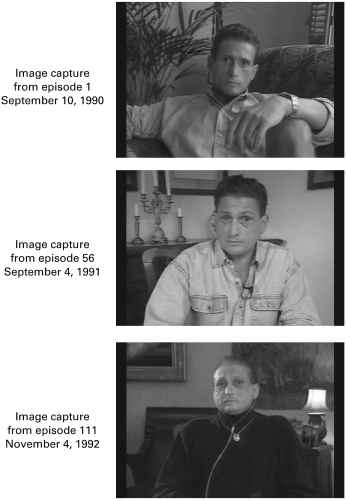
Dr. Peter Jepson-Young in scenes from “An AIDS Diary.”
The mediating role of places in institutional work
The role that Dr. Peter’s apartment played in the diaries suggests that places can mediate institutional work by providing an interpretive lens through which people understand the institutions that actors are working to affect. This process is shaped by the geography of everyday life. Some places have the potential to play a mediating role because they represent ideas with which people are familiar and comfortable. From an institutional perspective, home represents a “proximal institution,” a shared idea with which actors in a community are familiar and in frequent contact. In contrast, the inclusion of people living with HIV in definitions of “us” as they pertain to human solidarity concerned an institution that was much less a part of the daily lives of the diaries’ viewers. These “distal institutions” represent shared sets of ideas, rules, or beliefs, but ones that are less common objects in the discourse of a community, so that members of the community might consider them only infrequently and with less direct experience than proximal institutions. Peter’s life in and around his apartment provided a connection to viewers through their shared experience and understanding of the everyday institution of home. The ability of places to act as signifiers for proximal concepts depends on their connection to the signified (the concept of “home” in this case) being both interpretable and authentic: the narrative in which the place is embedded needs to provide a frame through which the relationships between places and proximal concepts and distal institutions can be interpreted sensibly (Weick, 1995) as well as accepted emotionally (Hochschild, 1979; Buckland, 2001).
Places Complicate
Our study suggests that places play one more role in institutional work: they complicate it. By this we mean that some places are incorporated into institutional work as “practical objects” that introduce unexpected complexity to these processes. By a practical object, we mean something that is used as a tool, with particular affordances owing to its materiality (Gibson, 1977), to achieve some desired ends by facilitating a practice or set of practices (Vaara and Whittington, 2012). So whereas the notion of a signifier highlights how places can affect institutional work on a symbolic basis, the notion of a practical object highlights how a place might be used functionally to facilitate institutional work. We draw on two places from our study to illustrate this complicating role: the Dr. Peter Centre and the churches that housed the Mat Program. Both places complicated institutional work that aimed to shift local definitions of human solidarity by shifting the boundaries of “us” as expressed in practices and discourse. The Dr. Peter Centre complicated institutional work that focused on institutionalizing “comfort care”: an approach to providing HIV/AIDS care in which all people living with HIV/AIDS are treated as one would treat one’s family or close friends in such a situation. The churches, as in the case of the Tri-Cities, were involved in efforts to shift the boundaries of “us” so that it acknowledged the presence of people living homeless locally and included them within the boundaries of care and mutual obligation.
The Dr. Peter Centre as a place
The Dr. Peter AIDS Foundation was established days before Peter died, with the mission to provide comfort care to others living with HIV/AIDS. As Peter described it,
As I have lived with AIDS during the last six years, I have been sustained by the love and support of so many people. In facing each new challenge, I have always been secure in this comfort care. . . . Quality of life and well-being are sometimes as simple as a trip to see family, a meal out with friends or being able to live the rest of one’s life at home. (Dr. Peter Jepson-Young, quoted in Gawthrop, 1994: 242)
The idea to institutionalize comfort care through the development of an HIV/AIDS day center came from local agencies, which were finding themselves overwhelmed with demand for their services. The Dr. Peter Centre opened in 2003 as Canada’s first HIV/AIDS day health program and supported-living residence. It is located across from St. Paul’s Hospital on a residential street in the West End of Vancouver. It consists of a purpose-built, four-story building attached to and incorporating an existing heritage house, totaling approximately 30,000 square feet. The Centre includes treatment, counseling, and therapy rooms, as well as 24 suites, common rooms for art, music, watching TV, and eating meals, and an enclosed courtyard with a small garden.
The Dr. Peter Centre as a practical object
In the institutionalization of comfort care, the Dr. Peter Centre acted as a “practical object” with two key dimensions: (1) complexity describes the ways activities in a place span institutional domains often understood as separate; and (2) embeddedness describes the connection of places to the day-to-day routines of individuals, organizations, or communities. Table 4 presents illustrative data for our findings.
Data Supporting the Dr. Peter Centre Complicating Institutional Work
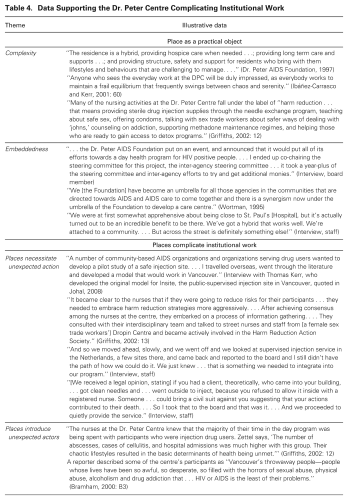
The complexity of the Dr. Peter Centre stemmed from the combination of ideas and practices that cut across the domains of healthcare, addictions, family, and community occurring in a single place. In an early statement of its purpose, the Centre was described as providing three distinct forms of care: (1) “hospice care when needed (like a freestanding hospice or like dying at home),” (2) “long term care and supports (like a . . . group home),” and (3) “structure, safety and support for residents . . . who often have addictions and/or diagnosed mental illnesses” (Dr. Peter AIDS Foundation, 1997). Because the Centre’s clientele include drug users and sex workers, nursing evolved to include such activities as “providing sterile drug injection supplies . . ., teaching about safe sex, offering condoms, . . . [and] talking about safer ways of dealing with ‘johns’” (Griffiths, 2002: 12). The complexity that impinges on Dr. Peter Centre staff is illustrated by a story a staff member told us about an evening spent with a young resident,
doing puzzles and . . . helping her with her English. Then she goes to do whatever and she comes back with knapsack and jacket, and she says, “I’m going out.” It’s about midnight, and . . . all of a sudden you switch from playing games, to helping with school, to “OK, do you have clean needles in your knapsack? Do you have condoms? Do you have warm enough clothes?” . . . Then off she goes and then coming back at three or four in the morning and her neck is red and she’s having a hard time breathing and she’s in pain and it’s because the john she hooked up with at some motel was into choking her during sex. You go through sitting with her while she cries through the shame of prostituting. . . . Getting her in her pj’s and sitting there holding her hand until she falls asleep. (Interviewee)
This story shows how activities in the Centre not only spanned domains of care but required staff to integrate caring for participants’ health, safety, and well-being in novel, creative ways. Although large healthcare organizations may respond to the various needs of people living with HIV/AIDS who are also drug users and involved in sex work, their responses are more often separated across facilities, with the provision of HIV therapies, living accommodation, and harm-reduction programs associated with distinct locations, each in its own place. As we discuss in greater detail below, the co-location of these activities made the dynamics within the Dr. Peter Centre far more complex than if they had been separated.
The second dimension of the Dr. Peter Centre as a practical object was its embeddedness through connections to other organizations. Planning for the Centre connected it to a network of local healthcare and HIV/AIDS agencies: the “Dr. Peter Steering Committee” included representatives from the Dr. Peter AIDS Foundation, AIDS Vancouver, the British Columbia Persons with AIDS Society, St. Paul’s Hospital, the B.C. Centre for Excellence in HIV/AIDS, Vancouver Health Department, Greater Vancouver Mental Health Services, and the Lower Mainland Region Alcohol and Drug Program. The Centre’s daily operations connected it to an array of agencies working in healthcare, addictions, poverty alleviation, housing, and family services across Vancouver. The Centre is also embedded in the work of other organizations and communities as a model of HIV/AIDS care. Delegations seeking to understand the Centre’s approach have come from across Canada and countries around the world, including China, Russia, Norway, South Africa, and the Ukraine.
The complicating role of the Dr. Peter Centre
The Dr. Peter Centre complicated the institutional work of institutionalizing comfort care by necessitating unexpected actions and introducing unexpected actors. Perhaps the most striking complication in the efforts to institutionalize comfort care was the establishment of a supervised injection room for intravenous drug users. When the Dr. Peter Centre was being established, the populations most affected by HIV/AIDS were shifting: although HIV/AIDS still predominantly affected gay men, it had started to become evident in increasing numbers of injection drug users. The rate of HIV infection among injection drug users had risen in ten years from relatively low rates (1–5 percent) in 1988 to epidemic levels (23–30 percent) by 1998 (Fischer, Rehm, and Blitz-Miller, 2000). As the face of AIDS changed, so did the faces in the Dr. Peter Centre. By 2000, 91 percent of participants were on income assistance, 69 percent had no fixed address or lived in hotels, 61 percent had a chemical dependency, 61 percent had a mental illness, and 41 percent had a history of sexual abuse.
In the late 1980s, Vancouver began to suffer from dramatically increasing numbers of overdose deaths, rising from only 17 in 1987 to 200 in 1993. By 2000, there were more than 130 in the first six months of the year. These deaths were felt deeply in the Dr. Peter Centre: many participants and staff knew drug users who had died and attended their memorials; staff became involved in groups, such as the Harm Reduction Action Society, that were organized in response to the epidemic of overdoses. The deaths also spurred action inside the Centre: in December 2001, following the overdose of a participant in the Centre’s laundry room, two nurses approached the executive director saying they wished to supervise participants injecting drugs. The nurses felt their relationships with participants were being undermined because participants had to leave the Centre to inject, often in unsafe conditions with unsterile materials. The executive director sought advice from the Registered Nurses Association of British Columbia, which argued that the nurses had a professional duty of care to provide this service where needed. The Centre also sought advice from lawyers, who suggested the likelihood of criminal prosecution was low because the nurses would not be directly handling an illegal substance. So in January 2002, the Dr. Peter Centre quietly began to operate a supervised injection service. In April of that year, at the launch of a report on the legal and ethical issues of establishing safe injection facilities, the Centre’s executive director announced it was already running one (Bohn, 2002a, 2002b).
The churches as practical objects
A second set of places that illustrates how places complicate institutional work comprises the five churches in which the Mat Program was housed. The churches, located in residential neighborhoods across the Tri-Cities, were not unusual with respect to their complexity or embeddedness prior to the Mat Program. Their proposed use as overnight accommodation for homeless individuals changed that, however, and complicated the institutional work of shifting the boundaries of “us” to include the people living homeless in the Tri-Cities. Table 5 presents illustrative data for these findings.
Data Supporting the Churches Complicating Institutional Work

Like many churches, those involved in the Mat Program had social outreach as part of their mission but had limited engagement. A key organizer of the Mat Program commented,
We thought we could provide that opportunity by doing outreach to homeless people on their own church grounds. We thought that could be pretty powerful. Here’s a chance to minister to people who are social outcasts, the margins of society, and do it right on their own home turf.
Although the churches had some contact with issues of poverty and addiction, primarily through educational programs put on for them by the NGO that conducted the crucial homeless count, the Mat Program would significantly increase their involvement in activities spanning institutional domains. The embeddedness of the churches prior to the Mat Program could also be described as moderate: they were connected to the routines and day-to-day lives of individuals who attended religious services and other activities and to the neighborhoods within which they were located. This changed significantly, however, with the proposal and development of the Mat Program.
The complicating role of the churches
Like the Dr. Peter Centre, the churches complicated institutional work by necessitating unexpected actions and introducing unexpected actors to the process. The proposal to run the Mat Program in local churches immediately encountered bureaucratic troubles. While churches were associated with humanitarian work, their zoning designation did not permit people to stay overnight. There was no zoning category for a temporary shelter, so each city had to create and approve a new type of activity: “We had to add a new definition for land use. . . . This is kind of a special case because I don’t think anyone would have envisioned a church, perhaps, operating as a temporary shelter” (interview, municipal planner). The need to deal with zoning issues came as a surprise to Mat Program organizers, who thought they could avoid such problems by moving the Mat Program among the churches: “I thought that at a month at a time, you wouldn’t have to go through any kind of a rezoning process. . . . And boy, I was wrong on that one! [laughter]” (interview, Mat Program organizer).
The zoning issue led to a series of unexpected actions by the Mat Program organizers, including public work that focused on assuaging the concerns of neighborhood residents and political work aimed at influencing elected officials who made zoning decisions. The public work of Mat Program organizers involved neighborhood meetings, a homelessness workshop for individuals and families living near the churches, and a formal public hearing in each of the three Tri-Cities municipalities. As one organizer recounted, “I had to go back to those churches . . . and talk to each one of the leaders of those churches.” Meetings with neighborhood groups often went badly for Mat Program organizers: “We had the public meeting I mentioned at Coquitlam Alliance Church. . . . And it didn’t go very well. After, Rob and I were asked to go to a meeting at Ranch Park School. . . . And this was a lynch mob.” Mat Program organizers also hosted a public workshop that included a councilor from each of the three cities, a representative of the region, the director of Hope for Freedom, and a couple who had been homeless. An important part of the process was the public hearing held by each city council, the most dramatic of which was hosted by Coquitlam City Council: “Oh yeah, it was a big event. We had a very, very strong negative reaction . . . much of it was incited by the Ranch Park crowd that were mostly foaming at the mouth” (interview, Mat Program organizer). The hearing was the longest in the city’s history, running until 3:00
Using the churches to house the Mat Program also introduced unexpected actors to the process. Organizers had to deal with politicians, civic and provincial bureaucrats, consultants, lawyers, and volunteers, as well as the neighborhood residents and church congregations with whom they had expected to engage. One organizer told us that interacting with politicians was crucial: “[Usually], I very seldom went political with anything. The shelter program I had to kick it up a notch. I had to schmooze politicians. . . . I was told right off the get go, ‘If you don’t do some backroom talking with the politicians, this is going to fail.’” Consultants were also key, particularly with respect to ensuring the churches were in compliance with regulations: “We hired a code consultant . . . [who is] an expert on building codes—more expert than the City is” (Mat Program organizer). Lawyers became involved when one of the municipalities agreed to the rezoning but required an unusual “sunset clause”: “I got three civil rights lawyers that called me and said ‘. . . what they did last night at city council is illegal. It’s not enforceable.’ What I did is, I called another [lawyer] . . . very familiar with this kind of stuff . . . [who] had a look at it” (Mat Program organizer). Using the churches for the Mat Program also led to an unexpectedly large number of volunteers: “I’ll never forget the first meeting that we had. There was about 250 [volunteers] that showed up. We had chairs for maybe 75 to 100” (Mat Program organizer).
The complicating role of places in institutional work
Our analysis of the Dr. Peter Centre and the churches suggests that places complicate institutional work through their “concreteness”—their materiality, association with day-to-day routines, and geographic locations. The Dr. Peter Centre represented the primary concrete mechanism through which those connected to and inspired by Dr. Peter worked to institutionalize comfort care. A range of other devices could have been used, such as the development of a social network of carers or educational programs for healthcare professionals, which might have had different dynamics with respect to whether and how they complicated the institutional work, linked to their different kinds of concreteness. Similarly, the way in which the churches complicated institutional work stemmed from their physical, geographic, and practical qualities. Their situation in the heart of residential neighborhoods and their proposed new use as overnight accommodation necessitated unexpected public and political forms of work that involved an unexpected array of actors.
From an institutional perspective, the Dr. Peter Centre and the churches can be described as complex, embedded practical objects. Such objects are complex in that they are used for, or proposed to be used for, purposes that span institutional domains often understood as separate, such as religious worship and shelter for the homeless, disease treatment and injection drug use. They are embedded in that they are connected to the day-to-day lives and routines of other organizations or communities. Places vary along these dimensions, and it is this variance that our study suggests is key to understanding which places are likely to complicate institutional work.
Discussion
We began by arguing that places have been significantly overlooked in organizational research despite their potentially profound consequences for organizational life. Our study confirmed these consequences, showing that places affect how organizational actors understand problems, marshal resources, employ routines, and construct connections between concepts. We identified three distinct roles that places play in institutional work—containing, mediating, complicating—each associated with a specific ontology—social enclosure, signifier, practical object. The methods we adopted mean we cannot claim these are the only roles and ontologies associated with places or how long a comprehensive list of such roles and ontologies might be. Instead, we claim that for this set of places and cases, these roles and ontologies were important to understanding the interplay of institutions, institutional work, and places. To use our findings to explore the role of places as active ingredients in organizational life, we integrate our findings into a process model of place in institutional work and explore the degree to which places can play any of the three identified roles.
An Integrated Process Model of Place in Institutional Work
Figure 3 presents an integrated process model of our findings that revolves around three key concepts—institutions, institutional work, and places—and suggests recursive relationships among them. Beginning at the left, institutions motivate and shape institutional work, which in turn affects institutions, sometimes as actors intended and sometimes not. The institutional work incorporates, intentionally or not, places that take on different ontological forms: social enclosures, signifiers, practical objects. How actors incorporate a place into their institutional work determines the ontological form assumed by that place. In the case of the Tri-Cities, for example, actors engaged with it as a social enclosure, drawing on its routines and resources and invoking the collective identity with which it was associated. Further, there is a feedback loop, so as a place is incorporated into institutional work, it will shape that institutional work as actors respond to its presence. Again in the case of the Tri-Cities, actors involved in developing the Mat Program adjusted their strategies and tactics over time as they felt the impacts of the Tri-Cities’ collective identity and resources and routines.

A process model of places, institutions, and institutional work.
Our findings further suggest that a place taking on an ontological form is associated with its playing a specific role in institutional work—containing, mediating, complicating—depending on characteristics of the place. When places incorporated into institutional work as social enclosures are well bounded and organized, they are more likely to contain institutional work. When places are incorporated as signifiers, they are more likely to mediate the relationship between institutional work and targeted institutions to the extent they represent proximal, plausible concepts. When places are incorporated into institutional work as practical objects, they are more likely to complicate it if they are associated with activities that span institutional domains and are embedded in the day-to-day routines of a wide range of actors.
A key research question that guided the paper was how places shape institutional work. Our study suggests that the roles places play have predictable effects in this regard. When places contain, as the Tri-Cities did, they shape institutional work by leading interested actors to leverage place-specific resources and routines and establish priorities and limits to institutional work based on their place-specific identities. Places that play a mediating role, such as Dr. Peter’s apartment, shape institutional work by allowing actors to target more distal institutions, providing cognitive and emotional pathways to those institutions, and lessening the perception of risk or threat associated with institutional change. When places take on complicating roles, as did the Dr. Peter Centre and the churches, they engender institutional work that is likely to change as it progresses, incorporating more elements and ideas as new actors become involved and the tensions among domains are addressed.
The roles that places take on can also affect the outcomes of institutional work. Our study suggests that as places take on different ontologies and play different roles, they connect institutions to different stabilizing mechanisms and consequently affect the basis for their institutionalization. Places acting as social enclosures that contain institutional work embed institutional change in place-specific routines and resources. The institutional work contained by the Tri-Cities, for instance, embedded new boundaries around “us” that included people living homeless in sets of existing routines and resources associated with Tri-Cities organizations. This can lead to a situation in which institutionalization depends on the stability and power of place boundaries (Douglas, 1996). In contrast, places that act as signifiers, mediating the relationship between institutional work and institutions, embed institutional change in the language, cognition, and emotion of community members (Hodge and Kress, 1988). The contribution of Dr. Peter’s apartment to shifting beliefs about people living with HIV/AIDS was through its impact on how people in British Columbia talked and thought about those beliefs. Thus institutionalization of such changes depends on the degree to which places help to achieve taken-for-granted shifts in discourse and cognition among community members. Finally, places acting as practical objects that complicate institutional work embed institutional change in newly formed or transformed sets of networks and practices, which are often emergent and unexpected. The Dr. Peter Centre embedded comfort care in the practice of supervised injection, the network of social, professional, and legal actors that were required to establish it, and the range of harm-reduction practices that accompanied it. The institutionalization of ideas and practices tied to places as practical objects may depend on the costs, particularly in terms of social capital and legitimacy, of disrupting those new networks and practices.
The Specificity of Roles and Places
An important issue that emerges from our analysis is whether any place could potentially play any of the three roles we identified. Our analysis suggests a conditional “yes” to this question. It suggests any place could hypothetically play any of the roles we identified, but the likelihood would depend on the match between the characteristics of that place and the requirements of the role. Taking Dr. Peter’s apartment as an example, it was able to mediate institutional work because it represented the proximal concept of home and provided a plausible and authentic instance of that concept. To consider whether it could contain institutional work would be to understand it as a social enclosure and focus on institutions within it, examining the degree to which Peter’s home is sufficiently bounded and organized to support institutions and institutional work aimed at affecting them. If we consider the potential for Dr. Peter’s apartment to act as a practical object complicating institutional work, the issue becomes the degree to which it is used for purposes that span multiple institutional domains and are embedded in a range of other actors’ day-to-day routines. We could, for instance, have focused on the use of Dr. Peter’s apartment as a practical object in the filming of the diaries. The production of the diaries brought Peter’s apartment into multiple institutional domains, including domestic, journalism, medicine, and politics, and connected it to an array of actors from each of these domains. 5 Although we did not have the data available to us to explore these dynamics, we might expect that using the apartment as a set complicated the institutional work in ways that using a purpose-built film studio would not have done.
The implications of this question are theoretically significant. It suggests that our analysis is not idiosyncratic to the particular places we explored: the possibility of all places containing, mediating, and complicating institutional work is real, but only under conditions more closely associated with some places than others. It also highlights the question of how we “choose” the place in which we are located when locations are associated with multiple, potentially salient, places: Are we in a farmer’s market or a parking lot? Am I in my office, my school, or my university? Our findings suggest that the answers to these questions are rooted in the actions and aims of actors and the role that places play in that action. If, for example, actors are engaging with a place as a social enclosure to contain institutional work, they will draw on the boundedness and organization of the place to accomplish that work. This may be clearest in nested places, such as a personal office, faculty building, and university campus, so that if my efforts to achieve a desired end are frustrated by the limits of my office qua office, I may engage with it as a location within my school or my university.
Generalizing beyond Place
An important potential direction for future research is to consider whether phenomena other than places might take on the ontologies and play the roles we have identified. Beginning with places as social enclosures, if boundedness and organization are key to containing institutional work, then other phenomena, such as organizations or social networks, could act as social enclosures, containing institutional work and targeted institutions if they were sufficiently bounded and organized. If an organization contained institutional work, for instance, our analysis suggests the construction of institutions would be organization-specific, rather than place-specific as in our study. In our study, the boundedness and organization we observed, along with the construction of the problem and the response, were all distinctly connected to the Tri-Cities rather than some other phenomena, which suggests that the Tri-Cities played this containing role but that places are not the only phenomenon that might do so.
With respect to places as mediating institutional work, the question becomes whether other phenomena could act as signifiers that represent plausible, proximal concepts. In the case of Dr. Peter’s apartment, a reasonable, complementary focus to our analysis might have been to look at Peter himself mediating the connection between the diaries and beliefs about people living with HIV/AIDS. Although we did not examine Peter as a signifier because of our focus on place, it is reasonable to assume his appearance in the diaries may have played a mediating role, perhaps representing the concept of a “nice man” or “a trusted neighbor.” That Peter may have played such a role does not suggest, however, that his apartment did not also play an important mediating role in this context. It may be that more distal institutions, as were targeted here, may lead to institutional work that relies on multiple signifiers representing plausible, proximal concepts in order to shift people’s beliefs and behavior.
Finally, turning to places as practical objects complicating institutional work, our findings suggest the potential for other phenomena to play such roles and how they might do so. If, for instance, a technology was used as a practical object in the institutionalization of an idea, and using that technology, by virtue of its characteristics, necessitated unexpected actions and introduced unexpected actors, we would describe it as having complicated institutional work in much the same way that we saw the Dr. Peter Centre and churches do in our study.
Contributions and Future Research
This paper broadens the understanding of location in organization studies, in particular adding a consideration of place to the traditional focus on space. Our findings provide a corrective lens to the view that we now exist in a “flat” world (Friedman, 2007), in which places are largely irrelevant because locations represent nodes in global networks best understood in terms of generalized, abstract dimensions. There is no doubt some truth to the assertions that much of the world has been “McDonaldized” (Ritzer, 2012) and reduced to sites of “nothingness” (Ritzer, 2003). Perhaps this points, however, to the increased importance of places such as those examined here, places with qualities that allow them to play specific, important roles in organizational life. The Dr. Peter Centre is an important place in part because of its novel integration of distinct institutional domains, and the Tri-Cities is important in part because it represents a contemporary urban community with a strong shared collective identity, well-developed resources and routines, and meaningful boundaries. At the same time, Dr. Peter’s apartment and the churches used to host the Mat Program were not in and of themselves noteworthy; it was how those places were employed in organized efforts at social change that made them special and their contributions worth examining. Thus continuing to overlook places as a focus of scholarly attention would mean missing out on much of what makes the locations of organizational life interesting and important.
This study also has implications for the emerging focus on materiality in organizational research (Jones and Massa, 2013; Raviola and Norbäck, 2013). Our findings document the ontological flexibility of places, as they become social enclosures, signifiers, or practical objects, through their incorporation into institutional work. This shows that a physical object, including a place, represents a nexus of the ideational, social, and practical that can “become” distinctly different things in the world as actors’ efforts connect it to different institutional domains. Thus scholars wanting to examine materiality in organizational and institutional processes might usefully explore what physical objects become as they are incorporated into streams of action.
In addition, this study expands the boundaries of research on institutional work. Our findings show how institutional work is constituted by heterogeneous collections of objects, including places, that take on different ontological forms and play distinct roles. These findings resonate with organizational research and writing that draws on actor-network theory (Lee and Hassard, 1999; Steen, Coopmans, and Whyte, 2006) and suggest that organizational research on both institutional work and place could benefit from stronger links with this tradition. More specifically, future research could marry our notions of places containing, mediating, and complicating institutional work with a conception of people and objects as embedded in actor networks, which Latour (1996: 369) distinguished from “social networks” on the basis that actor networks include and accord equal status to non-human entities, describing both humans and non-humans as “actants.” Taking actor networks as a starting point could facilitate future research on place and institutions by drawing attention away from abstract understandings of space and absolute conceptions of scale toward what Latour (1996: 370) described as “irreducible, incommensurable, unconnected localities.”
An important direction for future research would be to adopt a broader cross-sectional approach, bringing in a greater diversity of places with heterogeneous relationships to institutions and institutional work, including limited or negative relationships. Especially important will be exploring institutional work that is more broadly dispersed geographically or occurs through virtual means, as may be increasingly important in many contexts. Thus the implications of the present study are connected less to claims of comprehensiveness or absolute assessments of the importance of different roles and ontologies than to the ways in which our findings and more general insights about the importance of place might inspire and influence future research on place in organization studies.
Finally, the multiple roles that places played in our study illustrate the potential for individuals and groups both to extend the boundaries of human solidary to include those previously excluded and to shore up those boundaries, ensuring the maintenance of exclusion. More pointed perhaps is the central tension that cuts through this paper: the Dr. Peter Centre and the Mat Program were built on shared narratives, relationships, and routines rooted in place, the same resources that were missing in the lives of the hard-to-house.
Footnotes
Acknowledgements
We thank Dev Jennings and the three anonymous reviewers for their immensely helpful comments and encouragement. For their constructive comments on various versions of this paper, we thank Mark Selman, Jan Kietzmann, Charlene Zietsma, seminar participants at the University of Manitoba, Boston University, York University, MIT and Simon Fraser University, and all of the members of the Beedie School of Business Write Clubs. We especially thank all the people connected to the Dr. Peter Centre and the Tri-Cities Mat Program who gave us their time and allowed us into their extraordinary journeys. Social Sciences and Humanities Research Council of Canada. Grant number: 410- 2006-2487.