



Abstract
Recent research on start-up accelerators has drawn attention to the central importance of social resource exchange among peers for entrepreneurial success. But such peer relationships contain both cooperative and competitive elements, making accelerators a prime example of a mixed-motive context in which successful generalized exchange—unilateral giving without expectations of direct reciprocity—is not a given. In our ethnographic study of a Silicon Valley accelerator, we sought to explore how generalized exchange emerges and evolves over time. Employing an abductive, sequential mixed-methods approach, we develop a process model that helps explain how a system of generalized exchange may or may not emerge. At the core of this model are the interaction rituals within social events that come to create distinct exchange expectations, which are either aligned or incompatible with generalized exchange, resulting in fulfilled or failed exchanges in subsequent encounters. Whereas fulfilled exchanges can kickstart virtuous exchange dynamics and a thriving generalized exchange system, failed exchanges trigger vicious exchange dynamics and an unstable social order. These findings bring clarity to the puzzle of how some generalized exchange systems overcome the social dilemma in mixed-motive contexts by highlighting the central role of alignment between structure and process.
Keywords
Emerging research on accelerators has drawn scholarly attention to social resource exchange among peer entrepreneurs (e.g., Amezcua et al., 2013; Cohen, Bingham, and Hallen, 2019). Accelerators are a form of organizational sponsor that offer cohort-based education programs of finite duration to nascent entrepreneurs. Besides supporting entrepreneurs in their pursuit of financial resources (e.g., Lounsbury and Glynn, 2001; Martens, Jennings, and Jennings, 2007), a key feature of accelerators is that they grant entrepreneurs immediate access to their peers (Grimes, 2018). Peer entrepreneurs can be a vital source of social resources, including advice, emotional support, and referrals (Saxenian, 1994; Huang and Knight, 2017; Hallen, Cohen, and Bingham, 2020). Accelerators encourage co-located entrepreneurs to help their peers (Amezcua et al., 2013: 1636; Cohen, Bingham, and Hallen, 2019: 834). In fact, the mission statements of virtually all accelerators emphasize the value of social exchange with peers who experience similar challenges. 1 Some explicitly seek to create a system in which giving without expectations of direct reciprocity is the norm. 2
In this sense, and from the perspective of social exchange theory, accelerators can be conceptualized as prototypical generalized exchange systems. Generalized exchanges are characterized by unilateral giving and receiving by members of a social unit, such that givers do not expect direct reciprocity from the recipient but rather anticipate indirect reciprocity from some other member in the future (Ekeh, 1974; Bearman, 1997). One of the continuing puzzles in organizational and sociological research on exchange is whether and how such unilateral giving and receiving can be sustained, as self-interested rational actors can directly benefit by receiving resources without giving any (Takahashi, 2000; Flynn, 2005; Willer, Flynn, and Zak, 2012). Some scholars argue that the act of unilateral giving signals an affective regard for the recipient above and beyond the instrumental value of the resource provided (Molm, Collett, and Schaefer, 2007), which can create social solidarity and motivate recipients to “pay” the favor forward. Others, however, warn that the social dilemma inherent in generalized exchanges threatens the stability of generalized exchange systems, as benefit receivers might succumb to the temptation to free-ride while benefit givers may hold back their own resources if they surmise their favor may never be indirectly reciprocated by other members (Yamagishi and Cook, 1993).
This social dilemma is likely to be particularly pronounced in the accelerator setting, given the mixed-motive nature of entrepreneurs’ peer relations (McAdam and Marlow, 2007). Although accelerators encourage cooperation, they (inadvertently) expose nascent entrepreneurs to competition. Because pivoting in response to feedback is an important part of nascent entrepreneurs’ journeys in an accelerator (Grimes, 2018), interactions with peers, albeit helpful, might place them in the same competitive space by the end of the program. Moreover, seeing peers achieve their targets can create significant pressure among entrepreneurs to “keep up” (Cohen, Bingham, and Hallen, 2019). Thus, by helping others, entrepreneurs risk lagging behind. In light of these tensions between benefits and costs of social resource exchange, we ask whether and how generalized exchange can emerge and be sustained among peer entrepreneurs in accelerators.
Extant social exchange theory addressing this broader theoretical question offers conflicting evidence. Whereas some studies offer support for a stable micro social order in generalized exchange systems (Molm, Collett, and Schaefer, 2007; Willer, Flynn, and Zak, 2012), others provide contradictory findings (Lawler, 2001; Lawler, Thye, and Yoon, 2008). Despite immense progress, what is not clear from extant research is how some generalized exchange systems overcome the social dilemma and keep a steady stream of exchange benefits flowing through the network while others fall apart (cf. Cook et al., 2013). To shed new light on this issue, our study draws attention to the evolution of the situational dynamics surrounding acts of giving and the nature of relationships among exchange participants (Huang and Knight, 2017), which have largely gone unexamined in extant social exchange research owing to the predominant use of experiments in which actors are placed in specific exchange structures as though social exchanges are independent of the participants and the social situations they are embedded in (Willer, Flynn, and Zak, 2012).
To this end, sociological research on interaction rituals (Durkheim, 1912; Goffman, 1967; Collins, 2004) provides a particularly relevant perspective that can be used to complement social exchange theory. What sets interaction ritual theory apart from many other theoretical approaches is its focus on understanding social life as it is experienced and the dynamics of concrete social situations (McFarland, Jurafsky, and Rawlings, 2013; Weiniger and Lizardo, 2019). In this way, interaction ritual theory is uniquely positioned to help unpack the macro–micro interface (Collins, 1981) by breaking down the “macro” of exchange structure into the “micro” of actors supporting each other and aggregating back to the “macro” of converging group emotions and perceptions (Menges and Kilduff, 2015; DiMaggio et al., 2019; Turner, 2019). In the tradition of Durkheim (1912), interaction ritual research explains how relational meanings and expectations generated in events carry forward to future encounters among the same actors. According to interaction ritual theory, repeated face-to-face interactions across situations result in identification with and affective orientation toward the collective—key processes that may sustain generalized exchanges (Molm, Collett, and Schaefer, 2007). Although this research enhances our understanding of cooperation in harmonious exchange settings, how interaction ritual dynamics operate in mixed-motive contexts, such as accelerators, is less well understood (cf. Fan and Zietsma, 2017: 2345).
Our ethnographic study of a Silicon Valley accelerator allowed us to explore how interaction rituals shape social order in a mixed-motive context that may (or may not) give rise to flourishing generalized exchanges among peers. The lead author conducted eight months of ethnographic fieldwork, observing and closely following the interactions between co-located nascent entrepreneurs, both in their common open workspace and in social events they attended together. Accelerators are social units populated by different kinds of social events in which interaction processes originate and are carried forward to other social situations. Integrating insights from social exchange and interaction ritual theory, we build a theoretical model demonstrating how dynamics initiated in early interaction rituals can solidify, escalate, or be redirected with the introduction of alternate rituals, giving rise to generalized exchange structures that either stabilize, flounder, or revitalize over time.
Interaction Rituals and Generalized Exchange
The Social Dilemma in Generalized Exchange
Social exchange theory conceptualizes social life as a series of exchanges that are structured in distinct ways (Emerson, 1972). The theory is among the most widely used conceptual lenses in sociology and management scholarship to understand exchange relationships among actors (e.g., Gulati and Sytch, 2007; Willer, Flynn, and Zak, 2012). Two specific exchange structures identified in social exchange theory are direct and generalized exchange. Direct exchange involves a transfer of resources between two actors with the expectation of bilateral reciprocity (Ekeh, 1974). Direct exchange structures can be negotiated—referring to a simultaneous exchange between two actors after bargaining over terms—or reciprocal—referring to sequential acts of giving and receiving within a dyad (Molm and Cook, 1995).
Generalized exchange, in contrast, involves indirect giving and receiving of resources among actors who belong to a group (i.e., A’s unilateral giving to B is reciprocated not by B but by another member of the group) (Ekeh, 1974). Generalized exchange can take several forms. In chain generalized exchange, resource exchange flows in one direction to complete a circular pattern among a group of actors (Bearman, 1997; Schilke and Rossman, 2018). In net generalized exchange, actors take turns contributing to group objectives (Cheshire, 2007). Finally, pure generalized exchange does not follow any specific pattern (Willer, Flynn, and Zak, 2012); at the time of giving, it is not apparent to the giver which of the group members might reciprocate the favor, in what form, or when (Takahashi, 2000).
Accelerators particularly encourage pure generalized exchange among entrepreneurs from a cohort who undergo similar challenges (Cohen, Bingham, and Hallen, 2019) and are encouraged to “help its other peer organizations build their ventures” (Amezcua et al., 2013: 1636). Through their objectives and mission statements, accelerators implicitly or explicitly signal to entrepreneurs that they expect them to give “first to others . . . with no specific expectations of return” (see footnote 2; https://www.techstars.com/). In the accelerators studied by Cohen, Bingham, and Hallen (2019: 834), founders refer to the generalized exchange promoted by accelerators as “(t)he vibe [to] ‘help everyone at all cost’.” Moreover, accelerators suggest that unilateral exchanges may be indirectly reciprocated by other peers, drawing entrepreneurs’ attention to a potentially supportive cohort of peers who will become the foundation of their support system (Amezcua et al., 2013; Hallen, Cohen, and Bingham, 2020). 3 As is typical of pure generalized exchanges, when and in what form any of their peers might reciprocate is not explicitly specified (Lévi-Strauss, 1969; Ekeh, 1974; Yamagashi and Cook, 1993). While an entrepreneur who gives to a peer may, in the future, receive from someone else in the cohort, there is no guarantee he or she will.
This uncertainty exposes generalized exchange structures to a social dilemma: in addition to the risk of nonreciprocity, participants have to overcome the temptation to free-ride (Yamagashi and Cook, 1993; Takahashi, 2000). On the one hand, rational self-interested actors may succumb to the temptation to free-ride, as they will be better off if they appropriate all the benefits of the system without giving to others themselves. On the other hand, participants who perceive the risk of nonreciprocity in the system to be high will refrain from engaging in unilateral exchanges. Recent research suggests that this social dilemma is very real in resource exchange networks in accelerators (Grimes, 2018; Cohen, Bingham, and Hallen, 2019). In their study examining how accelerator designs mitigate the bounded rationality of entrepreneurs, Cohen, Bingham, and Hallen (2019) suggested that although entrepreneurs learned from their peers, they also felt pressure to outperform them. By providing the opportunity to observe each other’s progress in open workspaces, accelerators facilitate information sharing and learning from peers. But exposing entrepreneurs to the progress of peers also creates peer pressure to outperform them. This competitive component is particularly salient, as entrepreneurs in accelerators may imitate each other’s best practices (Cohen, Bingham, and Hallen, 2019) or pivot into their peers’ product domains (Grimes, 2018). While entrepreneurs stand to gain from sharing social resources, they may also incur costs by losing their competitive advantage in the process.
Given these concerns, not only have scholars expressed surprise that generalized exchange systems are established in the first place, but they are equally puzzled by the stability of some generalized exchanges (Takahashi, 2000). The proponents of generalized exchange trace this structure’s potential stability back to the affective orientation inherent in the exchanges involved (Lévi-Strauss, 1969; Ekeh, 1974; Molm, Collett, and Schaefer, 2007). Considering the nontrivial risk of nonreciprocity, the very act of unilateral giving in generalized exchanges may convey an affective orientation toward the recipient above and beyond the instrumental value attached to the resource. Similarly, recipients tend to treat the benefits they receive from other participants as unilateral gifts, resulting in attachment to the group. Accordingly, generalized exchange can produce a stable micro social order comprising a recurrent pattern of exchange based on individual actors’ sense of belonging to the group, their enduring relationships with each other, and their positive feelings about the exchanges (Molm, Collett, and Schaefer, 2007; Lawler, Thye, and Yoon, 2008).
Social exchange scholarship, however, has produced inconclusive empirical findings on the stability of generalized exchanges. For instance, whereas Lawler, Thye, and Yoon (2000) found that generalized exchanges are considerably less stable than direct exchanges, Molm, Collett, and Schaefer (2007) produced evidence to the contrary. Interestingly, even though Molm, Collett, and Schaefer (2007) found evidence for the persistence of generalized exchanges, there was substantial variation. While unilateral giving crumbled quickly in some generalized exchange systems, it was remarkably stable in others. If the affective orientation communicated by the act of giving was sufficient to generate a stable micro social order, the instability of some of the generalized exchange systems is difficult to explain. Resolving this discrepancy has not been easy, as much extant social exchange research has exogenously assigned actors to specific exchange structures in lab experiments, as though social exchanges are independent of the situations and the context in which the actors are embedded. We depart from this practice by closely examining the evolution of situational dynamics surrounding acts of giving and the nature of relationships among exchange participants. As Baldassarri (2015: 363) put it, “if one wants to understand the mechanisms through which cooperation emerges in a specific social setting, it is important to focus on how patterns of social relations affect actors’ motives . . . or their expectations about others’ behavior.”
To gain a deeper conceptual understanding of the emergence and evolution of generalized exchanges, we turn to interaction ritual theory, which uses as its starting point the dynamics of social situations to explain the emergence of stable social order. By examining emergent social situations that pave the way for future interactions and social ties, interaction ritual theory helps elucidate the founding conditions and ensuing dynamics underlying stable vs. unstable generalized exchanges.
Interaction Rituals and Social Order
At its core, interaction ritual theory explains how social encounters, ranging from small to very large gatherings, create shared experiences, common fate, and ultimately strong identification with the group (Durkheim, 1912; Goffman, 1967; Collins, 2004). By providing shared emotional experiences to participants, interaction rituals make membership in a group meaningful. Interaction ritual theory originates in Durkheim’s (1912) work on religious rituals. By allowing actors to interact on the basis of intensely shared emotions that endure long after the event that triggered them, religious rituals promote identification with the group and moral obligation toward fellow group members. Goffman (1967) extended Durkheim’s (1912) work to the secular domain of everyday micro-social encounters, including smaller gatherings, such as informal parties, and dyadic social encounters, such as dinners.
Collins (2004) synthesized Durkheim’s and Goffman’s ideas into interaction ritual theory. According to this theory, interaction rituals are activated when actors co-located in a physical space focus their attention on a common activity and experience shared emotions (e.g., joy, amusement, solemnity). While common focus refers to the focus of co-located actors’ attention on a particular activity or object that they become mutually aware of as they observe each other doing the same thing, shared emotions refers to an emotional experience that co-located actors share when they direct their collective attention to a certain activity or object (Collins, 2004). Although intensely shared emotions experienced in social events may carry over to day-to-day interactions, Collins (2004) noted that collective sentiments will be reduced to mere memories if they are not renewed in subsequent rituals. While some interaction rituals can persist routinely over time in a predetermined fashion (e.g., routinely held formal meetings), other interaction rituals (e.g., dinners, informal meetings) need not recur regularly. Recurrence of interaction rituals over time, whether predetermined or not, constitutes an interaction ritual chain (Collins, 2004).
As individuals move from one social encounter to the next, they derive high emotional energy from rituals that provide a sense of belonging to the group and low emotional energy from rituals that make them feel excluded from the group (Collins, 2004). Goffman (1959, 1967) shed light on how individuals respond to the emotional energy derived from social encounters by examining the finer details in a sequence of micro social encounters, ranging from dyadic to small-group interactions. Goffman (1967) argued that in every micro interaction, individuals project a version of themselves. For instance, “to ask for a job, a loan of money, or a hand in marriage is to project an image of self as worthy” (Goffman, 1967: 106). When individuals find that their projected self is discredited in a social encounter, they feel shame and embarrassment, while acceptance of their projected self generates pride. Goffman (1967: 44) pointed out that “refusal of a request for assistance becomes a delicate matter, potentially destructive of the asker’s face.” Individuals react to shame by resorting to anger in subsequent social encounters or even avoiding the interaction altogether (Scheff, 1990).
Overall, research on interaction rituals shows that a common focus and shared emotions can generate strong identification with the group and that individuals are drawn to those social encounters from which they derive high emotional energy (see Weiniger and Lizardo, 2019, for a review). While prior research has demonstrated how interaction rituals enable cooperation among individuals, it has often assumed that the costs of cooperation are trivial (e.g., Furnari, 2014). Most prior organizational research that has used interaction ritual theory to understand cooperation in groups has been conducted in unproblematic contexts involving interdependent individuals who work toward a common goal and has mainly focused on positive emotions (e.g., Metiu and Rothbard, 2013). Yet in mixed-motive contexts, such as accelerators, cooperation carries substantial costs and risks to individual actors. We present evidence from a Silicon Valley accelerator and build an interaction ritual theory of the emergence of generalized exchange in such mixed-motive contexts.
Methods
Research Setting
Accelerators have become an increasingly important phenomenon in the start-up ecosystem worldwide (Hallen, Cohen, and Bingham, 2020). A typical accelerator runs start-up camps for a finite period and brings together, through a competitive selection process, entrepreneurs who are unlikely to have known each other prior to entering the accelerator (Cohen, Bingham, and Hallen, 2019). As elaborated above, the interests of entrepreneurs both align and conflict in the accelerator setting, making it representative of mixed-motive contexts. From September 2014 to April 2015, the lead author conducted ethnographic fieldwork in a well-known Silicon Valley accelerator, in which entrepreneurs obtained access to mentors, investors, and corporate clients. All participants in our study were guaranteed confidentiality and anonymity. The three mentors were in-house experts with substantial experience in accelerating start-ups. The accelerator co-located entrepreneurs in an open workspace in which they encountered investors and corporate clients either as guest speakers in weekly meetings or through mentor referrals. At the time of our study, the accelerator focused on early-stage technology-related start-ups seeking seed funding. Each quarter, the accelerator organizes start-up camps for nascent entrepreneurs typically lasting ten weeks and ending with a demo day. The accelerator offers two different types of start-up camps—one in which entrepreneurs obtain equity investment, and another in which start-ups incorporated outside the U.S. are required to pay a fee to be part of the Silicon Valley experience.
Sampling Design
The spring 2015 cohort, the focus of our investigation, included three distinct start-up camps: Camp A, entrepreneurs staying on from the fall 2014 cohort who obtained equity investment from the accelerator (the accelerator allowed entrepreneurs to remain at the accelerator for up to four months after demo day); Camp B, a new batch of entrepreneurs incorporated outside the U.S. who paid a fee to be part of the accelerator; and Camp C, a new batch of entrepreneurs who obtained equity investment from the accelerator. Table 1 provides details on the features and composition of these three camps.
Descriptives by Camp

Although Camp A attended the mandatory weekly formal meetings in the fall of 2014, they were not attending any weekly formal meetings during the quantitative data collection period in the spring of 2015.
To check the robustness of our findings and clarify mechanisms, we also consider the fall 2014 cohort—Camps X, Y, and AF—for which we had data from preliminary interviews and observations. 4 We use the label “Camp AF” because the entrepreneurs from this fall camp who remained at the accelerator became Camp A in spring 2015. The program structures of Camps X and AF were comparable to those of Camp C, with entrepreneurs obtaining equity investment from the accelerator; the program structure of Camp Y was comparable to that of Camp B, with entrepreneurs being incorporated outside the U.S.
Alternative design choices might have involved a study of multiple accelerators with an experimental intervention in some of them or an experiment involving an intervention event in the middle of an accelerator’s training efforts. But studying a realistic case in a natural setting aligned better with our objective to observe the organic evolution of exchange structures over time. In particular, this approach allowed us to pursue our broad, open-ended research questions while creating an intimate connection with and understanding of the empirical phenomenon of our study in situ (Suddaby, Bruton, and Si, 2015; Huang, 2018). The Silicon Valley accelerator we studied allowed us to observe in a natural setting how the emergent social situations within social exchange units shaped the nature of exchange relationships among co-located peers, culminating in the emergence or nonemergence of generalized exchange. We investigated these emergent processes over time in one cohort and checked for robustness of our qualitative findings with comparable data from a previous cohort. We then deductively examined the emergent theory using quantitative analysis.
Data Sources
We used several data sources that complemented each other or allowed for triangulation, including interviews and observations.
Interviews
The lead author conducted interviews in two phases. The first round of interviews occurred between September and December 2014 and involved 20 individuals participating in the fall 2014 cohort, including entrepreneurs, mentors, and accelerator staff. The primary goals of these initial interviews were to understand how the accelerator was structured and to gain insights into the challenges faced by early-stage entrepreneurs, their personal approaches to networking, how they interacted specifically within the accelerator, and the kind of support they provided each other. We began with purposeful sampling of the mentors and staff in the accelerator, who were very knowledgeable of how the accelerator was structured. Sampling of the entrepreneurs was also purposeful in that we decided to interview several entrepreneurs from all three camps (X, Y, and AF). These preliminary interviews provided useful insights into entrepreneurs’ general approaches to networking and to seeking social support from their peers. They also provided preliminary insights into the heterogeneity of interactions and resource exchanges across camps.
The second round of interviews of the spring 2015 cohort (Camps A, B, and C) was conducted following the cohort’s demo day, between mid-March and April 2015. The primary aim was to gain a better understanding of our emerging interpretations of social resource exchange. The first author interviewed all 49 entrepreneurs who were observed during the ten-week period, with interviews lasting between 45 minutes and two hours. She interviewed some entrepreneurs multiple times when certain patterns appeared consistently over the course of several interviews that required further probing. While observations of the workplace interactions (described below) provided deep insights into the interaction patterns across camps, the interviews with entrepreneurs served two purposes—complementary and confirmatory. First, interviews complemented observations by providing rich insights into the content of the interactions (i.e., quality of peer relationships, kind of social resources exchanged) and into what transpired in social events. Second, interviews helped us confirm the interaction patterns the first author observed in the open workspace. For instance, in interviews, we did not come across cases in which entrepreneurs brought up surprising relationships with their peers that were not captured during the observation period. This gave us confidence that two entrepreneurs who did not interact with each other in the workspace also did not interact outside of it. We provide our interview protocol in the Online Appendix (http://journals.sagepub.com/doi/suppl/10.1177/0001839220970936).
Observations
Our observations enabled us to capture tacit, socially distributed dynamics. Between January and April 2015, the lead author conducted in-depth fieldwork five days a week, spending all day observing workplace interactions, participating in weekly formal meetings, and attending joint social activities whenever possible. During this period, the lead author made detailed records of interactions in the open workspace by seating herself in a location near the watercooler with a good view of the entire space. The first author noted the content of conversations whenever possible. She also recorded the proceedings of all nine formal weekly meetings organized for Camp C entrepreneurs. Of the three camps that occupied the open space in the spring of 2015, only start-ups in Camp C could attend weekly formal meetings, whereas Camp A start-ups (from the fall cohort that stayed in the accelerator after their demo day) and Camp B start-ups (incorporated outside the U.S.) had access to one-on-one mentor meetings upon request. The first author also observed the founders by joining them for lunch, tea, and informal pitch practice sessions. 5 In total, the first author conducted around 1,400 hours of observation, excluding interviews.
Other data
The first author was also part of a closed Facebook group of entrepreneurs from the spring 2015 cohort. By the end of the study period, we also had access to the Twitter handles and LinkedIn pages of all the entrepreneurs in our dataset. Further, we retrieved information about the start-ups from their webpages and from AngelList—a platform that lists start-ups seeking investment, employees, and clients. The first author obtained detailed data on informal weekend activities from the entrepreneurs near the end of the study period. While we relied on entrepreneurs’ recall for these data, to increase accuracy the first author contacted all the participants to confirm accounts provided by others. In addition, the entrepreneurs routinely updated the closed Facebook group with posts about their informal activities through pictures and status updates that tagged participants. Some even tweeted or blogged about their trips. This helped to corroborate the first-hand accounts provided by the entrepreneurs.
Abductive Analysis
We used an abductive approach to interpret our ethnographic data and construct our theoretical model. Abductive analysis was particularly suitable in light of the inconclusiveness of existing social exchange scholarship, limited evidence on social resource exchange among peers in the accelerator setting, and emerging insights from our data that could not be explained by existing research (Kreager et al., 2017; Shepherd and Suddaby, 2017). Abduction refers to an iterative inferential process that spurs both inductive and deductive reasoning (Suddaby, 2006), such that inductive grounded open coding generates theoretical leads by identifying unexpected themes that diverge from existing theory, which are pursued deductively through a re-analysis of existing data or through new data-gathering rounds (Timmermans and Tavory, 2012).
Our abductive analysis used a sequential mixed-methods strategy, proceeding from qualitative to quantitative analysis (e.g., Huang and Pearce, 2015; Kreager et al., 2017). We began our qualitative analysis with open coding of interviews and field observations to form first-order codes, which involved systematically categorizing statements that were similar and dissimilar across Camps A, B, and C (Pratt, 2009). Our early iterations involved looking for statements describing social resource exchange among peers. For instance, statements from entrepreneurs across all camps indicated active resource seeking, e.g., “needed some information.” Yet from the way entrepreneurs completed their resource request statements, it was clear that their peers’ responses were starkly different across camps, e.g., “and got some solid input” (Camp B) vs. “were not responsive” (Camp C). At this stage, we also coded words and phrases from our field notes that increased our understanding of the context and situations in which entrepreneurs’ relationships and social resource exchange experiences are embedded. Collective sentiments in different social events emerged as a dominant theme in our early coding process, resulting in fresh rounds of data collection pertaining to the nature of social events, e.g., informal events in Camps A and B. Over the course of revising our theorizing, we conducted new rounds of coding by revisiting subsets of the data.
To build our theoretical model, we employed temporal bracketing—”the decomposition of data into successive adjacent periods” (Langley, 1999: 703)—in view of the recurrence of interaction episodes in our data. Identifying such sequences of events was essential to creating structure in the theoretical model (Shepherd and Suddaby, 2017). Each interaction episode comprised distinct social events and subsequent workplace exchange dynamics associated with those events. This temporal decomposition of comparable episodes that recur over time allows replication of emergent theory (Langley, 1999). We were able to identify three distinct phases from the temporal ordering of our data. We treat the seven days following the new entrepreneur orientations as phase 0, as these early inter-camp interactions were similar across camps. In the weekend that followed, several entrepreneurs from Camps A and B engaged in informal activities, which marked the beginning of phase 1. The transition from phase 1 to phase 2 was mediated by virtuous (Camp A and B) and vicious (Camp C) exchange cycles set in motion by dyadic social encounters in the workspace. While a clear breakpoint in collective sentiments in a formal weekly meeting marked the beginning of phase 2 in Camp C, the transition to phase 2 in Camps A and B was more gradual.
We compared first-order codes within and across phases to identify common and distinct themes over time. To arrive at second-order codes from first-order codes, we iterated between themes and existing literature (Eisenhardt, 1989). For a literature that could speak to interaction dynamics spurred by collective sentiments in social events, we turned to interaction ritual theory (Durkheim, 1912; Goffman, 1967; Collins, 2004). Finally, we combined related second-order theoretical categories into aggregate dimensions. As an illustration of this process, consider the following statements from Camp C entrepreneurs: 6
Statement 1 captures Victor’s experience in early formal weekly progress meetings: “You come thinking you have found the right tagline. And then he destroys it. That was a lot of stress.”
Statement 2 captures Oliver’s curt ending to an exchange with Tom during one of the later weekly sessions, when Tom asked Oliver about a platform used in their new video campaign: “So you are asking me about details of my campaign, which I am not sharing.”
We initially categorized statements 1 and 2 as indicative of first-order codes “tense about progress” and “unwilling to share information,” respectively, which tended to specifically apply to entrepreneurs in Camp C. Although both statements pertained to shared negative emotions, they were reflective of different phases in the program period. As we iterated between first-order themes and literature, these statements were included under a second-order code “shared emotions”—”tense” in phase 1 and “distrust” in phase 2—and finally under the aggregate dimension “tournament rituals.” Similar coding of statements pertaining to informal activities in Camps A and B resulted in the aggregate dimension “bonding rituals.” This coding process helped us build a theoretical model in which the exchange expectations set in meso interaction rituals shaped exchange dynamics in dyadic micro social encounters at the workspace, which subsequently spilled over into subsequent meso interaction rituals in a recursive process. This recursive process changed the nature of relationships between peers over time and culminated in distinct macro exchange structures. Moreover, we identified crossover paths by comparing peer relationships in Camp C with those in Camp AF from a previous cohort that had a similar program structure but different outcomes. Figure A1 in the Online Appendix illustrates our data structure. Table 2 contains representative first-order data underlying our theoretical categories.
Representative Quotes and Observational Entries Underlying Categories
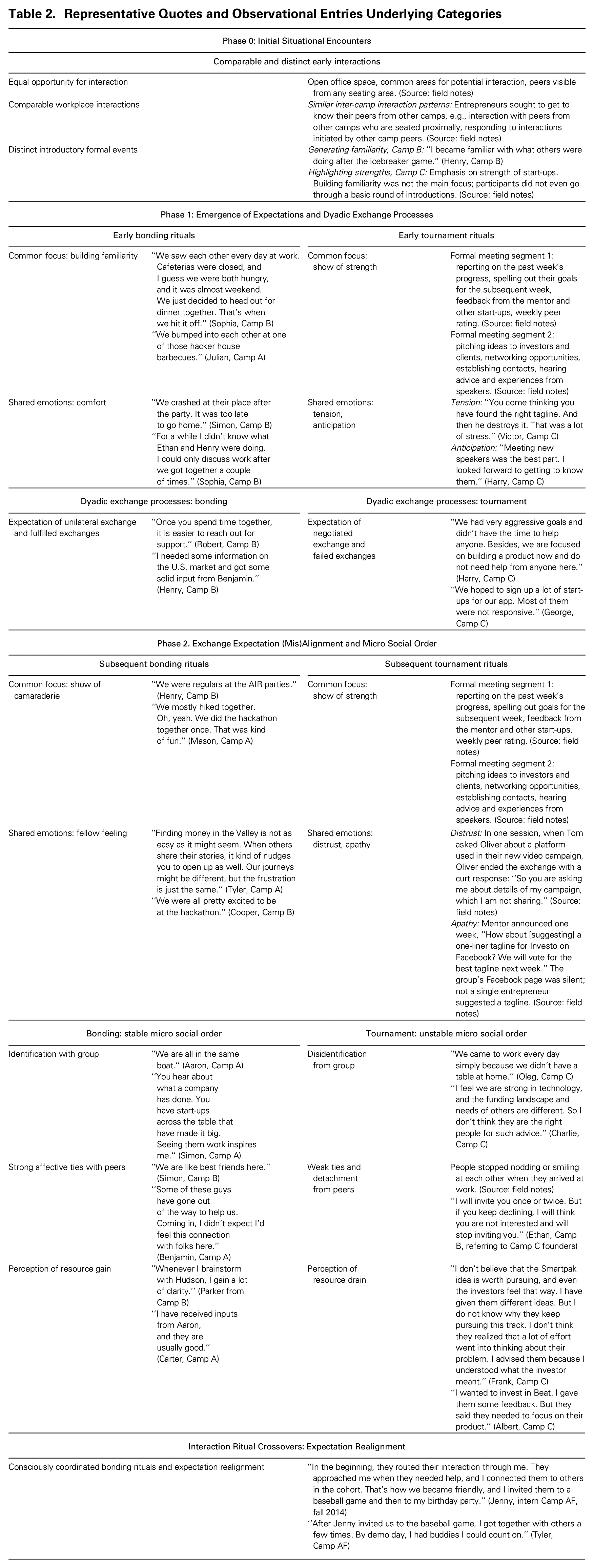
In line with our abductive analysis, we deductively pursued the relationships that surfaced in our inductive theoretical model through quantitative analysis. Specifically, we tested whether interaction rituals systematically affected entrepreneurs’ perceptions of unilateral exchanges and whether workplace interactions mediated this relationship. Our quantitative findings supported the theoretical insights that emerged from our qualitative analysis while accounting for alternative explanations. Below, we discuss in detail our findings from our qualitative analysis followed by those from our quantitative analysis.
Qualitative Analysis and Findings
Phase 0. Initial Situational Encounters
Introductory formal events in Camps B and C: Generating familiarity vs. highlighting strengths
During our core observation period, the accelerator organized formally structured new entrepreneur orientations for Camps B and C, as they were new to the accelerator, whereas entrepreneurs from Camp A, who were part of a previous cohort, already knew each other. For entrepreneurs from Camps B and C, the first encounter with peers in their camps occurred during these orientations. The orientation in Camp B was four days long. It began with a meet-and-greet session that was part of a friendly game in which entrepreneurs introduced themselves and their businesses and had to memorize their peers’ names. “By the time the game ended, we knew each other’s names by heart,” Henry explained. “Once we knew what others were doing, we just went up to them and discussed technology and business.” Throughout the rest of the event, Camp B entrepreneurs were introduced to the Silicon Valley ecosystem and the art of perfecting pitches, as well as fundraising and partnering with clients. Entrepreneurs had ample opportunity to get to know their peers during breaks for breakfast, lunch, drinks, and pizza. The four-day event not only made participants aware of their “common fate” as entrepreneurs but also created familiarity and comfort among them. “We were told how to position our start-up, raise funds, and get new clients,” Ethan shared. “Everything was new, and we just had the same set of challenges. It was an emotional state, and talking to each other came naturally. We interacted a lot during breaks.”
In stark contrast, the new entrepreneur orientation for Camp C lasted only two hours. The mentor gave a lecture during the first half, explaining what Camp C’s weekly group meetings would entail and emphasizing this cohort’s strengths and potential. “We received hundreds of applications. You are some of the best in the country,” he said. “You may not realize it, but you are here because we believe you can make it big.” The first author expected a round of introductions during which she would note the founders’ names; instead, the mentor drew attention to only two companies, one with close to a million users and another in a much-sought-after domain. He also pointed out that entrepreneurs should support each other, and one of the first examples of such support included “exchange of users.” The orientation concluded with a game, which involved finding peers with similar hobbies (i.e., music, reading). Camp C entrepreneurs spent the rest of their first day in the open workspace, and weekly meetings started the next day.
Comparable early interactions across camps and asymmetric emergence of bonding rituals
Entrepreneurs from all three camps shared the same open workspace, which offered them ample opportunities to interact. Founders could see every table from virtually any location in the space, and they passed by other camps’ tables on the way to the watercooler—Figure 1 shows a seating map. For the first few days, entrepreneurs in all camps made comparable use of this opportunity for interaction; their first encounters with peers from other camps occurred in this space. As is typical of such interactions, seating proximity and homophily (i.e., focusing on peers from the same country or race) were key drivers of founders getting to know each other (Rivera, Soderstrom, and Uzzi, 2010).

Seating Map
Despite these comparable initial levels of interaction, the emergence of informal activities across camps was asymmetric as the first weekend neared. Plans for informal weekend activities initiated by peers emerged quickly within and across Camps A and B but were conspicuously absent in Camp C. We discuss these differences more in the section on early bonding rituals in phase 1, but it was clear within just a few days that the familiarity established in the introductory formal event in Camp B made its founders more comfortable with each other than the founders in Camp C were. That level of comfort in Camp B also seemed to help those founders initiate and welcome informal events with peers from Camp A.
Camp C entrepreneurs did make earnest efforts to become acquainted with their peers during that first week. For instance, right after the new entrepreneur orientation, Harper volunteered to collect the Twitter handles, e-mail addresses, and LinkedIn profiles of all the founders in Camp C. Subsequently, he posted this information on the camp’s Facebook page. But Camp C’s entrepreneurs were not as familiar and comfortable with each other as Camp B’s were in that first week, and the result was that Camps A and B started engaging in informal events earlier than Camp C did.
Phase 1. Emergence of Expectations and Dyadic Exchange Processes
In this section, we explain how interactions within and between Camps A and B intensified while those even among peers within Camp C gradually dwindled. Figure 2 illustrates the difference in the weekly interaction trajectories of the three camps. In addition, we show how interactions within and between camps spurred further differences that ultimately affected the exchange of resources.

Cumulative Workplace Interactions Initiated by Camp Members
Early bonding rituals as a basis for expectations of unilateral exchange
Founders across Camps A and B regularly engaged in informal bonding rituals, such as getting together on the weekends for hiking, day trips, parties, surfing, basketball games, and dinner. These rituals were naturally occurring and unscripted, and they allowed participants to build a common focus and shared emotions organically, “without formally stereotyped procedures” (Collins, 2004: 53, 275).
Common focus: Building familiarity
Camp A and B entrepreneurs spent time together outside the work context in a variety of bonding rituals focused on socializing and getting better acquainted. AIR, a start-up in Camp A that had obtained an early round of angel funding, regularly organized weekend parties and invited everyone from the workspace. These parties were instrumental in bringing entrepreneurs from Camps A and B together. As Henry from Camp B said, “AIR has a party in their house every two weeks. They have a nice house, big, with a yard. There, you meet other teams. I got to know some of the other guys at the AIR party.” Other bonding rituals were smaller, some involving as few as two people. Niles recalled about a colleague in the workspace, “We were sitting across from each other in different corners, and one day Ralf asked me out for a drink. And from then on, we got talking to each other and meeting each other for a beer regularly, and our bond grew over time.”
Shared emotions: Comfort
In early bonding rituals, peers’ common focus on building familiarity generated a shared feeling of comfort, which enabled them to open up about problems they faced. During a spontaneous walk, Philip felt at ease sharing concerns with Isabelle. “He needed to get something from Target, and we just walked together and discussed problems he didn’t want his team to know about,” she said. Similarly, Ethan emphasized that get-togethers with other founders created the comfort to talk about a variety of issues: “We discussed all sorts of things, from how to build a start-up to ‘do you have a place to stay?’” The shared feeling of comfort emerging from these rituals encouraged entrepreneurs to reach out to each other for support.
Unilateral exchange expectations and fulfilled exchanges
Camp A and B entrepreneurs brought the shared feeling of comfort they experienced in bonding rituals into their frequent workplace interactions (Collins, 2004), which took the form of ping-pong sessions, watercooler conversations, lunches, and brainstorming and feedback sessions. These workplace interactions then became occasions for seeking resources from peers. For example, James told us, “We went out hiking one day, and afterward we were more at ease with asking for help.” Carter echoed this idea, saying, “It is easiest to approach people that you hang out with for help. I wanted some help on sales strategy and got a lot of information from Hudson just by walking over to their table.” Julian regularly counted on Edwin, with whom he had bonded outside of the workspace: “Whenever I ask Edwin for feedback, he offers helpful suggestions.”
These resource requests mostly became gratifying experiences (Goffman, 1967), because peers readily fulfilled them without signaling any expectation of reciprocity from the recipients. Entrepreneurs in Camps A and B recalled predominantly engaging in unilateral exchanges that resembled pure generalized exchange (Takahashi, 2000). In this example, an entrepreneur explained how a peer, Ethan, provided a key resource (networking support) when the entrepreneur needed it the most: I feel very nervous and lost when I am alone in meet-ups. When I feel uncomfortable and nervous, I know things are not going well. That’s why I attended crucial meet-ups with Ethan. I am glad he accompanied me. We stayed together for half an hour, and when I was comfortable Ethan went about his own business while I networked alone. I was comfortable that way and felt more relaxed.
Another founder, James, explained that he got a ride home from Lincoln in a time of need despite the fact that initially, James “thought he was a weird guy and wouldn’t talk much.” James explained that “as I interacted with him on our group’s weekend trip, I got to know him better. He is a very nice guy and would do anything to help.”
Over time, bonding ritual participants came to expect support from their peers, felt comfortable enough to reach out to them, and were rarely disappointed in the process. The fulfilled exchanges between them became gratifying rituals that kickstarted a cycle of giving and gratitude. The ultimate result was a thriving generalized exchange system within and among Camps A and B.
Early tournament rituals as a basis for expectations of negotiated exchange
For entrepreneurs in Camp C, the accelerator held mandatory weekly formal meetings, which were highly structured, scripted, and organized very much like a tournament. Again, a common focus and shared emotions became apparent over time, but they were fundamentally different than those we witnessed in the bonding rituals in the other camps.
Common focus: Show of strength
Throughout the program period, the common focus in Camp C’s mandatory weekly meetings was on the show of strength, with entrepreneurs striving to display their superiority relative to peers. Every weekly meeting began with entrepreneurs reporting on the past week’s progress and spelling out their goals for the subsequent week, followed by feedback from the mentor and the other start-ups. Entrepreneurs’ weekly goals in these meetings revolved around planning product development, launching applications, gaining users and clients, meeting sales targets, seeking investors, and obtaining media coverage. The start-ups tracked their progress by publicly announcing which goals had been met. Each week, entrepreneurs rated each other’s progress on three dimensions: goal achievement, feasibility of goals for the upcoming week, and fundability of the business. The first segment of each meeting ended with the announcement of the ratings results. Thus Camp C entrepreneurs participated in tournament-like rituals in which they displayed their strengths and determined who among them was the strongest.
The second segment of the weekly meetings involved opportunities to meet speakers invited by the accelerator, mostly successful founders from the Valley, investors, and potential corporate clients. The speakers shared their experiences with running or funding start-ups and provided information on the kinds of start-ups they were interested in funding or doing business with. The segment ended with Q&A sessions in which founders quizzed the speakers on various aspects of running a start-up, followed by smaller breakout sessions. The interactions were timed to provide every founder the same opportunity to interact with the day’s speakers. Each weekly session ended with a dinner, for which the meeting room was converted into a dining area. Most entrepreneurs used this opportunity to interact further with the speakers, but they paid little attention to their peers.
Shared emotions: Tension, anticipation
Early in the accelerator program, Camp C entrepreneurs displayed shared emotions that we characterized as tension and anticipation. When the mentor singled out an entrepreneur to discuss potential business opportunities, this generated a shared emotion of tension among others. When the mentor assured an entrepreneur of promising business introductions (e.g., “I will introduce you to Belores—you can explore possibilities of user exchange with them” or “Talk to the CEO of Osmotics—he can promote your merchandise and your app”), it not only made that entrepreneur uncomfortable but also triggered the curiosity of others who felt left out. While founders who were singled out did not want others to be aware of their potential connections, their peers prodded the mentor for more details (e.g., “Can you tell me more about Belores? We would like to acquire users from them, too”).
The formal meetings also created a shared emotion of anticipation, as entrepreneurs eagerly awaited what their peers or external speakers had to offer. At the first meeting, the mentor explicitly advised the entrepreneurs in Camp C “to make use of each other.” Some types of support did not involve a lot of effort from the founders (e.g., downloading and providing developmental feedback on each other’s apps), whereas others required higher commitment (e.g., swapping users and offering technical help with product development). The entrepreneurs received mixed signals on the exchange expectations the mentor set for them. On the one hand, suggestions such as providing feedback on peers’ apps and encouraging experts to provide technical help to their peers signaled expectations of generalized exchange in which an entrepreneur unilaterally gives to a peer, with the expectation that another peer in their cohort may return the favor (Molm, Collett, and Schaefer, 2007). On the other hand, the mentor’s advice “to make use of each other” and “swap users” signaled that they should engage in negotiated exchanges with their peers (Lawler, Thye, and Yoon, 2008), creating anticipation of direct exchange among participants. “I genuinely wanted to know what each one of them had to offer,” Oliver noted.
Ultimately, expectations of negotiated exchange came to dominate in Camp C amid entrepreneurs’ pressure to perform each week and guest speakers’ advice to network strategically. In contrast, calls for unilateral exchange did not resonate with a majority of Camp C’s founders, as was evident in the dyadic exchange dynamics in the workspace.
Expectations of negotiated exchange and failed exchanges
In the early days of the program, Camp C entrepreneurs exhibited an openness to get to know their peers through interactions with proximal and similar others both within and across camps. With increasing participation in tournament rituals, however, the nature of entrepreneurs’ interactions shifted to negotiating with and assessing the value of peers rather than getting to know them. If a founder promoted his or her start-up one day, another would promote his or her business the next time they encountered each other. One founder told us, “Initially, we checked out every start-up to know what they did.” When the early interactions suggested that some of their peers were not valuable to them, entrepreneurs consciously avoided them. Jack explained, “We don’t do much networking if it does not bring us any benefit.” Another entrepreneur acknowledged being wary of start-ups that could pivot into their technological space: “We kind of chatted a couple of times about the future of IOT. They were too keen, I should admit.”
When they realized that peers might have something valuable to offer, Camp C entrepreneurs actively sought resources from them. But their requests for support from peers often went unheeded. We heard, “I went to Albert for VC connections. He hasn’t introduced me to any yet” and “Will any of these companies even be interested in helping? Many of them have not even downloaded our app.” In one of the early tournament rituals, the mentor introduced a founder as a user interface (UI) expert and asked her if she could help another company with their UI. She agreed at the time, but during interviews it became apparent that she did not follow through. When entrepreneurs approached their peers with resource requests, they did not always realize that their peers expected direct reciprocity. When the first author asked Hazel whether she had helped another company, her response was, “What’s in it for me?” Although some Camp C entrepreneurs recalled unilaterally giving to their peers, it was typically not in response to requests. When entrepreneurs did give to their peers, their offerings were mostly unsolicited and often did not match their peers’ needs: “I connected Triple with a big player”; “I have mostly had an advising role with these firms”; “I have advised Alex; they have an interesting technology.” Albert explained why he provided unsolicited support: “I gave some companies advice even when they did not ask for it, because I wanted to gain their respect and develop some reputation among them for future connections.”
Failed exchanges were often a result of misaligned expectations. While some exchanges failed because of unfulfilled requests, others failed because they did not match the needs of the recipients and expectations of the giver. On one hand, when entrepreneurs failed to receive social resources from peers they approached, it was because their peers did not see value in giving those resources to them. On the other hand, entrepreneurs who found themselves in unilateral exchanges did not expect those exchanges to be unilateral but held clear expectations of reciprocity. Failed exchanges became shaming rituals in the sense that individuals experience shame when they face rejection and feel undervalued by their peers in an interaction (Goffman, 1967; Scheff, 1990; Scheff and Retzinger, 1991). Shame resulting from rejection is known to threaten social bonds (Goffman, 1967; Scheff, 1990). In sum, failed exchanges in Camp C kickstarted a cycle of avoidance and shaming, resulting in an unstable micro social order.
Phase 2. Exchange Expectation (Mis)Alignment and Micro Social Order
Cycle of giving and gratitude, thriving generalized exchanges, and a stable social order
In fulfilled exchanges in Camps A and B, entrepreneurs either received resources in response to their requests or benefited from need-based unilateral giving from peers. Fulfilled exchanges became gratifying rituals, and actors were drawn to more such positive experiences (Goffman, 1959, 1967; Collins, 2004). Entrepreneurs who benefitted from a peer’s unilateral giving engaged in a chain of positive exchanges and interactions, which included forming a bond with the giver, giving to other peers, and responding positively to resource requests. As more peers experienced fulfilled exchanges, they continued the virtuous cycle: our resource exchange data revealed that entrepreneurs who recalled receiving a favor paid 72 percent of those favors forward to other peers. Interestingly, these acts of paying forward were not recalled by the givers; we deduced them from the accounts of resource gains that recipients recalled with gratitude.
Entrepreneurs who had fulfilled exchanges in the workspace experienced camaraderie and fellow feeling in subsequent bonding rituals, which then fed into dyadic exchange processes at the workspace and gave rise to a stable micro social order. By the end of the study period, entrepreneurs experiencing bonding rituals found themselves embedded in tight-knit networks populated with affective ties, identified with their peers, and recalled resources gained from their peers more than resources they gave to others.
Subsequent bonding rituals
Common focus: Show of camaraderie
Over time, the common focus in bonding rituals in Camps A and B evolved into a show of camaraderie, which involved entrepreneurs displaying good rapport and sociability by regularly engaging in activities together. While some activities were reflective of the shared interests entrepreneurs identified outside work as they got to know one another, others were just convenient venues that allowed them to be in the company of friends. For instance, entrepreneurs from Camps A and B created a routine around basketball games. “We figured some of us like basketball,” James from Camp B said. “We had this routine of heading to dinner after a basketball game.” Other entrepreneurs planned various activities to connect with each other on a regular basis. “All of us went out a lot during weekends,” Robert (Camp B) told us. “We always found something to do,” Daniel (Camp A) noted. “It helps you unwind.”
Shared emotions: Fellow feeling
Entrepreneurs’ shared emotions in bonding rituals gradually evolved from comfort in early rituals to fellow feeling—an exchange of emotions that corresponded with the affective state of their peers (Smith, 1759; Sugden, 2002). Entrepreneurs reflected each other’s emotions by celebrating each other’s success, anguishing in each other’s misery, and sharing each other’s excitement. Bonding rituals became contexts in which entrepreneurs shared the highs and lows they experienced on their entrepreneurial journey. “When we are together, we talk about all sorts of stuff, from funding and client hiccups to things that remind us why we became entrepreneurs in the first place,” explained Benjamin. As they shared their experiences, entrepreneurs echoed each other’s sentiments, reflecting fellow feeling: “When they landed a client deal, all of us celebrated”; “My family rejoices when I succeed. But when it gets rough, I go to my buddies. They feel my pain better than my family.”
Stable micro social order
The unilateral exchanges that Camp A and B entrepreneurs continued to engage in were accompanied by attendant dimensions of individual entrepreneurs’ identification with the group, strong and enduring affective ties with peers, and perceptions of resource gain.
Identification with group
Over the course of engaging in joint activities and exchanging resources, bonding ritual participants came to recognize their common fate as entrepreneurs. By opening up to one another and knowing each other’s resource needs, the founders realized that many of them faced similar problems, which made it easier to relate to one another (e.g., Pratt, 2000). Mason put it succinctly: “It is not your problem versus their problem. It is about everyone having a common problem and how we help each other solve it.” Entrepreneurs viewed their peers’ experience as inspiring because it reflected the entrepreneurs’ self-concept of striving and persisting through rejections before achieving one’s goals. “The other day, Viewbit got some positive response from an angel,” Henry reported. “It might look all pretty from the outside, [but] we have spent enough time with each other to know it didn’t come easy. Little successes like theirs give us hope.”
Strong affective ties with peers
As entrepreneurs experienced positive emotions through many bonding rituals and fulfilling exchanges, they developed strong affective relationships with their peers. Ethan from Camp A explained, “You form closer relationships if you spend private time together in addition to spending time in a business environment. If you are only saying hello at work, it will only remain a weak relationship.” Other entrepreneurs from Camps A and B told us, “There are some founders I have met over the past three months whose friendships I would keep for life” and “I am very close to him at a personal level. I trust him with my problems and value his opinions.” Aaron and his co-founders, who were financially stronger than many of their peers, invited Mason to stay with them when he had to move out of his residence. Mason’s gratitude for this unilateral giving was evident: “Hanging out with others helped me understand so much about them. I am closest to Aaron and Ethan. Both of them care about others’ wellbeing and are open-hearted people. They have no bias in what kind of people they let into their networks.”
While most entrepreneurs in Camps A and B formed one or two high-trust relationships, they generally developed close relationships with all of those with whom they interacted regularly. “Let me put it this way,” Henry said, “I have the phone numbers of Ethan, James, and Simon.” Moreover, entrepreneurs in Camps A and B sustained affective sentiments toward those Camp B participants who joined only later on. New entrepreneurs who either joined their team at the accelerator mid-program or replaced an outgoing co-founder benefitted from the ongoing virtuous giving–gratitude cycle in Camps A and B. Robert immediately felt welcome when some of the entrepreneurs from his cohort received him at the airport: “Henry told me about all of them. It was nice to see the whole gang at the airport. They picked me up pretty late in the night.”
Perception of resource gain
For bonding ritual participants, unilateral social resource exchange often came in the form of advice, technical help, and introductions to valuable contacts and was perceived positively. Entrepreneurs were grateful for such social resources they received from their peers: “Martin was very helpful in developing our sales structure”; “Simon is very good with pitches. He was kind enough to help me with my pitch slides”; “Carter helped us with getting the TiECon demo table at a discount and also introduced us to some angels”; “Aaron gave me tips on how to deal with investors”; and “Mason genuinely cares. He has made many introductions for me.” Social resources that entrepreneurs needed seemed accessible through their peers. We observed Carter from Camp A casually obtaining advice about approaching investors from his friend Aaron:
Hey Aaron, how did you all manage to get funding? I am in that stage now, and I am looking for strategies.
We just had an interesting enough subject line to trigger curiosity and sent it to random investors. I’ll send it to you.
Really, was it that simple? (laughs) Thanks, man!
Although some unilateral resource exchanges among bonding ritual participants did involve considerable effort and opportunity costs for givers, in interviews, givers did not bring up the support they provided others. Hudson’s approach to social resource exchange summarized how much a cycle of giving and gratitude was key to the emergence of generalized exchange among bonding ritual participants: “In Silicon Valley, it is all about paying it forward. You don’t get immediate help from people that you have helped but from some other people along the way.”
Cycle of avoidance and shaming, non-emergence of generalized exchange, and dissolution of micro social order
In failed exchanges in Camp C, resource seekers and resource givers both felt rejected by their peers. Resource seekers felt rejected because peers declined their resource requests. Resource givers felt rejected because peers appeared to undervalue the resources they were offering—resources that often were unsolicited and/or did not match entrepreneurs’ needs. Accordingly, many resource givers found themselves in unilateral exchanges when they expected to be in bilateral reciprocal exchanges.
Failed exchanges became shaming rituals, as entrepreneurs who felt undervalued and rejected by their peers avoided their peers in order to stay away from such negative experiences (Goffman, 1959, 1967; Scheff, 1990; Collins, 2004). Entrepreneurs who were shamed severed ties with the peers responsible for the shaming and avoided others. In Figure 3, we compare the growth of cumulative workplace interactions initiated by resource seekers who experienced failed exchanges with those initiated by the rest of the entrepreneurs in Camp C. Although both categories had similar starting points, Camp C entrepreneurs who were rejected by their peers were quick to avoid further interactions with their peers in the open workspace. This contributed to a vicious cycle of shaming and avoidance. Their negative experiences at the workspace manifested as apathy and distrust in subsequent tournament rituals, culminating in the non-emergence of a generalized exchange system and an unstable micro social order. By the end of the study period, rapid dissolution of ties resulted in a sparsely connected network that was populated with more isolates than meaningful ties. Entrepreneurs disidentified with their peers, recalled weak ties with them, and described their unilateral giving as a “waste of time.”
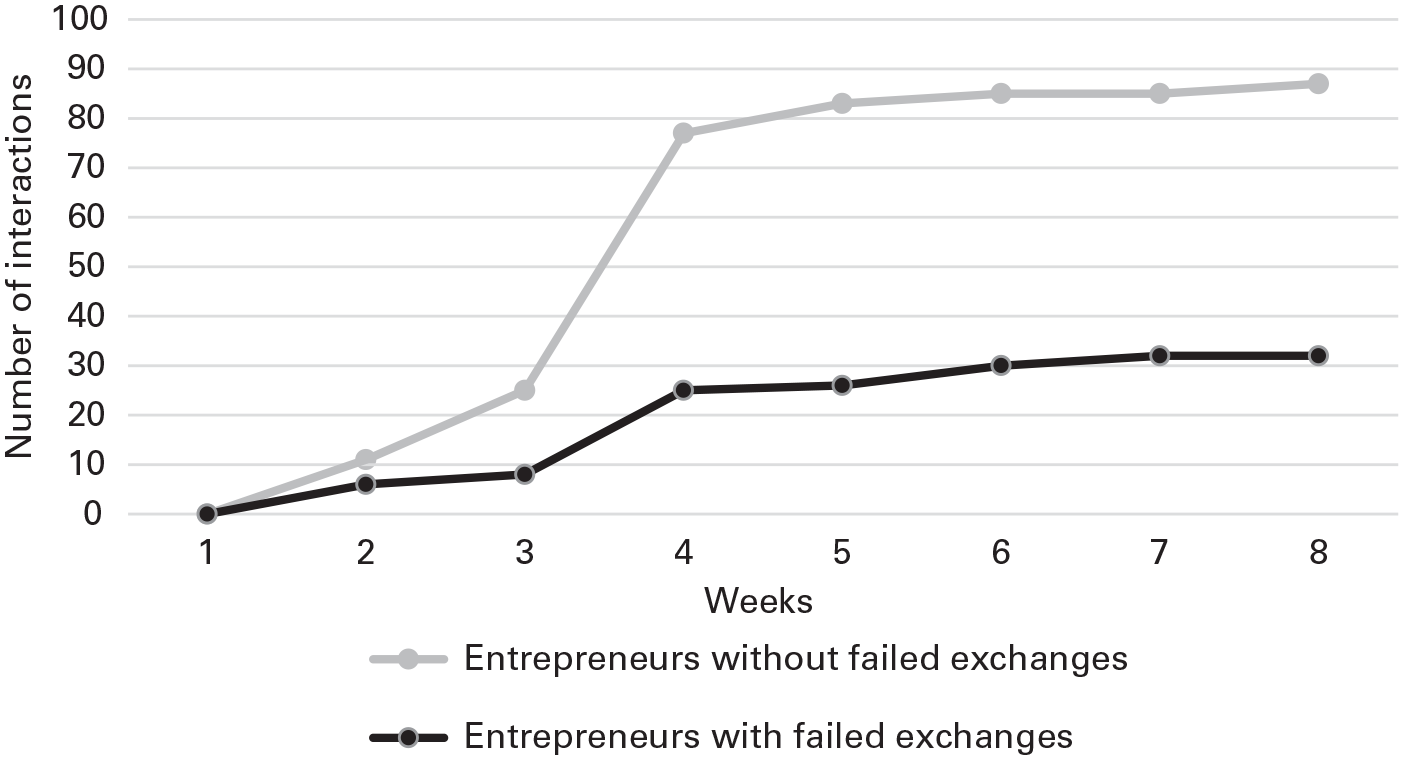
Cumulative Workplace Interactions Initiated by Camp C Entrepreneurs
Subsequent tournament rituals
Common focus: Show of strength
The common focus in subsequent rituals in Camp C remained on the “show of strength.” In early tournament rituals, the show of strength was mainly limited to the first segment of the weekly meetings (the progress pitches). Over time, it came to dominate the second segment (the external speakers) as well. During breakout sessions with speakers, entrepreneurs increasingly tried to draw attention to their own start-ups. In some instances, entrepreneurs were aggressive, talking over one another and not allowing others to complete their statements.
Shared emotions: Distrust and apathy
Over time, the avoidance and shaming triggered by failed exchanges in the workspace culminated in entrepreneurs’ clear distrust of and apathy toward the weekly tournament rituals. Distrust—the attribution of sinister motives and a desire to buffer oneself from the effects of others’ actions (Janowicz-Panjaitan and Krishnan, 2009; Reimann, Schilke, and Cook, 2017)—was reflected in entrepreneurs’ verbal exchanges at the progress presentations and in the breakout sessions that followed. Camp C founders were highly reluctant to share information with each other even if it was not proprietary. Two weekly meetings midway through the program became trigger events that contributed to a negative spiral in interaction dynamics following rituals. In one session, a verbal exchange between an audience member and a presenter, whose product was in the very early stages, quickly became heated. “What is your tool?” Charlie asked Alex during his presentation. Alex responded, “I will not say.” Charlie then asked, “Why? Do you have your IP [intellectual property] on it?” Alex surprised Charlie with his response: “No, but what if you switch? We spent a whole lot of time figuring it out.” Charlie quickly tried to tone down his approach: “We won’t switch. We are just curious.” The exchange ended when the mentor intervened.
One of the breakout sessions with speakers showed the culmination of entrepreneurs’ apathy toward each other. The stage was set during the second week of the program, when the mentor publicly announced the impending visit of a major player in the sports business. He suggested that Veezo, one of the start-ups in the camp, could partner with the sports company. There was nothing unusual about the match, as Veezo was the only start-up to develop a sports app and was thus a clear candidate to benefit from the stadium presence of the client. In every meeting that followed, the mentor reminded Harper, the CEO of Veezo, to “have a good demo ready” for the client. Thus it was essentially understood in the cohort that the sports company was Veezo’s potential client. When the day arrived, the mentor also invited Alex—the CEO of Cloudnet, a start-up in the cloud computing space—to pitch to the speakers. While Alex’s pitch received a good response from the speakers, Harper’s pitch failed to impress them. Rather than being supportive of Harper, the other entrepreneurs used the breakout sessions with the client to promote their own companies. Having excelled during the pitch, Alex could have given Harper the opportunity to better explain his case during the breakout session. Instead, he chose to dominate the discussions with the client at the table. By the time Harper succeeded in gaining the client’s attention, the entrepreneurs were asked to switch tables to interact with other speakers. Similarly, Albert—whose product, a generalized photo messaging app, shared some similarities with Veezo’s app—used Harper’s failed pitch as a platform to establish the superiority of his own start-up’s app. Sensing this potential rivalry, the mentor had always tried to keep their markets separate. Yet Albert succeeded not only in getting the client interested in his app but also in obtaining an invitation to pitch to other senior members of the client’s company. Harper watched helplessly as his peers exploited an opportunity that had initially been his alone: “I tried to approach [the client] later, but they seemed to be in a hurry. No promises from them for a meeting. I guess they are now more interested in other start-ups.”
Unstable micro social order
Disidentification with group
Over the course of several failed exchanges, tournament ritual participants came to disidentify with their group, Camp C. Disidentification occurs when actors experience a disconnection from their peers and maintain a sense of self-distinctiveness that is often in opposition to that of their group (Pratt, 2000), which was clearly evident among Camp C founders. “We moved to the corner so that we are kind of invisible,” one told us. “We don’t have the time to waste socializing with people here,” another said. Accordingly, founders maintained a distinctive self-concept as entrepreneurs, which they did not believe aligned with that of their peers. “I didn’t interact with others as they were doing unrelated things,” explained Charlie. And although they were co-located with other fintech start-ups in the accelerator, Tom, the CEO of Finnit, explained that he could not relate to his peers in the accelerator because he met more fintech start-ups at other meet-ups in the Valley: We didn’t find many we could connect with. Imagine a school where kids are asked to do projects. And a group of four kids are doing a project on volcanoes and they stumble upon kids outside the school who are working on volcanoes. Then these four kids would always want to be out of the classroom and be in that crowd that loves volcanoes.
Over time, tournament ritual participants ceased to see any value in engaging in social resource exchange with their peers: “There is nothing other companies can offer us” and “We eavesdropped all the time but heard no useful information; it was just repetitive.”
Weak ties and detachment from peers
The detachment from peers that tournament ritual participants felt in the second phase was evident from the manner in which founders evaded each other. Upon arrival at the open workspace, they avoided eye contact and did not acknowledge each other’s presence. Moreover, entrepreneurs from Camp C typically declined ties initiated by founders from Camps A and B. Referring to his neighbors from Camp C, Benjamin from Camp A complained, “I don’t even know their names. There is pretty much no relationship; they did not make even the smallest of effort, such as a smile.” Henry from Camp B felt similarly ignored by his Camp C neighbors: “Some people walk by me and ignore me, and I don’t feel like introducing myself to them. The Beat guys never even said hi to me.”
Close ties were strikingly absent in Camp C. Its founders could not recall a single meaningful relationship with another start-up from the accelerator. Only weak ties emerged from the few interactions they had with each other: “All my connections here are at the surface level.” Founders such as Jacob, Austin, and Harry explained that none of their ties fit their definition of a close tie: “They are all only contacts at a ‘friendly’ level. None of them are close enough to call when I have a problem”; “Actually, I don’t even have any of their phone numbers”; and “I am not close enough to anyone to invite them to my birthday party.”
Perception of resource drain
More and more, tournament ritual participants perceived their unilateral exchanges as a resource drain. Camp C entrepreneurs felt they gave more social resources to their peers than they received from them. Whereas the mentor encouraged entrepreneurs to provide valuable support, such as swapping users or help with technology, even minimal support (downloading apps or giving feedback on them) was not forthcoming. Strikingly, entrepreneurs only recalled the social resources they gave their peers. Because these offerings were often unsolicited, their peers failed to acknowledge the resources they received. For instance, Albert claimed to have helped the founders of Triple, but in interviews the Triple team did not acknowledge receiving anything from Albert. Tournament ritual participants often felt their peers did not reciprocate their help: “I know many who only want to take and do not care to give,” said Austin. Entrepreneurs also complained that their attempts to help others constituted a wasted effort. Many felt their peers did not value the help they provided. For instance, Frank’s offer for help was not well received by Jack and Harry, the founders of Beat: I approached Jack and Harry about introducing them to someone who does testing of encrypted data in Mexico. I told them about this at the weekly meeting. They thanked me but never got back to me. I approached them at their table later and asked them whether they would like that introduction. They just said they would check out the website and that was it.
Similarly, Austin felt the founders of Smartpak failed to put his suggestions into practice: With Smartpak, I had a conversation to sign up with them, but their model was too complex. I wanted them to simplify the tool and give people simple benefits, not stocks. I gave them my advice, and they took the feedback but did not put it into practice.
Interaction Ritual Crossover Incidents: Realigned vs. Unaltered Exchange Expectations
The possibility of realigning exchange expectations and breaking an existing exchange cycle occurred when entrepreneurs occasionally veered into an alternate interaction ritual or at least had the opportunity to do so. We refer to such moments of possibility as interaction ritual crossover incidents. As we show next, our findings reveal that while intervening bonding rituals may realign exchange expectations set by tournament rituals, expectations set by a bonding ritual chain appear robust to intervening tournament-like rituals.
Expectation realignment: Response to intervening bonding rituals
Entrepreneurs from Camp C were free to engage in bonding rituals, yet they did so on only one occasion. We compare crossover rituals in Camp C with those from Camp AF in the fall 2014 cohort. The striking similarity in the program structure of Camp C and Camp AF prompted us to examine how a stable micro social order emerged in Camp AF in spite of undergoing accelerator-induced tournament rituals. Not only was the formal weekly meeting structure similar for Camp AF and Camp C, but their meetings were also run by the same mentor. Yet our preliminary interviews indicated that founders in Camp AF formed strong ties with each other, whereas those in Camp C did not.
Intervening bonding rituals in Camp AF
As we revisited Camp AF, our interviews sought to understand what brought these founders closer to their fall 2014 cohort. We learned that one structural component that differentiated Camp AF from Camp C was their access to an intern, Jenny. The intern in fall 2014 was assigned a table in the open space and grew friendly with the founders. Most importantly, she initiated and consciously coordinated two informal social events for the founders from Camp AF. Although the entrepreneurs themselves were reluctant to engage in bonding rituals, the intern convinced them to attend these events. Benjamin aptly summarized the intern’s role in realigning expectations in Camp AF in the fall of 2014: “Jenny organized events to get us together, and that created great camaraderie. One time she got us tickets to a baseball game, and another time she invited all of us to her birthday party.” These informal social events became bonding rituals focused on building familiarity among entrepreneurs. Aaron explained how the baseball game and party with the intern became a turning point for his cohort: “That’s when we let down our guard and began discussing the personal issues we faced as founders. Until then, we were minding our own business.”
The social events organized by the intern generated a bonding ritual chain, whereby entrepreneurs subsequently engaged in more such bonding rituals on their own. The intervening bonding rituals effectively realigned expectations. In our preliminary interviews, Camp AF founders described their peers as “family” and recalled resources they gained from their peers including significant technology-related support, help with refinement of pitch decks, and solid advice whenever an entrepreneur needed it (see Table A2 in the Online Appendix for sample quotes). Because the first author had not directly observed the founders’ interactions in the fall of 2014, she conducted an online interview with the intern, who corroborated the details provided by the founders from Camp AF; Table 2 provides sample quotes.
Intervening bonding ritual in Camp C
One informal social event was consciously coordinated in Camp C as well. One of the start-ups invited founders from their camp to a weekend party to test their app. In spite of the instrumental objective behind the party, it succeeded in developing some sense of comfort among participants. This single informal event had a noticeable effect on short-term interactions within Camp C. On the days following the party, founders who attended the party greeted each other with a verbal “good morning” or acknowledged each other with a smile, wave, or nod when entering the workspace. (These basic courtesies had virtually disappeared since their early encounters in the program.) But the party turned out not to be sufficient to realign expectations, as entrepreneurs reverted to avoiding each other a few days later.
While one bonding ritual was not sufficient to realign expectations in Camp C, once exchange expectations in Camp AF were realigned through sustained engagement in bonding rituals, their tournament rituals ceased to have a negative influence on exchange dynamics.
Unaltered expectations: Intervening tournament-ritual-like scenarios
Camp B founders, who predominantly participated in bonding rituals, encountered two tournament-ritual-like scenarios: a pitch-practice session and the demo day. In the early half of the program, a few entrepreneurs from Camp B set up a pitch-practice session in the accelerator’s auditorium. Pitches bring out the strengths and weaknesses of a start-up, are key to obtaining funding (Kanze et al., 2018), and can potentially turn into show-of-strength rituals. Nonetheless, Camp B founders offered constructive feedback and supported each other. For instance, Henry and Ethan volunteered to record their peers’ pitches and shared the videos with them later. And Simon, whose pitch deck was noticeably better, helped Lincoln hone his pitch deck.
On demo day, Camp C founders were able to pitch their start-ups on stage, while Camp B founders were only allowed to use demo tables to showcase their products. A number of them tried to convince the accelerator to let them pitch on stage, and after some effort, Ethan and Philip managed to get the opportunity to pitch their ideas to a larger audience. To some extent, the demo day had the potential to evolve into a tournament ritual for Camp B founders. First, the demo tables were placed next to each other, and entrepreneurs vied for audience attention. Second, although many tried to pitch their start-up on stage, only two managed to get this opportunity. Surprisingly, however, the demo day evolved into a bonding ritual for Camp B founders. When Ethan and Philip pitched their start-up, many other founders left their demo tables to cheer for them.
These observations suggest that although exchange expectations set by tournament rituals can be realigned by introducing bonding rituals, once bonding rituals set actors into a virtuous giving–gratitude cycle, exchange expectations may not lend themselves to realignment, and the relationships remain remarkably robust.
Discussion of Qualitative Findings
Two key surprising findings emerge from our qualitative analysis. First, by virtue of occupying the open workspace, all entrepreneurs had equal opportunity to interact with each other. Yet interaction patterns, which were comparable in the beginning, diverged considerably across camps. Composed of entrepreneurs who were newcomers to the accelerator, Camps B and C followed similar interaction trajectories initially. But the interaction trajectory of Camp C soon flattened out, whereas Camp B’s interaction patterns quickly came to resemble those of Camp A entrepreneurs who had stayed on from the previous program period (see Figure 2). While a tight-knit network populated by affective ties emerged across Camps A and B, Camp C entrepreneurs not only gradually distanced themselves from their peers in Camps A and B but also discontinued interactions with peers from their own camp. Figures 4a and 4b show cumulative interactions at the end of phase 1 and phase 2, respectively.
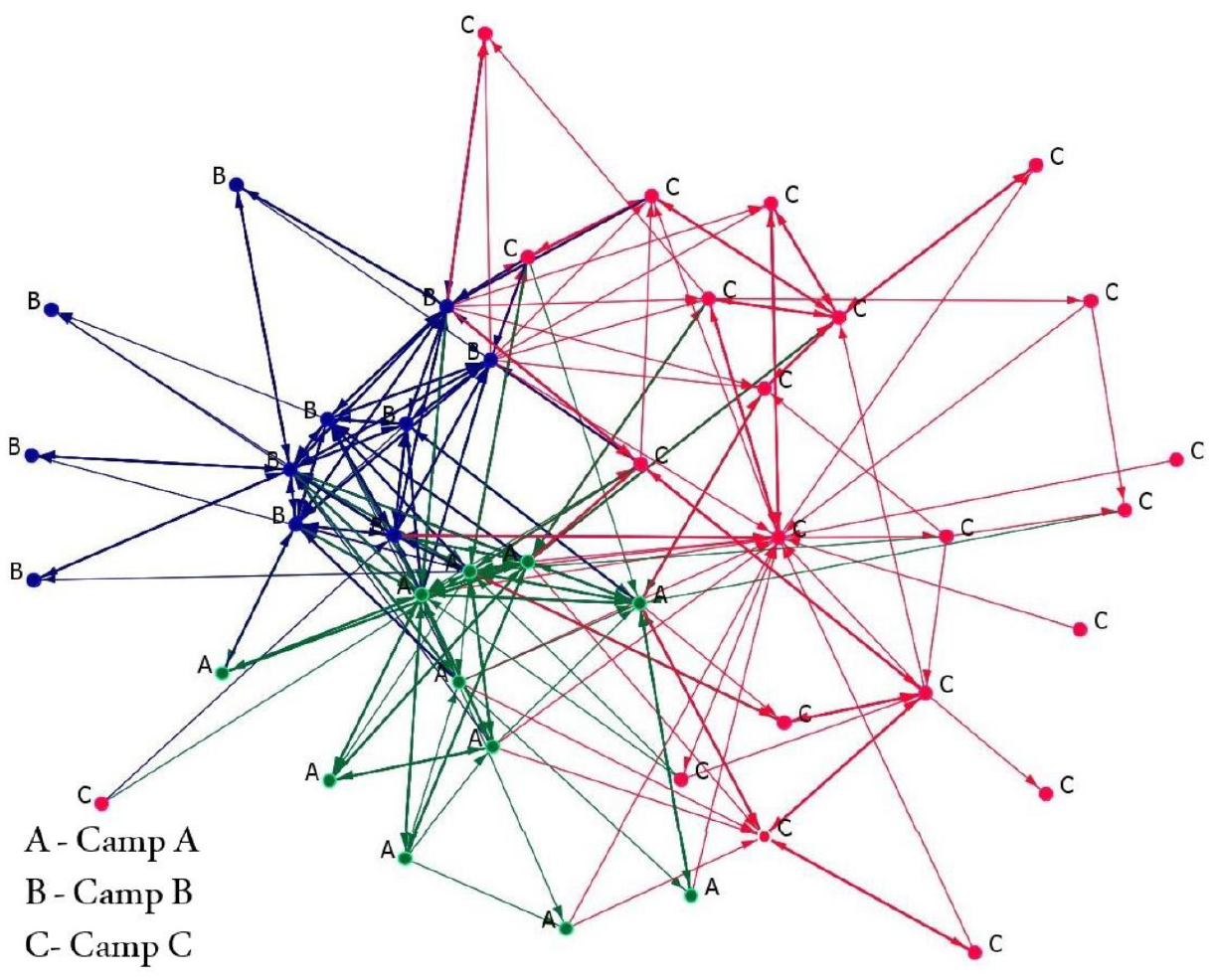
Cumulative Interactions among Entrepreneurs in Phase 1*
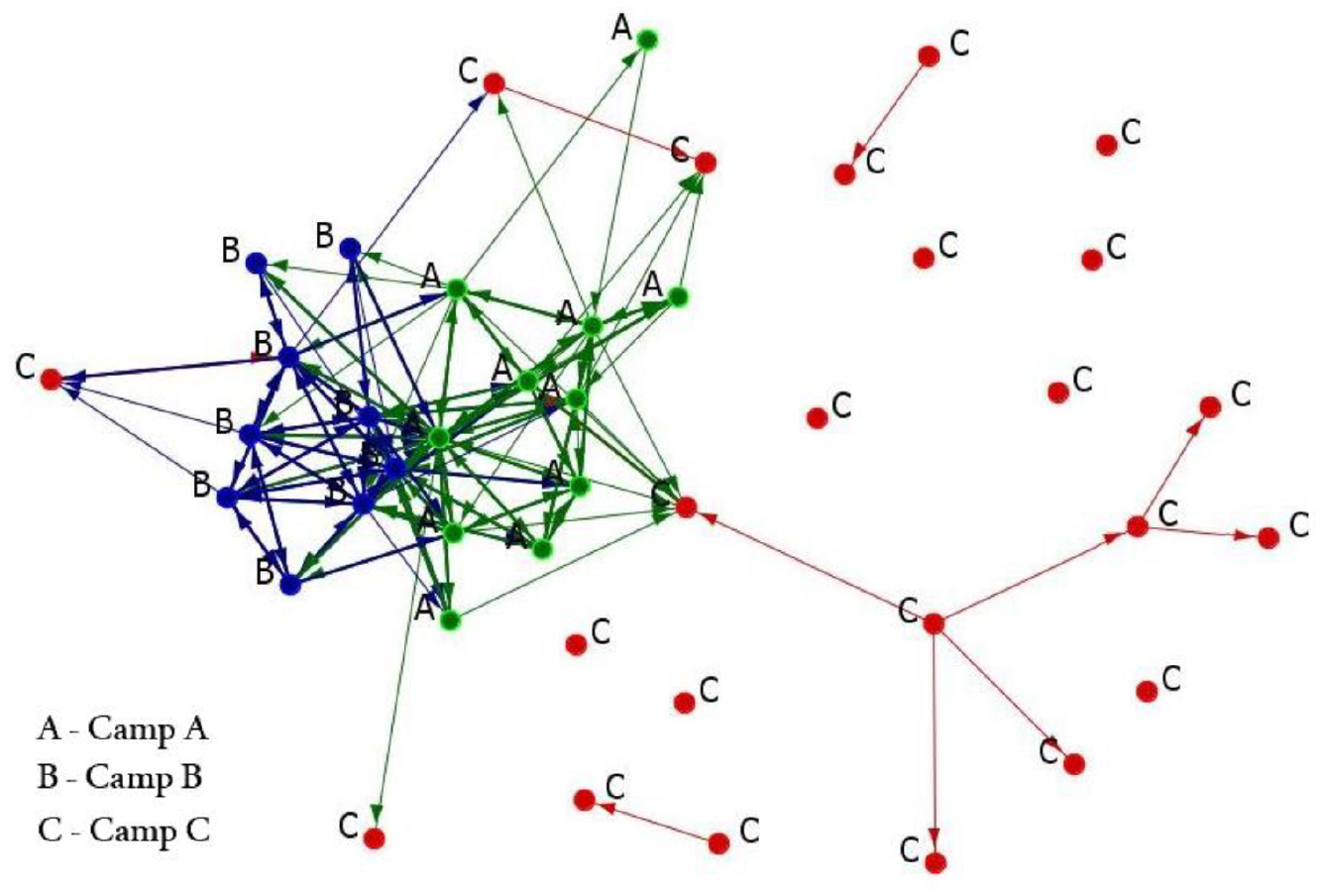
Cumulative Interactions among Entrepreneurs in Phase 2*
Second, entrepreneurs across all three camps engaged in unilateral exchanges. Yet while unilateral giving in Camps A and B evolved into a thriving generalized exchange system, unilateral exchanges in Camp C succumbed to the inherent social dilemma resulting in a breakdown of social resource exchange altogether. It is striking that even small acts of giving (e.g., offering a ride home) elicited gratitude among receivers in Camps A and B, while acts of giving that objectively seemed more valuable (e.g., offers to invest) went unacknowledged in Camp C.
Our qualitative analysis allowed us to unpack the mechanisms contributing to the divergence in interaction patterns and exchange outcomes across camps over time. Interaction rituals shaped micro social order indirectly through dyadic exchange processes at the workspace. While expectations of exchange emerged in interaction rituals, it was entrepreneurs’ fulfillment of or failure to realize these expectations that directed their exchange relationships with their peers along divergent paths. Fulfilled exchanges in the workspace set in motion a virtuous cycle of giving and gratitude, marking the emergence of a generalized exchange system. Failed exchanges in the workspace set in motion a vicious cycle of avoidance and shaming, marking the non-emergence of a generalized exchange system.
While our data on tournament rituals were drawn from several sources (i.e., observations, interviews, and social media archives), details on bonding rituals primarily came from interviews and social media archives. Considering that interview data represent retrospective accounts and can be subject to biases, it is possible that entrepreneurs in Camps A and B overstated the importance of bonding rituals in their interviews. Moreover, whereas participation in bonding rituals might be endogenous to interaction dynamics in the workspace, participation in tournament rituals was exogenous as it was mandated by the accelerator. This raises the possibility that the intense workplace interactions observed in Camps A and B might be a result of unobservable factors, which might have contributed to participation in bonding rituals as well. To pursue these issues, we decided to augment our qualitative insights with quantitative analyses. These analyses not only reflect a clear sequence of events over time but also allow us to account for the endogenous nature of bonding rituals and to rule out alternative explanations. In our quantitative analyses, we test (a) whether participation in the two types of interaction rituals systematically influenced workplace interactions and (b) whether workplace interactions indeed mediate the relationship between participation in interaction rituals and the emergence of generalized exchange.
Quantitative Analysis and Findings
We examined the effect of participation in different rituals (bonding and tournament) on two directed, dyad-level dependent variables: workplace interactions and perceptions of resource gain. The first author collected data on workplace interactions from live observations she made during the fieldwork with the spring 2015 cohort, while data on perceptions of resource gain were collected during exit interviews with entrepreneurs. (Refer to the earlier “Methods” section for details of the data collection procedures.) Below we describe the measurement of these dependent variables and estimation techniques we used to analyze each.
Dependent Variables
Workplace interactions between dyads is a directed and repeatable process. An entrepreneur dyad entered the risk set when the pair was present on a given day and each node belonged to a different start-up. With these restrictions, the 49 entrepreneurs in our sample generated a total of 2,106 directed dyads. In any given day, if founder A initiated at least one conversation with founder B from a different start-up, we coded workplace interaction from founder A to founder B as 1 on that day and as 0 otherwise. Similarly, if founder B initiated at least one conversation with founder A, we coded workplace interaction from founder B to founder A as 1 on that day and 0 otherwise. However, when founders A and B met each other by the watercooler and spontaneously engaged in a conversation, we treated this interaction as bidirectional—i.e., an interaction was recorded for both founders in the dyad. In total, we recorded 938 such daily workplace interactions. While we considered only one directed interaction per dyad and workday in our main analysis, we also ran separate analyses to account for multiple daily interactions per dyad (see the upcoming section “Alternative Explanations and Robustness Checks” for details).
Perception of resource gain between dyads is a directed process. Each dyad of entrepreneurs could have exchanged several resources of varying importance during the study period, but the perception of gain or loss from an exchange depends on the subjective value attached to the social resources given to or received from a peer. Accordingly, each entrepreneur might recall a resource exchange only if he or she has expended considerable effort or incurred opportunity cost in giving it to a peer or has received a social resource with high subjective value from a peer. Thus, similar to Willer, Flynn, and Zak (2012), we collected data on social resource exchanges during exit interviews with each entrepreneur in our study. Specifically, we asked each entrepreneur to list the names of entrepreneurs to whom they gave social resources and the names of entrepreneurs from whom they received social resources, as well as to explain the type of resource in each exchange (for use in our qualitative analysis). We created a measure of perception of resource gain as follows: For any entrepreneur A, we measured their perception of dyadic resource gain vis-à-vis a given peer B as 1 if A recalled receiving social resources from B but did not recall giving any social resource to B. This variable took the value −1 if A did not recall receiving any social resource from B but recalled giving a social resource to B. In all other cases, this variable took the value 0. 7
Independent Variables
In our models predicting workplace interaction, we had six key independent variables capturing entrepreneurs’ participation in either tournament or bonding rituals. With regard to participation in tournament rituals, we first included dyad tournament ritual. This variable took the value 1 if both members of a pair attended a social event characterized by tournament rituals (i.e., a mandatory formal weekly meeting in Camp C) in the previous week, and 0 otherwise. Second, we included source only tournament and target only tournament, which took the value 1 if only the source or target node participated in the tournament ritual, and 0 otherwise.
With respect to participation in bonding rituals, we first included dyad bonding ritual, measured as the number of informal social events characterized by bonding rituals that both members of the pair attended together during the weekend (ranging from 0 to 3 in our data). We also included source only bonding and target only bonding, which were measured as the number of bonding rituals in which the source node or the target node alone participated.
In our models predicting perception of resource gain, with regard to tournament rituals, we included three variables similar to the ones mentioned above—cumulative dyad tournament, cumulative source only tournament, and cumulative target only tournament. These variables were measured at the end of the study period and capture the interactions in tournament rituals over the entire study period. With regard to bonding rituals, we included the cumulative number of bonding rituals in which the dyad, the source, and the target participated over the study period (cumulative dyad bonding, cumulative source only bonding, cumulative target only bonding). Finally, cumulative workplace interactions captured the total number of workplace interactions a dyad engaged in over the observation period.
Control variables
We included as controls several network context variables that are widely considered to contribute to tie generation—prior ties, reciprocity, indirect ties, and proximity (Rivera, Soderstrom, and Uzzi, 2010). In addition to these variables, we controlled for several individual- and dyad-level variables to account for alternative explanations, which we discuss in detail in the “Alternative Explanations and Robustness Checks” section. We summarize the measurement of all control variables in Table 3.
Overview of Control Variables

Correction for endogeneity of bonding rituals
Participation in tournament rituals was exogenous in nature because the accelerator mandated that Camp C entrepreneurs participate, but participation in bonding rituals was not entirely exogenous. While participation in a couple of bonding rituals was clearly coincidental, participation in others required coordination between participants.
Based on our qualitative evidence, we are confident that bonding rituals played a crucial role in encouraging workplace interactions. But we have also dealt with the endogeneity concern statistically, using instrumental variables. To establish causality, we used a two-stage residual inclusion model, also known as the control function approach (see Terza, Basu, and Rathouz, 2008; Wooldridge, 2010; Rao and Greve, 2018). In the first stage, participation in bonding rituals is regressed on an exogenous instrument and a set of covariates from the second-stage models. Pearson residuals from the first-stage models are then included as additional controls in the second-stage models (predicting workplace interaction and perception of resource gains). If the residuals are significant in the second-stage models after including the potentially endogenous variable (participation in bonding rituals) that was instrumented in the first stage, this implies that endogeneity was indeed a concern and was corrected by the inclusion of the first-stage residual. In the first-stage models (one each for dyad bonding, source only bonding, and target only bonding), we used living with family as an instrument. This was a dummy variable that was coded as 1 if a focal entrepreneur was living with family and 0 otherwise. 8
Estimation Techniques
To estimate workplace interactions, we used hazard rate models. These are suitable when analyzing the effect of time-varying covariates on discontinuous events such as tie formation (de Nooy, 2008). We used a Cox conditional gap time (also known as conditional risk set) model for repeated events (Prentice, Williams, and Peterson, 1981) as our primary specification. This model assumes that the duration time resets after each event occurrence. Hence, after the first event occurs, the dyad enters the risk set for the second event. By stratifying on event number and preserving information on the ordering of events, the model allows the baseline hazard function to vary across repeated events while the parameters of covariates stay the same across events (Jones and Branton, 2005). To deal with the non-independence of observations, we used robust standard errors that are clustered on both actors of a dyad simultaneously (Cameron, Gelbach, and Miller, 2011; Dahlander and McFarland, 2013) and employed Kleinbaum, Stuart, and Tushman’s (2013) clus_nway routine in Stata. Please see “Alternative Explanations and Robustness Checks” below for details on additional analyses using alternative specifications.
To estimate perception of resource gain, we used a tobit model. Tobit models are suitable to analyze truncated dependent variables such as ours. As before, standard errors in this model are clustered on both entrepreneurs using the clus_nway routine (Kleinbaum, Stuart, and Tushman, 2013).
Estimates for Workplace Interactions: Effects of Interaction Rituals
Table 4 presents the results of the Cox proportional hazard rate models predicting directed workplace interactions between dyads (i.e., A’s interactions with B and B’s interactions with A). Model 1 is the baseline with all controls. Model 2 shows the effect of participation in tournament rituals on workplace interactions. Models 3 and 4 show the effect of participation in bonding rituals on workplace interactions. Model 5 is the full model with all the controls and the theorized effects included. Below, we only interpret the coefficients of our theorized variables and the coefficients of those control variables that are not further discussed in the alternative explanations section. In line with research on tie formation (e.g., Rivera, Soderstrom, and Uzzi, 2010), proximity (β = .164; SE = .048; p = .001), indirect ties (β = 1.303; SE = .131; p < .001), and prior ties (β = .839; SE = .155; p < .001) explained the likelihood of workplace interaction.
Stratified Cox Gap Time Models for Likelihood of Workplace Interactions*
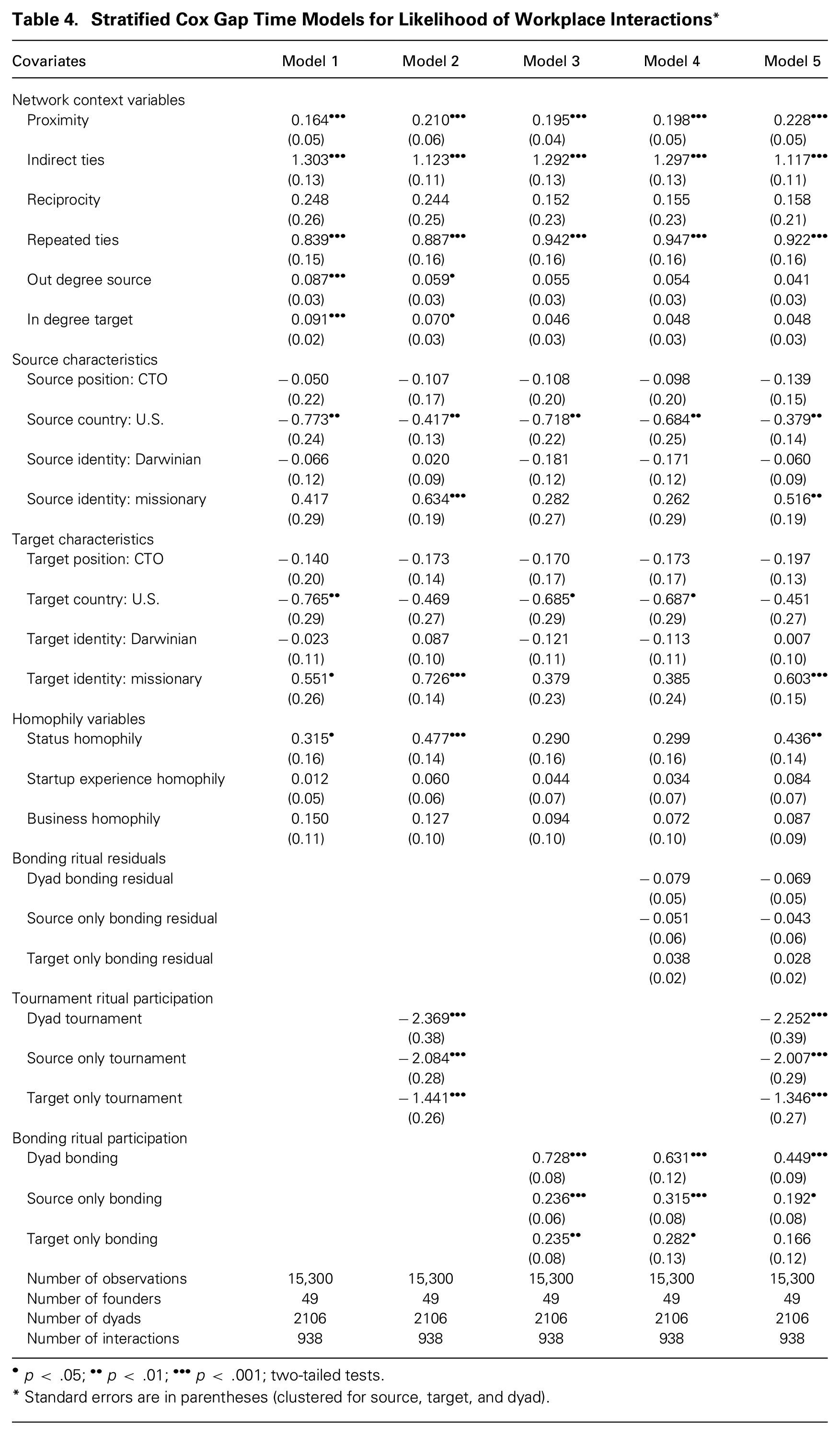
p < .05; ••p < .01; •••p < .001; two-tailed tests.
Standard errors are in parentheses (clustered for source, target, and dyad).
Models 2 and 5 show the effect of participation in tournament rituals on workplace interactions. As predicted, the estimated coefficient for the dyad tournament ritual was negative (model 2: β = −2.369; SE = .378; p < .001 | model 5: β = −2.252; SE = .39; p < .001). An examination of this variable’s marginal effect in model 5 demonstrates that there was an 89.5-percent
Estimates for Perception of Resource Gain: Effects of Rituals and Workplace Interactions
Table 5 presents the results of the Tobit models predicting perception of resource gain of a focal source vis-à-vis a focal target in a focal dyad (i.e., A’s perception of resource gain from B in dyad AB and B’s perception of resource gain from A in dyad BA). Model 1 is the baseline with all controls included. Models 2 and 3 show the effect of the cumulative tournament rituals and cumulative bonding rituals, respectively, on perception of resource gain. Model 4 shows the additive effect of participation in cumulative tournament rituals and cumulative bonding rituals on perception of resource gain. Model 5 analyzes the mediating effect of cumulative workplace interactions. The estimated coefficients of one of the control variables, indirect ties, are negative, indicating that entrepreneurs who continued to have an indirect tie with a peer did not perceive a resource gain. This suggests that in order to receive resources from a peer, an entrepreneur ought to have at least interacted with the peer once.
Tobit Models Predicting Perception of Resource Gain*
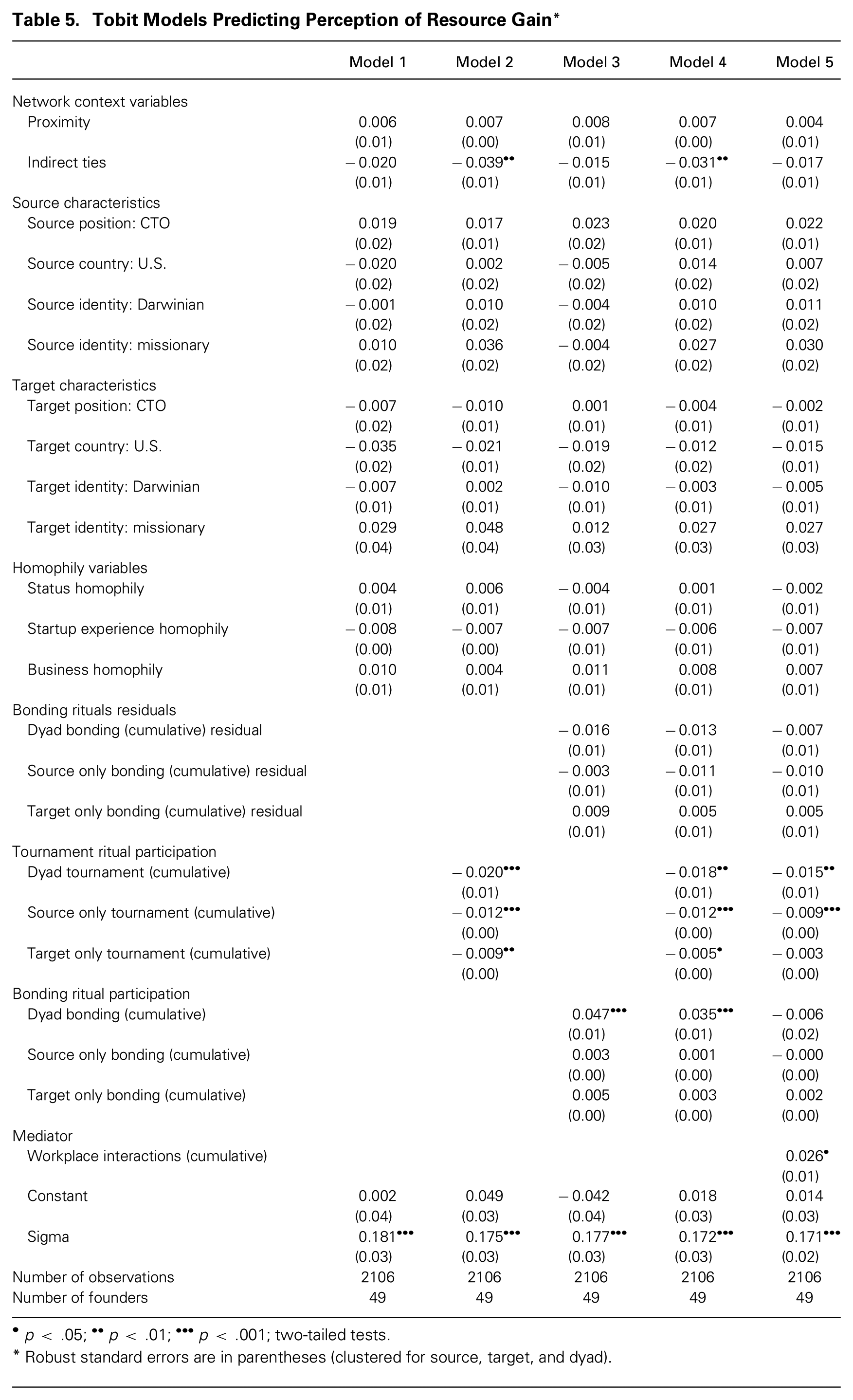
p < .05; ••p < .01; •••p < .001; two-tailed tests.
Robust standard errors are in parentheses (clustered for source, target, and dyad).
As expected, the estimated coefficient for cumulative tournament rituals was negative (model 2: β = –.020; SE = .006; p = .001 | model 4: β = –.018; SE = .006; p = .001). With every additional tournament ritual in which a dyad participated, the source’s perception of resource gain drops by .020 points. Similarly, as expected, the estimated coefficient for cumulative bonding rituals was positive (model 3: β = .047; SE = .012; p < .001 | model 4: β = .035; SE = .010; p < .001). With every additional bonding ritual a dyad participated in, the source’s perception of resource gain increases by .047 points.
Our qualitative findings indicated that bonding rituals increased workplace interactions, which in turn encouraged generalized exchange among peers. In line with our expectation, the coefficient for cumulative workplace interactions is positive in model 5 (β = .026; SE = .012; p = .033). With every additional workplace interaction by a dyad, the sources’ perception of resource gain increases by .026 points. In this model, the coefficient for cumulative bonding rituals drops out of significance (β = –.006; SE = .017; p = .704), suggesting that workplace interactions fully mediate the relationship between bonding rituals and perception of resource gain. A Sobel test confirmed this mediation effect (t = 2.013; p = .044). There is also some evidence of partial mediation of workplace interactions in the relationship between tournament rituals and perception of resource gain. The coefficient for cumulative tournament rituals remains significant (model 5: β = –.015; SE = .006; p = .008) in the full model, even though it is less pronounced than in model 2 (β = –.018; SE = .006; p = .001). A Sobel test confirmed this mediation effect (t = −2.048; p = .041).
Discussion of Quantitative Findings
Our quantitative findings provide strong support for our qualitative insights. Whereas participation in bonding rituals resulted in a substantial increase in workplace interactions, participation in tournament rituals produced a notable decrease in workplace interactions. Bonding ritual participants were more likely to perceive their exchanges as gainful because bonding rituals encouraged repeated workplace interactions, which is key to social resource exchange in the workplace and the associated perception of resource gain. Conversely, tournament ritual participants were less likely to perceive their exchanges as gainful because tournament rituals discourage repeated workplace interactions.
Our quantitative analysis mitigated some of the weaknesses of the qualitative analysis by showing that even after correcting for endogeneity of bonding rituals and accounting for other factors that might be related to workplace interactions and generalized exchange, our main findings pertaining to interaction rituals are remarkably robust. Overall, our quantitative analysis supports the inductive theorizing that emphasizes how the type of interaction rituals shapes the emergence or non-emergence of generalized exchange through dyadic exchange processes in workplace interactions.
Alternative Explanations and Robustness Checks
We pursued a variety of potential alternative explanations for more stable interaction patterns and a thriving generalized exchange system in Camps A and B compared with Camp C and ultimately concluded that our key findings are robust. First, Camp C might have been predisposed to being more competitive when entering the program. Second, individual founder characteristics or founder identity of Camp C entrepreneurs might have made them less prone to interactions than entrepreneurs in Camps A and B. Third, to address whether other differences across camps explain the contrasting interaction patterns, we compared the spring 2015 cohort (Camps A, B, and C) with similarly structured camps in the fall 2014 cohort (Camps X, Y and AF), for which we had data from preliminary interviews and observations. 9
We also ran several sensitivity analyses. First, we tested whether our quantitative results are robust to alternative specifications that consider analysis time to be discrete. Second, we analyzed an event count model to account for all interactions that a dyad engaged in on a given day. Finally, we excluded Camp C from our analysis to ensure that their nonparticipation in weekly bonding rituals was not inflating our results. Tables A1, A2, and A3 in the Online Appendix describe all these additional analyses in detail.
Discussion
Toward an Interaction Ritual Theory of Generalized Exchange among Peers
While encouraging unilateral giving, accelerators are exemplary mixed-motive contexts that make salient the challenges associated with the emergence and sustenance of generalized exchange among peers. Findings from this study demonstrate how accelerators can serve as platforms for generalized exchange while simultaneously also hindering it. In particular, we draw attention to substantial differences in the success of establishing a community of giving across different camps and cohorts of the same accelerator. The process model that emerged in this study, shown in Figure 5, identifies the exchange expectations generated in interaction rituals as key to shaping the nature of peer relationships and explaining the emergence or non-emergence of generalized exchanges.
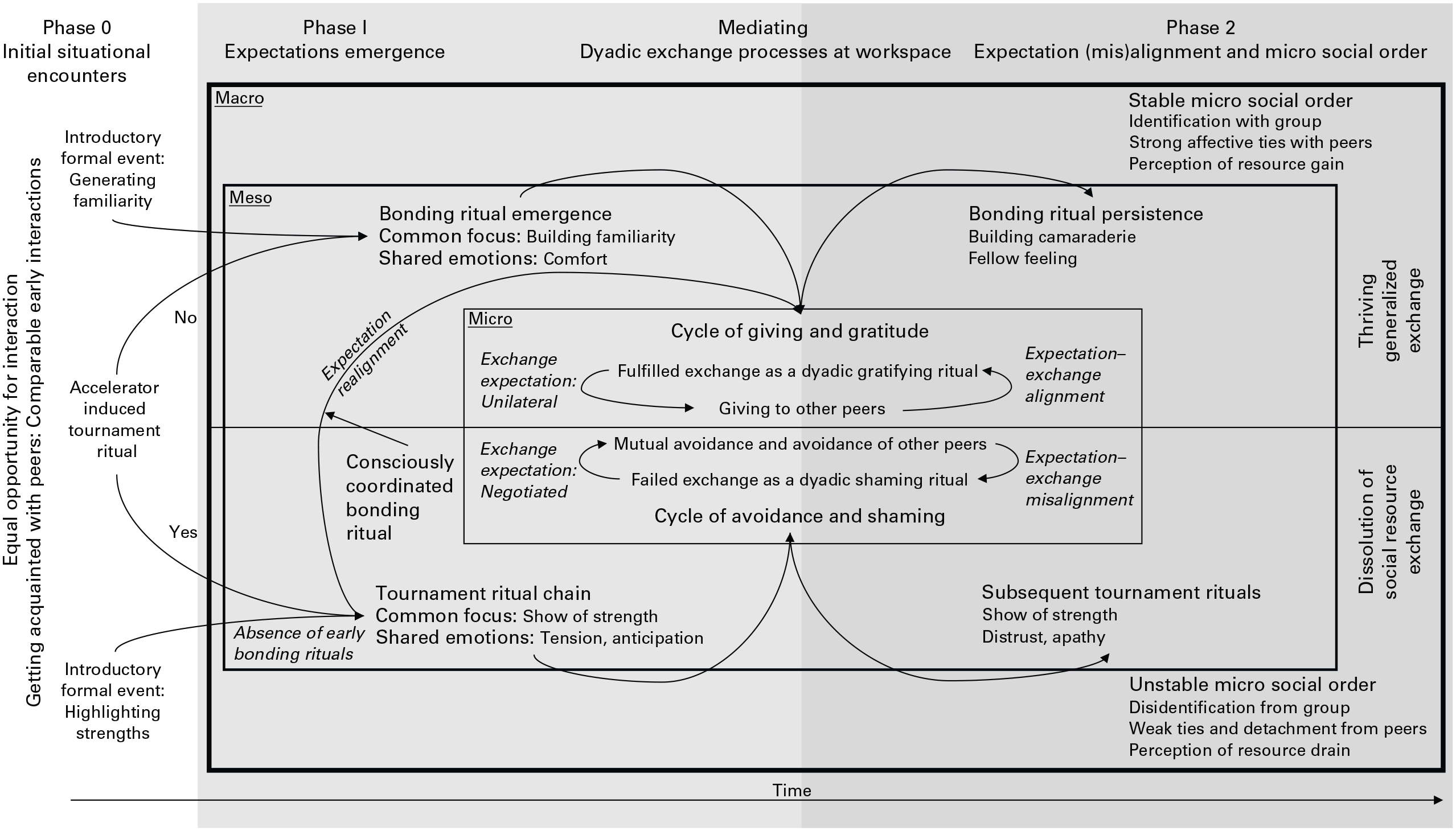
Process Model of Interaction Rituals and Social Resource Exchange
Interaction rituals within emergent social events significantly shaped the purposive act of giving by producing distinct exchange expectations. Whereas shared emotions in bonding rituals evolved into fellow feeling, those in tournament rituals deteriorated into distrust and apathy. In this respect, micro social encounters (Goffman, 1967) were key contributors to the evolution of interaction ritual chains. Expectations of exchange generated in bonding and tournament rituals fed into micro social encounters in the workspace, which in turn shaped the shared emotions in subsequent bonding and tournament rituals. Generalized exchange emerged among peers only when unilateral giving aligned with exchange expectations. Acts of resource seeking contributed as much to the exchange dynamics as acts of resource giving. While unfulfilled resource requests triggered a vicious cycle of avoidance and shaming, fulfilled resource requests initiated a virtuous cycle of giving and gratitude.
Voluntary engagement in bonding rituals was key to the emergence of virtuous exchange dynamics. In the absence of familiarity among entrepreneurs in the initial period, such voluntary participation in bonding rituals was largely shaped by the common focus in the formal events organized by the accelerator early on. While a common focus on building familiarity (e.g., the new entrepreneur orientation event in Camp B) encouraged the emergence of subsequent bonding rituals, a common focus on show of strength (e.g., the new entrepreneur orientation and weekly formal meetings in Camp C) discouraged the emergence of bonding rituals. But our model shows that vicious exchange dynamics set in motion by mandatory tournament rituals can be reversed when consciously coordinated intervening bonding rituals realign exchange expectations (e.g., social events organized by the intern for Camp AF). Our model and theory offer novel insights that challenge and extend existing research on organizational sponsorship, entrepreneur relationships, social resource exchange, and interaction rituals.
Understanding the Black Box of Social Events within Accelerators
Unpacking the interaction dynamics within social events allowed us to identify the conditions under which accelerators evolve into a community of giving (Amezcua et al., 2013: 1636; Grimes, 2018) versus degenerate into an “invitation to exploitation” (Takahashi, 2000: 1107). Recent research on accelerators has documented several potential gains from co-located peers (Cohen, Bingham, and Hallen, 2019), but it is not evident if these gains were a result of willful sharing of resources by peers or an outcome of resource appropriation by receivers. We were able to resolve this ambiguity by closely examining how the nature of relationships among peers evolved over time.
In our study, instrumental relationships among peers evolved into affective relationships or deteriorated into meaningless encounters depending on whether expectations of exchange set in earlier encounters were met or unmet in subsequent encounters. Interaction rituals within social events gave rise to different expectations of exchange depending on entrepreneurs’ common focus and shared emotions in these events. While tournament rituals created strong expectations of direct reciprocity from peers, bonding rituals did not. Accordingly, unilateral giving that emerged among bonding ritual participants did not diverge from their exchange expectations. But owing to reciprocity expectations among tournament ritual participants, giving to peers resulted in perceived costs for resource givers who viewed it as a zero-sum game. Moreover, the source of vicious exchange dynamics among tournament ritual participants lies in forcing entrepreneurs into tournament rituals before they have had the opportunity to develop the familiarity needed to initiate bonding rituals.
Thus our findings suggest that differentiating between social event types within accelerators matters more to our understanding of emergent exchange relationships than previously anticipated in organizational sponsorship research. While organizational sponsorship scholars agree that social events that allow entrepreneurs to network with their peers are a key feature of start-up accelerators (Amezcua et al., 2013; Cohen, Bingham, and Hallen, 2019), what transpires in different types of social events has largely remained a black box. Our study underscores the importance of accounting for the interaction rituals in different types of social events in accelerators, without which our understanding of exchange dynamics in peer relationships will be incomplete.
Understanding Affective Giving among Strategic Resource Seekers
Our study extends recent efforts to integrate affective processes into entrepreneurship research, especially as they pertain to entrepreneur relationships (e.g., Huang and Knight, 2017). With much emphasis on entrepreneurs’ instrumental resource-seeking behavior in prior entrepreneurship research, entrepreneurs’ affective giving behavior, which lays the foundation for the emergence of cooperative communities, has received only scant attention (see Saxenian, 1994, for an exception). Given that acquiring external resources is a fundamental challenge facing early-stage entrepreneurs, scholars have mainly portrayed entrepreneurs as strategic actors who purposefully use narratives and symbolic means to acquire resources for their ventures (Martens, Jennings, and Jennings, 2007). Peer relationships are no exception to this strategic resource-seeking behavior. For instance, in their work examining relationships between new ventures in the solar energy sector, Hannah and Eisenhardt (2018: 3182) showed that new ventures either competed heavily with other ventures or balanced competition and cooperation in a way that “impose[d] extractive terms” on their partners.
Based on these insights from prior research, what may be more surprising than the eventual collapse of exchange in Camp C is the emergence of generalized exchange in Camps A and B. Considering that entrepreneurs are often conceptualized as instrumental resource seekers, Camps A and B being populated with entrepreneurs who engaged in frequent affective resource giving was contrary to expectations. Entrepreneurs across all camps sought resources, but willing givers emerged only when actors were made to realize their common fate as entrepreneurs thanks to their participation in bonding rituals. While our findings are not inconsistent with the notion that entrepreneurs are instrumental resource seekers (Martens, Jennings, and Jennings, 2007; Stuart and Sorenson, 2007), they bring forth the novel insight that participation in rituals that reinforce expectations of unilateral exchange can nonetheless give rise to affective giving. Further, resource seekers benefitting from their giving peers can trigger a giving–gratitude cycle resulting in more unilateral giving to other peers.
Through this novel peer-to-peer community perspective, our study complements earlier research on the affective relationships between entrepreneurs and potential investors (Huang and Knight, 2017). While this earlier research shed light on how building an affective relationship with a targeted other enables bilateral resource exchange, our findings suggest that for the emergence of a generalized exchange system, affective attachment to the group may matter more than affective attachment to any particular actor. In our study, affective attachment to a group was made possible by expectations of unilateral exchange generated in bonding rituals, followed by a cycle of giving and gratitude triggered by fulfilled exchanges. In contexts such as accelerators, which encourage generalized exchange among peers, resource-seeking attempts become fulfilled exchanges only when resource seekers find affective givers who identify with the group and give without expectation of direct reciprocity.
Understanding Stability and Instability of Generalized Exchanges
Our study provides novel insights into the stability or instability of generalized exchange systems that are at the heart of social exchange theory. We advance an argument that emphasizes the need for an alignment between actors’ exchange expectations and the emergent exchange structure. Only when such alignment is achieved will actors willingly participate in that form of exchange. But exchanges fail when the emergent exchange structure does not align with exchange expectations. The notion that participation in a certain type of exchange is driven by differences in expectations of reciprocity has been missing in prior research, possibly because social exchange theory has predominantly been studied using experiments that assign actors to exchange structures (Molm, Collett, and Schaefer, 2007; Lawler, Thye, and Yoon, 2008, 2009), as though exchanges occur independent of the situations in which they are embedded. Contrary to this assumption, we find that social exchanges are embedded in a chain of social situations in which expectations gradually emerge and become reified. Our findings suggest that understanding how social situations actors find themselves in give rise to different exchange expectations is key to explaining why some generalized exchange systems thrive while others whither or fail to take off.
Delving deeper into the dynamics surrounding failed vs. successful exchanges, our findings support the notion that an affective orientation and pro-group sentiments can be critical (Molm, Collett, and Schaefer, 2007; Willer, Flynn, and Zak, 2012)—but these processes need not be inherent in the exchange structure, as previously assumed. Claims in prior social exchange research that the act of unilateral giving communicates affective orientation to the recipient were not uniformly supported in our study. In fact, acts of unilateral giving can also be perceived as incomplete exchanges awaiting direct reciprocity. Although unilateral giving occurred in all three camps, it communicated affective orientation only in Camps A and B while carrying expectations of delayed reciprocity in Camp C. This finding provides insight into variation within (rather than across) exchange structures, thus helping to explain divergent findings in prior research (e.g., Molm, Collett, and Schaefer, 2007; Lawler, Thye, and Yoon, 2008). Specifically, not all generalized exchange structures are ripe with affective orientation and pro-group sentiments; rather, these processes emerge only when unilateral giving is perceived as such and not as a dyadic reciprocal exchange attempt.
In addition to resource giving, our findings also emphasize the critical importance of resource requests for the emergence of successful generalized exchange. In particular, unilateral exchanges were perceived as beneficial only when the giving was commensurate with what was requested. And unmet resource requests in failed exchanges led rejected actors to attribute the failure to the group and disengage from subsequent interactions and acts of giving. This process underscores the importance of taking into account the outcomes of resource requests, which are yet to receive attention in social exchange research.
Overall, our analyses extend social exchange theory’s insights on the functioning of different types of exchange structures by highlighting their interactional components. Our model emphasizes that not only are micro interactions shaped by exchange structures, but exchange structures are also created, sustained, or altered by micro interactions (Turner, 2019; Zucker and Schilke, 2020), thus adding much-needed process insights into how different types of exchange unfold over time.
Understanding Interaction Rituals in Mixed-Motive Contexts
Research on interaction rituals tends to emphasize how a common focus and intensely shared emotions, which are the key ingredients in rituals, will unify participants (Durkheim, 1912; Collins, 2004; Metiu and Rothbard, 2013). By studying the emergence of interaction ritual chains in a mixed-motive context, we show that the same ingredients that can unify participants—a common focus and intensely shared emotions—may also disrupt social order, depending on their type. Most prior interaction ritual research has treated rituals as a unitary concept. Our study adds nuance by emphasizing that the nature of rituals can differ drastically across bonding and tournament rituals and that such differences have fundamental downstream consequences.
One might have expected that the intense emotions of tension and anticipation that participants in our study shared in early tournament rituals should have brought about an awareness of the common challenges they face as entrepreneurs. But because these shared emotions were founded on a common focus of show of strength, participants primarily paid attention to the costs of cooperation, which generated a strong self-orientation following the interaction ritual, despite intensely shared emotions. Micro social encounters in the workspace following the early tournament rituals became social situations in which entrepreneurs strived to benefit from their peers. This fact suggests that in mixed-motive contexts, a common focus and shared emotions can also make the competitive elements in people’s relationships more salient.
Our findings also shed new light on how interaction rituals emerge and evolve over time resulting in a stable or unstable social order. Interaction ritual theory argues that collective sentiments toward the group will fade away unless they are renewed and shared emotions are recreated in subsequent group rituals (Collins, 2004). Our findings show that shared emotions are not only renewed, but they can also either intensify or deteriorate as interaction rituals evolve over time, giving rise to a stable or unstable social order. In this respect, micro social encounters à la Goffman (1967) are key contributors to the evolution of interaction ritual chains. Expectations of interaction generated in bonding and tournament rituals feed into micro social encounters at the workspace, which in turn shape the shared emotions in subsequent bonding and tournament rituals. When expectations are met in dyadic micro social encounters, positive shared emotions intensify in subsequent meso group rituals, giving rise to a stable social order. Conversely, when expectations remain unmet in dyadic micro social encounters, shared emotions in meso group rituals can deteriorate, resulting in an unstable social order.
Our study also emphasizes that individuals can be engaged in multiplex interaction rituals with each other, which can make the interaction dynamics among participants more complex. In mixed-motive contexts, the common focus in one interaction ritual might contradict the common focus in another. In our study, Camp AF in fall 2014 began with tournament rituals, as did Camp C in spring 2015. But in Camp AF, intermittent bonding rituals organized by an intern prevented the shared emotions in the tournament rituals from spiraling downward. The positive emotions in bonding rituals introduced by the intern could override the negative emotions in tournament rituals, realigning expectations and reviving a stable social order.
Future Research and Generalizability to Other Settings
Our findings highlight how interaction rituals can shape the (non-)emergence of generalized exchange among entrepreneurs. But owing to the short period of time entrepreneurs spend in an accelerator, it would be premature to conclude that the generalized exchange that emerges in accelerators represents enduring communities of giving. Initial evidence from our study suggests that accelerators sow the seeds of generalized exchange by enabling a chain of bonding rituals among peers, which entrepreneurs may take with them to other contexts. The first author later interviewed the founder of one of the start-ups that graduated from the accelerator we studied. This start-up grew considerably in the five years after it graduated from the accelerator; at the time of the follow-up interview, it was big enough to implement generalized exchange norms inside the organization of 65 employees. In this company, Ethan and his co-founders assign economic goals such as “client acquisition targets” that can induce competition to the higher levels of management. At the employee level, they discourage people from “elbowing their way forward” and set examples of cooperation by engaging in bonding rituals with employees. “As it is, clients give us a tough time, and working with them is intense enough. At least we should have fun when we work with each other,” Ethan said. “I frequently have beer or lunches with our employees to bond with them. The general vibe around here is not about chasing individual goals but working together to reach our company’s goals.” Future research should examine further whether participants of bonding rituals carry the seeds of generalized exchange sown in platforms such as accelerators to other contexts, such as the design of their own organizations. Similarly, recent research has shown that organizations’ moral behavior is shaped by routine interactions with socially responsible peers (Krishnan and Kozhikode, 2015). Future research might examine whether the source of such positive influence lies in the bonding rituals in these interactions.
Our findings have broader implications for a variety of social settings beyond accelerators, especially those in which actors forming a cohort are expected to both cooperate and compete with each other—for example, faculty competing for grants and employees within teams competing for promotions (Johnson et al., 2006; Srivastava et al., 2017). We see the accelerator setting as a conservative context in which to investigate the cooperative–competitive processes for two reasons. First, unlike in firms, where teams are forced to cooperate through fiat in spite of competition to achieve tasks, entrepreneurs in accelerators can only be encouraged to cooperate. Second, entrepreneurs are in accelerators for a limited period and are under pressure to make the most of this time. Unlike teams, whose success hinges on cooperation, success for entrepreneurs participating in an accelerator program critically depends on the progress of their individual start-ups. Hence cooperation among entrepreneurs cannot be taken for granted, making peer relationships within accelerators a conservative test of the positive dynamics spawned by bonding rituals. Future research might examine the role of interaction rituals in facilitating peer acceptance in localized networks, which is shown to be vital for cultural assimilation in organizations (Srivastava et al., 2017). Participation in distinct interaction ritual types—tournament vs. bonding—during team formation might shed light on how peer acceptance originates in localized networks in organizations.
Supplemental Material
sj-pdf-1-asq-10.1177_0001839220970936 – Supplemental material for An Interaction Ritual Theory of Social Resource Exchange: Evidence from a Silicon Valley Accelerator
Supplemental material, sj-pdf-1-asq-10.1177_0001839220970936 for An Interaction Ritual Theory of Social Resource Exchange: Evidence from a Silicon Valley Accelerator by Rekha Krishnan, Karen S. Cook, Rajiv Krishnan Kozhikode and Oliver Schilke in Administrative Science Quarterly
Footnotes
Acknowledgements
We thank associate editor Dev Jennings, who through his expert guidance helped us enrich the original spirit of the paper. We thank the three anonymous reviewers for their insightful comments throughout the review process. We thank Steve Barley for his feedback during the early stages of data collection. Our paper has immensely benefitted from the thoughtful suggestions by Kathleen Eisenhardt, Dan McFarland, Huggy Rao, Toby Stuart, and Robb Willer. We would like to thank Chuck Eesley, Amir Goldberg, Dalhia Mani, Paolo Parigi, Jessica Santana, Sanne McFarland Smith, Sameer Srivastava, and Olga Volkoff for their helpful suggestions. We acknowledge feedback from seminar participants at the Stanford Network Forum, at Simon Fraser University, and at IIM Bangalore. Rekha Krishnan would like to dedicate this article to her 9-year-old, Amruta, whose faith in her Mom’s “accelerator paper” has been unflinching. Rekha Krishnan and Rajiv Krishnan Kozhikode acknowledge funding from Social Sciences and Humanities Research Council of Canada (Grant #: 410-2009-1607; 435-2017-1513). This project was initiated when Rekha Krishnan was a visiting scholar at the Institute for Research in the Social Sciences (IRiSS) of Stanford University.
Supplemental Material
Supplemental material for this article can be found in the Online Appendix at  .
.
1
2
3
“Working, not just alongside us, but with the other founders of the cohort will become the foundation of your support system. Being a founder can be tough, few people understand what you go through—no matter if you struggle alone or are responsible for hundreds of people. We are there for you during and after the program and founders often form strong fellow entrepreneur ties that subside long after they exit AngelPad.”
4
We thank the associate editor and an anonymous reviewer for this suggestion.
5
We use the term “founder” synonymously with “entrepreneur” and use these terms interchangeably throughout the manuscript.
6
All names are pseudonyms and are anglicized to mask the race of the entrepreneurs.
7
That is, whenever A recalled receiving from as well as giving to B, and whenever A did not recall receiving from or giving to B, the variable was coded as 0. Because resources are directed from one entrepreneur to the other, each dyad appeared twice in our dataset, once as a source and once as a target.
8
We expected that, in comparison with entrepreneurs living alone, entrepreneurs living with their families would be less likely to participate in bonding rituals over the weekend due to family commitments. In line with this expectation, our first-stage models revealed that entrepreneurs who lived with their families were significantly less likely to participate in bonding rituals, suggesting that this is a valid instrument.
9
We do not include Camp A in our comparison table because unlike entrepreneurs in all the other camps who were not familiar with each other when they entered the study period, Camp A entrepreneurs knew the peers within their camp when they entered the observation period in the spring of 2015.
Authors’ Biographies
References
Supplementary Material
Please find the following supplemental material available below.
For Open Access articles published under a Creative Commons License, all supplemental material carries the same license as the article it is associated with.
For non-Open Access articles published, all supplemental material carries a non-exclusive license, and permission requests for re-use of supplemental material or any part of supplemental material shall be sent directly to the copyright owner as specified in the copyright notice associated with the article.
